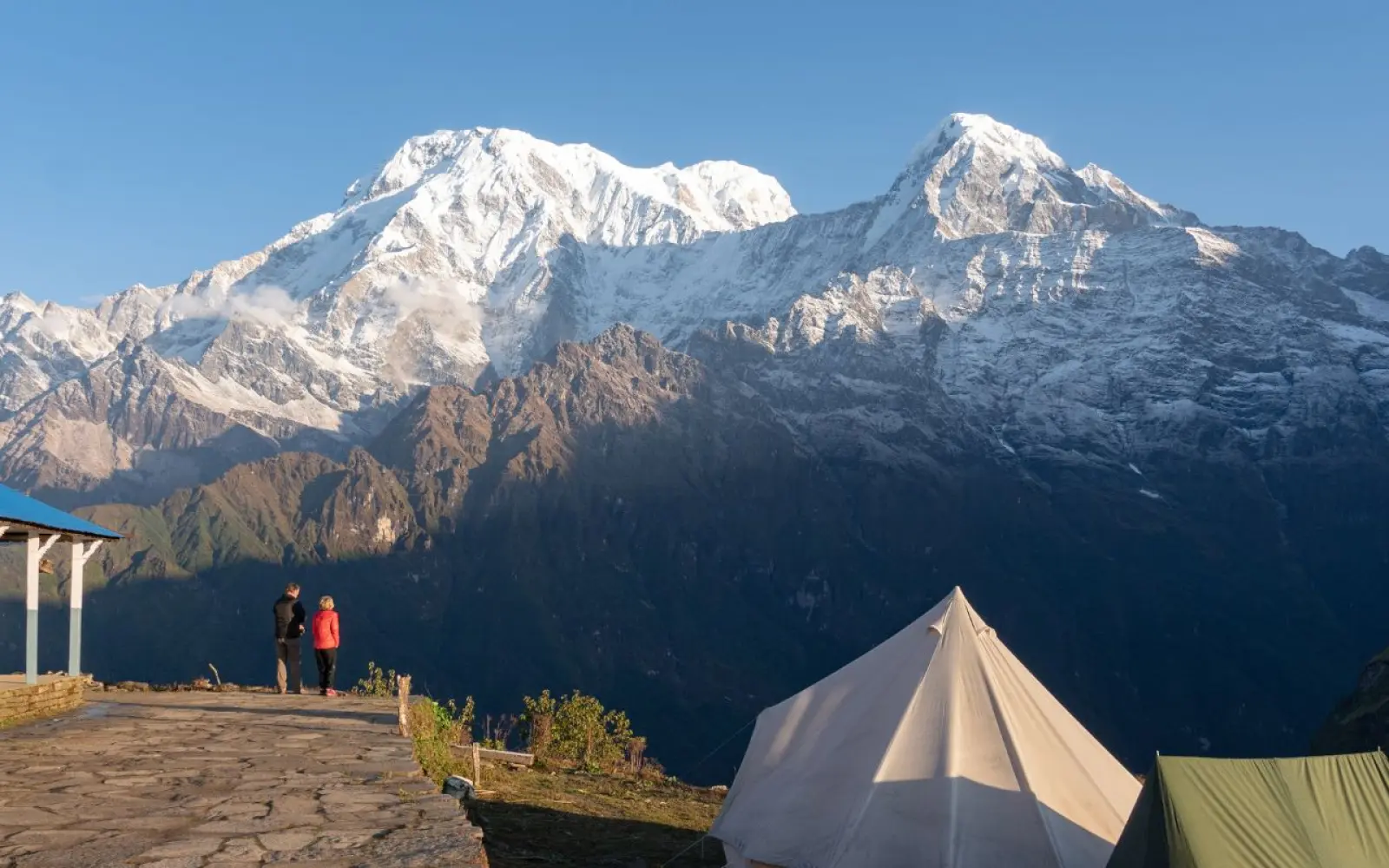
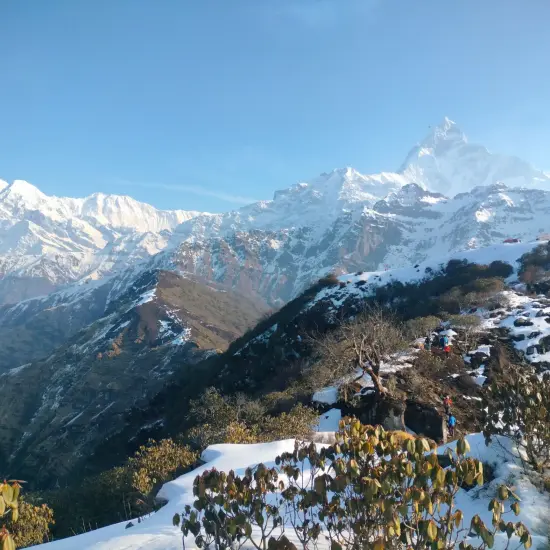
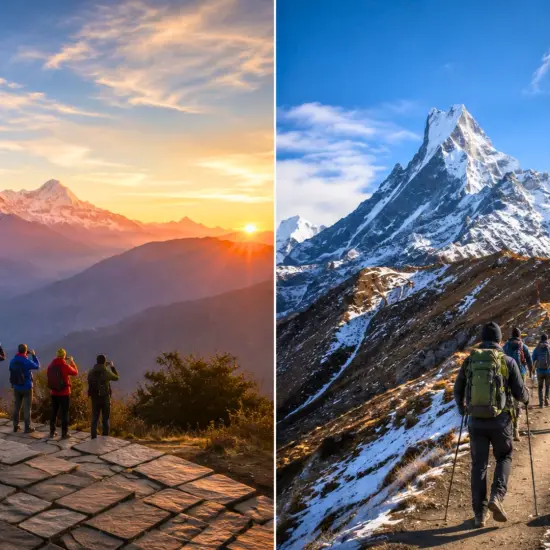
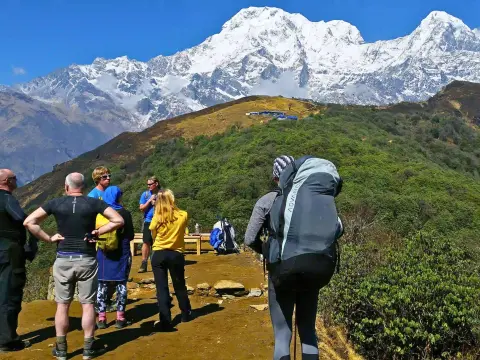
October and April are the two strongest months for the Mardi Himal Trek, and they're strong for different reasons. October gives the clearest mountain air of the year and the most stable weather. April gives the rhododendron forest in bloom, longer daylight, and good views. November is a close, underrated third.
What is the best time to trek Mardi Himal?
October and April are the two strongest months, and they're strong for different reasons. October gives you the clearest mountain air of the year and the most stable weather. April gives you the rhododendron forest in bloom, longer daylight, and views that are good rather than exceptional. November is a close, underrated third — drier and often clearer than October, at the cost of real cold.
That's the short version, and if your dates are already fixed, it's probably enough to act on. But "best time" isn't really one answer — it's a different answer depending on whether you want the clearest views, the flowers, the quietest trail, or simply the warmest walking you can get. The rest of this page is built around that: which month wins for your specific priority, how spring compares with autumn, and what October actually costs you against November that most articles don't mention.
Trek the Mardi Himal Trek
Five days, one ridge, and the closest you'll legally get to Machhapuchhre.
Mardi Himal Trek: month-by-month verdict
| Month | Verdict | Best for | Watch out for |
|---|
| January | Cold, dry, quiet | Snow, solitude, clear skies | High Camp nights below −10°C |
| February | Still winter, improving | Same as January, slightly milder | Snow and ice on the upper ridge |
| March | Clear, cold, transitional | Quiet trails, early rhododendrons, good visibility | High Camp still near −8°C at night |
| April | One of the two best months | Rhododendrons, long daylight, good views | Busy, particularly mid-month |
| May | Workable, warm, less reliable | Warmth, quiet trails, cheaper travel | Rising rain and haze, especially late month |
| June | Not recommended | Nothing this route does well in June | Monsoon arriving; poor visibility |
| July | Not recommended | Nothing this route does well in July | Peak monsoon rainfall |
| August | Not recommended | Nothing this route does well in August | Peak monsoon rainfall |
| September | Poor early, good late | Late-month value, thinning crowds | First half still substantially monsoon |
| October | The benchmark month | Clear views, warmth, beginner-friendliness | Nepal's busiest trekking month; first week can still be wet |
| November | Underrated, excellent | Driest air of the year, quieter than October | Meaningfully colder; snow risk rising by late month |
| December | Cold season begins | Solitude, dry air | High Camp below −10°C most nights |
Full temperature and rainfall figures for every month are in the weather guide — this table is a verdict, not a data table.
Which month is best for Mardi Himal?
This depends on what you're actually optimising for, and treating "best" as a single axis is where most articles go wrong. Here's how the real trade-offs stack up.
If you want the highest odds of a clear mountain view, October wins, with November close behind. Nothing else on this list comes close on visibility alone.
If you want the trek to feel alive rather than just correct — flowers, growth, colour on the trail — April is the only real answer. October's forest is pleasant; April's is the point.
If your dates are fixed and land in May, June, July or August, the honest recommendation scales down the further into that window you go. May is workable with the right expectations. June through August is where we'd actively suggest reconsidering, not because the trek becomes impossible, but because almost nothing it offers is at its best.
If you want to avoid people more than you want a guarantee of good weather, winter and November are your two real options — not monsoon, which is quiet for the wrong reasons (rain, mud, and poor visibility, not a pleasant kind of solitude).
If you're trekking for the first time, weather reliability matters more than any other factor, and that points squarely at October or April — see Mardi Himal Trek for beginners for the fuller case.
If daylight and trail conditions matter more than the view, April edges out October — spring gives roughly an hour more daylight at this latitude, useful margin on the 7–8 hour Day 4.
Trek the Mardi Himal Trek
Five days, one ridge, and the closest you'll legally get to Machhapuchhre.
Mardi Himal in spring: March, April, May
March is the coldest and quietest of the three, and the one without its own dedicated guide. Mornings are often the clearest of the whole spring season — pre-monsoon haze hasn't built up yet — but High Camp nights still run cold, around −8 to −3°C, and lingering winter snow on the upper ridge is a real possibility early in the month. The lowest rhododendron band starts flowering here. Good for someone who wants April's clarity without April's crowds and can handle the cold.
April is one of the two strongest months on this route. The main rhododendron forest between Forest Camp and Low Camp is at its best, daylight is long, and visibility is good early in the month, softening as haze builds toward May. Full day-by-day detail and the elevation-resolved flowering guide are in Mardi Himal Trek in April.
May trades reliability for warmth and quiet. Rainfall roughly doubles April's, and pre-monsoon haze peaks, so the mountain view becomes a genuine lottery rather than a near-certainty — though rain itself is manageable on a short trek, and it's really the haze that costs you, not the showers. Full breakdown, including why late May sometimes overlaps with an early monsoon, is in Mardi Himal Trek in May.
Trek the Mardi Himal Trek
Five days, one ridge, and the closest you'll legally get to Machhapuchhre.
Mardi Himal during monsoon: June to August
We're not going to tell you this trek is impossible in monsoon, because it isn't — teahouses in this part of the Annapurna region generally stay open, and the route is physically walkable. We are going to tell you plainly that we don't recommend it, and why.
What monsoon costs you: rainfall roughly six to seven times October's, spread across 18 to 22 rain days a month. Mountain visibility disappears for days at a stretch. The forest between Pitam Deurali and Low Camp turns to mud and running water. Leeches are constant on the lower trail. The Day 4 descent — 1,515 m on wet rock and roots — becomes meaningfully riskier. The approach road to Phedi and the exit road from Siding are both vulnerable to landslides after sustained rain.
What's true but doesn't change the recommendation: it's the quietest, greenest version of this trek, and High Camp is actually milder at night in monsoon than in October, because cloud cover traps heat that would otherwise radiate away. Neither of those offsets what you lose.
A trek being technically possible isn't the same as it being a good idea. If monsoon is your only window, we'd rather point you toward a rain-shadow route — Upper Mustang or similar regions north of the main Himalayan range stay trekkable through monsoon precisely because they sit outside its main path. That's a different trip and a different budget, but it's the honest alternative to a wet week on this particular ridge.
Mardi Himal in autumn: September to November
September splits in two. The first two to three weeks are still substantially monsoon — rain, cloud, limited visibility. The back half changes fast as the monsoon withdraws, and late September can be a genuine sweet spot: warm, greening, increasingly clear, and considerably quieter than October. Worth serious consideration if your dates are flexible.
October is the benchmark, covered in full in Mardi Himal Trek in October — the clearest air of the year, low rainfall from mid-month, and the best combination of warmth and visibility on the calendar. It's also Nepal's busiest trekking month, and the first week carries real risk the monsoon hasn't fully withdrawn.
November doesn't have its own dedicated guide yet, and it's arguably the most underrated month on this whole list. By the rainfall numbers, it's actually drier than October. The air is often even clearer, since post-monsoon haze has had another month to fully settle. What you give up is warmth — High Camp nights drop to around −8 to −3°C, colder than October's −5 to 0°C — and by late in the month, snow and ice on the upper ridge become a real consideration rather than a remote one. Crowds thin out noticeably compared with October, particularly after the first couple of weeks. If you want October's clarity with meaningfully fewer people and can handle the cold, November deserves more consideration than it usually gets.
Mardi Himal in winter: December to February
December is where the cold season properly starts — dry, often clear, and the trail empties out fast as temperatures drop.
January is the coldest month of the year on this route. High Camp nights regularly sit below −10°C, and Base Camp on Day 4 morning is colder still before wind chill. Snow and ice on the upper ridge are the norm through this month, not the exception.
February is still winter, but the edge starts to come off toward the end of the month, and the first hints of the coming spring appear at lower elevations.
Winter isn't automatically a bad idea — it's a specific one. It suits experienced cold-weather trekkers who want the mountains largely to themselves, are properly equipped for sustained sub-freezing conditions, and are comfortable with a guide's decision to stop at High Camp or the Upper Viewpoint rather than push to Base Camp — a routine outcome in winter, not a rare one. It's a strong season for photography: clear air and empty trails together are hard to find anywhere in Nepal.
It's a poor fit for first-time trekkers, anyone without cold-weather gear and experience using it, and anyone who wants a guaranteed shot at the full route rather than a conditional one.
Mardi Himal in October vs November
The comparison worth spending real time on, because the gap between these two months is smaller than their booking numbers suggest.
| Factor | October | November |
|---|
| Rain | Low from mid-month | Lower still — the driest month of the year on this route |
| Temperature | Comfortable low down, freezing overnight at High Camp | Colder throughout; High Camp nights around −8 to −3°C |
| Visibility | Excellent | Often excellent, sometimes clearer with even less haze |
| Snow | Unlikely, rising slightly late in the month | Rising through the month; a real factor by late November |
| Crowds | Nepal's busiest trekking month | Noticeably quieter, especially after the first two weeks |
| Daylight | Shorter than September or October's own start | Shorter again than October |
| Trail conditions | Dry and firm from mid-month | Dry and firm, more likely to carry ice up high |
| Overall feel | The known, popular, dependable choice | The same core experience with fewer people and a sharper edge of cold |
Choose October if you want the warmest version of this weather window, you're travelling with less cold-weather gear or experience, or you'd rather book the month everyone already recommends and not think about it further.
Choose November if October's crowds bother you more than its slight edge in warmth, you're comfortable with cold nights, and you want a real shot at even clearer air.
Neither is a compromise. This is one of the closer calls on the calendar, and it comes down to your cold tolerance more than anything else.
Mardi Himal in April vs October
The two headline months, and the decision most people are actually trying to make when they search "best time."
| Factor | April | October |
|---|
| Weather stability | Good, softening through the month | The most stable of the year |
| Temperature | Warmer at lower elevations; similar at High Camp | Slightly cooler overall, comparable at High Camp |
| Rainfall | Roughly 25–30% more than October | The lower of the two |
| Mountain views | Good, hazier by late month | The clearest of the year |
| Rhododendrons | In bloom on Day 2 — April's defining feature | None; amber forest late in the month instead |
| Snow | Possible early, unlikely by mid-month | Possible late, unlikely before then |
| Crowds | Busy, peaking mid-month | Busier still — Nepal's single busiest month |
| Daylight | Roughly an hour more than October | Shorter |
Photographers wanting the sharpest possible mountain shots should choose October without much hesitation. Flower lovers and anyone wanting a forest that feels alive rather than just present should choose April — nothing about October compensates for missing the bloom. First-time trekkers do well in either, with April's extra daylight margin a small edge. Anyone who dislikes cold mornings will find April's are marginally milder, though neither month spares you a freezing 04:30 start at High Camp. Anyone prioritising the clearest possible view above everything else should choose October and accept the crowd that comes with it.
Full detail on both months, including the day-by-day breakdown, is in Mardi Himal Trek in April and Mardi Himal Trek in October.
Mardi Himal in May vs October
The decision for anyone with a narrower travel window who's weighing a warm, quiet trek against the most reliable one.
Rainfall: May runs roughly two and a half times October's, most of it as afternoon showers rather than sustained rain.
Cloud: May builds earlier and more often. October's mornings are reliably clear for longer.
Temperature: May is warmer everywhere except High Camp, where the two are close.
Flowers: May catches only the tail end of the high-altitude rhododendron band, mostly in the first half of the month. October has none.
Visibility: October, clearly — the biggest single difference between the two.
Crowds: May is considerably quieter, and gets quieter still as the month progresses.
Trail conditions: October is drier and firmer; May's forest sections hold more moisture and leeches return as the month goes on.
Overall reliability: October, without much argument.
The honest read for someone with limited vacation days: if this is a once-off trip and the mountains are the reason you're going, book October and accept the crowd. If May is your only window, go anyway — the trek is still worthwhile, the rain is manageable, and the real cost is haze rather than washout. Full detail in Mardi Himal Trek in May.
Early vs late season
Seasons aren't blocks — they change meaningfully from their first week to their last, and "spring" or "autumn" as a single recommendation hides that.
Early spring (March) vs late spring (May): early spring is colder and clearer; late spring is warmer and hazier. The middle of the range — April — is where most of the advantages of both ends overlap, which is a large part of why it's recommended so consistently.
Early autumn (September) vs late autumn (November): early autumn is still substantially monsoon for its first half, then improves fast; late autumn is reliably dry and clear but cold. October sits in the middle and captures the best of both, at the cost of being the busiest point on the whole calendar.
The general pattern: the middle of each trekking season tends to be safest; the edges trade a known risk (leftover monsoon, encroaching cold) for a real advantage (quieter trails, lower prices, sometimes clearer air). If you have flexibility, deciding whether you want the "safe middle" or an "edge with a trade-off" is often more useful than picking a single month off a list.
When is the best time to see rhododendrons on Mardi Himal?
Roughly mid-March through mid-April, for the main flowering band on this route.
Flowering follows elevation rather than a fixed date. The lower band, around 2,000–2,500 m, flowers from late February into March. The core band, 2,500–3,000 m — the Forest Camp to Low Camp stretch, which is Day 2 of this trek — peaks in March and April, in red shading to pink. A higher band, 3,000–3,600 m, flowers later still, into April and early May, in pink and white.
What this means for booking: the second and third weeks of April give the best odds of catching the core Day 2 forest at its peak. Early April favours the lower sections; by late April the bloom has moved into the higher band above Low Camp.
One honest caveat that applies every year: peak bloom shifts by one to two weeks depending on winter temperatures and how early spring warmth arrives. Nobody can promise flowering on your specific dates, and anyone who does is guessing. The full elevation-by-elevation breakdown, mapped directly onto this itinerary, is in our April guide.
When are mountain views clearest on Mardi Himal?
October, then November. Post-monsoon air is washed clean of the haze that builds through spring, and this pair of months gives the clearest sightlines of the Annapurnas from this ridge all year, with November sometimes edging out October since it has an extra month of settling air behind it.
Mornings beat afternoons in every recommended season. The Mardi ridge is the first real barrier that moist air off the Pokhara valley meets on its way toward the main range, and that builds cloud through the morning in most months. Clear or clearing at dawn, building by mid-morning, occasionally clearing again at dusk — that's the pattern the 04:30 Day 4 start is built around.
Close peaks are more forgiving than distant ones. Machhapuchhre at close range from High Camp is dramatic in nearly any month with a clear morning. It's the long view west across Annapurna I through IV that suffers most from haze, and that's specifically what October and November deliver over the rest of the year.
Year-to-year variation is real. A hazy October is possible, and a clear early-May morning happens too. These are odds, not guarantees, and no article — including this one — can promise you a specific view on a specific date.
What is the best time to see snow on Mardi Himal?
December through February, when snow and ice above roughly 3,500 m are the routine condition on the upper ridge, not an occasional one.
Outside that window, snow becomes progressively less likely: early spring (March, early April) can carry lingering winter snow, particularly on shaded ground; late spring (May) sees it only rarely, from an unusual weather system; monsoon essentially never, since precipitation at this altitude falls as rain even in summer; late autumn (November) sees rising risk toward the end of the month as winter approaches.
Old snow and fresh snow aren't the same thing. Settled snow on a well-used section is usually manageable with microspikes. Fresh snow on an unconsolidated slope, especially right after a storm, is a different and more serious situation — exactly the case where your guide's read of the day matters more than any seasonal average.
We won't promise snow on any specific date, including in the depth of winter — some years are drier than others even in January. What we can tell you is which months make it likely rather than possible.
Trek the Mardi Himal Trek
Five days, one ridge, and the closest you'll legally get to Machhapuchhre.
When is Mardi Himal least crowded?
Monsoon, unambiguously, though we don't recommend booking around that fact alone — it's quiet because almost nobody chooses to trek in rain and low visibility, not because it's a pleasant kind of solitude.
Among months we'd actually recommend, winter and late May are the quietest. Winter is quiet because of the cold, not because conditions are poor in any absolute sense — it's often dry and clear, just cold enough to deter most trekkers. Late May is quiet because the spring season is winding down and the pre-monsoon build-up is starting to show.
November sits in an unusually good spot here: Eexcellent weather, paired with noticeably lower crowds than October, simply because it's colder and gets far less marketing attention. If your ideal trip is "October's conditions without October's crowd," November is closer to that than any actual shoulder-season compromise.
We won't invent visitor numbers or claim a specific "quietest day" — nobody publishes that data at this level of detail for a single trekking route. What's reliably true is the relative ordering: October busiest, April close behind, May and March moderate, November and winter quiet, monsoon empty.
What is the best time for a beginner to trek Mardi Himal?
October, then April, for the same reason in both cases: dry trail, stable weather, good visibility and moderate temperatures remove several of the variables a beginner is least equipped to handle — particularly footing on the Day 4 descent and judgement calls about weather on the exposed upper ridge.
Longer daylight gives April a small additional edge for a first-timer, since it adds real margin on the long days without changing anything about the altitude or the physical demand.
What good weather doesn't remove, in any month: Base Camp is still 4,500 m regardless of the forecast, Day 4 is still 950 m up and 1,515 m down in 7–8 hours, and beginners still need to prepare for the possibility of rain or cold even in a recommended month. Weather improves the odds; it doesn't remove the work. Full guidance in Mardi Himal Trek for beginners.
What is the best month for a solo Mardi Himal trek?
October or April for the easiest logistics; November or late May if quiet trails and easy teahouse booking matter more to you than the busiest company on the ridge.
Trail traffic and accommodation demand cut both ways for a solo trekker. Busier months mean company and more people around if something goes wrong, but also genuine competition for High Camp beds. Quieter months mean easy bookings and a calmer trail, but weather decisions — particularly on the exposed Day 4 ridge — rest more heavily on your own judgement with fewer other trekkers to compare notes with.
Navigation, visibility and communication all favour the same months that favour beginners — clear, dry, stable conditions are easier to read alone than changeable ones. Rain and fog raise the stakes of every judgement call a solo trekker has to make without a second opinion.
Foreign nationals need a licensed guide from a registered agency in every month, regardless of season — that rule doesn't loosen in quieter periods. Full detail in Mardi Himal Trek solo.
What is the best time to photograph Mardi Himal?
There isn't one objectively best month here — it depends what you're photographing.
For sweeping mountain panoramas, October and November, without much competition. The clearest air of the year is what makes or breaks a long-lens shot of the Annapurna range from the upper viewpoint.
For colour and texture in the frame, April. The rhododendron forest on Day 2 gives you something October's forest simply doesn't — foreground interest against the same mountain backdrop.
For empty-trail, minimalist compositions, winter. Clear air and near-empty camps together are a rare combination in Nepal, and December through February is where you find it.
For a moodier, atmospheric look, oddly, the shoulder of monsoon or a foggy late-May morning can produce compositions the "perfect visibility" months can't — cloud sitting in the valleys below Low Camp, light diffused rather than harsh. Not a reason to plan a trip around, but worth knowing if you already have a wet-weather trip booked and want to make the most of it.
Light itself favours early starts in every season. The 04:30 departure on Day 4 isn't only about beating the cloud — sunrise light on Machhapuchhre from the Upper Viewpoint is a different photograph from the same peak at midday.
Which month has the clearest skies on Mardi Himal?
October, with November close enough behind that the difference often comes down to the specific year rather than the month itself.
The mechanism is straightforward: post-monsoon air has had rain wash the dust and haze out of the atmosphere, and that clarity holds through October and often improves further into November as the air continues to settle with no fresh moisture or agricultural burning to cloud it again. Spring haze, by contrast, builds progressively from March through May with no equivalent cleansing event.
Morning versus afternoon matters as much as the month. Even in October, cloud typically builds from mid-morning on this ridge — the "clearest skies" answer is really "clearest mornings in October and November," not all-day clarity.
Year-to-year variation is real and worth acknowledging honestly. A particularly wet monsoon that withdraws late can push a hazy start into early October. A dry winter can leave November unusually clear. These are strong seasonal tendencies, not fixed outcomes — which is exactly why a short-range forecast close to your departure matters more than any seasonal average once your dates are set.
When is Mardi Himal warmest?
Depends entirely on where on the route you mean, and conflating the two is the single most common mistake in Mardi Himal season.
At Pokhara and the lower trail, the warmest months are June through August — hot and humid, in the high 20s to low 30s°C. May and September aren't far behind.
At High Camp (3,550 m), the answer is different and slightly counterintuitive: monsoon (June–August) actually produces the mildest overnight temperatures of the year up there, because thick cloud cover traps heat that would otherwise radiate away on a clear night. October and November, by contrast, are colder at High Camp specifically because their clear skies let heat escape overnight.
So which month is "warmest" for the trek as a whole? If you mean the whole experience including a comfortable trek, May is the realistic answer — meaningfully warmer than April at low elevations, without monsoon's rain and visibility problems. If you're asking purely which month has the mildest High Camp nights, it's technically June through August, but that comes bundled with everything covered in the monsoon section above, and we wouldn't recommend booking on that basis alone.
For elevation-by-elevation temperature figures across the whole year, see the weather guide.
Why altitude changes everything about "best time"
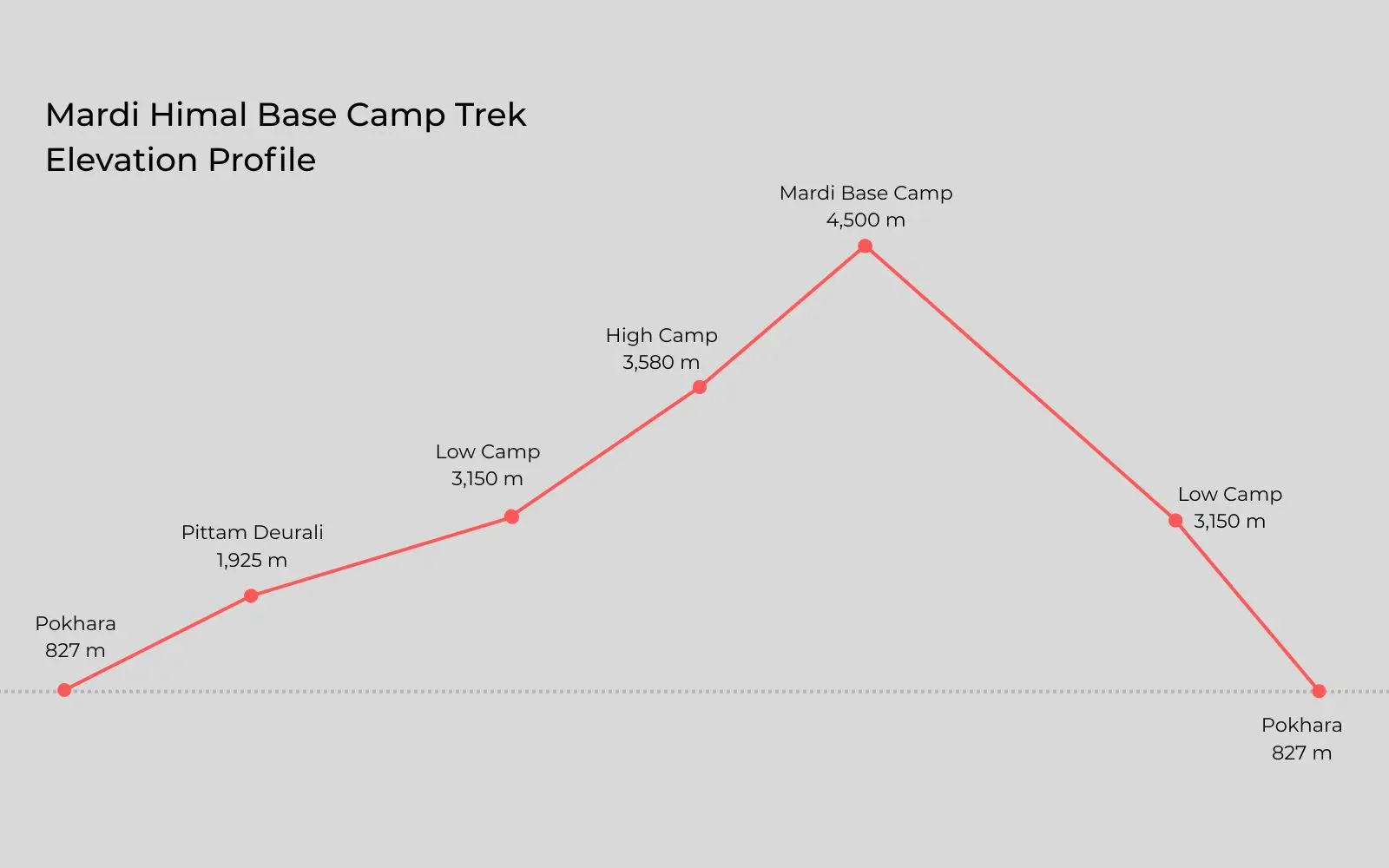
"Best time to trek Mardi Himal" can't be answered from Pokhara's weather, because Pokhara sits at 822 m and the trek's two headline days happen 2,700 to 3,700 m higher.
The figures that matter, and shouldn't be confused with each other:
- High Camp — 3,550 m — where you sleep on Day 3, the highest overnight stop on the trek.
- The Upper Viewpoint — 4,200 m — reached early on Day 4, giving nearly the same panorama as Base Camp with less exposure.
- Mardi Himal Base Camp — 4,500 m — the highest point most trekkers reach, on a same-day out-and-back from High Camp.
- Mardi Himal itself — 5,587 m — the actual summit, which is a separate climbing objective requiring a climbing permit, not part of this trekking itinerary.
A month that's warm and settled at Pokhara tells you nothing reliable about conditions at 3,550 m or 4,500 m. That's why every seasonal claim on this page and in our weather guide is tied to a specific elevation, and it's why "best time" ultimately means "best time for the day you sleep at 3,550 m and walk to 4,500 m," not "best time to be in Pokhara." Full altitude detail, including acclimatisation considerations, is in our Mardi Himal Trek altitude guide.
How season changes the actual 5-day route
Pokhara → Phedi → Pitam Deurali → Low Camp → High Camp → Mardi Himal Base Camp → Low Camp → Siding → Pokhara
This is a route reference, not a live weather system — it shows where the path goes, not today's conditions on it. What it does illustrate well is why season matters differently on different days: the first two days sit below the treeline and are comparatively sheltered in any season; from Low Camp upward, you're exposed to whatever the sky is doing.
| Day | Route | Main seasonal consideration |
|---|
| 1 | Pokhara → Phedi → Pitam Deurali | Heat is the main variable, worst in late spring and monsoon, mildest in autumn and winter |
| 2 | Pitam Deurali → Low Camp | The forest holds moisture longest of anywhere on the route — the section most changed by a wet versus dry season |
| 3 | Low Camp → High Camp | First exposure to wind and full sun as the treeline ends; the day snow risk becomes relevant in winter and early spring |
| 4 | High Camp → Base Camp → Low Camp | The day weather matters most in every season — cold everywhere, but icy in winter and wet-risk in May |
| 5 | Low Camp → Siding → Pokhara | Warms fast on descent in any season; road conditions at Siding are the main monsoon-adjacent variable |
Best time by priority
This is the table that actually answers the question behind most searches for "best time" — because the honest answer depends entirely on what you're optimising for.
| If your priority is... | Best period | Why |
|---|
| Clearest mountain views | October, then November | Post-monsoon air at its cleanest; November sometimes edges ahead with an extra month of settling |
| Rhododendron flowers | Mid-March to mid-April | The core Day 2 forest band peaks here; a higher band flowers into early May |
| Warmest conditions | May, realistically | June–August is technically milder at High Camp but too wet to recommend |
| Least rain | November | Marginally drier than December and January, clearly drier than October |
| A snow experience | December–February | Snow and ice above 3,500 m are the norm, not the exception |
| Fewer trekkers | Winter, or late May, among recommended months | Genuinely quiet without monsoon's drawbacks |
| Beginner-friendly conditions | October, then April | Dry, stable, and forgiving of inexperience |
| Photography | October/November for panoramas; April for colour; winter for empty-trail minimalism | Different photographic goals point to different months |
| Cooler weather | December–January | High Camp nights regularly below −12°C |
| A lower-season, unhurried atmosphere | November or late May | Quieter trails and easier bookings, without monsoon's rain |
There is no single best month for everyone
This is worth stating plainly rather than leaving implicit, because it's the actual insight behind every table on this page.
Someone who wants clear skies should book a different month than someone who wants flowers. Someone chasing snow wants the opposite conditions from someone who simply wants warmth. Someone who values fewer people on the trail more than a guaranteed view has a different best month than someone who's flying a long way specifically to photograph the Annapurnas.
October gets recommended more than any other month on this route, and for the majority of trekkers — first-timers, photographers, anyone who wants the safest bet — that recommendation holds up. But "most people should book October" and "October is the best month" aren't quite the same claim, and the difference matters if your priorities aren't the average ones. Use the priority table above rather than a single verdict, and you'll end up with the month that's actually right for your trip rather than the one that's right for most trips.
When should you book Mardi Himal?
How far ahead to book depends heavily on which month you've chosen, since demand varies enormously across the calendar.
October and mid-April are the tightest windows. Teahouse capacity at High Camp is the real constraint — very few lodges, no booking system beyond your guide phoning ahead — and guides and porters are in highest demand across the entire Nepal trekking industry in these two periods. Book several weeks out if your dates are fixed to either.
May, March, and late April or late October are considerably more relaxed. Teahouse pressure eases noticeably, and a couple of weeks' notice is usually enough.
Winter and monsoon rarely require advance booking at all — availability is rarely the constraint in either season, for opposite reasons.
Group departures versus private treks matter here too: our fixed-date group departures run most frequently through October and April, are marked as guaranteed to run, and fill earliest for those two months specifically. A private trek gives you full date flexibility in any season but doesn't benefit from a group's shared guide cost.
Good weather doesn't guarantee a good trip
Worth saying plainly, even in October.
Booking the statistically best month improves your odds; it doesn't remove mountain weather from the equation. Clouds happen in October. Rain happens in April. Snow happens outside winter, occasionally. Views that were spectacular from Low Camp can disappear by the time you reach Base Camp two hours later, in any month on this list.
This is exactly why the whole trek is built around a 04:30 start on Day 4, why the Upper Viewpoint at 4,200 m exists as a legitimate stopping point rather than a fallback, and why a guide's decision to adjust the plan on any given day should be read as competence rather than as the trip going wrong. Booking well improves your odds. It was never going to guarantee the view.
Packing for Mardi Himal by season
The full list by category is on the Mardi Himal Trek page — there's no standalone Mardi packing guide on the site yet. Here's what changes by season specifically.
Spring (Mar–May): a layering system spanning the widest daily temperature range of the year — warm at Pokhara, near-freezing at High Camp. A waterproof shell becomes necessary by May, and microspikes are worth carrying in March and early April.
Monsoon (Jun–Aug): a proper waterproof shell and trousers, not a shower-resistant jacket, plus dry bags for everything inside your pack. If you're trekking in this window at all, this is not optional kit.
Autumn (Sep–Nov): the most standard packing list of the year in September and October — a normal layering system with a shell as backup. By November, add microspikes and tighten your sleeping bag rating toward −10°C.
Winter (Dec–Feb): microspikes are standard rather than optional, your sleeping bag should be rated to −10°C or colder, and insulated gloves and a proper down jacket aren't a suggestion — High Camp nights regularly drop below −10°C.
Permits, briefly
Whichever month you choose, the permit requirements don't change with the season: an ACAP permit and a TIMS card, plus a licensed guide for foreign nationals throughout the Annapurna Conservation Area. Government fees are flat year-round. Full detail, including current costs and how to arrange them, is in our Mardi Himal Trek permits guide.
Does season affect difficulty?
The route itself doesn't change — the altitude, the roughly 3,700 m of cumulative climbing, and the 1,515 m Day 4 descent are identical in every month. Season changes how those numbers feel.
Dry trails generally make the walking easier, in every sense — better grip, faster pace, less mental fatigue from constant footing decisions. Rain makes the forest sections and the Day 4 descent slippery and meaningfully more demanding. Snow or ice above 3,500 m adds technical difficulty to ground that's otherwise a straightforward walk. Cold increases fatigue simply by making the body work harder to stay warm. And altitude — the one constant — doesn't change based on season at all; 4,500 m is 4,500 m in July and in January.
Full breakdown of the route's inherent difficulty, independent of season, is in our Mardi Himal Trek difficulty guide.
Ready to trek Mardi Himal?
Now that you know when you want to go, here's the itinerary you'd actually book.
The 5-day route — Pokhara → Phedi → Pitam Deurali → Low Camp → High Camp → Mardi Himal Base Camp → Low Camp → Siding → Pokhara — includes a government-licensed guide, ACAP and TIMS permits and government fees, teahouse accommodation, all meals on the trek, and transfers between Pokhara and the trailheads. Rates run from US$300–360 per person in a group to US$470 for a solo private trek, with fixed-date group departures running most frequently through October and April.
Planning Mardi Himal? Check the current Places Nepal itinerary, inclusions and available departures and choose the period that matches the conditions you actually want.
Trek the Mardi Himal Trek
Five days, one ridge, and the closest you'll legally get to Machhapuchhre.
Choosing the right Nepal trek for your travel dates
Mardi Himal isn't the only route worth matching to a season, and if your dates don't fit any of the windows above, a different trek might serve you better than forcing Mardi Himal into the wrong month.
If your only window is deep monsoon (June–August), consider a rain-shadow route instead — regions north of the main Himalayan range sit outside the monsoon's main path and stay trekkable through summer, which this route doesn't.
If you want Mardi Himal's short, accessible format but with less altitude commitment, the Ghorepani Poon Hill Trek runs on a similar seasonal calendar with a gentler high point.
If you have more time than Mardi Himal's five days and want the same conservation area at a less compressed pace, Annapurna Base Camp shares Mardi's peak October and April windows with a longer, more gradual itinerary.
If you're drawn to October or April specifically for the weather and want a bigger objective to match, the Everest Base Camp Trek and Annapurna Circuit Trek run on broadly the same seasonal logic — clear post-monsoon autumn, warm flowering spring — at a considerably larger scale.
If Mardi Himal's crowds in peak season are the actual problem, Manaslu Circuit or the Short Manaslu Circuit follow a similar autumn-and-spring pattern with meaningfully fewer people on the trail.
You can also browse by treks by season or treks by month directly, or filter specifically for rhododendron treks if flowers are what's driving your dates rather than any one destination.
None of these is a better trek than Mardi Himal in the abstract — they're different trades of duration, altitude and crowd level, and the right one depends on what actually matters to you about the trip, not just the month you have available.
Trek the Ghorepani Poon Hill and Mardi Himal Trek
Discover the Best of the Annapurna Region in One Trek.
Mardi Himal Trek Best Time: FAQs
What is the best time to trek Mardi Himal? October and April are the two strongest months, for different reasons — October for the clearest views and most stable weather, April for the rhododendron forest and longer daylight. November is a close, underrated third.
Which month is best for Mardi Himal? It depends on your priority. October for views and reliability, April for flowers, November for October's clarity with fewer crowds, and winter for snow and solitude. There's no single answer that fits every traveller.
Is October the best month for Mardi Himal? For most people, yes — it has the clearest air of the year and the most stable weather. It's also the busiest month, and the first week can still carry residual monsoon in a late year.
Is November good for Mardi Himal? Very. It's actually drier than October by the rainfall numbers and often just as clear, at the cost of colder nights and rising snow risk on the upper ridge later in the month.
Is April good for Mardi Himal? Yes — one of the two best months, with the main rhododendron forest in bloom, long daylight, and good early-month visibility that softens as the month progresses.
Is May good for Mardi Himal? Workable rather than ideal. Warm and quiet, but rainfall roughly doubles April's and haze reduces mountain visibility. Fine if May is your only window; not the first choice if you're picking freely.
Can you trek Mardi Himal in winter? Yes, for properly equipped and experienced cold-weather trekkers. Expect High Camp nights below −10°C and routine snow and ice above 3,500 m. Not recommended for first-timers.
Can you trek Mardi Himal during monsoon? Technically, yes — teahouses stay open and the route is walkable. We don't recommend it: heavy rain, poor visibility, mud, leeches, and landslide-prone approach roads outweigh the quiet trails and lower cost.
What is Mardi Himal weather like by month? It varies substantially by both month and elevation. See our full weather guide for month-by-month temperature and rainfall figures at every camp.
When does it snow on Mardi Himal? Most reliably December through February above 3,500 m. Possible but less likely in early spring and late autumn; rare in monsoon and late spring.
When do rhododendrons bloom on Mardi Himal? The main forest band on Day 2 peaks from mid-March to mid-April. A higher band above 3,000 m can flower into early May.
When are mountain views clearest? October, then November — the clearest post-monsoon air of the year, with mornings consistently better than afternoons on this ridge.
When is Mardi Himal least crowded? Monsoon is quietest overall but not recommended. Among months we'd suggest, winter and late May are the quietest, and November is quieter than October while offering comparable or better weather.
What is the warmest month for Mardi Himal? At Pokhara and the lower trail, June through August. At High Camp specifically, those same months are technically mildest overnight due to cloud cover — though we'd recommend May as the realistic "warm and still worthwhile" choice.
What is the coldest month for Mardi Himal? January, with High Camp nights regularly below −10°C and routine snow and ice on the upper ridge.
Is Mardi Himal good for beginners? Yes, in the right month. October and April give a first-timer the most forgiving combination of dry trail, stable weather and good visibility.
What is the best time for beginners? October first, April a close second. Both remove several of the variables — wet trail, poor visibility, unpredictable cold — that a beginner is least equipped to judge on their own.
Is Mardi Himal good for solo trekking? Yes, in any month, provided you have a licensed guide as required for foreign nationals. October and April offer the easiest logistics; November and late May offer quieter trails for those who prefer them.
What is the best month for solo trekking? October or April for straightforward logistics and company on the trail; November or late May if you'd rather trade some crowd for a quieter experience.
When is the best time for photography? October and November for mountain panoramas, April for colour and texture from the rhododendrons, and winter for empty-trail, minimalist compositions. No single month serves every kind of photography equally.
Is October better than April for Mardi Himal? For visibility and reliability, yes. For flowers and daylight, April has the edge. Neither is a wrong choice — they suit different priorities.
Is April better than May? For weather, views and rhododendrons, yes. May offers warmer, quieter trekking and cheaper travel in exchange for less reliable views.
Is October better than November? Marginally warmer, yes, and more popular — but November is drier and sometimes clearer, with noticeably fewer people. It's one of the closer calls on the calendar.
What should I pack for Mardi Himal depending on season? A layering system in every season, with a waterproof shell becoming essential from April through September, and microspikes added from November through February. Full seasonal detail is above.
Should I book Mardi Himal in advance during peak season? Yes, particularly for October and mid-April, when High Camp bed availability and guide demand are both under real pressure. Shoulder months need far less lead time.