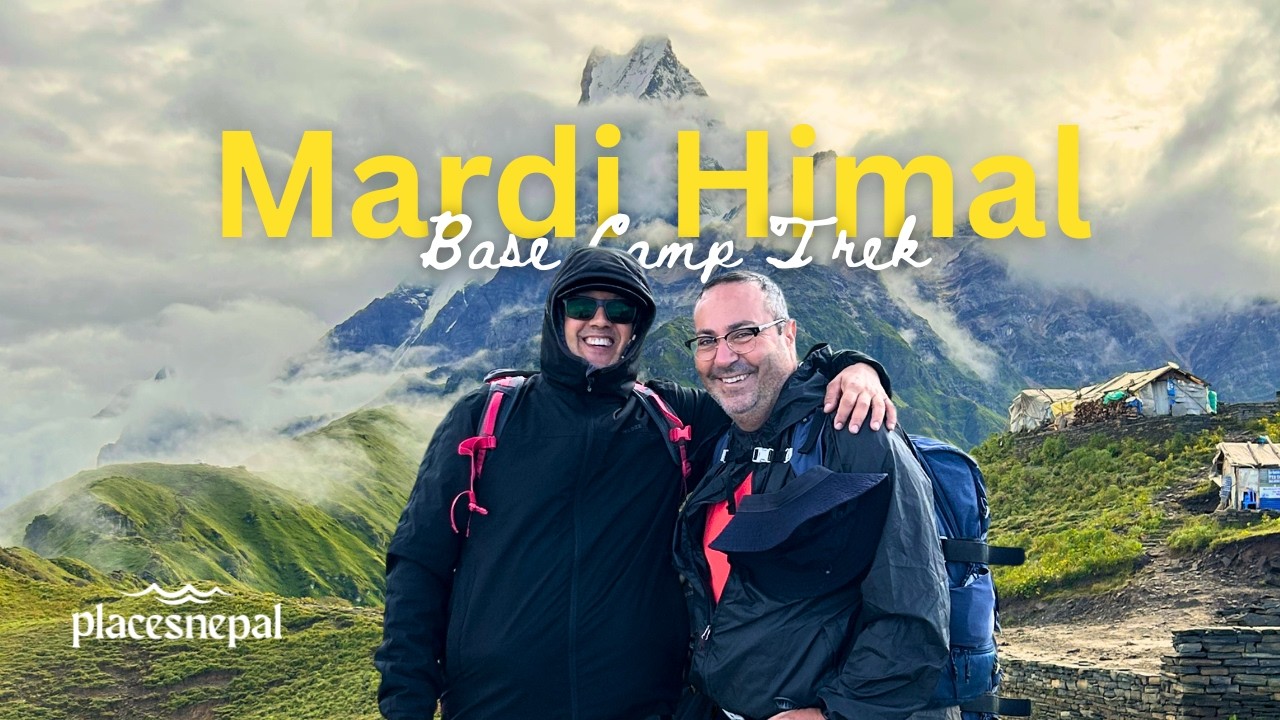
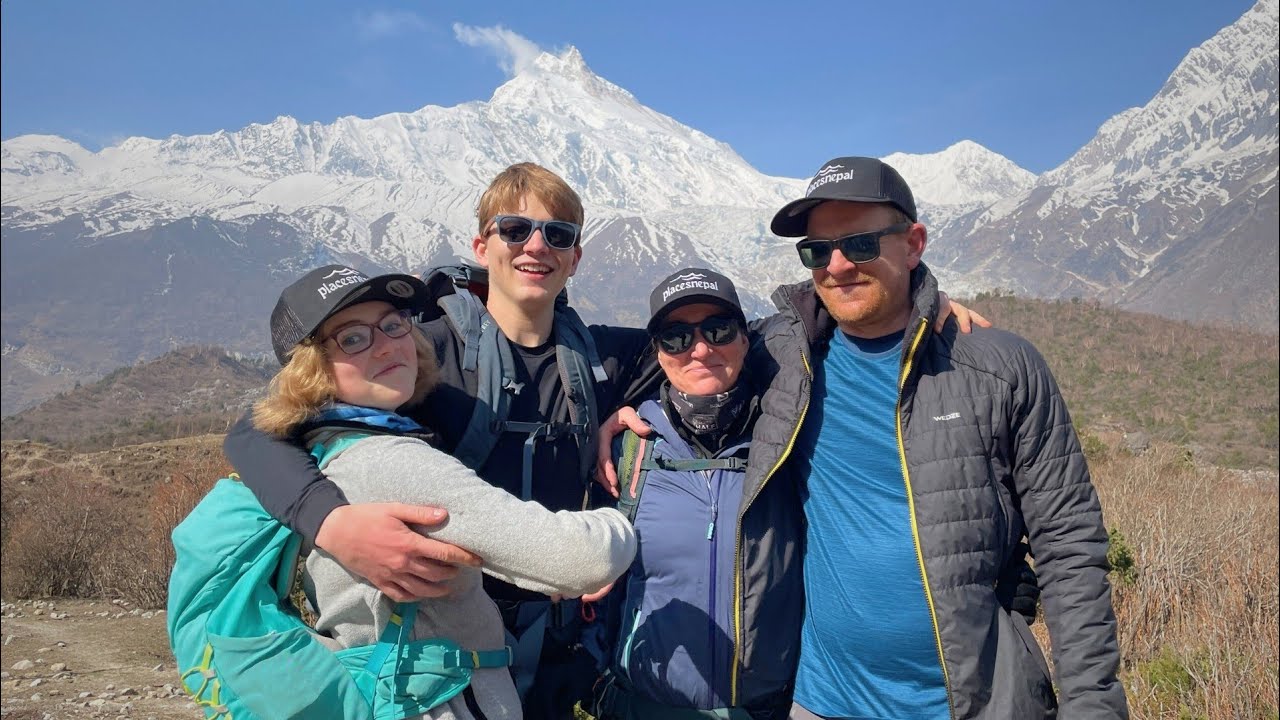
Mardi Himal doesn't have one weather. On any given day, Pokhara can be 28°C and sunny while High Camp, 2,700 vertical metres above it, is 4°C and socked in cloud. The trek climbs from 822 m to 4,500 m in four days, and the weather changes character roughly every thousand metres.
What is the weather like on the Mardi Himal Trek?
Mardi Himal doesn't have one weather. On any given day, Pokhara can be 28°C and sunny while High Camp, 2,700 vertical metres above it, is 4°C and socked in cloud. The trek climbs from 822 m to 4,500 m in four days, and the weather changes character roughly every thousand metres — warm and humid at the bottom, cool and forested in the middle, cold and exposed at the top.
Season matters too, and it interacts with altitude rather than simply adding to it. October is dry at every elevation. May is warm at the bottom and still cold at the top. Winter is cold everywhere but dry and stable. There's no single answer to "what's the weather like" — there's an answer for your month, your day on the trek, and the time of day you're asking about.
This page is the full reference: month by month, camp by camp, and organised by the question you actually have — will it rain, will I see the mountains, how cold is High Camp, what should I pack. For three months with enough going on to deserve their own full treatment, we've written dedicated day-by-day guides — October, April and May — and this page links to them rather than repeating them.
Mardi Himal weather at a glance
| Season | Lower trail (Pokhara–Pitam Deurali) | High Camp / upper route | Rain | Snow | Visibility | Overall |
|---|
| Spring (Mar–May) | Warm, warming through the season | Cold nights throughout; daytime mild | Rising through the season, moderate by May | Possible early, unlikely by May | Good early, hazier by late May | Best combined with April; workable through May with more tolerance needed |
| Monsoon (Jun–Aug) | Hot, very humid | Mild by comparison, but cloud-bound | Heavy — the wettest three months of the year by a wide margin | Rare — falls as rain even at altitude | Poor most days | Technically walkable, not recommended |
| Autumn (Sep–Nov) | Warm, cooling through the season | Cold, driest of the year | Low from October, lowest in November | Rising risk on the upper ridge from late October | The clearest of the year | The benchmark season, especially October |
| Winter (Dec–Feb) | Mild by day, cold at night | Very cold, often below −10°C at night | Lowest of the year | Most likely of any season above 3,500 m | Excellent — driest air of the year | Quiet, cold, for properly equipped and prepared trekkers |
Weather vs climate: what's the difference?
Worth being precise about this before the numbers start, because it's where most seasonal content quietly misleads people.
Climate is what usually happens. "High Camp is typically −5 to 0°C at night in October" is a climate statement — it's built from years of observation and it tells you what to expect and what to pack.
Weather is what's actually happening on a given day. Your specific October Wednesday might be −8°C and clear, or 2°C and raining. Climate didn't get it wrong; weather is just the individual outcome that climate describes in aggregate.
What this means for you: every figure on this page is a climate statement — a typical range built from seasonal patterns and our own operating experience on this route. None of it is a forecast for your trek dates. As your departure approaches, climate should hand off to an actual short-range forecast, and on summit morning, to what your guide can see on the ridge. We cover exactly that handoff further down.
Mardi Himal weather by elevation
Pokhara sits at 822 m. Mardi Himal Base Camp is at 4,500 m. Any weather source that quotes Pokhara or Kathmandu and calls it "Mardi Himal weather" is describing the first thirty minutes of a five-day trek.
Pokhara (822 m) — the warmest point on the trip in every month. Humid for much of the year, driest and clearest in winter.
Phedi and the lower trail (1,130–1,650 m) — similar to Pokhara, slightly cooler, and the most physically demanding heat of the trek because you're climbing rather than sitting.
Pitam Deurali (1,925 m) — the first genuine drop in temperature. Comfortable by day year-round; the evenings are where you first reach for a layer.
Forest Camp (2,550 m) — cooler again, and the dampest point on the route regardless of season, because dense canopy holds moisture longer than open ground.
Low Camp (2,985 m) — where the trek's climate changes. Ridge wind appears here for the first time, and nights are cold in every month of the year.
High Camp (3,550 m) — cold. This is the figure people ask about most, and the honest answer is that High Camp nights are near or below freezing for eight months of the year and only reliably above freezing in June, July and August — which happen to be the three months you shouldn't come.
Mardi Himal Base Camp (4,500 m) — the coldest, most exposed point on the route, reached shortly after sunrise on Day 4, which is the coldest part of the coldest day. Wind matters here more than the thermometer.
Annual range by elevation
| Location | Elevation | Typical daytime range across the year | Typical night range across the year |
|---|
| Pokhara | 822 m | 15–32°C | 8–22°C |
| Pitam Deurali | 1,925 m | 18–26°C | 5–14°C |
| Forest Camp | 2,550 m | 14–20°C | 2–10°C |
| Low Camp | 2,985 m | 8–17°C | −2 to 7°C |
| High Camp | 3,550 m | 2–15°C | −12 to 4°C |
| Mardi Himal Base Camp | 4,500 m | −2 to 8°C | −16 to 0°C |
Read this as a year-round envelope, not a single month. The month-by-month table below breaks these ranges down properly. These figures are typical/approximate, based on our own operating experience on this route, and are not a substitute for a forecast close to your departure date.
Mardi Himal weather month by month
| Month | Pokhara (day) | High Camp (day) | High Camp (night) | Rain* | Rain days* | Snow risk (3,500 m+) | Visibility | Verdict |
|---|
| Jan | 15–20°C | 2–6°C | −12 to −6°C | 12 mm | 1.6 | High | Excellent | Cold, quiet, dry — for prepared trekkers |
| Feb | 17–22°C | 3–7°C | −11 to −5°C | 15 mm | 2.2 | High | Excellent | Still cold, still dry, improving |
| Mar | 21–26°C | 5–9°C | −8 to −3°C | 26 mm | 3.9 | Moderate | Very good | Good transition month; lower rhododendrons starting |
| Apr | 24–29°C | 5–10°C | −6 to 0°C | 67 mm | 7.9 | Low, early only | Good, hazier late | One of the two best months — full guide |
| May | 27–32°C | 8–12°C | −4 to 1°C | 153 mm | 14.0 | Low | Fair, hazy | Workable pre-monsoon — full guide |
| Jun | 28–32°C | 10–14°C | 0–4°C | 293 mm | 18.4 | Very low | Poor | Not recommended — monsoon arriving |
| Jul | 27–31°C | 11–15°C | 2–6°C | 418 mm | 22.2 | Very low | Poor | Not recommended — peak monsoon |
| Aug | 27–31°C | 11–15°C | 2–6°C | 416 mm | 21.4 | Very low | Poor | Not recommended — peak monsoon |
| Sep | 25–29°C | 9–13°C | −2 to 3°C | 265 mm | 16.3 | Low | Poor early, good late | Wet start, real value in the last ten days |
| Oct | 22–28°C | 6–10°C | −5 to 0°C | 61 mm | 5.4 | Low, rising late | The best of the year | The benchmark month — full guide |
| Nov | 18–24°C | 5–9°C | −8 to −3°C | 8 mm | 1.0 | Moderate, rising | Excellent | The driest month of the year, and colder than October |
| Dec | 15–20°C | 3–7°C | −12 to −6°C | 8 mm | 0.8 | High | Excellent | Cold, quiet, winter beginning |
*Rainfall and rain-day figures are drawn from Okhaldhunga and Tatopani, two Nepal mid-hill reference stations tracked by DHM and the WMO — not Mardi Himal itself, but representative of the seasonal pattern across the region. Temperature ranges are our own typical figures based on operating this route, not independently measured, and none of this is a forecast.
The month that surprises people
November and December are the driest months of the year on this route — not October. Both reference stations put October at roughly 61–63 mm against November's 8–9 mm and December's 8–12 mm. October's reputation as "the driest month" is really about the combination of low rain, warm temperatures and post-monsoon clarity, not about rainfall alone. November is drier and clearer than October; it's simply colder, which is why October gets more bookings and November gets less credit than the numbers say it deserves. If low rainfall is your only priority, November wins. If you want low rain and comfortable temperatures, October is still the right answer.
Mardi Himal weather in spring: March, April, May
March is the coldest of the three spring months and the one without its own dedicated guide, so here's the fuller picture. It's a genuine winter-to-spring transition: mornings are often the clearest of the whole spring season, because pre-monsoon haze hasn't built up yet, but High Camp nights still run −8 to −3°C and lingering winter snow on the upper ridge is a real possibility, especially in the first half of the month. The lower rhododendron band, between roughly 2,000 and 2,500 m, starts flowering in March — see our April guide for the full elevation-by-elevation bloom breakdown, since the pattern spans both months. Trails are quiet. This is a strong choice for someone who wants April's stability without April's crowds and can handle a colder High Camp.
April is one of the two best months on this route — warm lower elevations, the main rhododendron forest in bloom on Day 2, long daylight, and good visibility that softens as the month goes on. Full day-by-day detail, the early-vs-late-April breakdown, and the elevation-resolved flowering guide are in Mardi Himal Trek in April.
May trades April's reliability for warmth, quiet trails and cheaper travel. Rainfall roughly doubles April's and pre-monsoon haze peaks, so mountain views become a genuine lottery rather than a near-certainty. It's workable and often rewarding, particularly in the first half of the month, but it asks for more tolerance than April does. Full breakdown, including the honest rain-versus-cloud distinction and the DHM monsoon-onset data that explains why late May can occasionally already be monsoon, is in Mardi Himal Trek in May.
Mardi Himal weather in monsoon: June, July, August
This is the season nobody markets and everybody should understand honestly rather than avoid discussing.
What it actually is: the wettest three months of the year by a wide margin. Regional stations record 293 mm in June, 418 mm in July and 416 mm in August — roughly six to seven times October's rainfall, spread across 18 to 22 rain days a month. Nepal's monsoon normally arrives around 13 June and withdraws around 2 October, though both dates shift by a week or more in most years.
What it feels like on this route: hot and extremely humid at Pokhara and the lower trail. Warm, oddly, at High Camp — nights there run 0 to 4°C, milder than October or November, because thick cloud cover traps heat that would otherwise radiate away on a clear night. That's a genuine quirk of monsoon climate at altitude: the coldest nights of the year happen in the driest, clearest months, not the wettest ones.
What it costs you: almost everything the trek is for. Mountain visibility disappears for days at a time. The forest sections between Pitam Deurali and Low Camp turn to mud and running water. Leeches are constant and unavoidable on the lower trail. The Day 4 descent — 1,515 m on wet rock and roots — becomes meaningfully more dangerous. The approach road to Phedi and the exit road from Siding are both vulnerable to landslides after sustained rain, and delays or reroutes are common rather than exceptional.
Is the trek still operating? Teahouses in this part of the Annapurna region generally stay open through monsoon — this isn't a route that physically closes the way some restricted-area treks effectively do. But almost no operator promotes group departures in these months, and for good reason: the return on effort is poor.
Who it might still suit: someone with absolutely no other window, who wants the walk and the achievement more than the view, and who accepts wet boots as part of the deal. For everyone else, this is the one season on this page we'd actively steer you away from, and we'd rather tell you that before you book than after you're standing in the forest in a downpour.
Mardi Himal weather in autumn: September, October, November
September is two different months in one. The first two to three weeks are still substantially monsoon — 265 mm on average, the third-wettest month of the year — with cloud, rain and limited visibility. The back half of the month changes fast as the monsoon begins its withdrawal, and late September can be a genuine sweet spot: warm, greening, increasingly clear, and considerably quieter than October. If your dates are flexible, the last ten days of September are worth serious consideration.
October is the benchmark, for reasons the full Mardi Himal Trek in October guide covers in detail — the clearest air of the year, low rainfall from mid-month, and the best combination of warmth and visibility on the calendar. It's also the busiest month, and the first week carries real risk that the monsoon hasn't fully withdrawn.
November doesn't have a dedicated guide on this site yet, so here's the fuller version. It's drier than October by the numbers — 8 mm against October's 61 mm at comparable stations — and the air is often even clearer, since post-monsoon haze has had another month to fully clear. What you give up is warmth: High Camp nights drop to −8 to −3°C, colder than October's −5 to 0°C, and by late November snow and ice on the upper ridge become a real consideration rather than a remote one — microspikes are worth carrying from mid-November onward. Crowds thin out noticeably compared with October, particularly after the first couple of weeks. For a trekker who wants October's clarity with fewer people and can handle the cold, November is arguably underrated on this route.
Mardi Himal weather in winter: December, January, February
Cold, dry, quiet, and not automatically a bad idea.
What it's like: the driest air of the year, alongside November — 8 mm in December, 12 mm in January, 15 mm in February at comparable stations, and the lowest rain-day counts of any season. Skies are frequently clear for days at a stretch. The cost is temperature: High Camp nights run −12 to −5°C through the coldest stretch, and Base Camp mornings on Day 4 are colder still, likely below −15°C before wind chill.
Snow is the defining feature. Unlike any other season, winter snow above roughly 3,000 m is common rather than occasional, and the upper section from High Camp to Base Camp regularly holds snow and ice from December through February. Microspikes shift from optional to standard kit. Some smaller teahouses at High Camp close for the season or run with reduced capacity, since winter trekking numbers on this route are a fraction of autumn's.
Who winter suits: experienced cold-weather trekkers who want the mountains essentially to themselves, are properly equipped for sustained sub-freezing conditions, and are comfortable with a guide's call to turn around if the upper ridge is unsafe. It's a good season for photography — clear air and empty trails are a rare combination anywhere in Nepal.
Who should consider another month: first-time trekkers, anyone without cold-weather gear and experience using it, and anyone who wants a guaranteed shot at Base Camp rather than a conditional one. Winter is the one season where a guide's decision to stop at High Camp or the Upper Viewpoint, rather than push to Base Camp, is a routine outcome rather than a rare one.
Does it rain on the Mardi Himal Trek?
Yes, seasonally and predictably rather than randomly.
Monsoon (June–August) is when it rains — 293 to 418 mm a month, most days, often for hours. Pre-monsoon (April–May) sees rising rainfall as the season progresses, mostly as afternoon showers and thunderstorms rather than sustained rain. Post-monsoon (October–November) is the driest stretch of the year alongside winter. Winter (December–February) is dry, with occasional weather systems bringing snow rather than rain at altitude.
What rain changes, in every month it happens:
- Mud on the forest sections between Pitam Deurali and Low Camp, which hold moisture longest of anywhere on the route.
- A harder Day 4 descent. 1,515 m down on wet rock and roots is the single highest-consequence section of the trek in any season.
- Lost visibility. Rain and cloud travel together.
- Wet kit compounding across a multi-day trek — damp boots on Day 2 are still damp on Day 5 without proper drying opportunities.
- Pace. Start earlier in wetter months. Afternoon is when rain arrives in every season it occurs at all.
- Road conditions. The Phedi approach and Siding exit roads are both more vulnerable after sustained rain, mainly a monsoon and late-pre-monsoon consideration.
What it doesn't usually mean: cancelling the trek. Outside monsoon, rain on this route is an inconvenience managed with a shell, poles and a slower pace — not a reason to turn back, except specifically on the Day 4 summit push, where a bad morning is worth waiting out or turning around from rather than pushing through.
Does it snow on the Mardi Himal Trek?
Depends entirely on where and when, and this is worth being specific about rather than giving a single answer for the whole route.
Below 3,000 m — Pitam Deurali, Forest Camp, Low Camp — snow is rare in any month and not something to plan around.
Above 3,500 m — High Camp to Base Camp — snow risk by season:
| Season | Snow likelihood on the upper ridge |
|---|
| Winter (Dec–Feb) | High. Regular occurrence; microspikes standard |
| Early spring (Mar, early Apr) | Moderate. Lingering winter snow, especially on shaded ground |
| Late spring (late Apr, May) | Low. Occasional unusual system; rarely persists |
| Monsoon (Jun–Aug) | Very low. Precipitation falls as rain even at this altitude |
| Early autumn (Sep, early Oct) | Low |
| Late autumn (late Oct, Nov) | Rising through the period, moderate by late November |
Old snow versus fresh snow matters practically. Old, settled snow on a well-trodden section is usually manageable with microspikes. Fresh snow on an unconsolidated slope, particularly right after a storm, is a different and more serious proposition — this is exactly the situation where a guide's judgement about the day's route is worth deferring to completely.
The honest position across the whole year: we won't tell you there's no snow, because the upper ridge holds it for a genuine chunk of the calendar. We won't tell you there's guaranteed snow either, because outside winter it's the exception rather than the rule. Ask about current conditions before the summit push whenever you're trekking between November and April.
Is Mardi Himal weather better in the morning?
Yes, in every season this trek is recommended for, and it's the single most important practical fact on this page.
The mechanism: the Mardi ridge is the first significant barrier that moist air rising off the Pokhara valley meets on its way toward the main Annapurna range. That orographic lift builds cloud reliably through the morning and into early afternoon, in every season except deep winter when there's little moisture to lift in the first place. Mornings are clear or clearing; afternoons build cloud; evenings occasionally clear again.
Why this drives the whole itinerary's timing: Day 4 starts at 04:30 specifically to reach the Upper Viewpoint at sunrise and Base Camp shortly after, while the ridge is still clear. Leave two hours later and you may climb 950 m into a wall of white that would otherwise have been the best view of the trip.
Is this a universal rule? No — in deep winter, high pressure can hold all day and views stay clear from dawn to dusk. And in unsettled weather, mornings can occasionally be worse than afternoons if a system is moving through. But as a planning default across the seasons this trek is recommended for, "clear morning, cloudy afternoon" is the pattern to build your day around.
When is mountain visibility best on Mardi Himal?
October, for the clearest air of the year and the best combination of visibility and temperature. Post-monsoon skies are washed clean of the haze that builds through spring, and this is the single best month for photographing the Annapurnas from this ridge.
November is close behind and sometimes better, since it has an extra month of clear post-monsoon air with even less haze — the trade is colder temperatures.
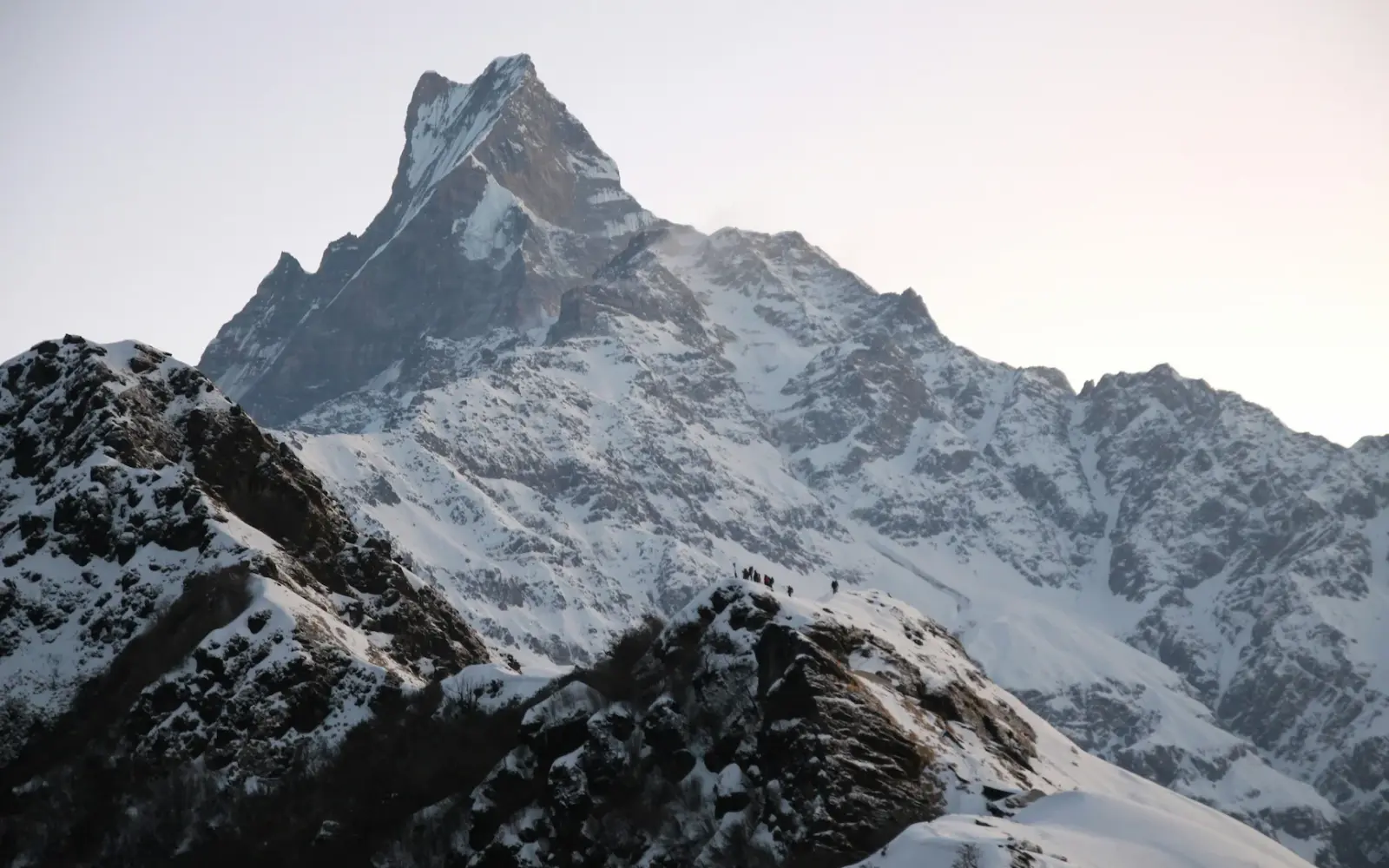
Close peaks are more forgiving than distant ones, in every season. Machhapuchhre, at 6,993 m and viewed from close range starting at High Camp, is spectacular in nearly any month with a clear morning. It's the long view west across Annapurna I through IV from the upper viewpoint that suffers most from haze and cloud, and that view is what October and November deliver over the other months.
Spring haze builds progressively from March through May as dust and agricultural burning accumulate with no monsoon rain to clear them — March is the clearest spring month, May the haziest.
Monsoon visibility is poor most days, full stop, regardless of time of day.
Winter visibility is excellent on clear days, which are frequent, though the cold limits how comfortable extended time at a viewpoint actually is.
No month guarantees a clear view. October and November give you the best odds; nothing on this route gives you a certainty.
What is the weather like at Mardi Himal High Camp?
High Camp (3,550 m) is where the trip's true climate lives, and it's colder than most people expect from a place they're picturing from a warm Pokhara hotel room.
Why it feels dramatically colder than Pokhara, even on the same day: roughly 2,700 metres of elevation gain, at a standard lapse rate, accounts for most of the difference on its own — before wind, exposure or time of day are even factored in. A 30°C Pokhara afternoon and a near-freezing High Camp night on the same trek isn't unusual weather; it's the ordinary shape of this route.
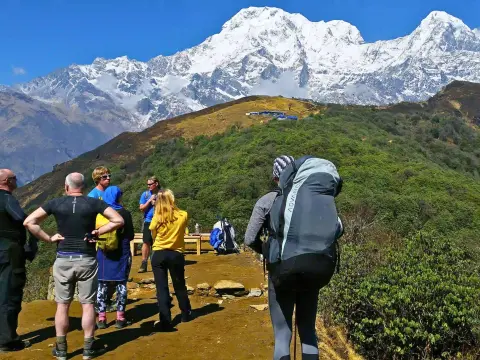
Wind becomes a factor here for the first time on the trek — the treeline ends just above Low Camp, and High Camp sits on open ridge with nothing to break the wind. Wind chill routinely makes the effective temperature several degrees colder than the air temperature alone would suggest.
Frost is normal on most mornings outside the height of monsoon. Tent poles, boot laces and anything left outside overnight will often have a thin layer by dawn.
Night-time temperatures, by month, run from the near-freezing figures of October and April down to the −12°C range of December and January — see the month-by-month table above.
Snow is possible here in any month from November through April, and standard in December through February.
What this means practically: the sleeping bag rating on your packing list (−5 to −10°C, tightening to −10°C or below for winter) isn't a suggestion — High Camp is the coldest place most trekkers on this route will have ever slept.
What is the weather like at Mardi Himal Base Camp?
Base Camp (4,500 m) is colder and more exposed than High Camp, and you're only there for a short window on Day 4 — which changes how you should think about it.
Elevation and exposure: almost 1,000 m higher than High Camp, on fully open alpine ground with no shelter of any kind. Whatever wind exists at High Camp is stronger here.
Timing is everything. You reach Base Camp shortly after sunrise, which is the coldest part of the day at this altitude — the sun hasn't yet warmed the ridge, and overnight cold is at its deepest just before and around dawn.
Cloud behaves differently up here than lower down. Base Camp can be in cloud while Low Camp, 1,500 m below, is clear, and the reverse can happen just as fast. This is rapid-changing mountain weather rather than the more gradual build-up you see lower on the route.
Snow or ice on the approach is the main seasonal variable — see the snow-by-season table above. The final stretch from High Camp is where any accumulation matters most.
What this means for your visit: Base Camp conditions can be meaningfully worse than what you experienced ten minutes earlier at the Upper Viewpoint, or than what your teahouse host described from Low Camp that morning. This is exactly why the Upper Viewpoint at 4,200 m is treated as a legitimate stopping point rather than a consolation prize — it gives most of the panorama with less exposure to Base Camp's specific, harder-to-predict conditions.
Weather along the 5-day Mardi Himal route
xx
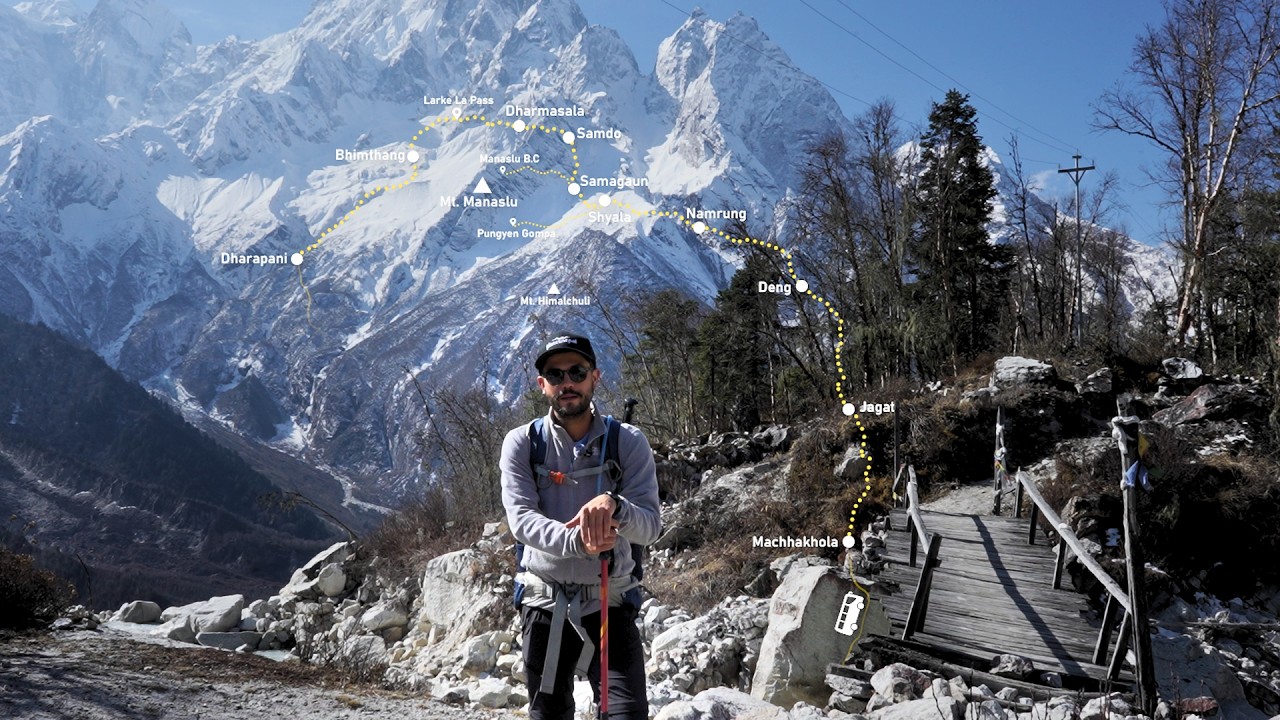
Pokhara → Phedi → Pitam Deurali → Low Camp → High Camp → Mardi Himal Base Camp → Low Camp → Siding → Pokhara
This map is a route reference, not a live weather or trail-condition system — it shows where the path goes, not what it's doing today. That said, it's a useful way to see why this trek's weather behaves the way it does: it's a single ridge, climbing steadily, with the treeline (and with it, shelter from wind) ending abruptly around Low Camp. Everything above that point is exposed; everything below it isn't.
Weather by trekking day
| Day | Route | Main weather consideration |
|---|
| 1 | Pokhara → Phedi → Pitam Deurali | Heat and humidity on the climb out of Phedi. The trek's hottest working hour in most months |
| 2 | Pitam Deurali → Low Camp | Forest holds moisture longest of anywhere on the route — the section most affected by recent rain in any season. Largest single-day temperature drop |
| 3 | Low Camp → High Camp | First exposure to wind as the treeline ends. Sun exposure rises sharply above the canopy |
| 4 | High Camp → Base Camp → Low Camp | The coldest start of the trip in every month, and the day most likely to be decided by weather rather than fitness. Highest exposure on the ridge, and the steepest 1,515 m of descent on wet or icy ground when conditions are against you |
| 5 | Low Camp → Siding → Pokhara | Warming fast as you descend. Road conditions at Siding are the main variable after heavy rain |
How does weather affect Mardi Himal Trek difficulty?
The route doesn't change with the weather. The altitude, the roughly 3,700 m of cumulative climbing, and the 1,515 m Day 4 descent are identical in January and July. What changes is how those numbers feel.
Good weather doesn't make the trek flat. Clear skies and dry trail remove the worst variables, but Day 2's climb and Day 4's descent are still the same physical work in perfect conditions as in poor ones.
Bad weather can make an otherwise manageable section significantly harder. Rain turns the Day 2 forest into a slip hazard. Wind at High Camp turns a merely cold night into a uncomfortable one. Snow or ice on the upper ridge adds real technical difficulty to ground that's otherwise a straightforward walk. Heat on Day 1 in late spring or monsoon adds fatigue that a cool October morning simply doesn't.
The factors, by direction of effect:
- Harder: mud, rain-slicked roots and rock, strong wind at altitude, snow or ice above 3,500 m, heat and humidity at lower elevations, poor visibility making pacing and navigation harder.
- Easier: dry firm trail, stable temperatures, clear visibility for morale and pacing, calm conditions on the exposed ridge sections.
Full breakdown of the route's inherent difficulty, independent of season, is in our Mardi Himal Trek difficulty guide.
What weather is best for beginners on Mardi Himal?
Dry, moderate, stable weather makes this trek meaningfully easier for someone attempting it for the first time. Specifically: firm trail underfoot (removes the slip risk that catches inexperienced trekkers on the Day 4 descent), moderate temperatures at both ends of the route (removes the heat-fatigue and cold-shock extremes), decent visibility (keeps morale up on a demanding day), and low precipitation (removes the mud and the wet-kit compounding that turns a hard trek into a miserable one).
By that standard, October and April are the best months for a first Himalayan trek on this route — both covered in full in their own guides, with the honest trade-off between them (April's flowers versus October's clarity) explained there.
What good weather doesn't remove: the altitude is still 4,500 m at Base Camp regardless of the forecast. Day 4 is still 950 m up and 1,515 m down in 7–8 hours. Beginners still need to prepare for cold, for the possibility of rain even in a "good" month, and for a guide's call to turn around if conditions on the day don't match the seasonal average. Weather improves the odds; it doesn't remove the work. Full guidance in Mardi Himal Trek for beginners.
Which weather conditions are best for solo trekking on Mardi Himal?
The same conditions that suit beginners matter even more for someone making their own weather decisions.
Visibility and navigation. This route is a single, well-defined ridge and easy to navigate in clear weather. Fog changes that — the upper section above High Camp can lose definition fast, and a trail that's obvious in sunshine becomes a matter of following your feet in whiteout.
Rain and snow both raise the stakes of being alone, specifically on the Day 4 descent, where a fall on wet or icy ground is a bigger problem without a companion to help.
Communication matters more when weather is unpredictable. Mobile coverage on this route thins above Forest Camp and is unreliable above High Camp in any season, which means a fast-changing weather situation at altitude often has to be assessed and decided on alone, without a forecast update.
Why this makes weather matter more for solo trekkers, not just more relevant: a guided trekker gets a second opinion on the Day 4 turn-around call. A solo trekker's read of the conditions is the only read there is. That's not a reason to avoid solo trekking — it's a reason to lean toward the more stable months and to build in a buffer day. Full detail, including the current guide requirement for foreign nationals, in Mardi Himal Trek solo.
Weather and crowds aren't the same thing
Worth separating, because they're often assumed to move together and they don't always.
Ideal weather usually means busier trails. October's combination of clear skies and comfortable temperatures makes it Nepal's single busiest trekking month, and High Camp beds are contested. April follows a similar, slightly less extreme pattern.
Poor or difficult weather usually means quieter trails. Monsoon is nearly empty. Winter is quiet specifically because of the cold, not because the weather is bad in any absolute sense — it's dry and often perfectly clear, just cold enough to deter most trekkers.
And then there's November — genuinely excellent weather (drier and often clearer than October) paired with noticeably lower crowds, simply because it's colder and less marketed. If your ideal trip is good weather without October's crowd, November is the month that actually delivers that combination, more than any "shoulder season" framing usually credits it for.
The takeaway: don't assume a quiet trail means bad weather, and don't assume good weather means a crowd you can't avoid. Check both separately.
What should you pack for Mardi Himal weather?
Organised by what you're actually protecting against, since that's more useful than a flat list.
For rain
- Waterproof shell jacket with a hood
- Waterproof trousers
- Pack cover, plus dry bags inside the pack for sleeping bag, spare clothes and electronics
- Spare socks — more than feels necessary
For cold
- Fleece or softshell mid-layer
- Insulated down jacket
- Warm hat
- Insulated gloves for summit morning, lighter gloves for daytime
- Warm socks and a sleeping bag rated to at least −5 to −10°C, tightening to −10°C or colder for winter
For sun
- Sunglasses with genuine UV protection
- SPF 50 sunscreen
- Sun hat
For changing conditions
- A proper layering system rather than one heavy item — base layer, mid layer, insulating layer, shell
- Trekking poles, which matter in every season and become closer to essential on a wet or icy Day 4 descent
- Spare socks (again — it's the most under-packed item on this list)
For electronics
- Power bank, since charging on the trail is paid and sometimes solar-limited
- A sealed dry bag for phone, headlamp batteries and camera, regardless of season — humidity finds its way into anything unsealed over five days
There's no dedicated Mardi Himal packing article on the site yet — for now, the complete list by category is on the Mardi Himal Trek page.
What shoes are best for Mardi Himal weather?
A broken-in waterproof trekking boot with ankle support and genuine tread, in every season. That single specification covers most of what the weather on this route asks of footwear.
Grip matters more than anything else. The stone steps low down, the rooted forest in the middle, and the loose rock on the Day 4 descent are all more dangerous wet than dry, and worn-out tread is a common, avoidable cause of falls.
Waterproofing matters most in the pre-monsoon and monsoon months — April through September — when the forest sections are reliably damp to wet.
Ankle support matters most on the Day 4 descent, in any season, simply because of the 1,515 m of loose, uneven ground.
Microspikes are the one seasonal addition worth carrying — standard kit from December through February, worth having from November through early April, and unnecessary the rest of the year unless a specific snowfall event changes the picture.
We wouldn't recommend anything beyond a good trekking boot and, where relevant, microspikes. This route doesn't require mountaineering boots or crampons in normal conditions in any month.
What happens if the weather turns bad on the Mardi Himal Trek?
A realistic response, not a dramatic one.
- Slow down. Most weather-related problems on this route are footing problems, and rushing makes them worse.
- Get the shell on before you're soaked, not after — once base layers are wet they stay wet for the rest of the day.
- Shelter and wait where sensible. A short delay at a teahouse or camp costs less than pushing through deteriorating conditions.
- Adjust timing. A guide may move a start time earlier, shorten a day, or hold at a lower camp. That's normal operating judgement, not a sign of a trip going wrong.
- Avoid unnecessary exposure on the ridge. The section from Low Camp to Base Camp is where weather decisions matter most — there's little to gain from pushing onto open, exposed ground in deteriorating conditions.
- Follow local advice. Teahouse hosts and guides read this specific ridge's behaviour from years of daily observation, and that beats any forecast for the immediate decision.
- Accept that the itinerary may adjust. On a route that reaches 4,500 m, the published schedule is a plan, not a promise. A guide who tells you the summit push is off for the morning is doing their job, not failing at it.
We're not going to construct rescue scenarios that don't reflect what actually happens on this trek most of the time. The realistic bad-weather outcome on Mardi Himal is a delayed start, a shortened day, or a turn-around at the Upper Viewpoint rather than Base Camp — not an emergency.
How to check the Mardi Himal weather forecast
Four different sources, useful at different distances from your departure.
Before booking — seasonal climate. Everything on this page. Useful for choosing a month and packing correctly. Not predictive of any specific date.
7–10 days before — extended forecast. Broad direction only at this range — whether a system is approaching. Treat the specifics as noise this far out.
1–3 days before — short-range mountain forecast. The useful window. Look specifically for a forecast that resolves by altitude rather than giving one number for the whole region — a Pokhara forecast tells you almost nothing about High Camp.
On the trail — local conditions plus your guide. The best source available, and free. Teahouse hosts at Low Camp and High Camp have watched this ridge's weather for years, and combined with a guide's read of the sky, this beats any app for the actual summit-morning decision.
Why a Pokhara forecast isn't enough on its own: the 2,700 m of elevation between Pokhara and High Camp means the two locations are frequently experiencing different weather systems, not just different temperatures. A clear Pokhara forecast says nothing reliable about cloud on the ridge.
No forecast, at any range, is reliable at 3,500–4,500 m on an exposed ridge. Use forecasts to plan the trip and local knowledge to decide the day.
"Best weather" doesn't mean "best month"
Different trekkers are optimising for different things, and the single best all-round month isn't necessarily best for what you specifically want.
Best for clear mountain views: October, with November a close and often underrated second.
Best for warmest trekking conditions: technically June through August, when High Camp nights are milder than any other season — but that warmth comes bundled with the worst rain and visibility of the year, so most trekkers are better served choosing May for a warm-but-still-viable month.
Best for rhododendron flowers: the main forest bloom, on Day 2 between Forest Camp and Low Camp, peaks from mid-March to mid-April. A higher band above 3,000 m can still flower into early May.
Best for lowest rainfall: November, narrowly ahead of December and January, and considerably ahead of October — see the note above on why October still gets the recommendation despite this.
Best for a snow experience: December through February, when snow and ice on the upper ridge are the norm rather than the exception.
Best for fewer trekkers: monsoon, unambiguously — though not recommended for the reasons above. Among months we would recommend, winter and late May are the quietest.
Best for beginner-friendly weather: October and April, in that rough order, for the combination of dry trail, moderate temperatures and reliable visibility.
Best for the lowest temperatures, if that's specifically what you're after: December and January, when High Camp nights regularly drop to −12°C or below.
Weather decision table
| Your priority | Best period | Why |
|---|
| Clear mountain views | October, then November | The clearest post-monsoon air of the year, in that order |
| Warmest trekking conditions | May, realistically | June–August are warmer at altitude but too wet to recommend |
| Rhododendron flowers | Mid-March to mid-April | Main forest band peaks here; see the April guide for the elevation breakdown |
| Lowest rainfall | November | Marginally drier than December and January, clearly drier than October |
| A snow experience | December–February | Snow and ice above 3,500 m are routine, not occasional |
| Fewer trekkers, recommended months | Winter, or late May | quiet without monsoon's drawbacks |
| Beginner-friendly weather | October, then April | Dry, stable, and forgiving of inexperience |
| Coldest conditions, if wanted | December–January | High Camp nights regularly below −12°C |
Comparing the four seasons
| Factor | Spring (Mar–May) | Monsoon (Jun–Aug) | Autumn (Sep–Nov) | Winter (Dec–Feb) |
|---|
| Rain | Rising through the season; moderate by May | Heavy — the wettest three months by far | Wet early September, very low from October | Lowest of the year |
| Temperature | Warm and warming at low elevations; High Camp stays cold | Warm even at High Camp, hot lower down | Comfortable, cooling through the period | Cold to very cold throughout |
| Visibility | Good early, hazy by May | Poor most days | The clearest of the year, especially October–November | Excellent on clear days |
| Snow above 3,500 m | Possible early, unlikely by May | Rare — falls as rain | Low, rising by late November | Common |
| Trail | Firming through the season | Muddy, leeches, landslide-prone approach roads | Dry and firm from mid-September | Dry, but icy on the upper ridge |
| Crowds | Busy, peaking in April | Very quiet | Busiest of the year in October, easing by late November | Quiet |
| Beginner suitability | Good in April, workable in May | Not recommended | Excellent, particularly October | For prepared, cold-weather-experienced trekkers |
How Mardi Himal's weather compares to other Nepal treks
Worth a brief mention, because weather is one of the real reasons people choose between Nepal's trekking routes, not just between months on the same one.
Mardi Himal's short length is itself a weather advantage. At five days, a single bad-weather stretch has less room to ruin the trip than it would on a two-week route — you have one summit day to protect, not several, and a short window of good weather is more likely to cover it. Longer routes like the Annapurna Circuit or Everest Base Camp need several consecutive good days, particularly around their high passes, which raises the stakes of any single bad-weather stretch.
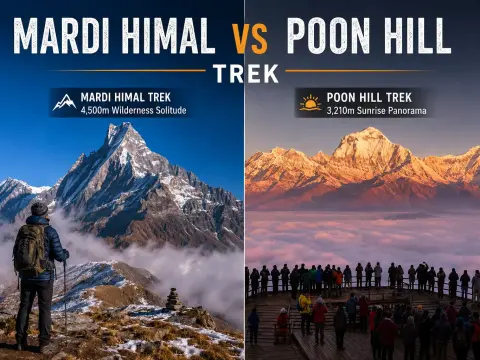
Compared with Poon Hill, Mardi Himal reaches considerably higher and is more weather-sensitive at the top — Poon Hill's summit is a short, low-altitude dawn walk that's rarely weather-dependent in the way Mardi's 4,500 m Base Camp day is.
Compared with Annapurna Base Camp, the climate pattern is similar — same conservation area, same October/April peak seasons — but ABC's longer itinerary spreads the altitude gain over more days, which is gentler on both body and weather exposure.
Compared with Langtang, a similar-length, similar-altitude alternative, the seasonal pattern tracks closely, and the same October-then-April preference generally applies.
None of these are better or worse choices in the abstract — they're different trades between duration, altitude exposure and weather sensitivity, and Mardi Himal's specific trade is a short, weather-forgiving trek with one weather-critical day.
Ready to trek Mardi Himal?
Once you know what conditions you want, the dates follow naturally. If mountain views matter most, October or November. If you want the forest in bloom, April. If your dates are fixed to May or later spring, plan around mornings and build in a buffer day. If you have real cold-weather experience and want the ridge to yourself, winter is a genuine option most people overlook.
Know what conditions you want? Check the current Places Nepal Mardi Himal Trek itinerary, inclusions and available departures and choose your dates accordingly.
If you're not sure which season fits what you're after, tell us your priorities and your travel window and we'll give you a straight recommendation — including when the honest answer is a different month than the one you first had in mind.
Mardi Himal Trek Weather: FAQs
What is the weather like on the Mardi Himal Trek? It varies enormously by elevation and season — warm and humid at Pokhara, cool in the forest, and cold and exposed at High Camp and Base Camp. There's no single "Mardi Himal weather"; there's a pattern for each camp and each month.
What is the best month for Mardi Himal weather? October, for the best combination of low rainfall, clear visibility and comfortable temperatures. November is drier and often clearer but colder. April is the best spring alternative.
Is Mardi Himal cold? At the top, yes, in every month of the year. High Camp (3,550 m) drops below freezing at night for most of the year, and only stays reliably above freezing during the wet monsoon months.
How cold is High Camp? Typically −5 to 0°C at night in October and April, colder at −8 to −3°C in November, and −12 to −6°C in the depths of winter. Even in warm May it drops to around −4 to 1°C.
How cold is Mardi Himal Base Camp? Colder and more exposed than High Camp, typically −10 to −5°C in the pre-dawn hours you're there in October and April, and considerably colder in winter. Wind chill makes the effective temperature lower still.
Does it rain on Mardi Himal? Yes, seasonally. Heavily in monsoon (June–August), moderately and increasingly through spring (March–May), and rarely from October through February.
Does it snow on Mardi Himal? Rarely below 3,000 m in any month. Above 3,500 m, snow is common from December through February, possible in early spring and late autumn, and rare in monsoon and late spring.
When does it snow on Mardi Himal? Most reliably December through February on the upper ridge. Outside that window, snow depends on individual weather systems rather than the calendar.
Is Mardi Himal wet during monsoon? Very. June to August sees six to seven times October's rainfall, muddy forest trail, and poor mountain visibility on most days. It's technically walkable but not a season we'd recommend.
Is Mardi Himal dry in October? Yes, from around mid-month. The first week of October can still carry residual monsoon moisture in a late year.
Is November cold on Mardi Himal? Yes — colder than October, with High Camp nights around −8 to −3°C. It's also drier and often clearer than October, which makes it a strong, underrated alternative.
Is April good for Mardi Himal weather? Yes — one of the two best months, with warm lower elevations, good early-month visibility, and the rhododendron forest in bloom. Full detail in our April guide.
Is May rainy on Mardi Himal? Meaningfully more than April — roughly double the rainfall — though most of it falls as afternoon showers rather than sustained rain. Full detail in our May guide.
Is March cold on Mardi Himal? Colder than April at every elevation, with High Camp nights around −8 to −3°C and a real chance of lingering winter snow on the upper ridge. Visibility is often excellent.
Is December too cold for Mardi Himal? Not too cold to trek, but cold enough that it suits properly equipped, experienced cold-weather trekkers rather than first-timers. High Camp nights run −12 to −6°C.
Are the mountains visible in monsoon? Rarely. Cloud cover is heavy on most days through June, July and August, and clear mountain views are the exception rather than something you can plan around.
Are the mountains visible in October? Usually, especially in the morning. October has the clearest air of the year, though afternoon cloud is still a normal daily pattern.
Is Mardi Himal cloudy in May? Often by mid-morning. Mornings are frequently clear; cloud builds earlier and more reliably in May than in April or October.
Does weather change quickly on Mardi Himal? Yes, particularly above the treeline from Low Camp upward. Base Camp conditions can differ substantially from what you experienced at High Camp or Low Camp the same morning.
Is morning better than afternoon for mountain views? Almost always, in every recommended season. Cloud builds through the morning and into the afternoon on this ridge, which is why the Day 4 summit push starts at 04:30.
What should I pack for Mardi Himal weather? A full layering system, waterproofs, an insulated down jacket, a sleeping bag rated to at least −10°C, trekking poles, and dry bags for electronics — adjusted seasonally, with microspikes added for November through April.
Do I need a rain jacket? Yes, in every season except the depths of winter. It's essential rather than optional from April through September.
Do I need winter clothing? Not winter-specific gear for most months, but a proper down jacket and a sleeping bag rated to −10°C or below are needed for High Camp in every season — it's cold up there regardless of what month it is at Pokhara.
Is Mardi Himal suitable for beginners in bad weather? Weather can turn a manageable trek into a hard one for an inexperienced trekker, particularly on the Day 4 descent in rain or on an icy upper ridge. A guide's decision to shorten a day or turn around should be treated as normal, sensible operating practice.
How do I check the Mardi Himal weather forecast? Use seasonal climate data (like this page) to plan and pack, a short-range forecast in the final few days before departure, and your guide's on-the-ground read once you're on the trail — that last source is the most reliable for any specific day's decision.