October is the strongest month for the Mardi Himal Trek, with the year's clearest mountain visibility and low rainfall. It isn't uniform: the monsoon's normal withdrawal date is 2 October but has averaged around ten days later since 1997, so early October can still be wet. Mid to late October is the most reliable window.
Is October a good time to trek Mardi Himal?
October is the strongest month for the Mardi Himal Trek, with the year's clearest mountain visibility and low rainfall. It isn't uniform: the monsoon's normal withdrawal date is 2 October but has averaged around ten days later since 1997, so early October can still be wet. Mid to late October is the most reliable window.
That last point is the one worth reading twice, because almost every article about October trekking in Nepal treats the month as a single block. It isn't. The 3rd of October and the 27th of October are different treks, and if you have any flexibility over your dates, knowing why is worth more than everything else on this page.
Why October works for Mardi Himal
Four things line up in October, and they line up better for this trek than for most.
The air is genuinely at its clearest. Months of monsoon rain wash dust and haze out of the atmosphere, and the post-monsoon period is when the Himalayas look sharpest all year. On a route whose entire selling point is standing 15 km from Machhapuchhre with nothing in between, that matters more than it would on a trek you do for the walking.
Rainfall collapses. At mid-hill weather stations across Nepal, October rainfall runs at roughly a quarter of September's, and the number of rain days drops from around sixteen to around five. Regional figures give a sense of the shift: Tatopani in the Annapurna region records about 203 mm in September against 63 mm in October, and Okhaldhunga about 265 mm against 61 mm. Those aren't Mardi Himal stations, but the seasonal pattern across Nepal's mid-hills is consistent.
Temperatures are comfortable at the bottom and survivable at the top. Pokhara sits in the low-to-high twenties Celsius by day. High Camp at 3,550 m drops to around freezing overnight. Both are manageable with the right kit, and neither is extreme in the way December is.
Stable high pressure dominates. Mornings are reliably clear. That predictability is what makes the 04:30 summit start on Day 4 worth setting an alarm for — you can plan around it in a way you can't in spring.
What October doesn't guarantee: an empty trail, a bed at High Camp without your guide phoning ahead, or a rain-free week. It's the best month; it isn't a perfect one. This is peak season, and the trade-off for the weather is everyone else who read the same advice.
Early, mid and late October are three different treks
This is the section that should change your booking, so we'll spend some time on it.
The monsoon does not leave on schedule
Nepal's Department of Hydrology and Meteorology sets the normal monsoon withdrawal date for Nepal at 2 October, with normal onset on 13 June and a normal season of 112 days.
But DHM's own analysis found that withdrawal has been getting later, and the shift is statistically significant: the mean withdrawal date since 1997 runs about ten days later than the normal date. Recent seasons bear that out. In 2025 the monsoon withdrew from eastern Nepal on 10 October, eight days late, after a 135-day season — twenty-three days longer than normal. In 2024, retreat began on 6 October and completed on 12 October. In 2023 it happened in the second week of the month. The latest withdrawal on record is 19 October 2013.
The practical translation: in the current climate era, the first week of October is more likely than not to still be monsoon. That's not a reason to avoid early October. It's a reason to stop planning it as though the rain stops on the 1st.
Early October (roughly 1st–10th)
What to expect: residual monsoon moisture, more cloud than later in the month, a real chance of rain — particularly afternoon and overnight — and lingering mud on the forest sections between Pitam Deurali and Low Camp. Vegetation is at its greenest and the lower trail is lush. Leeches, which are a monsoon problem, usually taper off but can persist on damp forest trail in the first week or so.
Visibility is the genuine risk. Mountains may be in and out of cloud for whole days. If your only reason for coming is the view from Base Camp, early October carries the highest chance of disappointment of any part of the month.
What's good about it: noticeably fewer trekkers than mid-month, better teahouse availability, and the greenest the route looks all year.
Mid October (roughly 11th–22nd)
The most reliable window on the calendar for this trek. The monsoon has usually cleared by now even in a late year. High pressure is establishing. Mornings are consistently clear, afternoon cloud follows a predictable rhythm, and the trail has had time to dry.
It's also the busiest fortnight of the year on the trail, and it frequently overlaps with Dashain, Nepal's biggest festival, which affects domestic travel, staffing and transport availability. Book ahead.
If you want one recommendation and no nuance: mid October.
Late October (roughly 23rd–31st)
Driest and clearest, and colder. Air clarity is at its best. The lower forest turns amber and copper, which is a genuinely different look from the green of early October. Trail conditions are at their firmest.
The cost is temperature. Nights at High Camp drop meaningfully as the month closes, and the 04:30 start on summit morning gets properly cold. From late October onward, an early-winter feel arrives at altitude before winter actually does.
And this is when unseasonal weather becomes possible. Post-monsoon systems from the Bay of Bengal can push into Nepal in October and produce heavy snow at altitude with little warning. It's uncommon, it's not a reason to avoid the month, and it is a reason to build a buffer day into your schedule and to take your guide's turn-around calls seriously.
| Early Oct | Mid Oct | Late Oct |
|---|
| Monsoon status | May still be active | Usually cleared | Cleared |
| Rain risk | Moderate | Low | Lowest |
| Visibility | Variable | Good to excellent | Best of the year |
| Trail | Mud on forest sections | Drying, good | Firm and dry |
| Crowds | Building | Peak | Still busy, easing at month end |
| High Camp nights | Mildest of the month | Around freezing | Coldest |
| Snow above 3,500 m | Unlikely | Unlikely | Possible |
| Colour | Deep green | Turning | Amber and copper |
Mardi Himal October weather by altitude
The single biggest mistake in October weather content is quoting Pokhara's numbers as though they describe the trek. Pokhara sits at 822 m. Mardi Himal Base Camp is at 4,500 m. That's nearly 3,700 vertical metres, and on a clear October day the temperature difference between the two can exceed 25 °C.
Pokhara (822 m) — warm and pleasant. Short sleeves by day. This is the least useful reference point for what the trek feels like.
Phedi and the lower trail (1,130–1,650 m) — mild and humid, and warmer than you'd like on the climb out of Phedi. The stone steps up to Dhampus in October midday sun are the sweatiest hour of the trek.
Pitam Deurali (1,925 m) — comfortable by day, cool in the evening. First night where you'll want a fleece after dark.
Low Camp (2,985 m) — noticeably colder. Nights approach freezing. The ridge wind here can be sharp even when the air temperature is mild.
High Camp (3,550 m) — cold. Nights at or below freezing. This is where a proper sleeping bag stops being a suggestion.
Mardi Himal Base Camp (4,500 m) — cold and exposed, and you arrive shortly after sunrise, which is the coldest part of the day. Wind on the upper ridge matters more than the thermometer reading.
October temperature table
| Location | Elevation | Typical October conditions | Daytime | Night / early morning |
|---|
| Pokhara | 822 m | Warm, humid early in the month | 22–28 °C | Mild |
| Pitam Deurali | 1,925 m | Comfortable days, cool evenings | 18–22 °C | 8–12 °C |
| Forest Camp | 2,550 m | Cool, damp under canopy | 14–18 °C | 4–8 °C |
| Low Camp | 2,985 m | Cold nights, open ridge wind | 10–15 °C | 1–5 °C |
| High Camp | 3,550 m | Cold, freezing overnight | 6–10 °C | −5 to 0 °C |
| Mardi Himal Base Camp | 4,500 m | Cold and exposed | 2–6 °C | −10 to −5 °C |
Read this table correctly. These are typical autumn ranges we publish for this route based on our own operating experience — not a forecast, and not a guarantee for any specific date. Actual conditions in a given October week can sit outside these ranges in either direction, and late October generally runs colder than early October at every altitude on this list.
Does it rain on Mardi Himal in October?
Sometimes. Less than in any month since April, and far less than September — but "October is dry" is an overstatement, and it's more of an overstatement on this particular trail than on most.
Why Mardi catches more weather than its rain statistics suggest. The Mardi ridge is the first significant barrier that moist air rising off the Pokhara valley meets on its way north to the Annapurnas. That orographic lift is why the southern Annapurna foothills are among the wettest parts of Nepal, and it's why cloud builds on this ridge on most afternoons even in settled October weather. You'll typically get clear mornings and cloud from around 10:00 or 11:00. That's normal October behaviour here, not a sign the weather is breaking.
What rain means in practice:
- Mud on the forest sections between Pitam Deurali and Low Camp, mainly in early October. Tree roots plus wet ground is the single most slip-prone surface on the trek.
- Slippery descent. The Day 4 descent to Low Camp is the highest-consequence section on the route, and rain makes it materially worse.
- Visibility. Rain and cloud go together, and cloud is what stands between you and the reason you came.
- Leeches. A monsoon problem that generally fades in October, but can persist on damp forest trail in the first week or two.
- Clothing. A waterproof shell in your daypack every day, not buried in the duffel. This trail sees genuine rain, unlike the rain-shadow regions like Mustang.
- Timing. Start early. Cloud and any rain overwhelmingly build in the afternoon.
Nobody can promise you a rain-free October week. What we can say is that the odds are strongly in your favour from mid-month, and that a wet afternoon on this trek is an inconvenience rather than a trip-ender.
Are the mountains visible in October?
This is the month's headline, and it's earned.
Post-monsoon air clarity in October is the best of the year in Nepal. Photographs taken from the Mardi ridge in October consistently outperform any other season — Machhapuchhre and Annapurna South appear unusually sharp, and the definition on distant peaks holds in a way it doesn't in spring's pre-monsoon haze.
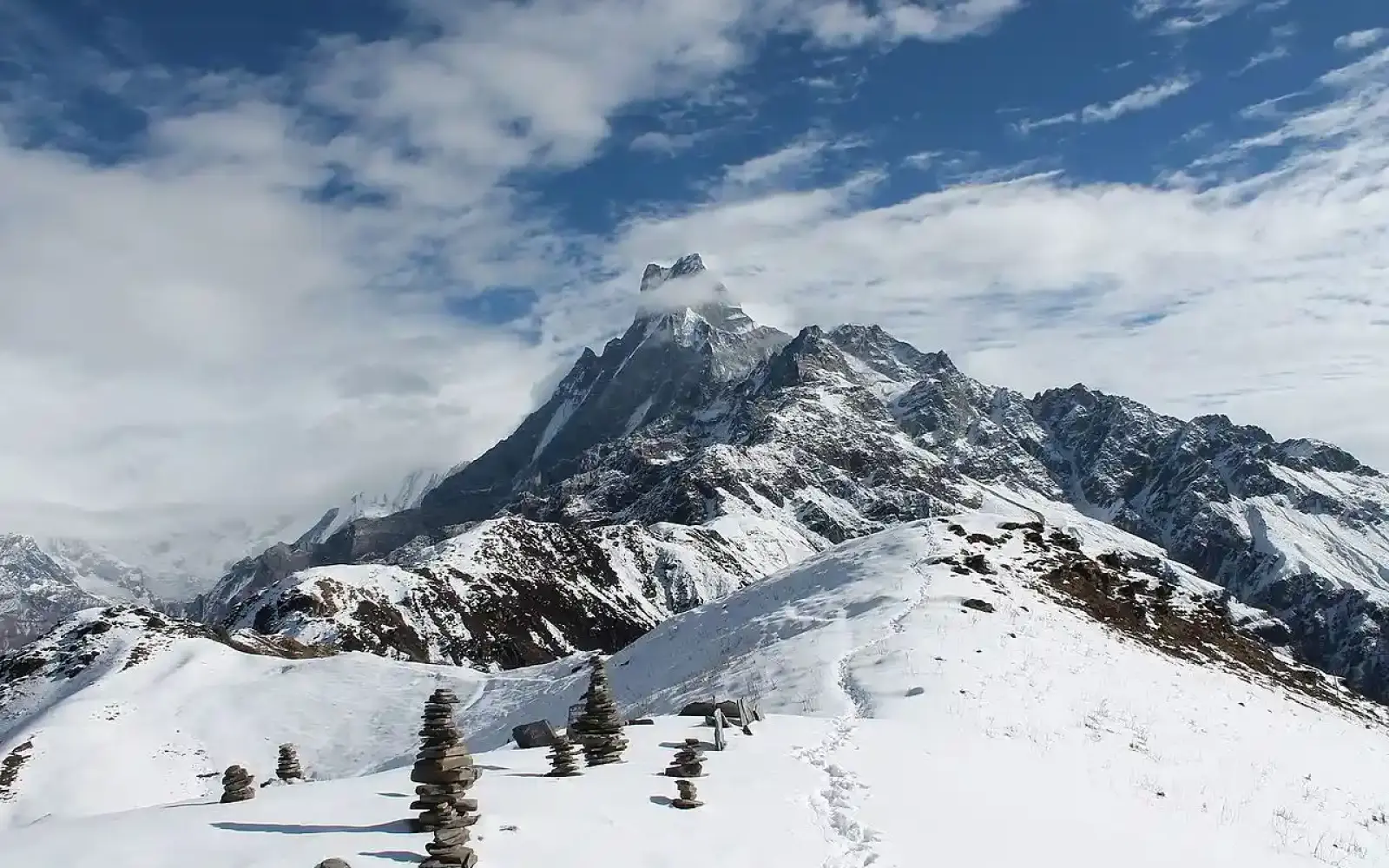
What you'll typically see from the route: Machhapuchhre (6,993 m) at extraordinarily close range from High Camp onward, Annapurna South (7,219 m) and Hiunchuli (6,441 m) from Low Camp, Annapurna I through IV lined up to the west from the upper viewpoint, and the summit ridge of Mardi Himal itself (5,587 m) above Base Camp.
The pattern that determines whether you see any of it: mornings are clear, cloud builds mid-morning, and it often clears again for golden hour. This is why the itinerary starts summit day at 04:30 and why your guide will be firm about it. Every hour of delay on Day 4 morning is a worse view.
Two honest caveats. Early October carries a real chance of days where the mountains simply don't appear. And even in perfect conditions, cloud on the upper ridge can roll in within ninety minutes. October gives you the best odds of the year, not certainty.
Does it snow on Mardi Himal in October?
Usually not, and not at the altitudes you'll be walking most of the time.
Below about 3,000 m — Pitam Deurali, Forest Camp, Low Camp — persistent snow in October is not something to plan for.
Above 3,500 m — High Camp and the ridge to Base Camp — snow is possible, mainly late in the month. Early-season snowfall events do happen, and the upper trail can hold icy patches after one.
What it would mean: if a snowfall event hits the upper ridge, the section from High Camp to Base Camp can require microspikes, and the trail becomes considerably more demanding. Our own guidance for this route is that microspikes become standard kit from around mid-November onward, and are worth checking on from late October.
We're not going to tell you there'll be snow in October, and we're not going to tell you there won't be. What we'd suggest: if you're trekking in the last week of October, ask your guide about current conditions before the summit push rather than assuming dry ground, and treat microspikes as a cheap insurance item rather than dead weight.
What are the trails like in October?
Early October: still recovering from the monsoon. The forest sections between Pitam Deurali and Low Camp hold moisture longest — dense canopy, mossy ground, and tree roots that stay slick after rain. Expect mud in the shaded stretches.
Mid October onward: progressively drier and firmer. By the second half of the month the forest trail has usually dried out and the stone steps out of Phedi are grippy rather than greasy.
Throughout the month: the trail itself is well-defined and well-marked from Phedi to Base Camp. The character changes three times — stone steps low down, rooted forest in the middle, open alpine ridge above the treeline — and each demands something different from your legs. The upper ridge is where October conditions can vary most week to week.
Post-monsoon damage. Landslides and trail erosion during the monsoon occasionally require sections to be rerouted, and the road to Phedi and the exit road from Siding are both vulnerable after sustained rain. This is normally resolved by mid-October but it's worth your guide checking current road conditions rather than assuming.
The route in October
Pokhara → Phedi → Pitam Deurali → Low Camp → High Camp → Mardi Himal Base Camp → Low Camp → Siding → Pokhara
This is the Places Nepal 5-day itinerary. Alternative Mardi Himal routes exist — the Kande and Australian Camp start, exits via Landruk or Ghandruk — and they're labelled as alternatives here because the day-by-day below refers to this one.
For October specifically, the useful thing to read off the map is the altitude ladder: you climb from 822 m to 4,500 m in four days, and the weather changes character at roughly 3,000 m. This map shows the recorded route. It does not tell you current trail or weather conditions — check both close to departure.
Full route detail is in our Mardi Himal Trek map guide.
Mardi Himal Trek in October: day-by-day
Day 1 — Pokhara → Phedi → Pitam Deurali (1,925 m)
How it feels: warm and humid, and the hardest hour of the trek for heat rather than altitude. The climb out of Phedi at 1,130 m starts on stone steps immediately, and in October midday sun that's genuinely sweaty work. Aim to be walking by 08:00 so you've made the height before the sun is overhead.
Trail: in early October the lower path can still be damp; from mid-month it's dry and firm.
Wear: light trekking clothes, sun hat, sunglasses, sunscreen. Your warm layers stay in the pack all day. Have a shell accessible in the first ten days of the month.
Afternoon rain: a real possibility in early October, less so later. Cloud typically builds from mid-morning regardless.
Evening: cool enough at Pitam Deurali for a fleece after dark, but nothing severe.
Day 2 — Pitam Deurali → Forest Camp → Low Camp (2,985 m)
Forest conditions: the dense rhododendron and oak canopy holds moisture longer than anywhere else on the route. In early October expect mud, wet roots and a damp, cool feel even on a clear day. By late October the same stretch is dry underfoot and noticeably crisper.
Views: limited through the trees for most of the day, which surprises people. The reward comes at Low Camp, where you break out onto open ridge and the Annapurnas appear.
Temperature shift: this is the day the trek changes climate. You start in mild forest and finish somewhere that will approach freezing overnight. Have your fleece and shell accessible before Low Camp — the ridge wind at the top of this climb catches people out.
Timing: longest walking day of the trek at around six hours. Start early; you don't want to be finishing in cloud.
Day 3 — Low Camp → High Camp (3,550 m)
The transition day. The forest lets go about an hour above Low Camp and you step onto open ridge at Badal Danda — "cloud hill," which on most October afternoons is exactly what it is: a sea of white filling the valley below with Machhapuchhre floating above it.
Wind and exposure: with no tree cover, wind becomes a factor for the first time. October wind on this ridge isn't extreme, but it turns a comfortable temperature into an uncomfortable one quickly.
Sun exposure: clear October skies at 3,500 m mean serious UV. Apply sunscreen before you leave Low Camp, not when you notice you're burning.
Layering matters today more than any other: you may be in a base layer climbing in sun at 10:00 and in an insulated jacket standing still at 15:00. Layers you can add and remove without stopping to unpack.
Arriving: High Camp at 3,550 m is the highest you sleep. Nights here sit around freezing in October and colder as the month goes on. A sleeping bag rated to −10 °C is the right call from October onward, not a precaution.
Day 4 — High Camp → Mardi Himal Base Camp → Low Camp
The day October is made for, and the day October's cold is most obvious.
04:30 start, in the dark, at close to freezing. This is the coldest you'll be all trek. Frost on the ground is normal. You're climbing an exposed ridge into whatever wind exists, before sunrise, and the layers you wore comfortably yesterday afternoon won't be enough. Warm hat, insulated gloves, and an insulated jacket you can walk in — plus a headlamp with fresh batteries and a spare set.
Why the early start is non-negotiable in October: clear mornings are the month's gift, and cloud typically builds from around 10:00. Reaching the Upper Viewpoint at 4,200 m for sunrise, and Base Camp at 4,500 m by around 08:00, is what buys you the view. Leave late and you may climb 950 m into cloud.
Ice and snow: possible on the upper section from late October after any snowfall event. Ask your guide or teahouse host about current conditions the night before rather than finding out at 05:30.
Visibility on summit morning is normally excellent in October — this is the single best month of the year for this specific view. Machhapuchhre at close range, Annapurna I to IV lined up west, Hiunchuli's west face from Base Camp.
Monitor the weather, not the plan. October is stable but not immune. If cloud, wind or fresh snow makes the upper ridge a bad proposition, turning around at the Upper Viewpoint — or below it — is the right call. The 4,200 m viewpoint offers nearly the same panorama for meaningfully less exposure.
Then the descent: 1,515 m down to Low Camp in the afternoon. In dry late-October conditions this is hard on the knees. After early-October rain it's hard on the knees and slippery. Poles from the top.
Day 5 — Low Camp → Siding Village → Pokhara
Temperature reverses. You drop 1,285 m to Siding at 1,700 m and the air warms noticeably with every hundred metres. What felt cold at breakfast is too warm by mid-morning — start in layers you can shed.
Trail: generally good by October, through progressively greener, warmer country. Tired legs plus loose gravel is the standard late-trek hazard, so keep the poles out.
Transfer: roughly 1.5 hours by road from Siding to Pokhara. The Siding road is one of the sections most affected by monsoon damage, so in early October it's worth your operator confirming it's clear. By late October it's normally in its best condition of the year.
What to wear on Mardi Himal in October
The design brief is a single day that spans more than 20 °C. A layering system solves it; one warm coat does not.
Lower elevations (Phedi to Pitam Deurali): light trekking trousers, a moisture-wicking short or long-sleeve top, sun hat, sunglasses, sunscreen. A shell in the daypack.
Mid elevations (Forest Camp to Low Camp): add a long-sleeve base layer and a fleece for evenings. Warm hat once the sun drops.
High Camp: insulated down jacket, fleece or softshell mid-layer, thermal base layers, windproof shell, warm hat, gloves. Nights are at or below freezing.
Base Camp morning: everything you own, put on before you leave the teahouse. Thermal base layers, fleece, down jacket, windproof shell, warm hat, insulated gloves, buff or neck gaiter. It's the coldest ninety minutes of the trek and you're walking, so you want layers that work while moving.
October packing essentials
- Broken-in waterproof trekking boots with ankle support
- Moisture-wicking base layers, 2–3 sets
- Fleece or softshell mid-layer
- Insulated down jacket
- Waterproof jacket and trousers — this trail sees real rain
- Sleeping bag rated to −5 to −10 °C
- Warm hat and sun hat
- Light gloves for daytime, insulated gloves for summit morning
- Buff or neck gaiter
- Sunglasses with UV protection and SPF 50 sunscreen
- Headlamp with spare batteries
- Trekking poles
- Water bottles or bladder, 2–3 L, plus purification
- Power bank
- Personal medication and blister kit
- Microspikes if trekking the last week of October — worth asking about conditions first
The complete list by category is on the Mardi Himal Trek page.
Is Mardi Himal crowded in October?
Yes. October is peak trekking season in Nepal and Mardi Himal is no longer the secret it was when teahouse trekking opened here in 2012.
What that actually looks like on this route: Forest Camp and High Camp fill up, particularly at weekends. Group departures run frequently. Popular viewpoints have people on them at sunrise. Teahouse capacity, not trail width, is the binding constraint.
The honest comparison: Mardi Himal still carries a fraction of the foot traffic of Annapurna Base Camp or the Everest Base Camp trail, and long sections of the ridge remain genuinely quiet even in October. But "quieter than the busiest treks in Nepal in the busiest month of the year" is a relative claim, and if solitude is your priority, October is the wrong month for it. Late October eases slightly as the month closes.
High Camp is the pressure point. Very few lodges, no booking system, and it fills. Trekkers walking with a guide get beds because their guide calls ahead from Low Camp. Independent trekkers arriving late in peak October are the ones who end up on a dining-room floor.
What crowds get you: company on the trail, a lively dining room, other people to compare notes with about how the altitude is treating you, and — for solo travellers — the easiest month of the year to not feel alone. It's not purely a downside.
We're not going to quote visitor numbers we can't verify. What we can tell you is that our own October departures fill earlier than any other month's.
Do you need to book Mardi Himal in advance for October?
For October specifically, yes — and this is one of the few months where it genuinely matters rather than being a booking-page nudge.
Why:
- Teahouse capacity at High Camp is the real constraint, and it's managed by guides phoning ahead, not by an online system.
- Guides and porters are in highest demand across the whole Nepal trekking industry in October.
- Transport — the Kathmandu–Pokhara flights and buses are busiest in October, and Dashain adds domestic travel pressure in the middle of the month.
- Group departures on fixed dates fill earlier for October than for any other month.
What we'd suggest practically: if you're set on October dates, book several weeks out rather than arriving in Pokhara and looking for something. If your dates are flexible, the last week of October is usually easier to secure than mid-month, and comes with the year's best air clarity as a bonus.
Our Mardi Himal group departures run on fixed dates through the autumn season and are marked as guaranteed to run, which matters when you're booking flights around them.
How much does the Mardi Himal Trek cost in October?
The package price does not change in October. Our Mardi Himal rates are the same year-round:
| How you book | Price per person |
|---|
| Solo private trek | US$470 |
| Private trek, 2–5 people | US$360 |
| Private trek, 6–10 people | US$340 |
| Private trek, 11–15 people | US$300 |
| Joining a fixed group departure | US$360 |
Included: government-licensed English-speaking guide, ACAP and TIMS permits and government fees, teahouse accommodation, all meals on the trek, private transfer Pokhara to Phedi and shared jeep from Siding back to Pokhara, and all guide and porter expenses.
Not included: travel insurance covering trekking to 4,500 m and helicopter evacuation, porter service (US$130 for the trek, one porter shared between two trekkers, 20 kg), the Nepal visa, hotels and meals in Kathmandu or Pokhara, and personal spending on the trail.
Government permit fees don't change seasonally either. ACAP is NPR 3,000 for foreign nationals and NPR 1,000 for SAARC nationals, flat year-round. The TIMS card is NPR 2,000 and NPR 1,000 respectively.
Where October does cost more: flights into Nepal, hotels in Kathmandu and Pokhara, and domestic flights to Pokhara all price up in peak season, and availability tightens. Those sit outside the trek package but inside your trip budget, and they're the reason an October trip costs more overall than the same trek in September even at an identical package price.
Full breakdown in our Mardi Himal Trek cost guide.
Is Mardi Himal harder in October?
The trek's difficulty rating doesn't change with the season — the altitude, the 3,700 m of cumulative climbing, and the 1,515 m Day 4 descent are the same in every month. What October changes is the conditions those numbers are attempted in.
What October makes easier:
- Visibility. Clear mornings mean you can see where you're going and where you've been, which reduces fatigue in a way that's hard to quantify but real.
- Dry trail from mid-month. The forest sections and the Day 4 descent are meaningfully safer dry than wet.
- Predictable weather for the summit-day decision. Fewer judgement calls.
- Company. More people on the trail means more support if something goes wrong.
What October makes harder:
- Cold on summit morning. A 04:30 start at close to freezing is a physical demand that September doesn't make.
- Early-month mud on the forest trail.
- Crowds at High Camp, which can mean a worse night's sleep before the hardest day.
- Possible snow or ice on the upper ridge late in the month.
Net: October is the easiest month to trek Mardi Himal well, and the cold on Day 4 morning is the one thing it makes genuinely harder. The full difficulty breakdown, day by day, is in our Mardi Himal Trek difficulty guide.
Is October good for beginners on Mardi Himal?
It's the best month for a first Himalayan trek on this route, with the usual caveat that "best month" doesn't make a hard trek easy.
What October gives a first-timer: the year's clearest views, which matters when you're doing something difficult for the first time and want it to be worth it; dry, predictable trail conditions; a busy trail with other trekkers around; and full teahouses with staff and food at every stop.
What October doesn't change: the altitude is still 4,500 m at Base Camp and 3,550 m at High Camp. Day 4 is still 950 m up and 1,515 m down in 7–8 hours. Fitness still matters more than experience, and the cold pre-dawn start is a specific demand a lot of beginners haven't trained for.
If you're a beginner picking October dates: mid-to-late October, and avoid the first week, where the visibility risk is highest and mud on the forest sections adds difficulty you don't need. See our Mardi Himal Trek for beginners guide for whether the trek suits you at all.
Is October good for solo trekkers?
Yes — it's the easiest month of the year to trek this route alone.
What helps: more trekkers on the trail means company, easier navigation, and people around if something goes wrong. Teahouses are fully staffed and open. Weather is predictable enough that the turn-around decisions are less frequent. And group departures run most often in October, which for a solo traveller is both the cheapest legal option and the most sociable.
What doesn't: accommodation demand is at its peak, and High Camp beds are the constraint. Being around other trekkers reduces risk; it doesn't eliminate it — they're strangers with their own schedule, not a rescue service. Altitude, cold, and the Day 4 descent are unchanged by how many people are on the ridge.
And the rules are the same in October as any month: foreign nationals need a licensed guide from a registered agency throughout the Annapurna Conservation Area. Full detail in Mardi Himal Trek solo.
Is October good for family trekking?
It depends far more on who's in the family than on the month, but October is the right month if you're going to do it.
In October's favour: stable weather, dry trail, warm days at lower elevations, and full teahouses.
Worth weighing honestly: the 7–8 hour Day 4 is a long day for a child or a less mobile family member, and it starts at 04:30 in near-freezing temperatures. High Camp nights are cold. The steep sections demand footing confidence. And in peak October, teahouse space for a family group needs booking well ahead.
A practical alternative: a longer, gentler version of this itinerary spreads the same altitude gain over more days with shorter walks, which suits families considerably better than the compressed 5-day route. Options are in our Mardi Himal itinerary comparison.
How to check Mardi Himal weather before you go
Four different things get called "the forecast," and they're useful at different distances from your trek.
Long-range seasonal expectations (months out). This is what the temperature table above is — historical patterns, not prediction. Useful for packing and for choosing a month. Useless for knowing what any specific day will do.
Extended forecasts (7–14 days out). Broad direction only — whether a system is moving in. Treat the detail as noise at this range.
Short-term mountain forecasts (1–3 days out). The most useful window, and worth checking daily once you're in Pokhara. Look for forecasts that model by altitude rather than giving a single number for a region.
Actual local conditions. The best source on this trek, and it's free: teahouse hosts at Low Camp and High Camp know what the ridge has been doing for the past week, and your guide will be asking them. This beats any app for the summit-morning decision.
One caution on all of it: no forecast is reliable at 3,500–4,500 m on an exposed ridge. Mountain weather at that altitude changes faster than forecast models resolve. Use forecasts to plan and local knowledge to decide.
What if the weather turns in October?
October is stable, not immune. If a system moves in, here's how a competent trek responds.
Heavy rain: delay the start, shorten the day, or hold at a lower camp. Wet rooted forest and a wet 1,515 m descent are the two things worth waiting out.
Snow on the upper ridge: check conditions before the summit push. Microspikes if there's ice. If the upper section isn't safe, the Upper Viewpoint at 4,200 m is the sensible turn-around, and it's a legitimate finish rather than a failure.
Fog and poor visibility: the most common October weather problem and the one that most affects summit morning. Cloud on this ridge often lifts — a guide who has walked it hundreds of times knows the difference between passing cloud and a day that isn't going to clear.
Strong wind above 3,500 m: the underrated hazard. Wind turns a manageable temperature dangerous quickly on exposed ground. It's a reason to turn back that trekkers routinely underestimate.
What we won't promise: that the itinerary runs exactly as published regardless of weather. It shouldn't. A published itinerary is a plan, and on a trek that reaches 4,500 m the plan yields to conditions. If your operator won't tell you that before you book, that's worth noticing.
October vs September vs November
| September | October | November |
|---|
| Conditions | Monsoon retreating through the month. Early September wet; the last two weeks clear progressively. Greenest of the three | Clearest air of the year. Low rainfall from mid-month. The benchmark | Dry and stable, cold and getting colder. Very good visibility |
| Crowds | Quietest of the three, especially the first three weeks | Peak. Busiest month of the year | Busy early, easing considerably by late November |
| Temperatures | Warmest. Mild nights even at altitude | Comfortable low down, freezing overnight at High Camp | Coldest. High Camp nights at −5 °C or below, dropping through the month |
| Suitability | Good value if you accept a visibility gamble and want a quieter trail. Late September is a genuine sweet spot | The default recommendation. Best odds on views, worst odds on solitude | Excellent if you're equipped for cold. Snow above 3,500 m becomes likely from late November, and microspikes become standard kit |
The short version: late September for quiet, October for certainty, November for cold clarity and thinning crowds. If your priority is seeing the mountains, October. If it's having the ridge to yourself, September or late November.
October vs spring
Spring — March, April and May — is the other main trekking season, and it's a genuinely different experience rather than a lesser one.
Visibility: October wins clearly. Spring carries pre-monsoon haze that softens distant peaks, and it builds through the season. March is the clearest spring month; by May the Himalayas are visible but lack October's definition.
Rhododendrons: spring wins outright. The forest between Pitam Deurali and Low Camp comes into full bloom from mid-March through April — crimson, pink and white — and it's one of the genuinely spectacular things on this route. October's forest is green early and amber late, which is lovely but not the same event.
Temperatures: broadly similar at altitude. Spring days at lower elevations run warmer.
Crowds: spring is busy but October is busier.
Trail: both are good. Spring can hold lingering snow above 3,500 m into early March; October can hold monsoon mud into the first week.
Choose October if you want the sharpest possible views and the most reliable weather. Choose late March or April if you want the rhododendrons and slightly fewer people, and you'll accept softer distant visibility.
October pros and cons
Pros
- The clearest mountain visibility of the year — the single best month for the view this trek exists for
- Low rainfall from mid-month, and far less than September
- Stable high pressure and predictable clear mornings
- Dry, firm trail conditions from mid-month
- Comfortable daytime temperatures at lower elevations
- Full teahouses, fully staffed, everything open
- The most group departures of any month, which matters for solo travellers
- Amber and copper in the lower forest late in the month
Cons
- Peak crowds — the busiest month of the year on this trail
- High Camp beds are genuinely constrained
- Cold pre-dawn start on Day 4, at or below freezing
- Early October can still be monsoon, with real visibility risk
- Possible snow or ice on the upper ridge late in the month
- Flights, hotels and transport all price up and tighten in peak season
- Dashain in mid-month affects domestic transport and staffing
October decision table
| What matters to you | October verdict |
|---|
| Clear mountain views | ★ Best month of the year. This is October's whole case |
| Warm weather | Warm low down, freezing at High Camp overnight. September is warmer |
| Low rain | Very good from mid-month. Early October carries real risk |
| Quiet trails | ✗ Worst month for this. Try late September or late November |
| Beginner-friendly conditions | ★ Best month, provided you avoid the first week |
| Snow | Unlikely below 3,500 m. Possible on the upper ridge late in the month |
| Lower prices | Trek package is the same year-round. Flights and hotels are at their most expensive |
| Accommodation availability | ✗ Tightest of the year. Book ahead, especially for High Camp |
Permits in October
Nothing changes seasonally. You need an ACAP permit (NPR 3,000 foreign nationals, NPR 1,000 SAARC) and a TIMS card (NPR 2,000 / NPR 1,000), and foreign trekkers need a licensed guide from a registered agency. Both permits are included in our package along with the government fees — send a passport copy and your dates.
The one October-specific note: permit counters in Kathmandu and Pokhara get busy in peak season, so if you're arranging your own ACAP, use NTNC's online portal before you fly or allow extra time at the counter. Full detail in our Mardi Himal Trek permits guide.
Trekking Mardi Himal this October?
October dates fill earlier than any other month, and High Camp beds are the constraint rather than trail space. If your dates are set, book with enough lead time that your guide can hold accommodation ahead of you.
Planning Mardi Himal this October? Check the current Places Nepal itinerary, inclusions and available October departures before booking your dates.
If you're still choosing between months, tell us what matters most — views, quiet, or budget — and we'll tell you honestly which window fits, including when the answer is late September rather than October.
Mardi Himal Trek in October: FAQs
Is October a good time to trek Mardi Himal? Yes — it's the strongest month, with the year's clearest visibility, low rainfall from mid-month, and stable weather. The trade-offs are peak crowds and cold pre-dawn temperatures on summit day.
What is the weather like on Mardi Himal in October? Warm and humid at Pokhara and the lower trail, cool at Low Camp, and around or below freezing overnight at High Camp (3,550 m). Days are typically clear in the morning with cloud building from mid-morning.
Does it rain on Mardi Himal in October? Sometimes, mostly in the first week or two. Rainfall across Nepal's mid-hills drops to roughly a quarter of September's levels in October, with rain days falling from around sixteen to around five. Carry a shell regardless.
Is October the best month for Mardi Himal? For mountain visibility and weather reliability, yes. For solitude or budget, late September or late November are better choices.
Is early October good for Mardi Himal? It's the weakest part of the month. The monsoon's normal withdrawal date is 2 October, but it has averaged around ten days later since 1997 — so the first week can still be wet, cloudy and muddy underfoot.
Is late October good for Mardi Himal? Very good. The driest, clearest part of the month with the lower forest turning amber. The trade-off is colder nights and a small chance of an early-season snowfall on the upper ridge.
How cold is Mardi Himal in October? Roughly 22–28 °C in Pokhara by day, 10–15 °C at Low Camp, 6–10 °C at High Camp by day and −5 to 0 °C overnight, and around −10 to −5 °C at Base Camp in the pre-dawn hours. Late October runs colder than early October throughout.
Does it snow on Mardi Himal in October? Not usually below 3,500 m. Snow on the upper ridge is possible, mainly late in the month. Ask your guide about current conditions before the summit push if you're trekking the last week.
Are the mountain views clear in October? October has the best air clarity of the year. Mornings are typically clear with cloud building from around 10:00, which is why summit day starts at 04:30.
Is Mardi Himal crowded in October? Yes — it's peak season. Forest Camp and High Camp fill up, especially at weekends. The trail is still quieter than Annapurna Base Camp or Everest, but October is the wrong month if solitude is your priority.
Do I need to book Mardi Himal in advance in October? Yes. Teahouse capacity at High Camp, guide availability, and transport are all under pressure in October, and Dashain adds to it mid-month. Book several weeks out rather than arriving and looking.
What should I pack for Mardi Himal in October? A full layering system for a 20 °C-plus daily range, a sleeping bag rated to −5 to −10 °C, waterproofs, insulated gloves and a warm hat for summit morning, and a headlamp with spares. Microspikes are worth considering for the last week of the month.
Is Mardi Himal suitable for beginners in October? It's the best month for a first Himalayan trek on this route. October doesn't change the altitude, the Day 4 demand, or the need to train — but it gives beginners the most favourable conditions available.
Is Mardi Himal safe in October? October has the most stable conditions of the year on this route, which reduces weather-related risk. Altitude, the exposed upper ridge and the long Day 4 descent remain the same in every month.
Is October better than November for Mardi Himal? October has clearer air and warmer nights; November has fewer people and still-excellent visibility, at the cost of real cold and a rising chance of snow above 3,500 m late in the month.
Is October better than September for Mardi Himal? October is more reliable for views and drier underfoot. September is quieter, warmer and greener, and late September is a genuine sweet spot if you'll accept some visibility risk.
How difficult is Mardi Himal in October? The difficulty rating is unchanged — October affects conditions, not the route. Dry trail and clear weather make it easier; the cold 04:30 start on Day 4 is the one thing October makes harder.
How much does Mardi Himal cost in October? The package price doesn't change seasonally: US$470 solo private, US$360 for a party of 2–5 or joining a group departure, less for larger groups. International flights and hotels do cost more in peak season.
Can I trek Mardi Himal solo in October? Yes, and October is the easiest month to do it — more trekkers around and the most group departures. Foreign nationals still need a licensed guide from a registered agency, as in every month.
What are the best dates in October for Mardi Himal? Mid October, roughly the 11th to the 22nd, is the most reliable window. The last week is the clearest and coldest. The first week carries the highest chance the monsoon hasn't finished.