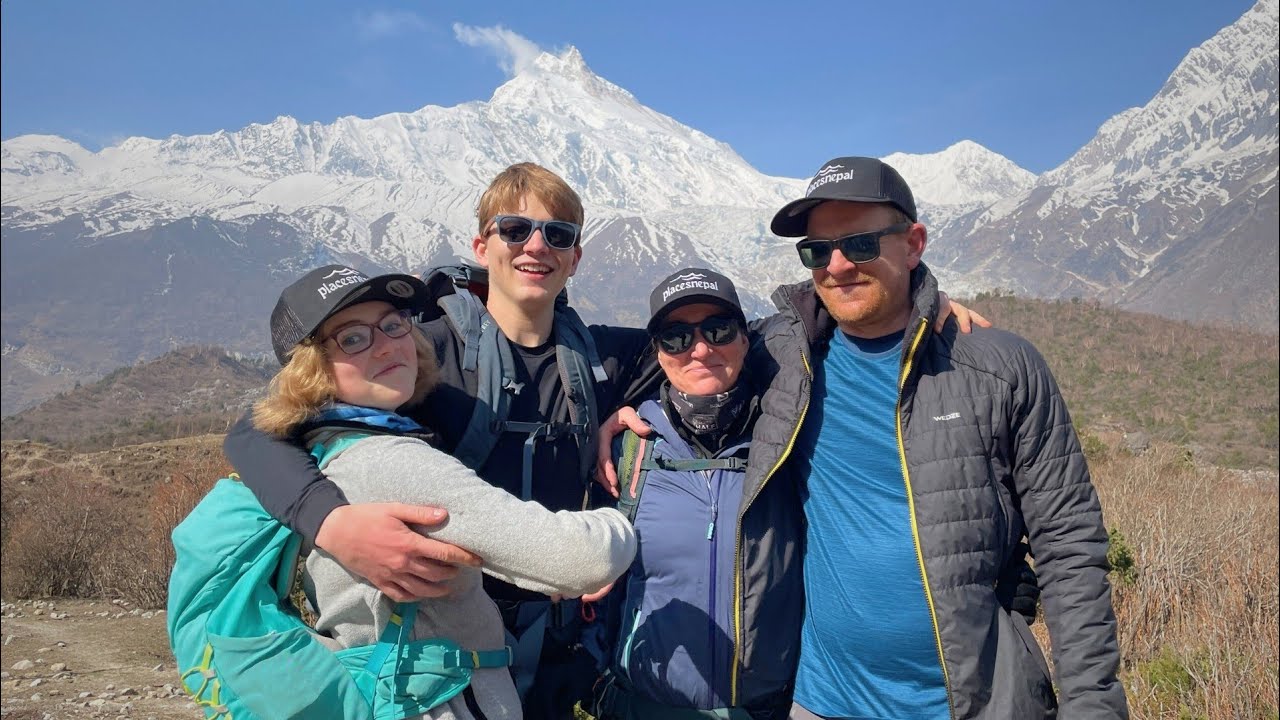
Mardi Himal Trek

Nepal
5 Days
Moderate
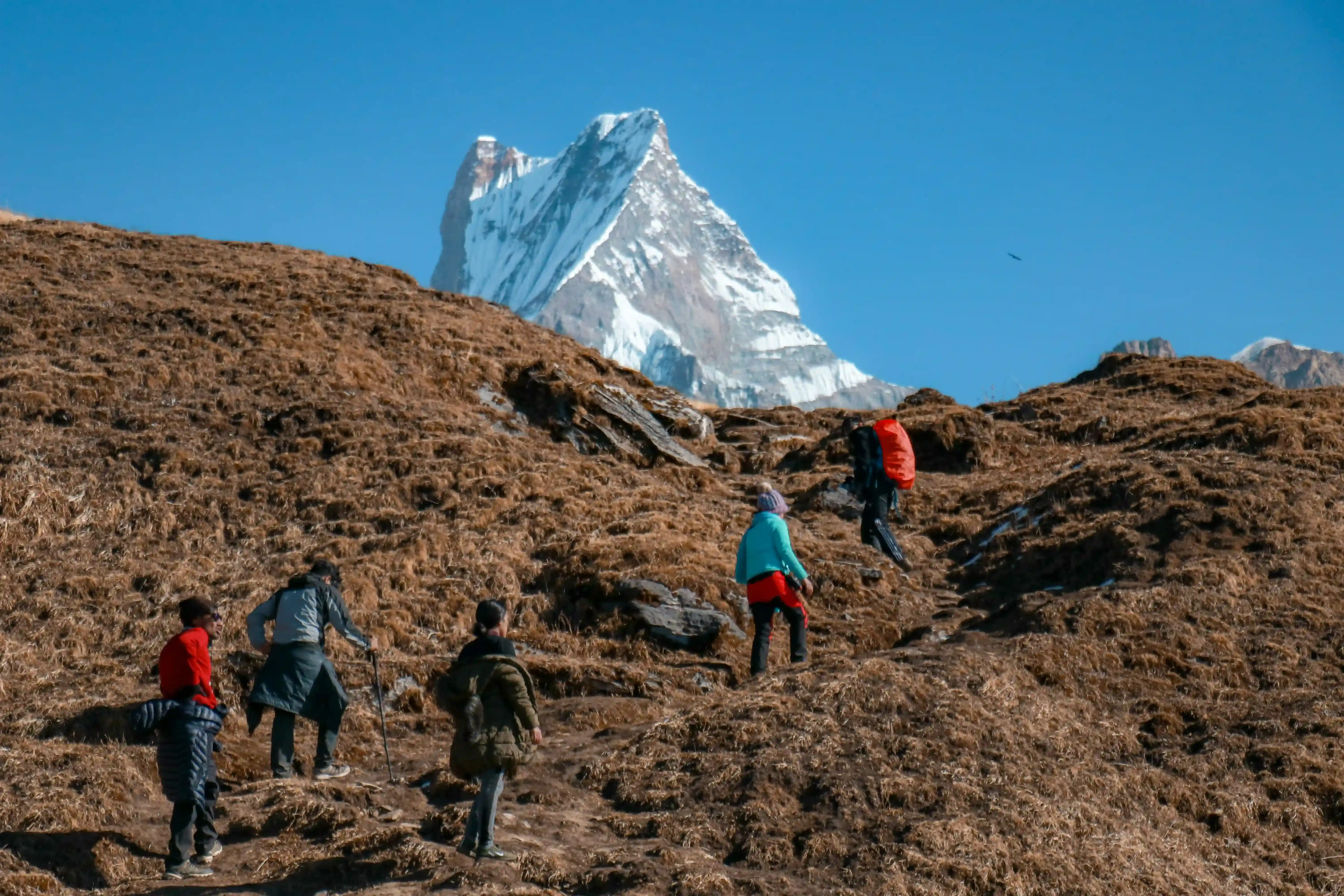
Five days, one ridge, and the closest you'll legally get to Machhapuchhre.
From
US$ 360
No of people Price per person
1 - 1 $470
2 - 5 $360
6 - 10 $340
11 - 15 $300

What's included?

All Foods

Breakfast, Lunch & Dinner during trek

Transportations

Private car from Pokhara to Phedi, and shared jeep from Sidding Village back to Pokhara.

Accommodations

Twin bed sharing during the trek

Guide

Expert English speaking guide

All Permits

All trekking permit fees and necessary documents

What is it really like?

Photos from the Mardi Himal Trek

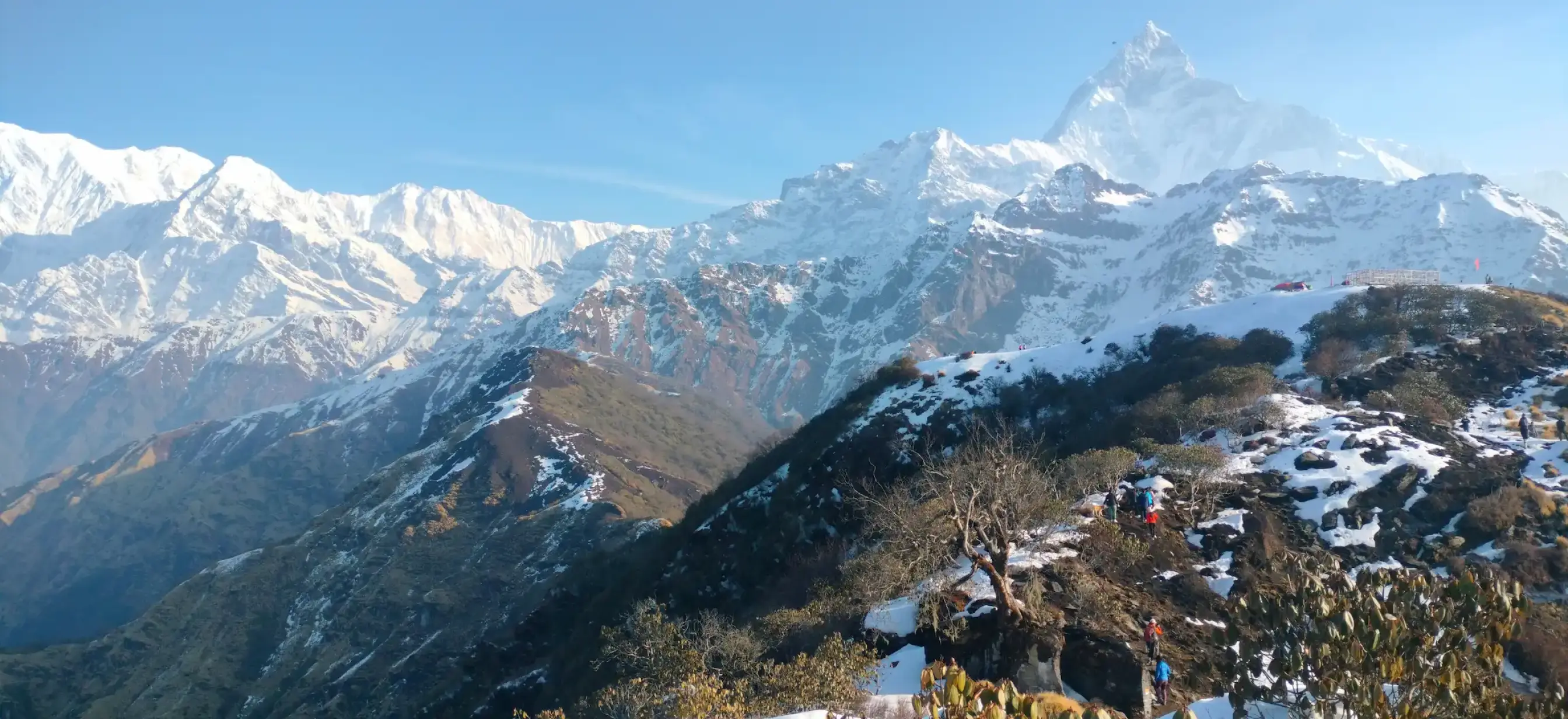
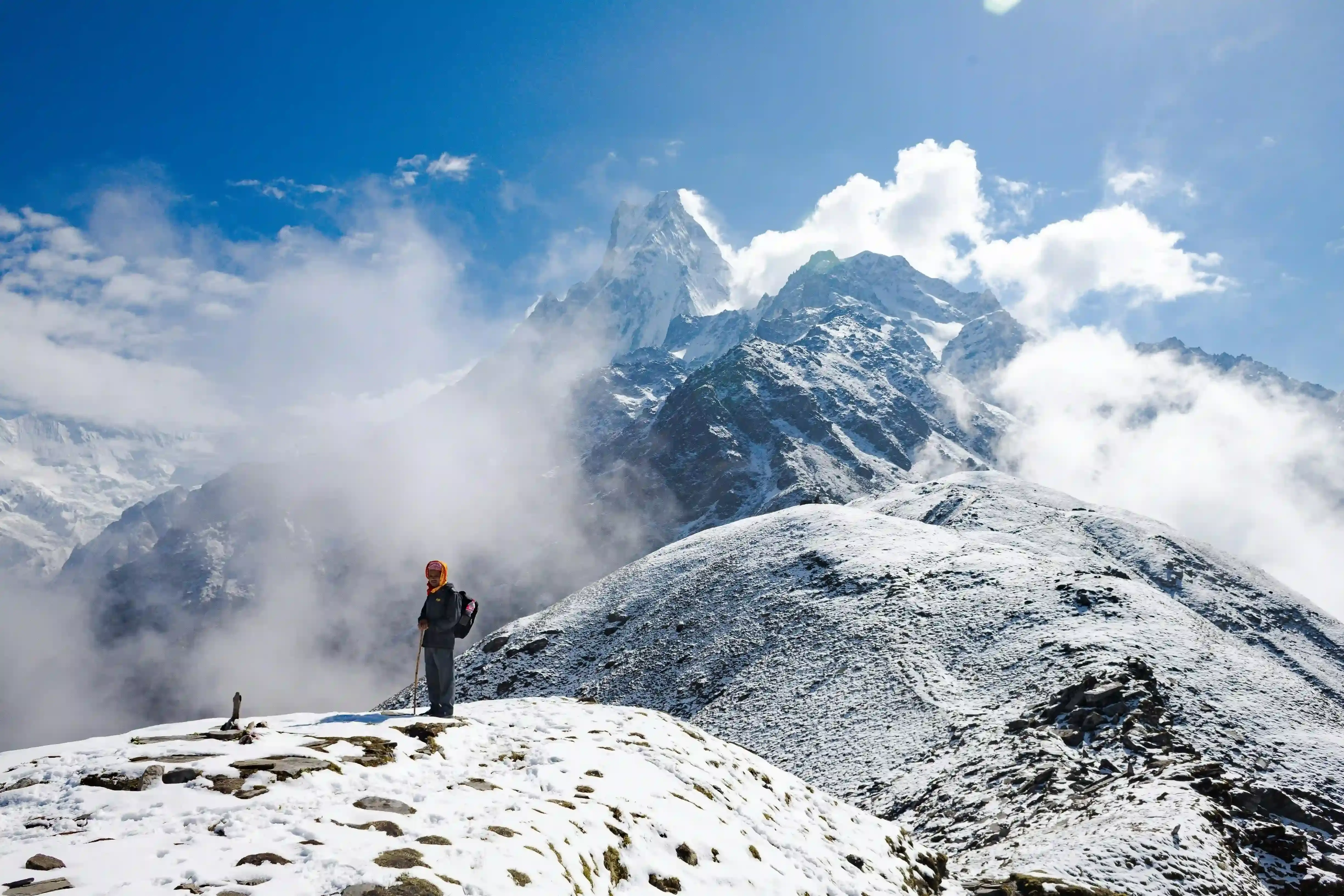
The Mardi Himal Trek is the Annapurna region's quiet overachiever. It only opened for teahouse trekking in 2012, which means the trail still feels like a local secret — narrow ridgeline paths, rhododendron forest that goes on for hours, and then suddenly you're above the clouds staring straight at Fishtail. It's short, it starts an hour from Pokhara, and it tops out at Mardi Himal Base Camp (4,500 m) without needing flights, technical gear, or three weeks of your life. If you've got five days and decent legs, this is probably the best view-per-day ratio in Nepal.

Key Information

Max. altitude

1,925 m / 6,316 ft

Accommodation

Lodge

Meals

Lunch & Dinner Included
Start
827 m
End
1,925 m
Gain
1,098 m
Grade
Moderate
4
Trekking hours
30
Drive from Pokhara (min)
Pokhara
827 m
Phedi
1,130 m
Dhampus
1,650 m
Pitam Deurali
1,925 m
07:00
Pokhara — Lakeside
The journey north begins
After an early breakfast collect your permits (TIMS + ACAP) if not already done, then board a local vehicle or jeep for the short drive to Phedi, the customary trailhead for the Dhampus ascent.
08:00
Phedi (1,130 m)
Stone steps into the hillside
The trail launches uphill almost immediately from Phedi through Gurung farmland and terraced fields. The climb to Dhampus is steady and rewarding — each switchback reveals a wider slice of Pokhara Valley below.
09:30
Dhampus (1,650 m)
A Gurung village with mountain views
Dhampus is one of the most photographed villages in the Annapurna foothills — its neat stone houses and marigold gardens frame a near-perfect view of Machhapuchhre. Stop for tea, then continue northeast along the ridge.
11:30
Pitam Deurali (1,925 m)
Ridge camp, rhododendron forest ahead
Pitam Deurali sits at a wooded saddle where the true Mardi Himal trail begins. Check in early, rest well, and take a short acclimatisation walk along the ridge before dinner. The teahouses here are cosy and the night sky is clear of city light.
First-night tip: Although altitude sickness is unlikely at 1,925 m, the 1,100 m gain from Pokhara in half a day is tiring. Drink 3–4 litres of water, skip alcohol tonight, and get to bed early — tomorrows is a long one.

Trail tips

Drive timing: aim to reach Phedi by 08:00 to complete the climb before midday heat and afternoon cloud.
Cash up: ATMs end at Pokhara. Bring sufficient Nepali rupees for the entire trek.

Max. altitude

2,985 m / 9,793 ft

Accommodation

Teahouse

Meals

Breakfast, Lunch & Dinner Included
Trekking hours
5 hrs
Distance (km)
10 km
Pitam Deurali
1,925 m
Forest Camp
2,550 m
Low Camp
2,985 m
07:00
Pitam Deurali (1,925 m)
Into the rhododendron forest
The longest trekking day on this itinerary. Start early and pace yourself from the outset. The trail heads north into dense forest, the canopy filtering the morning light into long diagonal shafts. Tree roots crisscross the path — trekking poles help considerably.
10:00
Forest Camp (2,550 m)
Halfway rest in the trees
A natural midpoint with a few teahouses tucked into the forest. Stop for lunch or a hot drink — this is the last reliable food stop before Low Camp. The air noticeably cools here and the forest thickens with oak, bamboo, and mossy boulders.
13:30
Low Camp (2,985 m)
First open views of the Annapurna range
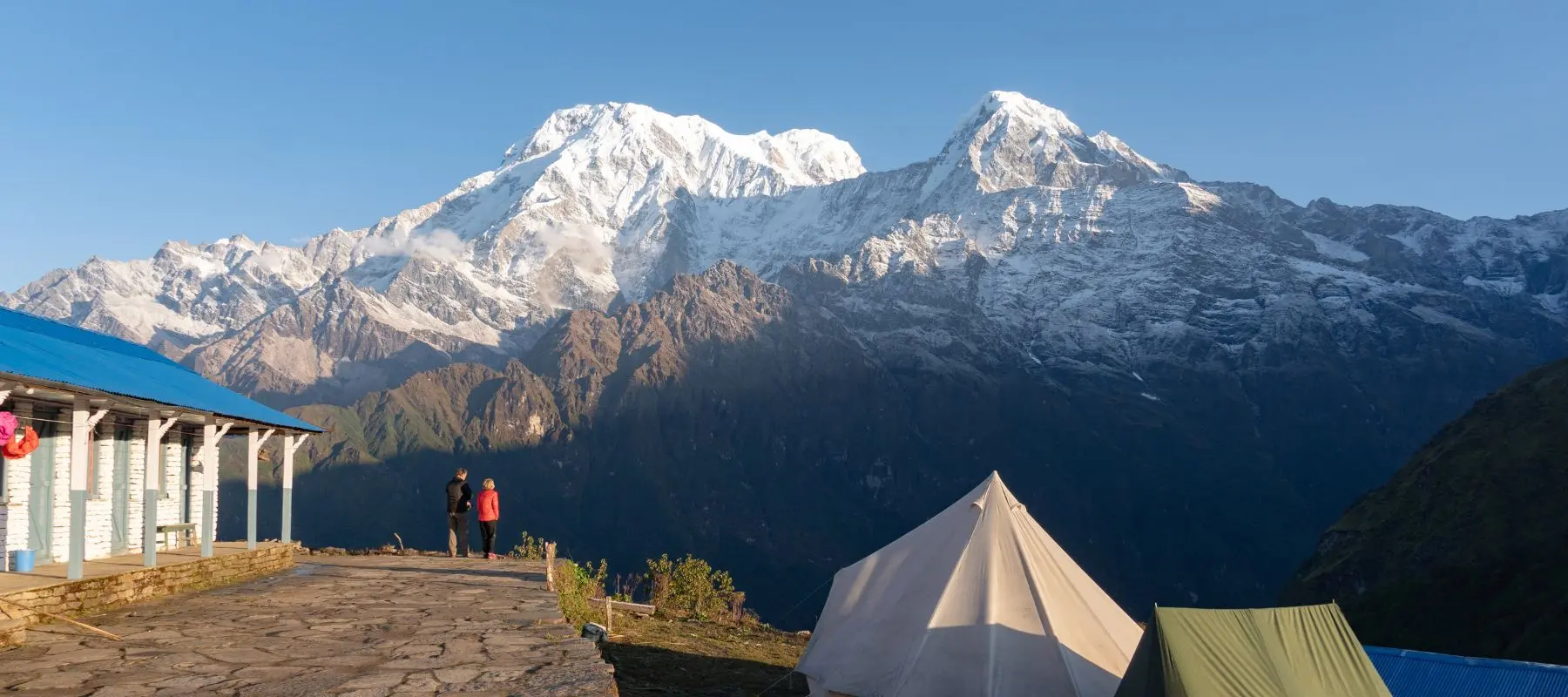
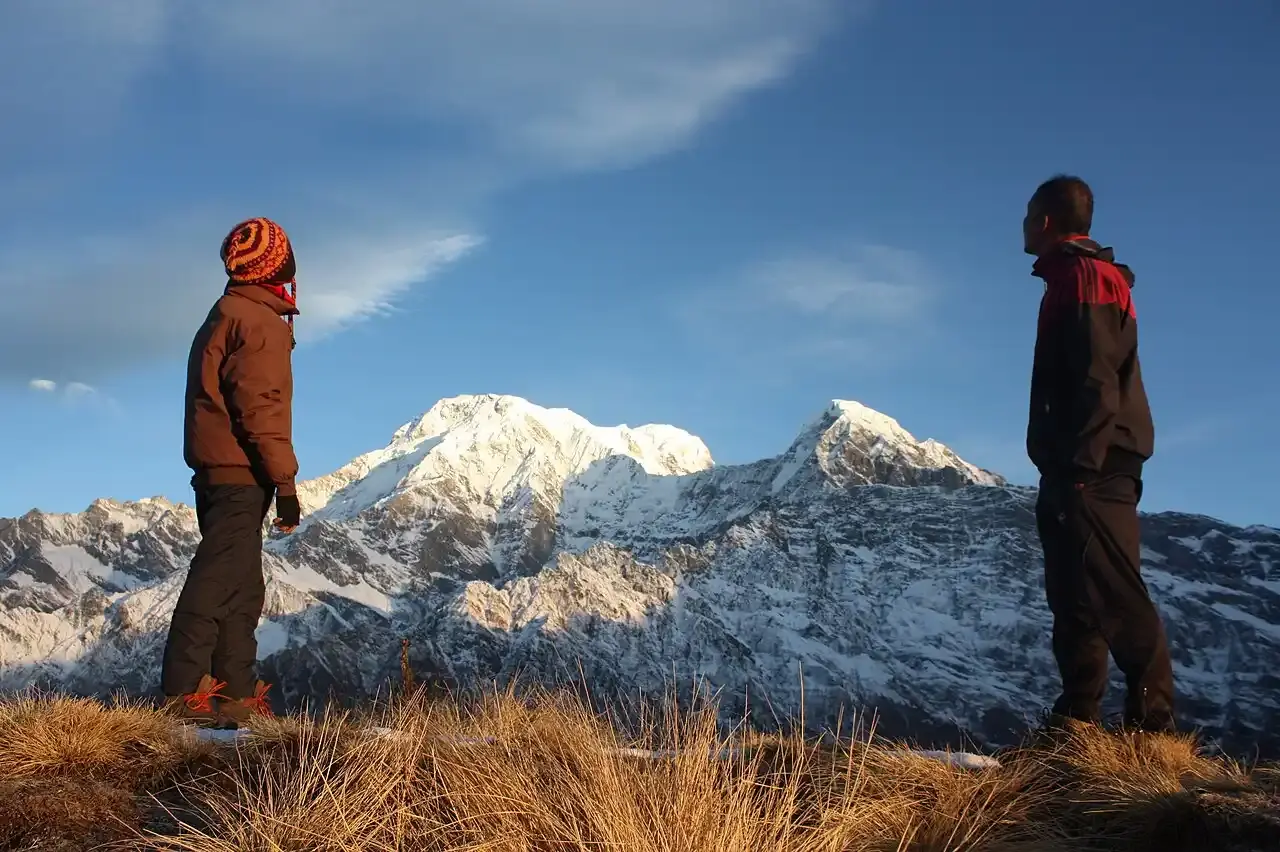
Low Camp emerges above the treeline onto an open ridge — and the views open up dramatically. Annapurna South, Hiunchuli, and the distinctive spire of Machhapuchhre fill the northern skyline. Arrive by early afternoon, rest, rehydrate, and let your body adjust to the elevation.
Hydration note: At nearly 3,000 m the air is significantly drier. Drink consistently throughout the day, not just when thirsty. Aim for 4+ litres by the time you reach camp.
Trail tips
Eat a full lunch at Forest Camp: the climb above 2,550 m is relentless and appetite diminishes at altitude — fuel up while you still feel like eating.
Layer up at Low Camp: the wind on the open ridge can be biting even in October. Have your fleece accessible, not buried in your pack.

Max. altitude

3,550 m / 11,647 ft

Accommodation

Teahouse

Meals

Breakfast, Lunch & Dinner Included
Trekking hours
6 hrs
Distance (km)
8 km

Low Camp
2,985 m
Middle Camp
3,150 m
High Camp
3,550 m
07:30
Low Camp (2,985 m)
A shorter day — use it wisely
Today's ascent is the shortest on the trek, which is deliberate — arriving at High Camp with energy to spare is far better than crawling in exhausted before tomorrow's long summit push. A relaxed start allows for a proper breakfast and time to appreciate the ridge views.
09:00
Middle Camp (3,150 m)
Above the last trees
The trail traverses an increasingly open ridge above the alpine scrubline. Middle Camp is a brief rest stop where the panorama begins in earnest — look back south for a sweeping view of Pokhara Valley, still visible on clear days.
11:30
High Camp (3,550 m)
Machhapuchhre fills the sky
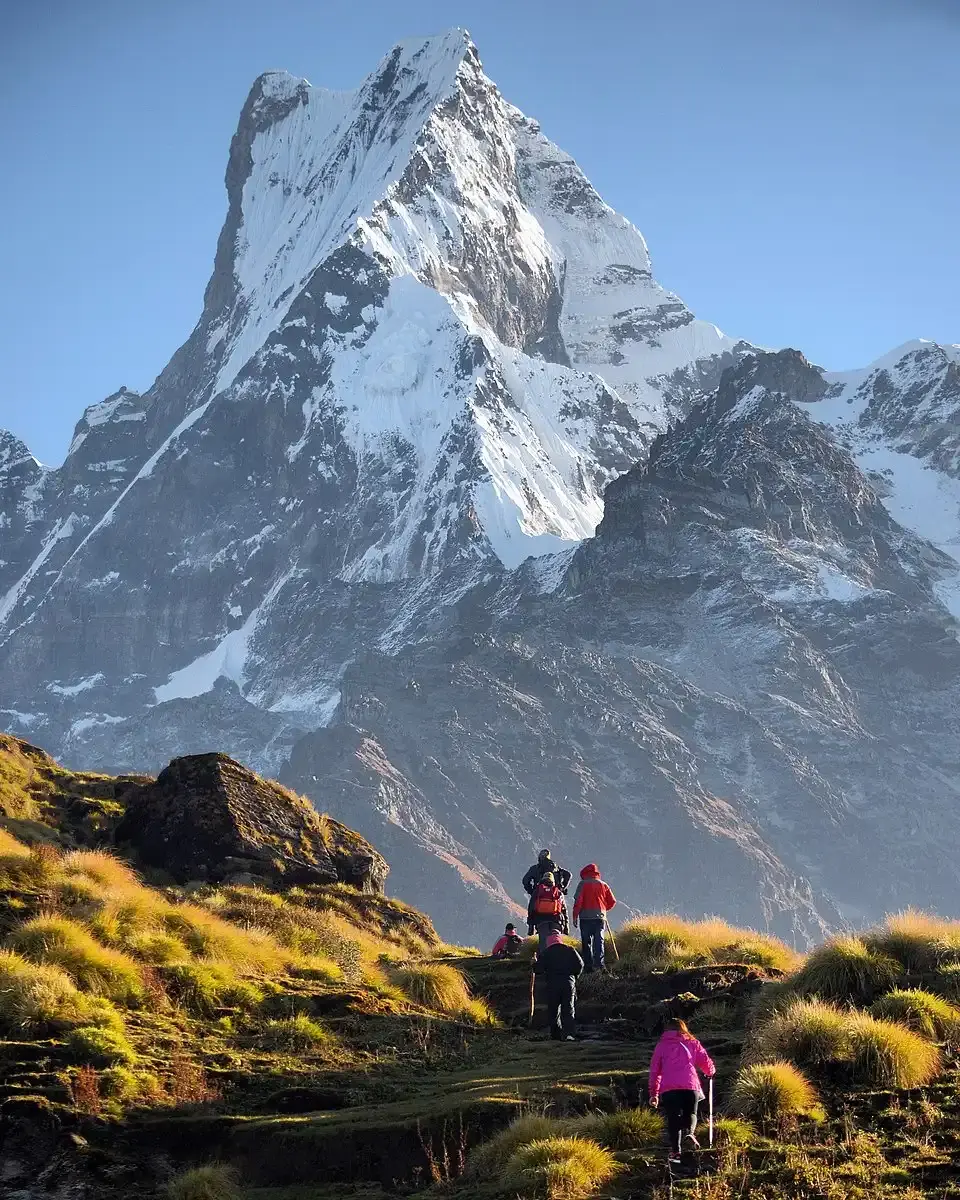
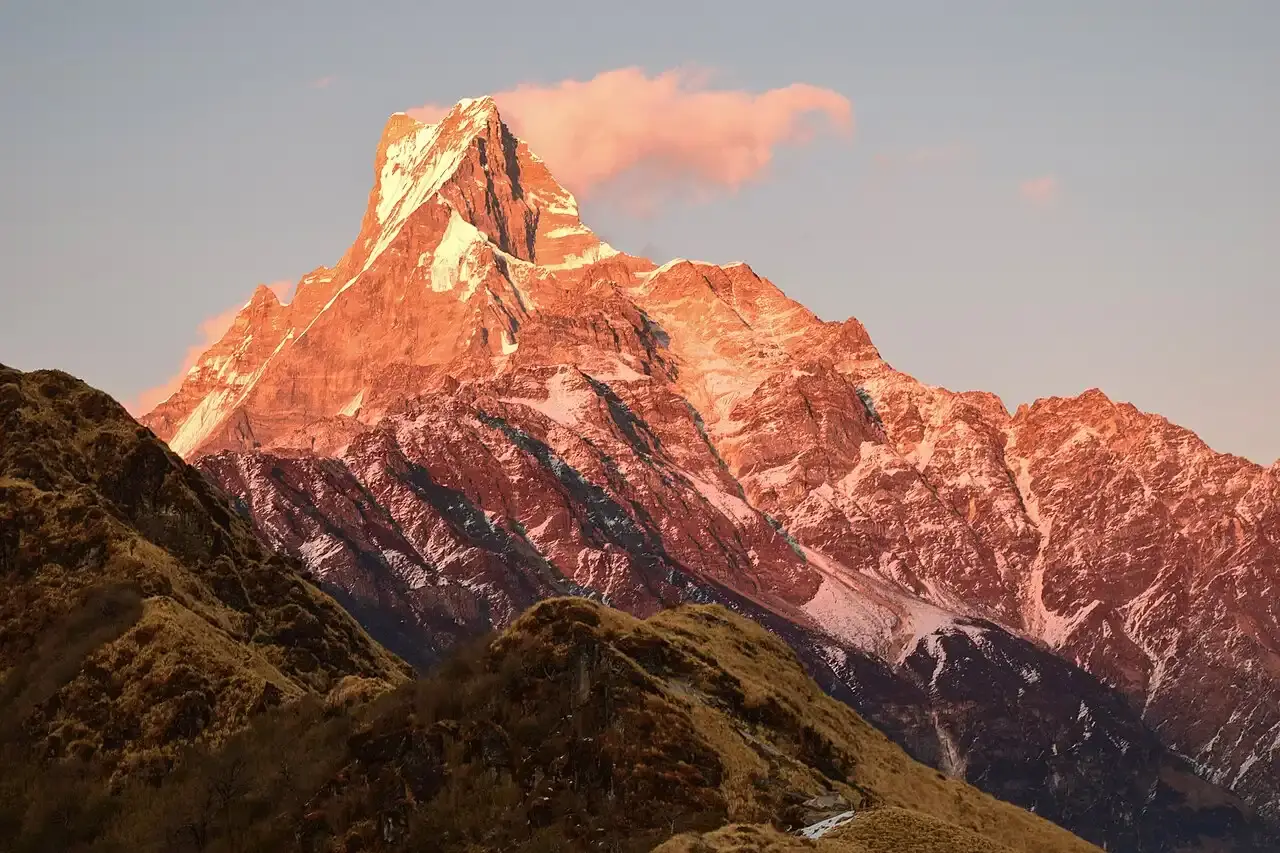
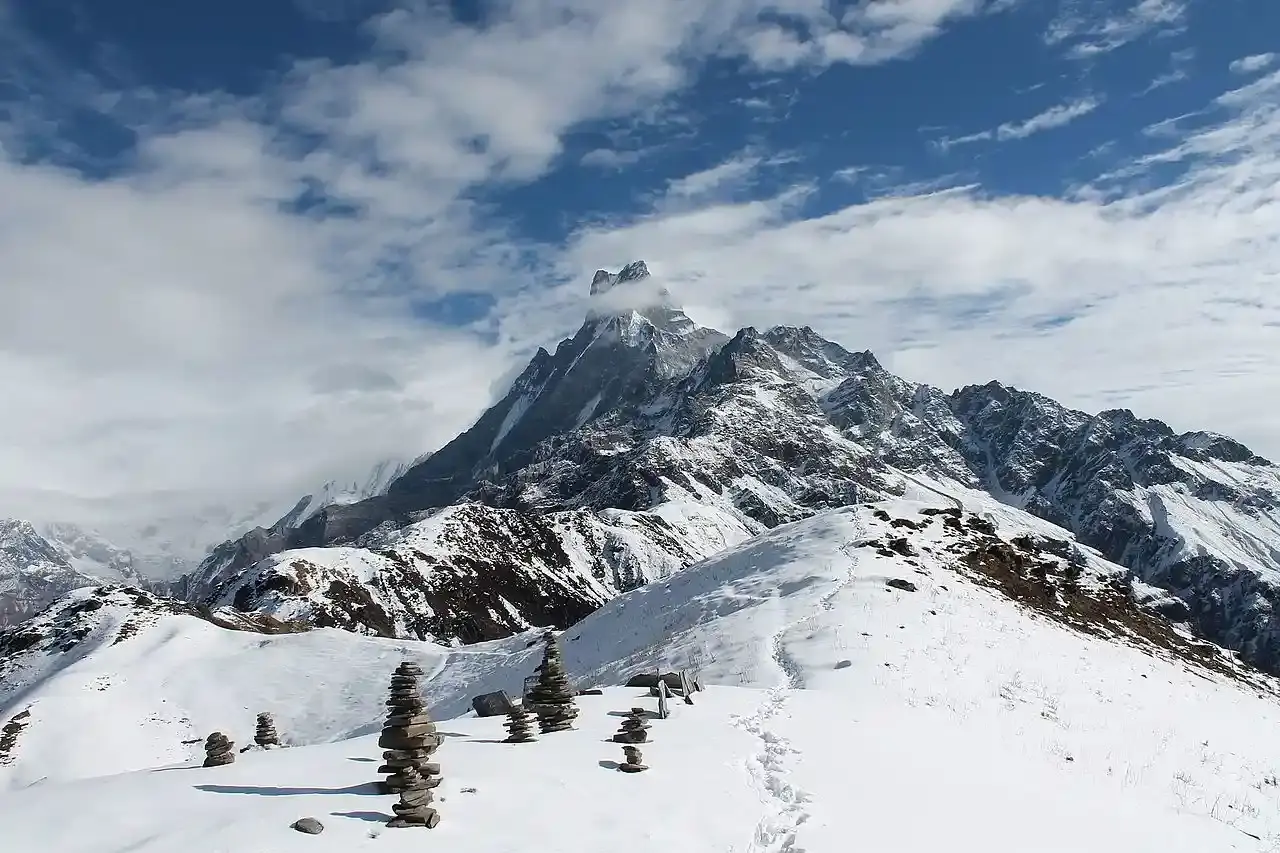
High Camp sits at the edge of the alpine zone on an exposed ridge with unobstructed mountain views in three directions. Machhapuchhre (Fishtail) looms extraordinarily close — its double-summited silhouette is unmistakeable. After check-in, rest in your room, eat a carbohydrate-heavy dinner, and sleep by 20:00 for an early start tomorrow.
Altitude advisory: At 3,550 m, acute mountain sickness (AMS) becomes a real concern. Common symptoms include persistent headache, nausea, dizziness, and difficulty sleeping. If symptoms develop and do not improve with rest and hydration, descend — never ascend with active AMS symptoms.

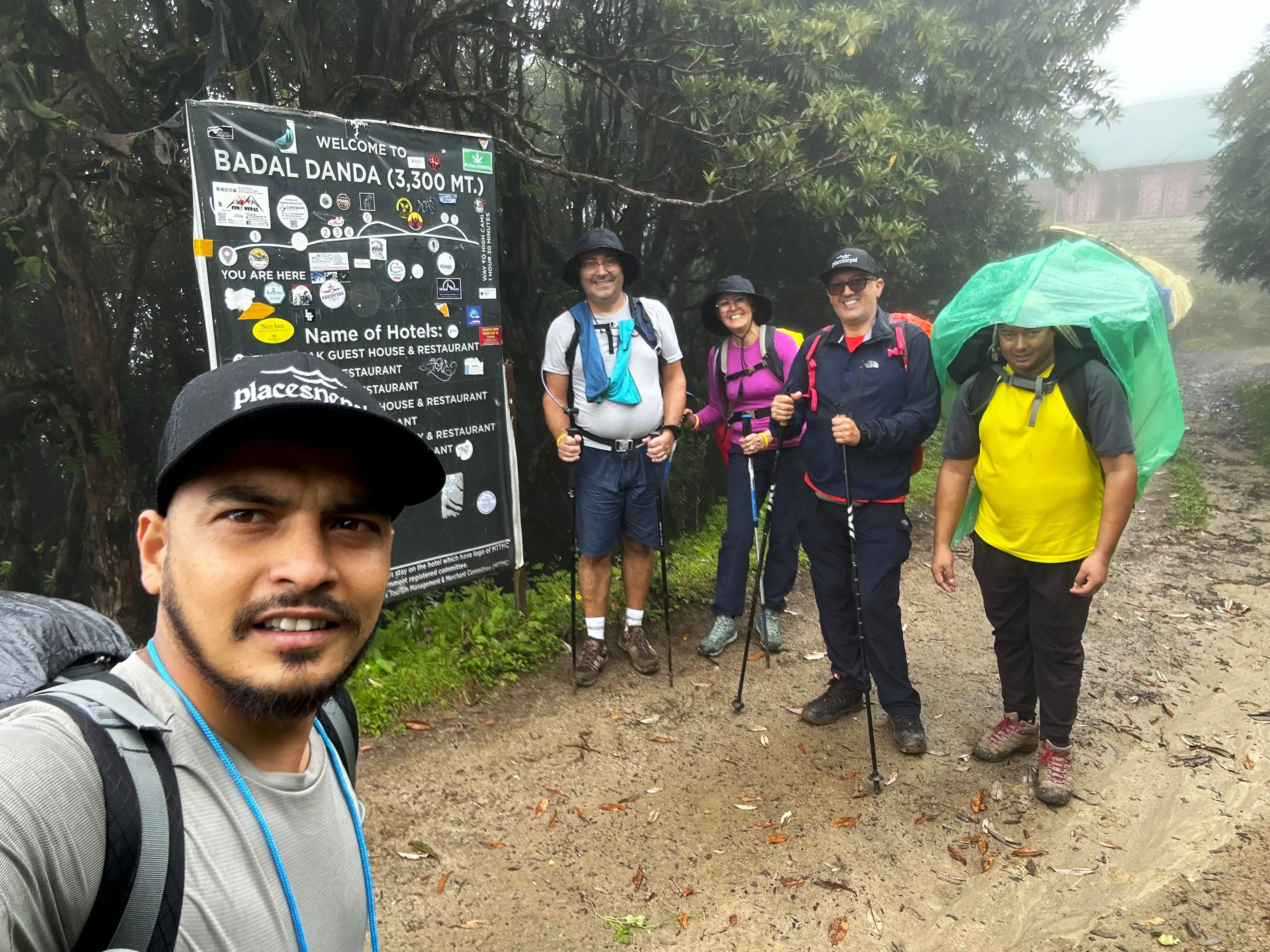
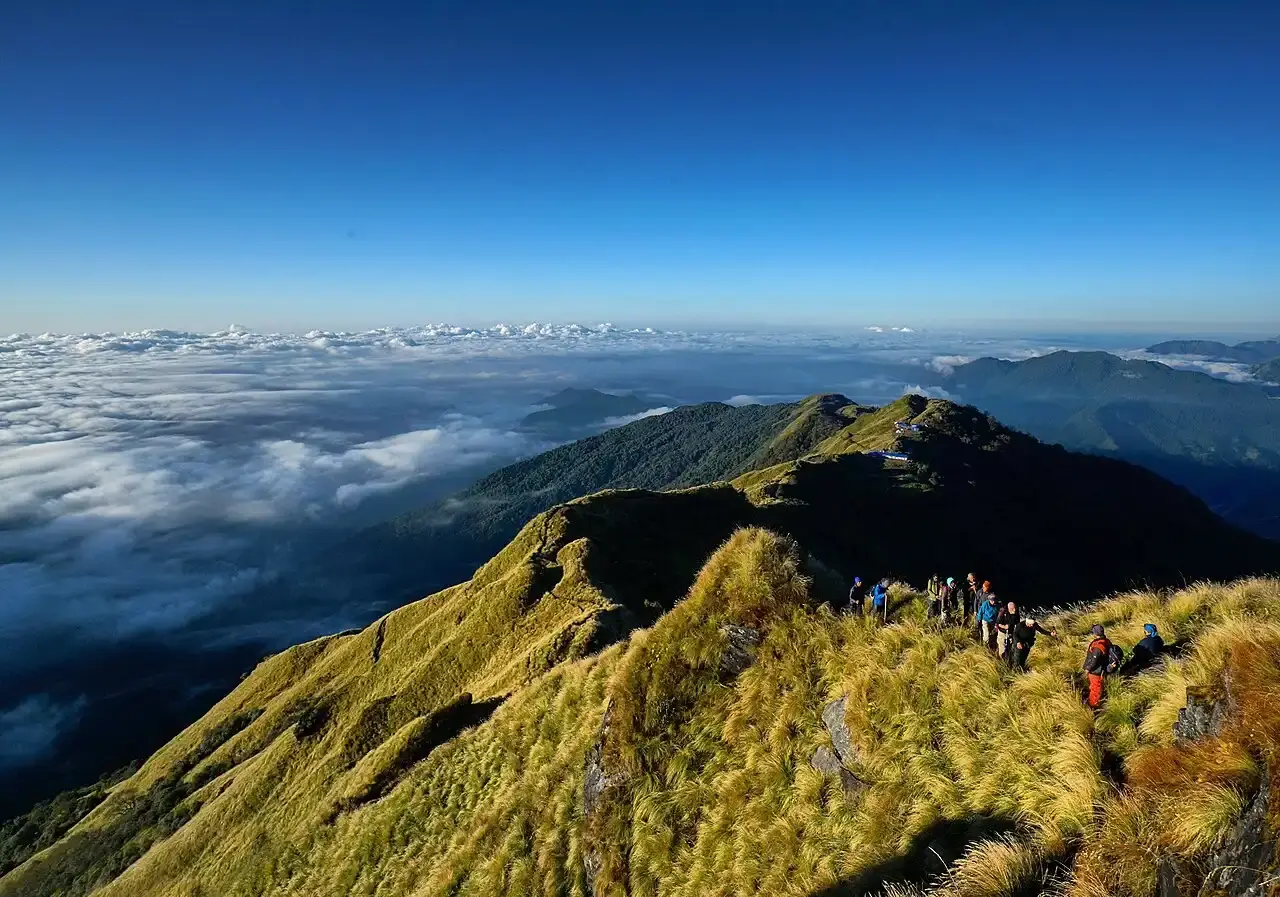
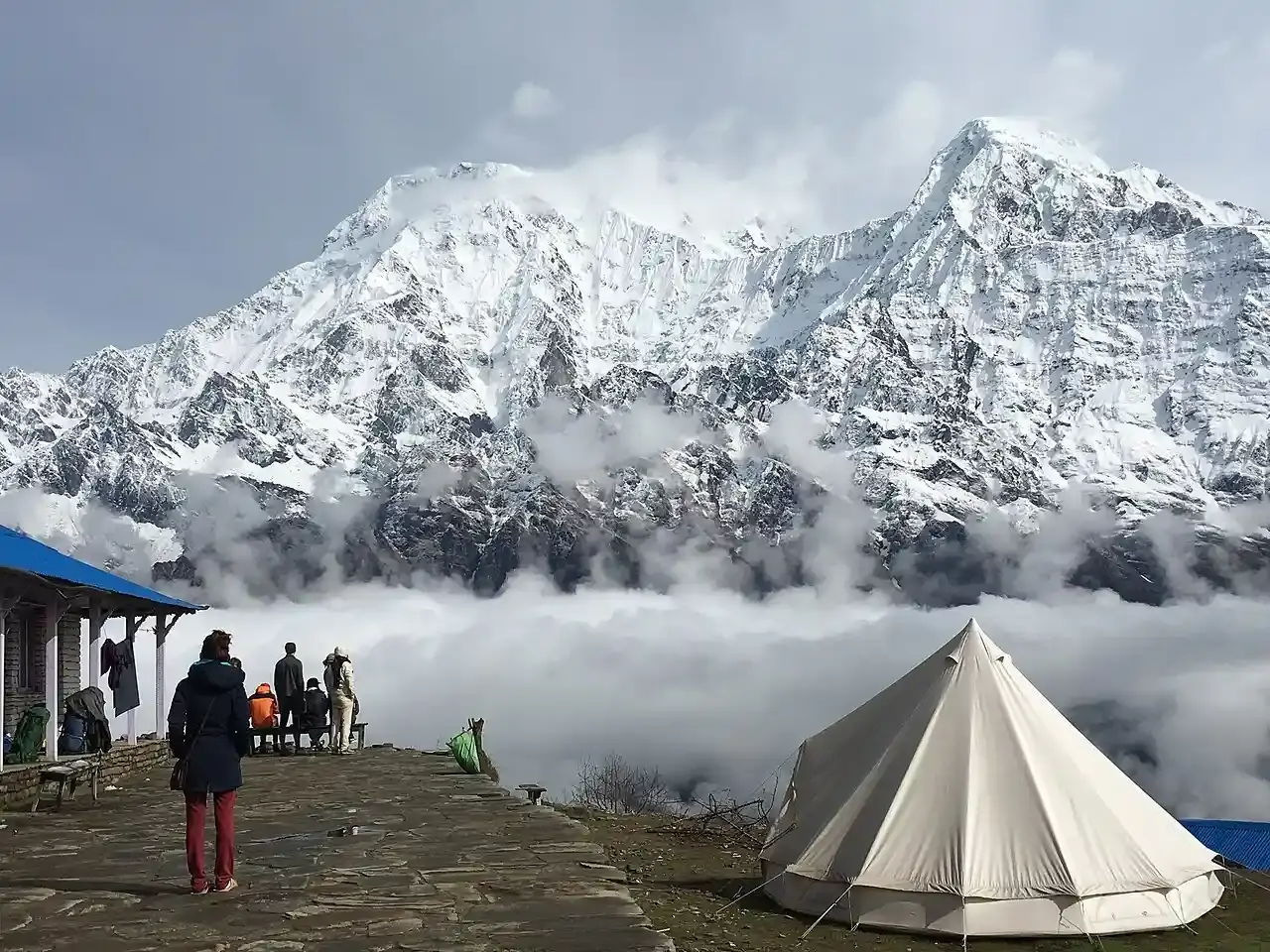
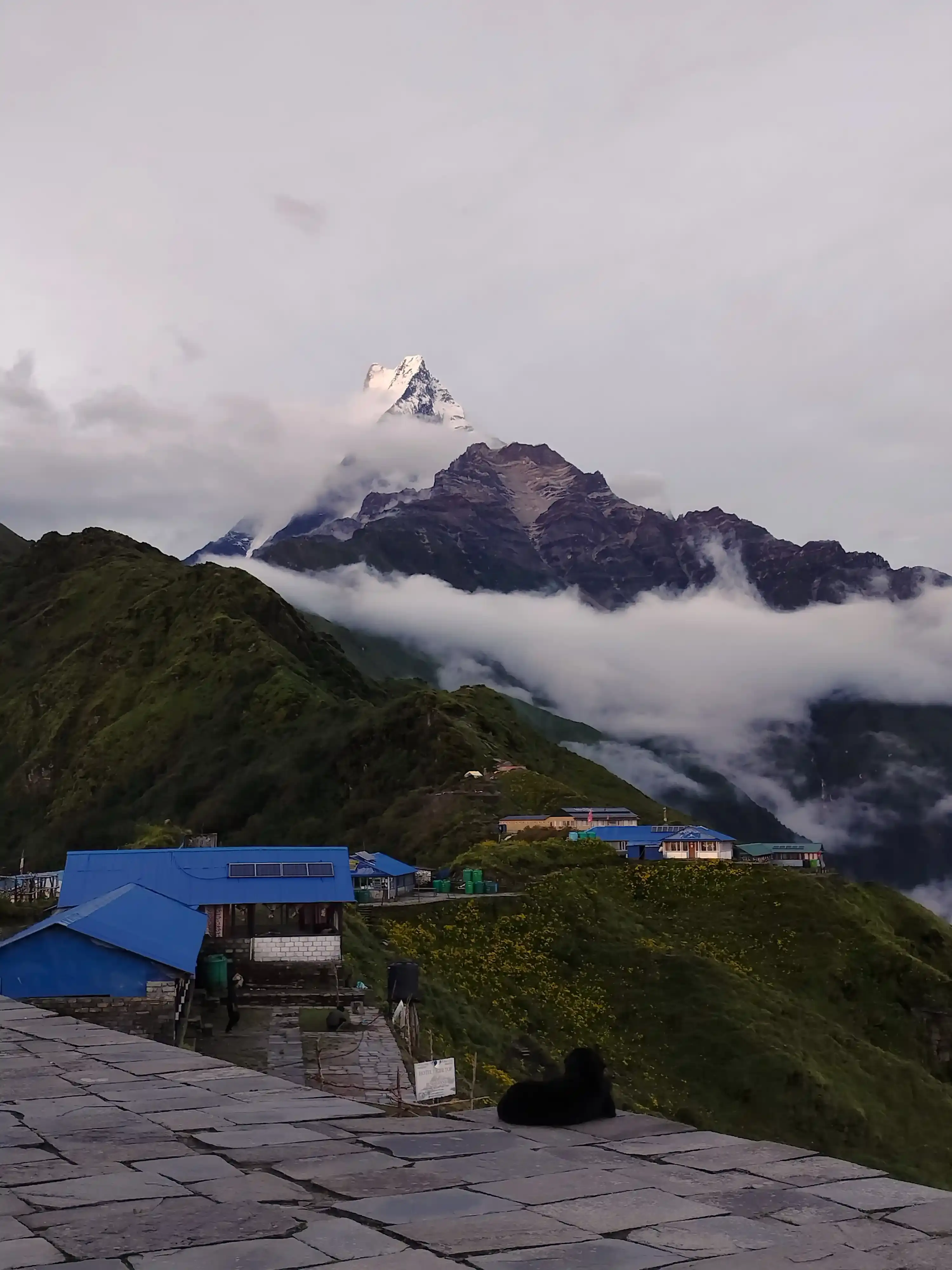
Today the forest finally lets you go. About an hour above Low Camp the trees thin out, and you step onto the open ridge at Badal Danda (3,210 m) — the name literally means "cloud hill," and on most afternoons you'll see why: a white sea of cloud fills the valley below while Machhapuchhre floats above it, close enough that it feels slightly rude.

This is the photo everyone comes home with. Most days we stop here for tea and let the cameras do their thing before the final push along the ridgeline to High Camp (3,580 m). The walking is easier than yesterday but the altitude starts whispering — go slow, drink more water than feels necessary, and save some phone battery for sunset.

Trail tips

Sleep early, wake early: tomorrow's 04:30 departure demands a 19:30–20:00 bedtime. Use the afternoon at High Camp for rest, not exploration.
Prepare your summit pack tonight: headlamp (with fresh batteries), warm layers, snacks, water, and camera — sorted and ready by the door.
Sun exposure doubles above 3,000 m: UV intensity increases sharply — apply SPF 50+ to face and hands before leaving tomorrow.

Max. altitude

4,500 m / 14,764 ft

Accommodation

Teahouse

Meals

Breakfast, Lunch & Dinner Included
Sleep alt.
2,985 m
Total hrs
7–8 hrs
Grade
Strenuous
+950 Metres 
ascent to base camp
- 1,515 Metres
descent to Low Camp
High Camp
3,550 m
Viewpoint
4,200 m
Base Camp
4,500 m
High Camp
3,550 m
Low Camp
2,985 m
04:30
Depart High Camp
Headlamps on, stars overhead
The pre-dawn start is cold and dark but exhilarating. A headlamp and warm base layers are essential. The trail climbs steeply northeast along the exposed ridge toward the viewpoint — go slowly and steadily; hurrying at this altitude backfires fast.
06:15
Upper Viewpoint (4,200 m)
Sunrise on the Himalayas
The viewpoint delivers one of the most spectacular sunrise vistas in the Annapurna region — Machhapuchhre at arm's reach, Annapurna I, II, III, and IV lined up to the west, and Mardi Himal's summit ridge just above. Many trekkers choose to stop here; continuing to base camp is optional but highly rewarding.
08:00
Mardi Himal Base Camp (4,500 m)
The highest point of the trek
Base Camp sits at the foot of Mardi Himal's steep summit faces. The scale here is humbling — glacial moraines, raw rock, and permanent snow fields above. Spend 20–30 minutes taking it in before beginning the descent. The descent from 4,500 m back to 2,985 m is long and knee-intensive — trekking poles are essential.
10:30
Return through High Camp
Collect bags, keep moving
Stop at High Camp to collect any bags left behind and have a proper hot meal. Then continue the descent to Low Camp, where the trail re-enters forest and the temperature rises noticeably. Knees will be feeling the 1,500 m descent — pace it out.
14:00
Low Camp (2,985 m)
Earned rest after a big day
You've completed the hardest day of the trek. Eat well, drink plenty of fluids, and allow your legs to recover. Low Camp feels noticeably warmer than High Camp and the views remain outstanding. Early dinner and early sleep.
Summit day safety: Turn back at any point if weather deteriorates, you feel symptoms of altitude sickness, or the trail becomes icy and dangerous without crampons. The viewpoint at 4,200 m offers nearly identical panoramas to base camp — reaching it is a complete success in its own right.

Trail tips

Bring trekking poles: the 1,500 m descent from base camp to Low Camp in a single afternoon is gruelling without them — poles reduce knee strain significantly.
Carry enough water: there are no reliable water sources above High Camp. Fill up at the teahouse before you leave and carry at least 1.5 litres per person.
Weather window: clear mornings are typical in autumn but clouds build by 10:00–11:00 — reaching the viewpoint by sunrise gives you the best visibility.
Crampons in winter: from December onward the upper trail can be icy; micro-spikes or crampons become necessary — check conditions with your teahouse host.

Max. altitude

822 m / 2,697 ft

Meals

Breakfast, Lunch included
Start
2,985 m
End
1,700 m
Descent
1,285 m
Trek
Easy
2.5
Trekking hours
1.5
Drive to Pokhara (hrs)
Low Camp
2,985 m
Siding Village
1,700 m
Pokhara
827 m
07:00
Low Camp (2,985 m)
One last mountain morning
Wake for a final sunrise from the ridge — the Annapurnas are best before cloud builds. After breakfast, pack up and begin the descent southwest toward Siding, a route that trades altitude for progressively warmer air and greener surroundings.
09:30
Siding Village (1,700 m)
Back to farmland and warm air
Siding is a traditional Gurung village at the base of the Mardi ridge, surrounded by terraced fields and fruit orchards. A vehicle arranged in advance will be waiting here. It's worth pausing for tea and a final look back up at the ridge you descended before the drive begins.
11:00
Drive to Pokhara
Mountains in the rearview mirror
The drive from Siding back to Pokhara takes roughly 1.5 hours on winding mountain roads. Arrive by early afternoon — enough time to clean up, have a proper sit-down meal in Lakeside, and reflect on a genuinely rewarding week in the hills.
Post-trek tip: Your body has spent five days at altitude and worked hard. On returning to Pokhara, prioritise rest and rehydration before any onward travel. A rest day in Pokhara is well-deserved and widely recommended before a long bus or flight journey.

Trail tips

Watch your step on descent: tired legs and loose gravel are a combination that causes most trail injuries. Go slowly and use your poles on the final downhill section.
Celebrate appropriately: Pokhara's Lakeside strip has everything from hot showers to cold Everest beer — you've earned both.

How to get to Mardi Himal trek — flights, buses, and trailhead access from Kathmandu and Pokhara

Trek begins
Phedi / Kande
Gateway city
Pokhara
Pokhara → trailhead
30 min drive
Distance from KTM
200 km 

Choose your route to Pokhara

By air
Fly from Tribhuvan International Airport (KTM) to Pokhara Regional Airport (PKR). The flight takes around 25–30 minutes and offers stunning aerial views of the Himalayas on clear days.
25–30 minMultiple daily
By tourist bus
Tourist buses depart from Thamel (Kathmandu) each morning, typically at 07:00–08:00. The ride follows the Prithvi Highway through river valleys and hill towns and takes 6–7 hours under normal road conditions.
6–7 hrsMorning departure
By private jeep
A private jeep or car gives you full flexibility on departure time and allows stops along the way. Faster than a bus on the same route, and considerably more comfortable on mountain roads. Best for groups of 3 or more splitting the cost.
5–6 hrsFlexible timing

Transport Notice: If you would like us to arrange your transport to Pokhara, please select the transfer option on the booking page.

Getting to Pokhara — arrival options

If flying — Pokhara Regional Airport (PKR)
Airlines serving the route
Buddha Air, Yeti Airlines, and Shree Airlines all operate scheduled flights on the Kathmandu–Pokhara route. Book in advance during peak trekking season (October, November, March, April) as seats fill quickly.
Airport to Lakeside
Pokhara airport sits close to the city centre. A taxi to Lakeside costs NPR 300–500 and takes about 10 minutes. Hotel pickups are available if pre-arranged.
Weather delays
Mountain flights operate on visual flight rules and are frequently cancelled or delayed in poor visibility, especially in the monsoon months. Always build a buffer day into your schedule and keep an eye on the morning forecast.
If busing — Prithvi Highway route
Departure point in Kathmandu
Tourist buses depart from the Tourist bus park near Thamel, between 07:00 and 07:30. Local public buses use the Gongabu bus park in northern Kathmandu and are cheaper but significantly more crowded and slower.
The route
The Prithvi Highway follows the Trishuli and Marsyangdi rivers west through Mugling before climbing into the hills above Pokhara. It is a scenic drive — the river canyon sections are genuinely impressive — though the road surface can be rough in places.
Arrival in Pokhara
Tourist buses drop passengers at the tourist bus park near Lakeside, which is within walking distance or a short taxi ride from most guesthouses.

From Pokhara to the trailhead

Pokhara → Phedi (trek start)
By taxi or jeep (Included)
The fastest and most convenient option. Phedi is roughly 11 km north of Pokhara's Lakeside district and the drive takes 25–35 minutes depending on traffic. Negotiate the fare in advance — expect to pay NPR 600–900 for a taxi, more for a jeep if you have a full group and heavy bags.
Mardi Himal Trek
Elevation Chart
Day 1
Teahouse/ Guesthouse
Breakfast
Lunch
Dinner
Day 2-4
Teahouse
Breakfast
Lunch
Dinner
Day 5
Breakfast
Lunch
Dinner
At a glance
Accommodation type
Teahouses all 5 days
Meals per day included
Breakfast, lunch, dinner
Payment on the trail
Cash only (NPR)
Dietary options
Veg-friendly throughout
How teahouses work: Every overnight stop on this trek is a teahouse — a family-run lodge that combines simple accommodation with a kitchen and dining room. You sleep, eat, and rest all in one place. Rooms are typically free or very cheap if you eat your meals there, which is the expected arrangement. Bringing your own food and skipping teahouse meals is considered poor form and may result in being asked to pay a room surcharge.

Accommodation quality by camp

Pitam Deurali
1,925 m
Good
Forest Camp
2,550 m
Good
Low Camp
2,985 m
Fair
High Camp
3,550 m
Basic
General rule: As altitude increases, teahouse comfort decreases. Lower camps have more competition between lodges, which pushes quality up. High Camp has very few options — what's available is functional but spartan. Manage expectations accordingly, and you'll be pleasantly surprised rather than disappointed.

What to eat on the trek

The dal bhat rule: On every day above 2,500 m, order dal bhat for dinner without exception. It comes with unlimited refills of rice, lentil soup, vegetable curry, and pickle — and Nepali trekking culture fully expects you to ask for seconds and thirds. No other dish on the menu delivers the same calories, warmth, or value. It is the mountain's best fuel.

Practical tips

  • Bring your own snacks from Pokhara. Energy bars, trail mix, nuts, dried fruit, and chocolate are available on the trail but cost two to three times the Pokhara price above Low Camp. Carry 5–7 days of between-meal snacks in your daypack.
  • Never drink unboiled tap or stream water. Water sources above Forest Camp can carry giardia and other pathogens. Always buy boiled water from teahouses or treat your own with purification tablets or a filter. Stomach illness at altitude is far more serious than at sea level.
  • Eat meals at the teahouse where you sleep. Teahouses operate on tight margins; rooms are subsidised by meal revenue. Walking to a different lodge for cheaper food is considered disrespectful and may result in being asked to vacate your room.
  • Cash only, Nepali rupees only. No card payments, no foreign currency, no mobile payments. Withdraw enough rupees in Pokhara to cover all meals, accommodation, tips, water, and extras for 5 days. Budget a minimum of NPR 15,000–20,000 per person as a comfortable working figure.
  • Eat even when you don't feel like it. Altitude suppresses appetite, but your body is burning more calories than usual just to keep warm and maintain basic functions. Force a full meal at every sitting from Low Camp onward — skipping dinner before a summit day is one of the most common mistakes on this route.
  • Avoid alcohol above 2,500 m. Alcohol accelerates dehydration and impairs the acclimatisation process. Even a single beer at High Camp can trigger or worsen altitude sickness symptoms overnight. Save the celebration for Lakeside in Pokhara.
Food safety above High Camp: There is no food or water available between High Camp and Mardi Himal Base Camp. On summit day, carry everything you need from the teahouse before you leave at 04:30 — at least 1.5 litres of water per person, plus energy bars or biscuits to eat at the viewpoint. Do not assume there will be anything available en route.

3.5
out of 5

Moderate–Challenging
Mardi Himal Base Camp Trek
A non-technical Himalayan trek that any reasonably fit person can complete with proper preparation. The route does not require ropes, crampons, or climbing experience — but it does demand sustained physical effort, good altitude awareness, and a willingness to push through discomfort on Day 4.
No technical climbingAltitude to 4,500 mStrenuous summit day5 daysWell-marked trail
EasyModerateChallengingStrenuousExtreme
Mardi Trek sits at 70% of the full difficulty scale — harder than Poon Hill, easier than Island Peak
Total Trek Distance
50 km
Highest sleep
3,550 m
Total trekking days
5 days
Longest day
6–7 hrs
Total ascent
3,700 m

Difficulty broken down by factor

AltitudeHigh
Reaching 4,500 m puts this firmly in high-altitude territory. Altitude sickness is a genuine risk above 3,000 m. The short 5-day schedule leaves limited time for acclimatisation — your body must adapt quickly.
Daily distanceModerate
Most days cover 6–10 km — manageable distances on their own. The challenge is doing this on steep, rooted terrain at altitude, not the raw kilometre count.
Elevation gainHigh
Day 2 climbs over 1,000 m and Day 4 involves 950 m of ascent plus 1,515 m of descent in a single day. Cumulative elevation gain over the trek is approximately 3,700 m — significant for any fitness level.
Trail technicalityLow
No climbing, scrambling, or fixed ropes under normal dry conditions. The trail is a well-defined path throughout. Tree roots and loose rock on the descent require care, but nothing is technically demanding.
Duration per dayModerate
Days range from 2.5 to 8 hours of walking. Three of the five days are 4–6 hours, which is very manageable. Day 4 is the outlier — a full 7–8 hour commitment that demands fitness, fuelling, and early departure.
RemotenessModerate
Teahouses are present at every overnight camp, but above Forest Camp mobile signal becomes unreliable and emergency evacuation is by foot or helicopter only. The trail is less crowded than ABC or EBC routes.
Descent strainHigh
Descending 1,500 m from Base Camp to Low Camp on Day 4 is the most physically punishing element of the trek. Knee and quad strength matter enormously here — this is the factor most likely to be underestimated.
Weather riskModerate
In the main trekking seasons (Oct–Nov, Mar–Apr) weather is generally stable. The exposed ridge above High Camp can attract sudden cloud and wind. Snow is possible above 3,500 m from November onward.

Day-by-day difficulty

Day 1
Pokhara → Pitam Deurali
4 hrs · 1,098 m gain · Forest trail
Moderate
Day 2
Pitam Deurali → Low Camp
6 hrs · 1,060 m gain · Dense forest ridge
Challenging
Day 3
Low Camp → High Camp
4 hrs · 565 m gain · Open alpine ridge
Moderate
Day 4
High Camp → Base Camp → Low Camp
7–8 hrs · 950 m up · 1,515 m down · Exposed
Strenuous
Day 5
Low Camp → Siding → Pokhara
2.5 hrs · 1,285 m descent · Farm trail + drive
Easy
Day 4 is the crux: Everything else on this trek is manageable with moderate fitness. Day 4 is a different category — a pre-dawn start at 4,500 m, sustained effort at altitude, and a long knee-destroying descent all in the same day. This single day is what separates the Mardi Himal Base Camp trek from a casual hill walk. Prepare specifically for it.

How it compares to other Nepal treks

Poon Hill (Ghorepani)3 days · max 3,210 m · very busy trail
1.8
Mardi Himal Base Camp ★5 days · max 4,500 m · quieter trail
3.5
Annapurna Base Camp7–10 days · max 4,130 m · well-serviced
3.0
Langtang Valley7 days · max 3,870 m · moderate trail
2.8
Everest Base Camp12–14 days · max 5,364 m · long approach
4.1
Island Peak Climbing18 days · 6,189 m · technical summit
4.8
Compared to Annapurna Base Camp: Mardi Himal Base Camp is shorter in duration but reaches a higher maximum altitude and compresses more vertical gain into fewer days. ABC spreads the effort over 7–10 days; Mardi Himal does the same work in 5. That compression is what makes the rating higher despite ABC being a more famous route.

Is Mardi Himal trek right for you?

Good fit if you…
Can walk 5–6 hours comfortably on hilly terrain
Have been training consistently for 6–8 weeks
Have some previous trekking experience
Are comfortable with basic teahouse accommodation
Don't have a history of altitude sickness
Are travelling in October–November or March–April
Want mountain views without a 2-week commitment
Reconsider if you…
Have done no physical training before the trek
Have known heart or serious lung conditions
Have previously suffered severe altitude sickness
Have significant knee problems or recent leg injuries
Are travelling in monsoon (June–September)
Are not comfortable with cold temperatures at night
Expect hotel-level comfort at high altitude

How to make it easier

  • Walk slower than feels necessary. The most common mistake on Day 2 and Day 4 is setting off at a pace that feels comfortable — and hitting a wall two hours in. The correct altitude pace is one where you can breathe fully through your nose the entire time. Slower than that feels embarrassing; faster than that causes problems.
  • Use trekking poles on every day, not just downhill. Poles reduce the load on your knees during descent by up to 25% and provide balance on rooted forest trail. Most trekkers who suffer knee pain on Day 4's descent either weren't using poles or hadn't trained descending with them.
  • Hire a porter for your main bag. Carrying a 10–12 kg pack to 4,500 m is a very different experience to carrying a 5–6 kg daypack. A porter takes your main bag between camps for a reasonable daily rate and significantly reduces fatigue — leaving your energy for the actual trekking.
  • Hire a guide.  A knowledgeable guide controls your pace, monitors your health, and makes critical decisions about weather and acclimatisation. On a trek that compresses significant altitude gain into 5 days, this is not a luxury — it is the single most effective risk-reduction measure available.


  • Sleep at Low Camp before attempting High Camp. This itinerary correctly builds in a night at Low Camp before ascending to High Camp — do not skip this night to save time. That extra night at 2,985 m is a meaningful acclimatisation step before sleeping at 3,550 m.
  • Know the symptoms of AMS and act early. Mild headache, nausea, and poor sleep are normal above 3,000 m. Persistent or worsening headache, loss of coordination, confusion, or breathlessness at rest are serious warning signs. Descend immediately if these develop — delay makes it worse.
Bottom line: Mardi Himal Base Camp is one of the most rewarding short treks in Nepal — spectacular views, genuine altitude, and far fewer crowds than the classic routes. Its difficulty is real but not intimidating. A fit, well-prepared trekker who respects the altitude and doesn't rush will find it challenging and deeply satisfying in equal measure.

Understanding the weather on the Mardi Himal Base Camp trek is one of the most practical things you can do before you book. The trail climbs from subtropical forest at around 1,800 m all the way to 4,500 m in just five days — and across that range, the temperature, visibility, and conditions can differ by 25 °C or more on the same afternoon. Getting the season right makes the difference between a summit day with 360-degree views and one spent in cloud.

Best time to trek Mardi Himal Base Camp

Dec-Feb
Cold
Mar
Best
Apr
Best
May
Good
Jun-Aug
Avoid
Sep
Good
Oct-Nov
Best

Good / manageable
Cold but possible
Avoid (monsoon)
Short version: October and November are the finest months for the Mardi Himal Base Camp trek — clear skies, stable weather, outstanding mountain visibility, and the Himalayas at their most photogenic. March and April are an excellent spring alternative, with rhododendron forests in full bloom along the lower trail. Every other month involves a real trade-off.

Season by season

🍂

Autumn

October & November — Peak Trekking Season
Best visibilityStable skiesBusiest months
Pokhara daytime
22–28°
Warm and sunny
High Camp night
−5–0°
Below freezing
Precipitation
Very low
Post-monsoon dry
Conditions
The post-monsoon atmosphere has been washed clean by summer rains; the result is extraordinary air clarity. Mountain photographs taken in October consistently outperform any other season. Machhapuchhre and Annapurna South appear impossibly sharp from the ridge.
Stable high pressure dominates October and November. Morning skies are reliably clear; afternoon cloud builds by 1:00–2:00 PM then disperses for golden-hour alpenglow. Summit day departure by 04:30 is essential.
November nights at High Camp drop to −5 °C or below. A sleeping bag rated to −10 °C is essential — not optional — from October onward.
What to expect
October is the busiest month on the Mardi Himal trail. Forest Camp and High Camp fill up — especially on weekends. Pre-book accommodation one night ahead through your guide.
The lower forest turns amber and copper in late October — a warm seasonal palette that contrasts beautifully with the snow peaks above.
Late November: first serious snowfall above 3,500 m arrives in some years. Check trail conditions and carry microspikes if trekking after mid-November.
Watch for: occasional early-winter storms can arrive with little warning after late October. Always check the morning forecast with your teahouse host before the 04:30 summit day departure. Cloud and wind on the upper ridge build faster than most trekkers expect.
🌸

Spring

March & April — Prime Rhododendron Season
Rhododendrons bloomWarm lower trailSofter visibility
Pokhara daytime
25–32°
Warm, some cloud
High Camp night
−6–−2°
Cold but drier
Precipitation
Low–mod
Increases into May
Conditions
The rhododendron forests between Pitam Deurali and Forest Camp burst into crimson, pink, and white from mid-March through April — one of Nepal's great seasonal spectacles and some of the most photographed trail scenery in the Annapurna region.
Daytime temperatures on the lower trail are warm and pleasant — comfortable in a single layer. Evenings above 2,500 m cool sharply.
Pre-monsoon moisture builds from late April. Visibility softens progressively through May — the Himalayas are still stunning but less crystalline than October.
What to expect
March is the clearest spring month. If mountain views are your priority, target the first three weeks of March before haze builds. April remains excellent for photography.
Afternoon cloud on the upper ridge is more common in spring than autumn. Leaving High Camp by 04:30 on summit day is even more important — aim to reach Base Camp before 10:00 AM.
Snow may linger above 3,500 m into March. Microspikes are recommended on the High Camp to Base Camp section until mid-March — check current conditions before departure.
Best for photography: Spring light has a warmer, softer quality than sharp autumn sun, and the rhododendron foreground turns the forest sections into extraordinary compositions. A wide lens and patience between Pitam Deurali and Low Camp will produce images that last a lifetime.
🌧️

Monsoon

June to August — Not Recommended
Heavy rainSlippery trailZero mountain visibility
Pokhara daytime
28–33°
Humid and cloudy
Rain days/month
20–25
June–August
Mountain views
Poor
Often zero
The rooted forest trail becomes genuinely hazardous in the monsoon. Persistent rain turns the Pitam Deurali to Forest Camp section into a slick, muddy channel. The Day 4 descent from Base Camp — already demanding in dry conditions — becomes a serious injury risk on wet ground.
Himalayan visibility disappears for days at a stretch from June through August. The mountains that make this trek worth doing are obscured by monsoon cloud for the vast majority of the summer. Reaching Mardi Himal Base Camp in a whiteout after five days of effort is deeply disappointing.
Landslide risk increases on the road sections between Pokhara and the trailhead. The Phedi approach road is vulnerable after sustained rainfall, and the Siding exit route is similarly affected.
🪱

Leeches on the Mardi Himal trail — June to September

Leeches are unavoidable on the forest sections during and immediately after the monsoon. The damp trail between Pitam Deurali and Forest Camp is prime habitat — they stand on vegetation at ankle height and attach silently, often unnoticed until you rest.

Where they appear
Pitam Deurali to Forest Camp — dense, shaded, perpetually damp
Grass and leaf litter — they wait at ankle height for body heat
Boot lace eyelets and sock tops — common entry points even through gaiters
How to deal with them
Salt or insect repellent on boots and socks before entering forest sections
Tuck trousers into socks and use gaiters to reduce access points
To remove: slide a fingernail under the sucker and flick — never pull or burn
Dangerous?
No
Peak months
Jul & Aug
Worst section
Deurali→Forest
Verdict: Avoid the Mardi Himal Base Camp trek from June through August. The conditions work against every element that makes this trek worthwhile. Wait for October and do it properly.
❄️

Winter

December to February — For Experienced Trekkers
Empty trailsSnow sceneryExtreme cold
Pokhara daytime
15–20°
Cool and crisp
High Camp night
−10–−15°
Genuinely severe
Snow above
3,000 m+
December onwards
Conditions
Winter skies are among the clearest of the year. Dry, cold, high-pressure air produces exceptional visibility — the Himalayas look sharper and more dramatic against a deep winter blue than at any other time.
Snow covers the trail above Low Camp from December onward. Crampons or microspikes become necessary safety equipment, not optional. The summit day ascent on snow requires confident footing and appropriate gear.
High Camp overnight temperatures drop to −10 °C or below. A four-season sleeping bag, full thermal layers, and a down jacket are the minimum equipment above 3,000 m in winter.
What to expect
The trail is nearly deserted in January and February. You may go full days without encountering another trekking party — a stark contrast to October crowds. For experienced trekkers seeking genuine solitude, this is compelling.
Some teahouses close in December and January — particularly Forest Camp and High Camp. Always confirm availability through your guide before departure.
Shorter daylight hours compress the summit window. Usable light runs roughly 06:30 to 17:30 — making the 04:30 High Camp departure even more critical to reach Base Camp in good conditions.
Winter verdict: Entirely possible and genuinely beautiful — but exclusively for trekkers who arrive fully equipped, physically prepared, and with a guide who knows winter conditions on this specific ridge. Not suitable for beginners or anyone without proper cold-weather gear.

Temperature by camp and season

Approximate temperatures across the Mardi Himal trek route
CampAltitudeAutumn dayAutumn nightSpring daySpring nightWinter night
Pitam Deurali1,925 m18–22 °C8–12 °C15–20 °C6–10 °C0–4 °C
Forest Camp2,550 m14–18 °C4–8 °C12–17 °C3–7 °C−4–0 °C
Low Camp2,985 m10–15 °C1–5 °C8–14 °C0–4 °C−7–−3 °C
High Camp3,550 m6–10 °C−5–0 °C5–9 °C−6–−2 °C−12–−8 °C
Base Camp4,500 m2–6 °C−10–−5 °C1–5 °C−12–−7 °C−18–−12 °C

Shoulder months — May and September

September — Transition month
The monsoon retreats through September. Early September is still wet; late September clears progressively and becomes genuinely suitable for trekking.
The post-monsoon forest is intensely green and lush — the most vibrant the lower trail sections look all year.
Trails are quiet. Last two weeks of September offer a real sweet spot — good conditions with far fewer trekkers than October.
May — Late spring
Rhododendrons have faded but the forest is full and deeply green. Lower trail temperatures can be warm — occasionally uncomfortable below 2,000 m.
Pre-monsoon haze softens mountain views compared to March. Distant peaks are visible but lack the sharp definition of the best trekking months.
Afternoon showers become more frequent from mid-May. First two weeks of May offer the best balance of warm temperatures and reasonable visibility.

Practical weather tips for Mardi Himal

  • Always start summit day before 05:00 AM. Cloud builds from the south as the valley warms and typically reaches the Base Camp viewpoint by 10:00–11:00 AM in every season. Every hour of delay on summit morning is a worse view at the top.
  • Pack for a 25-degree temperature range. A warm afternoon at Phedi and a freezing night at High Camp can happen on consecutive days of the same trek. Base layer, fleece, insulated jacket, and a windproof shell are all necessary — not just one or two of them.
  • Mountain weather changes rapidly above 3,000 m. A clear morning sky can shift to wind, cloud, and sleet in under 90 minutes at altitude. Keep a rain cover and a light shell accessible in your daypack on every single day — not buried at the bottom of your main bag.
  • Wind is the hidden danger above 3,500 m. Temperatures that feel manageable in still air become dangerous quickly when a ridge wind arrives. A windproof outer layer and neck gaiter are as critical as an insulating layer — exposed skin loses heat at an alarming rate in wind at altitude.
  • UV intensity at 4,500 m is approximately 45% higher than at sea level. Apply SPF 50+ sunscreen to face, neck, and the backs of your hands before the summit day departure, and reapply at the two-hour mark. Snow reflection above Low Camp multiplies the exposure further.


  • Private transfer from Pokhara to Phedi by car or van, and shared jeep transfer from Sidding back to Pokhara
  • Teahouse/lodge accommodation throughout the trek
  • Full-board meals during the trek (breakfast, lunch, and dinner)
  • All required permits, including ACAP and TIMS for the Mardi Himal Trek
  • Government-licensed, English-speaking trekking guide 
  • All expenses for guide and porter, including meals, accommodation, transport, salary, insurance, and equipment
  • Duffel bag for your trekking gear, carried by the porter (if hired)
  • All necessary paperwork, government fees, and local taxes
  • Official trek completion certificate from the company
  • Hotel accommodation and meals in Kathmandu and Pokhara before and after the trek
  • Porter service (20kg / 130$ extra)
  • Travel insurance, including emergency helicopter rescue and evacuation coverage
  • Personal expenses such as soft drinks, alcohol, bottled water, desserts, hot showers, Wi-Fi, laundry, and battery charging
  • International airfare to and from Nepal
  • Personal trekking clothing and equipment for cold and high-altitude conditions
  • Any expenses not mentioned in the “Cost Includes” section
  • Nepal entry visa fees upon arrival at Tribhuvan International Airport (Approx. USD 30 for 15 days / USD 50 for 30 days)
  • Tips for guides and porters
  • Extra costs caused by circumstances beyond our control, such as bad weather, landslides, illness, strikes, government policy changes, transport delays, or itinerary adjustments for safety reasons
  • Are you ready?
    Beginner
    Rarely exercise. Start training 10–12 weeks out. Focus on building a base before adding elevation.
    Intermediate
    Walk or exercise 2–3×/week. Begin training 6–8 weeks out. Focus on hills and endurance.
    Active
    Already fit and hiking regularly. 4 weeks of targeted hill and stair work is sufficient.
    What the trek demands: Mardi Himal is a 5-day moderate-to-challenging trek reaching 4,500 m. The hardest day involves 950 m of ascent and 1,515 m of descent in a single day. You do not need to be an athlete — but you do need to be comfortable walking 5–7 hours continuously on uneven terrain with a daypack on your back.

    Key exercises to train for the trek

    Stair climbing
    The single best training exercise for this trek. Mimics the sustained uphill gradient better than any gym machine. Use stairs, a stadium, or a multi-storey carpark. Work up to 30–45 minutes continuously.
    Priority
    Loaded hill walks
    Walk uphill carrying a 6–8 kg daypack — the weight you'll carry on the summit day. Hills of 200–400 m elevation gain are ideal. This builds the specific muscles needed and trains your joints for loaded descent.
    Priority
    Downhill training
    Most people ignore descent training — and then their knees suffer for it. Practice walking downhill on trails or steps. Eccentric muscle loading is different from climbing and causes more soreness if untrained.
    Often ignored
    Leg strength work
    Squats, lunges, step-ups, and single-leg deadlifts build the quad and glute strength needed for sustained climbing and knee stability on descent. 2–3 sessions per week is sufficient.
    Strength
    Cardio base
    Jogging, cycling, swimming, or rowing — any sustained aerobic activity that keeps your heart rate elevated for 30–60 minutes builds the cardiovascular base you need for multi-hour days at altitude.
    Endurance
    Core and balance
    A stable core reduces fatigue and protects the lower back when carrying a pack. Planks, dead bugs, and single-leg balance exercises pay dividends on rocky and root-covered trail sections.
    Support

    Beyond training — what else matters

    Boots before the trek: New trekking boots are one of the most common causes of blisters and ankle pain on the Mardi Himal trail. Wear your boots on every training walk from Week 1 onward — they need at least 30–40 hours of use to soften and shape to your feet before you rely on them for 5 days.
    • Sleep matters as much as exercise. Fitness is built during recovery, not during the sessions themselves. Aim for 7–8 hours of sleep per night throughout the training period — reducing sleep by even 90 minutes significantly impairs muscle repair and endurance adaptation.
    • Eat to fuel the training. Increase your protein intake during the strength weeks (aim for 1.5–1.8 g per kg of bodyweight) and prioritise complex carbohydrates on long walk days. Do not train fasted on long sessions — you need glycogen to perform and to adapt.
    • Train with trekking poles. If you plan to use poles on the trek — and you should — include them in your hill walk sessions from Week 3 onward. Using poles is a skill that takes practice; deploying them for the first time on a mountain is not the moment to learn.
    • Hydration discipline starts now. At altitude, the dry air and increased breathing rate accelerates water loss dramatically. Train yourself to drink consistently throughout exercise rather than waiting until you're thirsty — this habit is critical above 3,000 m.
    • Don't ignore flexibility. 10 minutes of stretching after every session — hip flexors, quads, hamstrings, and calves — reduces injury risk and improves recovery. Tight hip flexors are a leading cause of knee pain on steep descents.
    • Simulate the altitude mentally. There is no way to truly replicate thin air at sea level, but pacing discipline is something you can train. Practise walking at a pace where you can breathe fully and comfortably through your nose — this is roughly the pace you should maintain above 3,500 m.
    If you have a pre-existing condition: Any knee, hip, or cardiovascular issue should be discussed with a doctor before beginning this training programme. Altitude above 3,000 m can exacerbate certain conditions — a pre-trek medical check is strongly advisable for anyone over 50 or with a history of heart or lung problems.
  • Trekking backpack (25–35L)
    Hip belt essential for weight distribution
  • Sleeping bag (−10 °C rated) — Essential
    High Camp nights drop below −5 °C — do not rely on teahouse blankets alone
  • Sleeping bag liner
    Adds 3–5 °C warmth and keeps your bag clean. Silk is lightest.
  • Trekking poles (pair) — Essential
    Critical for the 1,500 m descent on Day 4
  • Headlamp + spare batteries — Essential
    Summit day starts at 04:30 in complete darkness
  • Daypack rain cover
    Most packs include one — check before buying another
  • Dry bags / zip-lock bags
    Keeps electronics and documents dry inside your pack
  • Power bank (20,000 mAh)
    Charging is unreliable above Forest Camp — a full bank covers 5 days
  • Water bottles (2 × 1L hard-sided)
    Hydration bladders freeze at High Camp — hard bottles are more reliable
  • Water purification tablets
    Lightweight backup for when boiled water isn't available
  • Camera or action cam (optional)
  • The ridge between High Camp and Base Camp deserves more than a phone
  • 6–8

    kilograms
    Sweet spot

    Pack light. You carry what you bring.

    On this trek, every kilogram on your back is a kilogram your legs carry up every pass and down every descent. There is no magic number — but trekkers who arrive with 6–8 kg move faster, tire later, and enjoy the experience far more than those struggling under 15+ kg. Before you zip up your bag, ask yourself honestly: will I use this? If the answer isn't a clear yes, leave it behind.
    Too lightSweet spotHeavyToo heavy
    Aim for 6–8 kg total pack weight · Everything above 10 kg will make the trek significantly harder

    Porter service available — not included in this package

    USD 25 / day
    About the service
    A porter carries your main duffel bag between camps, leaving you to walk with a light daypack only. This makes a meaningful difference on long ascent days and on the steep descent from High Camp.
    Porter service is available to add on at checkout when booking. If you decide mid-trek that you need one, speak to your guide — arrangements can sometimes be made in the lower villages, though availability is not guaranteed on the trail.
    Each porter carries a maximum of 18kg of trekker luggage. If you are a couple or pair sharing a porter, combine your bags within this limit.
    Who should consider a porter
    First-time trekkers or anyone who hasn't trained specifically with a loaded pack
    Trekkers with any history of knee, hip, or lower back issues — descent days are long and loaded
    Anyone whose bag weighs more than 10 kg after packing — a good indicator that a porter is the right call
    Trekkers who want to focus entirely on the experience rather than the physical effort of carrying
    The honest test: Pack your bag at home, put it on, and walk up and down a flight of stairs ten times. If it feels manageable and your knees are happy, you are ready. If it feels like a punishment, take something out — or add a porter. There is no award for suffering unnecessarily on a mountain.
  • What to leave behind

    Common weight offenders — don't pack these
    Jeans or cotton trousers — heavy, slow to dry, dangerously cold when wet
    More than 2 books — heavy and available as ebooks; one paperback maximum
    Full-size toiletry bottles — decant everything into 50–60 ml containers
    Laptop or tablet — there is no reliable power; leave it in Pokhara
    Excessive spare clothing — 2 trekking shirts and 3 pairs of socks are enough for 5 days
    Hair dryer or straightener — no, and no
    Multiple camera lenses — one versatile zoom lens is more practical than a full kit on the trail
    Valuables you can't afford to lose — leave jewellery, expensive watches, and non-essential electronics in Pokhara
    Final packing check: Put everything on your bed, pack it, put the pack on, and walk around for ten minutes. If your lower back or shoulders ache immediately, take something out. If you can move freely and comfortably, you are ready. The mountain will take care of the rest.
  • Moisture-wicking base layer × 2 — Essential
    Merino wool or synthetic only — cotton chills dangerously when wet
  • Thermal base layer × 1
    For sleeping and cold mornings at High Camp
  • Fleece mid-layer — Essential
    Core insulation for evenings above Forest Camp
  • Down or synthetic insulated jacket — Essential
    A proper puffer — not a fleece — for High Camp and summit morning
  • Waterproof shell jacket (hardshell) — Essential
    Also your wind layer for the exposed upper ridge
  • Waterproof shell trousers
    Lightweight and packable — earn their weight on wet descents
  • Trekking trousers × 2 (quick-dry)
    Zip-off legs are useful on the lower trail. No jeans.
  • Lightweight trekking shirts × 2
    Long-sleeved for sun protection above treeline
  • Underwear × 3–4 (quick-dry)
    Merino or synthetic — more pairs than other clothing
  • Buff / neck gaiter — Essential
    Exposed neck loses heat fast in wind above 3,500 m
  • Warm beanie / woolly hat — Essential
    Wear it to sleep at High Camp if needed
  • Sun hat with wide brim
    UV above the treeline is fierce — a brim is more reliable than sunscreen alone
  • Microfibre towel (small)
    Teahouses do not provide towels
  • Camp shoes / sandals (Crocs or flip-flops)
    Give feet a rest in the evenings — minimal weight, maximum comfort
  • Waterproof trekking boots (broken in) — Essential
    Mid or high-cut, waterproof, firm sole — worn in before the trek, not on it
  • Thick trekking socks × 3 pairs (merino wool) — Essential
    Warm when wet, odour-resistant, blister-resistant over multiple days
  • Thin liner socks × 2 pairs
    Reduces friction under thick socks — significantly lowers blister risk
  • Waterproof gaiters
    Keeps mud and water out of boots — useful after rain on any day
  • Insulated gloves — Essential
    Fingers suffer first in cold wind above 3,500 m — the 04:30 summit start demands these
  • Lightweight liner gloves
    Layer under insulated gloves or wear standalone on cooler lower-trail mornings
  • Blister plasters / Compeed (generous supply) — Essential
    One unmanaged blister can make Day 4's descent genuinely miserable
  • Sunscreen SPF 50+ (face & body) — Essential
    UV at 4,500 m is ~45% more intense than at sea level — apply before every summit section

    Lip balm with SPF — Essential
    Lips crack badly in cold, dry, windy ridge air

    UV-protection sunglasses (cat. 3 or 4) — Essential
    Snow blindness is a real risk above the treeline — wrap-around style preferred

    Wet wipes (large pack)
    Primary hygiene above Pitam Deurali where hot showers stop — unscented baby wipes are ideal

    Biodegradable soap & shampoo (decanted, 60 ml)
    Use only biodegradable products near water sources — no full-size bottles

    Toothbrush & travel-size toothpaste
    Travel tube only — you don't need the full 150 ml

    Hand sanitiser
    Use before every meal — water for handwashing is scarce at high camps

    Toilet paper + small trowel
    Carry your own supply — teahouses occasionally run out above Forest Camp

    Moisturiser for face & hands
    Altitude air causes skin to crack within days — morning and evening use makes a real difference

    Small ziplock waste bag
    Carry your rubbish out — the Mardi trail is cleaner than most; help keep it that way

  • Diamox / Acetazolamide
    Consult your doctor before taking
    Widely used for altitude sickness prevention above 3,000 m — obtain a prescription before departure
  • Ibuprofen & paracetamol — Essential
    Ibuprofen for altitude headache; paracetamol for general pain — carry both
  • Oral rehydration salts × 10 sachets — Essential
    Replace electrolytes daily above 3,000 m — mix with boiled water each morning
  • Antiseptic cream & assorted plasters
    Small cuts heal slowly at altitude — clean and cover promptly
  • Compeed gel blister pads
    Separate to standard plasters — reduces friction on existing blisters without removal
  • Anti-diarrhoeal (Loperamide)
    Stomach upsets are common on multi-day treks — Loperamide buys you time to manage
  • Antihistamine
    For reactions, insect bites, and as a mild sleep aid at altitude
  • Throat lozenges & cough drops
    Dry cold air causes throat irritation in almost everyone above 3,000 m
  • Lubricating eye drops
    Dry dusty air above the treeline causes irritation — brings significant relief on the summit ridge
  • Personal prescription medication — Essential
    Carry 20% extra supply
    Keep in your daypack, not your main bag, in case bags are separated
  • Passport + permit copies (laminated) — Essential
    Keep in your daypack — checkpoints require ID and losing your only copy is a serious problem
  • Nepali rupees — sufficient cash — Essential
    No ATMs beyond Pokhara — budget for water, charging, showers, and personal snacks ($150-$200)
  • Trail snacks — 5-day personal supply
    Energy bars, nuts, dried fruit, chocolate from Pokhara. Prices triple above Forest Camp.
  • Small padlock
    For your bag and teahouse room latch — lightweight deterrent, not a vault
  • Pocket knife / multi-tool
    Pack in checked luggage when flying — useful throughout the trek
  • Small notebook & pen
    Five days of genuine disconnection is rare — a journal captures what photographs can't
  • Spare glasses / contact lens supplies
    Dry air makes contacts uncomfortable above High Camp — glasses are more practical up high
  • Off the beaten path and straight into my heart!

    The Mardi Himal Base Camp Trek with Places Nepal was like flipping through a living postcard. Each day brought something magical—dense rhododendron forests, winding ridgelines, and at last, the dramatic face of Machapuchare towering above us. Our guide Naran was incredible—part mountain goat, part storyteller! He taught us how to greet locals in Nepali and surprised us with a sunrise tea at High Camp. I didn’t just trek a mountain—I discovered part of myself.

    A
    Anna Cross
    Austria

    Un voyage intérieur dans les montagnes du Népal.

    Ce trekking au Mardi Himal Base Camp avec Places Nepal fut bien plus qu’un simple effort physique. C’était un moment de recentrage, d’apaisement, de gratitude. Notre guide Karma, d’une gentillesse rare, m’a accompagné dans chaque pas difficile avec calme et chaleur. Les vues sur l’Annapurna et le Machapuchare depuis le camp de base étaient irréelles, presque sacrées. Ce voyage restera gravé dans mon âme pour toujours

    R
    Rosa Marina
    France

    Klein, fein, gewaltig – Mardi Himal war mein persönliches Abenteuer.

    Ich wollte eine kurze, aber eindrucksvolle Trekkingtour – und Places Nepal empfahl mir die Mardi Himal Route. Was für ein Glück! Keine Massen, nur Natur, Stille und ein Panorama, das sprachlos macht. Mein Guide Lhakpa war professionell, achtsam und sehr erfahren. Besonders beeindruckt hat mich die Nacht in Low Camp, als wir mit Stirnlampen Sterne beobachteten. Wer ein ruhiges, echtes Himalaya-Erlebnis sucht, ist hier richtig.

    K
    Kelvin G
    Netherlands

    Una luna de miel entre nubes y cumbres.

    Hicimos el trekking al Mardi Himal Base Camp como parte de nuestra luna de miel, y fue pura magia. Con la ayuda de Places Nepal y nuestro guía Ramesh, descubrimos la calidez de las aldeas gurung, dormimos en pequeñas casas de montaña y amanecimos frente al Machapuchare como si flotáramos en el cielo. Ramesh incluso organizó una pequeña celebración en High Camp con pastel de tsampa. Nunca imaginamos que nuestra aventura de amor sería tan hermos

    V
    Violet Greene
    Spain

    Dal caos alla calma: il mio primo trekking in Himalaya.

    Ero spaventato. Prima volta in Nepal, primo trekking della mia vita. Ma grazie a Places Nepal e al mio meraviglioso guida Sonam, ho superato ogni dubbio. Il Mardi Himal Trek è stato dolce ma potente: salite graduali, panorami mozzafiato, e una spiritualità che non si può spiegare. Arrivato al campo base, con le nuvole sotto di me e gli 8000 sopra, ho pianto di gioia. Un'esperienza che mi ha cambiato per sempre.

    J
    Jordan Bailey
    Italy

    Mardi Himal Base Camp Trek — 5 Days from Pokhara

    The Mardi Himal Base Camp trek is one of the best short treks in Nepal's Annapurna region — a five-day journey to 4,500 metres that delivers high-altitude Himalayan scenery, genuine solitude, and a summit-day experience that rivals treks twice its length. Starting and ending in Pokhara, it is compact, accessible, and increasingly sought after by trekkers who want more than a day-hike but cannot commit to a two-week expedition.

    Mardi Himal sits within the Annapurna Conservation Area, southeast of the iconic Machhapuchhre (Fishtail Peak). For decades the ridge leading to its base camp was unmarked and largely unvisited — a trail known only to local herders and a handful of explorers. Today it is one of Nepal's best off-the-beaten-path treks: accessible enough for any fit trekker, remote enough to feel genuinely wild, and short enough to fit into a tight travel window.

    The route climbs from the subtropical farmland around Phedi through dense rhododendron and oak forest to the open alpine ridge above the treeline, where the Annapurna massif fills the horizon in every direction. On the fifth day, a pre-dawn departure from High Camp leads to Mardi Himal Base Camp at 4,500 metres — and a 360-degree panorama that most trekkers describe as the finest view of their lives.

    Trek at a glance

    Duration
    5 days
    Max altitude
    4,500 m / 14,763 ft
    Difficulty
    Moderate–Challenging
    Trek start
    Phedi / Pokhara
    Trek end
    Siding Village → Pokhara
    Best season
    Oct–Nov · Mar–Apr
    Accommodation
    Teahouses throughout
    Meals
    All included

    Why trek Mardi Himal?

    360° Himalayan panorama
    The Base Camp viewpoint at 4,500 m offers one of Nepal's finest unobstructed views — Machhapuchhre at arm's reach, Annapurna I–IV, Hiunchuli, Gangapurna, and the summit of Mardi Himal itself above.
    Quiet, uncrowded trail
    Mardi Himal sees a fraction of the foot traffic of Everest Base Camp or Annapurna Base Camp. The ridge trail feels genuinely remote — long sections in complete silence broken only by birdsong and wind.
    Compact 5-day itinerary
    A complete high-altitude base camp experience in just five days from Pokhara. No two-week commitment. No acclimatisation layovers. Just five well-structured days of progressive altitude gain.
    Rhododendron forest
    The route between Pitam Deurali and Forest Camp passes through one of Nepal's most spectacular rhododendron forests — crimson, pink, and white in full bloom from mid-March through April.
    Authentic teahouse culture
    Family-run lodges at every camp serve freshly prepared Nepali meals and genuine mountain hospitality — a world away from the large, commercial teahouses on the Everest or Annapurna circuits.
    Circuit exit via Siding
    The trek descends through Siding Village — a traditional Gurung settlement — rather than retracing steps. A true circuit: different valley, different scenery, and a rewarding sense of completion.

    Mountains visible from the route

    Machhapuchhre
    6,997 m
    Fishtail Peak · closest view on the route
    Annapurna I
    8,091 m
    10th highest in the world
    Annapurna South
    7,219 m
    Visible from Low Camp onward
    Hiunchuli
    6,441 m
    Dramatic west face from Base Camp
    Mardi Himal
    5,587 m
    Summit towers above Base Camp

    5-day itinerary overview

    Day by day · Pokhara departure · circuit route
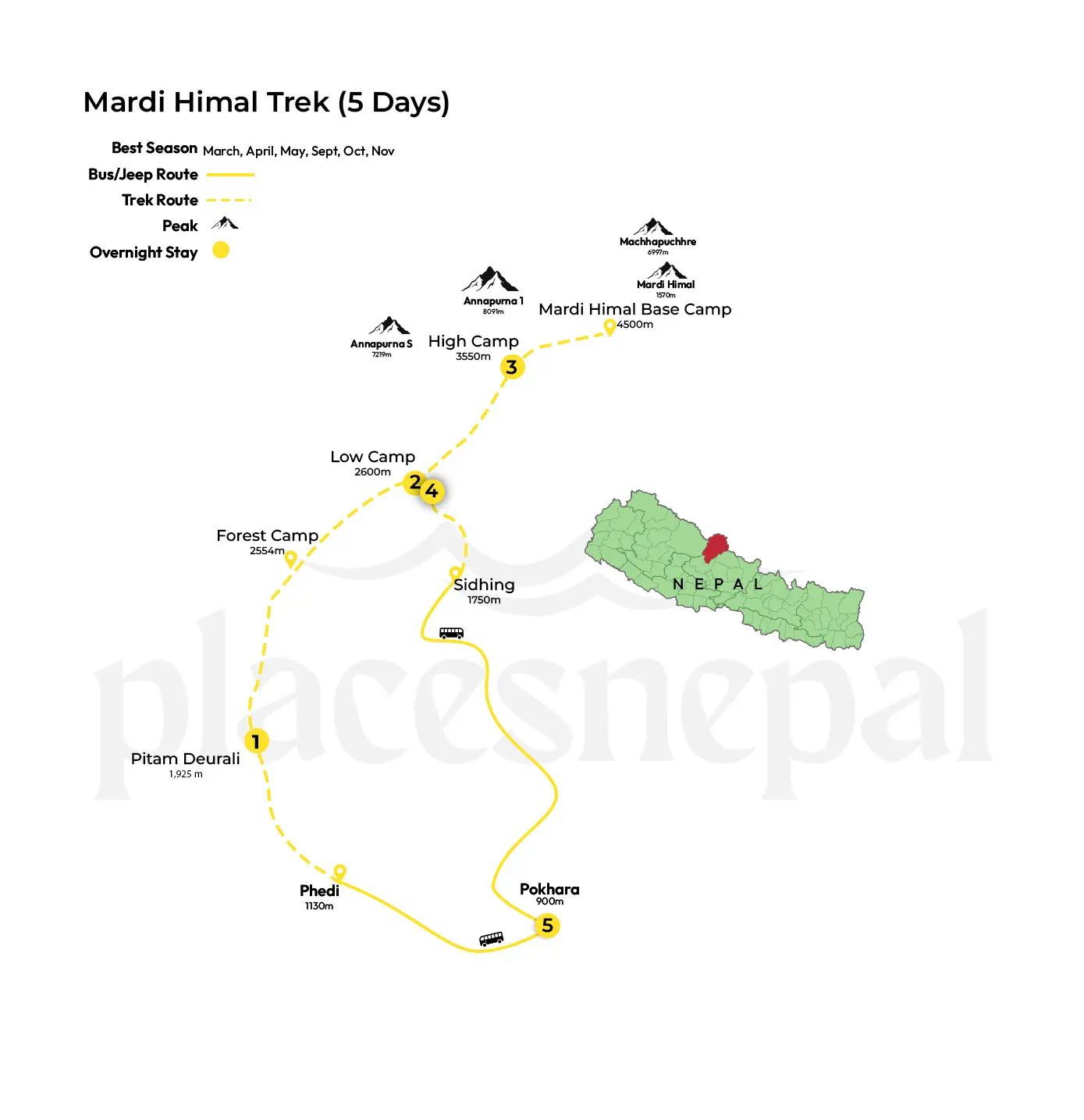
    Day 1Pokhara → Phedi (drive) → Pitam Deurali1,925 m4 hrs trek
    Day 2Pitam Deurali → Forest Camp → Low Camp2,985 m6 hrs trek
    Day 3Low Camp → High Camp3,550 m4 hrs trek
    Day 4High Camp → Mardi Himal Base Camp → Low Camp4,500 m summitSummit day · 7–8 hrs
    Day 5Low Camp → Siding Village → Pokhara (drive)1,700 m2.5 hrs trek
    Circuit route: This itinerary enters from Phedi and exits via Siding Village — a true circuit that avoids retracing steps and ends in a different valley. The descent through Siding offers a final glimpse of traditional Gurung village life before the drive back to Pokhara.

    The trek in detail

    The Mardi Himal Base Camp trek follows a northeast ridge from the Pokhara Valley into the heart of the Annapurna Conservation Area. The route gains altitude progressively over three days before a fourth-day summit push and a final descent to Siding Village. Each night is spent in a teahouse; all meals are provided throughout.

    The first day covers the approach from Phedi to Pitam Deurali — a 1,925 m ridge camp where the Mardi Himal trail proper begins. The forest here is dense and cool, and the trail passes through Gurung farmland before entering the rhododendron canopy that defines much of the lower route.

    Day two is the longest trekking day — a six-hour ascent through progressively thickening forest to Low Camp at 2,985 m. The route passes Forest Camp, a quiet cluster of teahouses in the trees, before breaking onto the open ridge at Low Camp where the first clear views of the Annapurna range appear. This is the day that separates Mardi Himal from a casual hill walk.

    Day three is shorter in distance but higher in altitude — a four-hour climb to High Camp at 3,550 m, where the forest gives way entirely to open alpine terrain and Machhapuchhre fills the northeastern horizon at extraordinary close range. This is the last teahouse camp before the summit and the setting for an early sleep before the 04:30 departure on Day 4.

    Day four is the most critical day of the trek. A pre-dawn climb from High Camp reaches the upper viewpoint at 4,200 m in time for sunrise, then continues to Mardi Himal Base Camp at 4,500 m. The panorama at Base Camp — Machhapuchhre, Annapurna I through IV, Hiunchuli, and the ridge of Mardi Himal itself — is the culmination of everything the trek promises. The descent follows: 1,515 m back down to Low Camp in a single afternoon, the most physically demanding section of the entire route.

    Day five is the reward — a gentle 2.5-hour descent from Low Camp through forest to Siding Village at 1,700 m, where a vehicle waits for the drive back to Pokhara. The contrast between the raw alpine environment of the previous four days and the warm, terraced farmland of Siding makes for an unexpectedly moving final morning.

    Who is this trek for?

    Well suited for
    Trekkers who can walk 5–6 hours comfortably on hilly terrain
    Those with a short travel window seeking a genuine high-altitude experience
    First-time trekkers in Nepal who have trained consistently beforehand
    Photographers and nature lovers — the route is visually extraordinary
    Anyone who wants Himalayan solitude without the Everest crowds
    Trekkers comfortable with basic teahouse accommodation
    Reconsider if you...
    Have done no physical preparation before the trek
    Have significant knee problems or recent leg injuries
    Have previously suffered severe altitude sickness above 3,000 m
    Are travelling in monsoon season (June–August)
    Expect hotel comfort or reliable electricity at high altitude
    Have known heart or serious lung conditions without medical clearance

    Trek extensions and alternative routes

    The Mardi Himal trail connects to several other routes in the Annapurna region, making it a versatile starting or ending point for a longer Nepal itinerary.

    Mardi Himal + Annapurna Base Camp (ABC)
    Trekkers can combine the Mardi Himal circuit with the Annapurna Base Camp trek, adding 3–4 days to reach ABC at 4,130 m. The trails connect via Chhomrong and the Modi Khola valley. A combined 9–10 day itinerary visits two of the Annapurna region's most spectacular destinations in a single trip.
    Mardi Himal + Ghorepani Poon Hill
    Poon Hill (3,210 m) is the most popular sunrise viewpoint in the Annapurna region. Combining it with the Mardi Himal trek creates a 9–10 day loop that covers two entirely different ridge systems and passes through iconic Gurung villages including Ghandruk and Ghorepani. Suitable for trekkers with slightly more time.
    Mardi Himal + Ghandruk Village Loop
    A shorter cultural extension that exits through Ghandruk — one of the largest and most beautifully preserved Gurung villages in Nepal. Adds one day to the itinerary and significantly enriches the cultural dimension of the trek with traditional architecture, local homestays, and a Gurung museum.

    How Much Does the Mardi Himal Trek Cost?

    Short answer: our fixed group departures start at US$350 per person, private treks from US$360 per person (price drops as your group grows — solo private is US$470). That covers the stuff that's annoying to organise yourself. Here's exactly where the money goes, because "package price" shouldn't be a mystery box.

    ⓘ Read more about Mardi Himal Trek Cost here: Mardi Himal Trek Cost

    What's inside the package price

    ItemRoughly what it costs
    ACAP permit (Annapurna Conservation Area)NPR 3,000 (~US$23)
    TIMS cardNPR 2,000 (~US$15)
    Licensed guide (5 days)US$125–175
    Pokhara ↔ trailhead transportUS$20–40
    Teahouse accommodation (4 nights)US$20–40
    Three meals a day on the trailUS$100–140

    Add porter service if you want your shoulders to thank you — extra US$130 for the trek, one porter carries for two trekkers.

    What's NOT in the package (budget this separately)

    • On-trail extras — hot showers (NPR 300–500), Wi-Fi (NPR 200–400), charging your phone (NPR 200–500 per device). All of these get pricier the higher you go, because everything up there arrives on someone's back.
    • Drinks and snacks — a Snickers at High Camp costs what a meal costs in Pokhara. That's just ridge economics.
    • Tips — not mandatory, always appreciated. Most trekkers budget around US$5–10/day for the guide and a bit less for a porter.
    • Travel insurance — non-negotiable for us. Make sure it covers trekking up to 4,500 m and helicopter evacuation.
    • Nepal visa — US$30 for 15 days on arrival.

    Realistic total for the 5-day trek: US$350–470 package + US$80–120 personal spending. Bring cash from Pokhara — there are no ATMs anywhere on the trail.

    Why do prices vary so much between companies?

    You'll see Mardi Himal packages online from US$200 to US$1,000+. The difference is usually: where the trek starts (Pokhara vs Kathmandu), group size, whether a porter is included, hotel nights before/after, and whether the company is local or an international reseller marking up a local operator (that's us, minus the markup — we're the ones actually on the trail).

    Required permits

      Annapurna Conservation Area — permit requirements
    TIMS CardTrekkers' Information Management System card — required for all trekking regions in Nepal. NPR 1,000 via a registered agency, NPR 2,000 for independent trekkers.
    ACAP PermitAnnapurna Conservation Area Permit — mandatory for entry into the conservation area. NPR 3,000 per person. Both permits are obtained in Pokhara or Kathmandu before the trek.
    Where to get themPermits can be obtained through the Nepal Tourism Board office in Pokhara or Kathmandu, but if you are trekking with Places Nepal, all permits are arranged on your behalf before departure so you can simply arrive and start the trek without dealing with paperwork. Permit checks are conducted at the checkpoint near Phedi, so keep digital or printed copies accessible during the trek.
    Note: Both permits are valid for single entry and cover the entire Annapurna Conservation Area. If you are also combining this trek with a Poon Hill or ABC extension, the same permits apply throughout.

    Best time for Mardi Himal Base Camp trek

    The Mardi Himal Base Camp trek is best undertaken in autumn (October–November) or spring (March–April) — Nepal's two main trekking seasons. Both offer stable weather, clear skies, and excellent mountain visibility.

    Autumn is the most popular season for good reason: the post-monsoon atmosphere is uniquely clear, the air is crisp, and the Himalayas are at their most photogenic. October in particular offers the most reliable conditions for the summit day ascent to Base Camp. Nights at High Camp drop below −5 °C from November — come equipped accordingly.

    Spring offers a different but equally compelling experience. The rhododendron forests between Pitam Deurali and Low Camp burst into colour from mid-March through April, turning the lower trail sections into one of Nepal's most photographed landscapes. Visibility is slightly softer than autumn due to pre-monsoon haze, but the floral display more than compensates.

    The monsoon months of June through August are not recommended — persistent rain makes the rooted forest trail slippery and dangerous, mountain views are obscured for days at a stretch, and leeches are abundant in the lower forest sections. December through February is possible for experienced trekkers with appropriate winter gear, but High Camp temperatures can drop to −15 °C and teahouses may be closed.

    Monday 7th September 2026
    To Friday 11th September 2026
    Guaranteed to run
    Available - Only 5 spots left
    Monday 14th September 2026
    To Friday 18th September 2026
    Guaranteed to run
    Monday 21st September 2026
    To Friday 25th September 2026
    Guaranteed to run
    Thursday 24th September 2026
    To Monday 28th September 2026
    Guaranteed to run
    Monday 28th September 2026
    To Friday 2nd October 2026
    Guaranteed to run
    Friday 2nd October 2026
    To Tuesday 6th October 2026
    Guaranteed to run
    Monday 5th October 2026
    To Friday 9th October 2026
    Guaranteed to run
    Monday 12th October 2026
    To Friday 16th October 2026
    Guaranteed to run
    Monday 19th October 2026
    To Friday 23rd October 2026
    Guaranteed to run
    Monday 26th October 2026
    To Friday 30th October 2026
    Guaranteed to run
    Monday 2nd November 2026
    To Friday 6th November 2026
    Guaranteed to run
    Monday 9th November 2026
    To Friday 13th November 2026
    Guaranteed to run
    Monday 16th November 2026
    To Friday 20th November 2026
    Guaranteed to run
    Monday 23rd November 2026
    To Friday 27th November 2026
    Guaranteed to run
    Monday 30th November 2026
    To Friday 4th December 2026
    Guaranteed to run

    Know Before Booking

    Mardi Himal Trek

    The Mardi Himal Trek is considered moderate to challenging, covering around 50 km round trip, with elevations ranging from 1,450 m to 4,500 m at Mardi Himal Base Camp. Trekkers need good physical fitness and experience with high-altitude hiking, but beginners with good health can also complete the trek with proper preparation.

    Factors Affecting Difficulty

    1. Steep Trails: Sections between Forest Camp and High Camp are steep and require careful footing.
    2. Altitude Gain: Rapid altitude changes can cause mild altitude sickness, so acclimatization is essential.
    3. Weather Conditions: Monsoon or winter snow can make paths slippery.
    4. Duration: Most trekkers complete it in 5 days, demanding stamina and endurance.

    Tips for a Safer Trek

    • Train with long hikes and stair climbs beforehand.
    • Carry lightweight gear and stay hydrated.
    • Take rest days for acclimatization to reduce altitude risks.
    • Hire a local guide for navigation and safety.

    Many trekkers ask, “When is the best time for Mardi Himal Trek?” The best seasons are autumn (September–November) and spring (March–May). During these months, the weather is moderate and visibility is clear. Himalayan views are at their best.

    Winter (December–February) is cold and can have snow at higher altitudes. Trekking is possible for experienced hikers with warm gear. Trails may be slippery.

    Monsoon (June–August) is not recommended. Heavy rain causes landslides, muddy trails, and poor visibility. Mountain views are often blocked by clouds.

    For a safe and enjoyable trek, plan your Mardi Himal Trek in autumn or spring. Winter is doable with preparation. Avoid monsoon due to high risks.

    Visa on Arrival

    Tourist visas can be obtained at Tribhuvan International Airport. Fees are USD 30 for 15 days, USD 50 for 30 days, and USD 125 for 90 days, all allowing multiple entries. Payment is in cash, preferably USD. To save time, complete the online visa form up to 15 days before arrival. Immigration and baggage clearance usually takes 1–1.5 hours.

    Airport Pickup

    A staff member will greet you outside the airport with a sign displaying your name and transfer you to your hotel via a private vehicle.

    SIM Cards

    Local SIM cards from Ncell or Nepal Telecom (NTC-Recommended) are available at the airport. Registration requires a passport copy and a passport-size photo.

    Currency Exchange

    Money exchange counters operate 24/7 in the arrivals area. Additional authorized exchange services are available near most hotels in the city.

    Teahouse accommodation is the most common option for the Mardi Himal Trek. These are basic lodges or guesthouses located along the trekking route, offering bed, meals, and shared bathrooms. Rooms are usually simple, clean, and warm, though hot water is limited, especially at higher altitudes.

    Meals are served in a communal dining area, typically including Dal Bhat (rice and lentil soup), noodles, and pasta. Electricity is available, but some teahouses rely on solar power, so charging devices may be limited.

    Teahouses provide a friendly, social atmosphere, where trekkers can relax, share stories, and enjoy panoramic Himalayan views. Booking in advance is generally not necessary, except during peak seasons (autumn and spring).

    Tips:

    • Carry a sleeping bag for comfort at higher elevations.
    • Bring snacks and personal items, as options are limited in remote areas.

    Teahouses along the Mardi Himal Trek serve a mix of Nepali and international dishes. The staple meal is Dal Bhat (rice and lentil soup), served with vegetables or meat. Other common options include noodles, pasta, soups, momos (dumplings), and eggs.

    Breakfast often features porridge, toast, eggs, and tea or coffee, while lunch and dinner offer hearty meals to fuel trekking. Fresh fruits and snacks are limited at higher altitudes, so it’s advisable to carry energy bars or trail mix.

    Drinks: Tea, coffee, and hot chocolate are widely available. Bottled water can be purchased, but it’s better to use a water purification method to refill bottles. Alcoholic drinks are rare in remote teahouses.

    The Mardi Himal Trek can be extended or combined with nearby trails for a more diverse trekking experience in the Annapurna region.

    1. Annapurna Base Camp (ABC) Extension: After reaching Mardi Himal Base Camp, trekkers can descend to ABC via Siding Village and Deurali, adding 2–3 days to the trek. This offers panoramic views of Annapurna South, Machapuchare, and Hiunchuli.

    2. Combined Mardi Himal and Ghorepani Poon Hill Trek: You can start or end the trek via Ghorepani, famous for its sunrise views over the Annapurna and Dhaulagiri ranges, adding 1–2 days.

    3. Short Mardi Himal Trek: For beginners or those short on time, the trek can be done as a 4–5 day round trip from Pokhara to High Camp and back, still offering excellent Himalayan views.

    4. Side Excursions: Explore local villages like Sidhing or Dhampus for cultural experiences, homestays, and traditional Nepali cuisine.

    To trek the Mardi Himal Trek in Nepal, you need two mandatory permits:

    1. ACAP Permit (Annapurna Conservation Area Project): This is required for all trekkers entering the Annapurna Conservation Area, including Mardi Himal. It helps support conservation and local communities.
    2. Trekking Information Management System (TIMS) Card: This card is mandatory for trekking in Nepal. It tracks trekkers for safety and can be obtained in Kathmandu or Pokhara.

    Cost:

    • ACAP Permit: Around USD 30–35 for foreigners.
    • TIMS Card: Approximately USD 20 for independent trekkers; included in most guided treks.

    The 5-day version is the sweet spot — but it's not the only way up. Here's how the options compare:

     4-Day Rapid5-Day Standard7-Day + Poon Hill
    Best forFit trekkers, tight schedulesMost people, first-timersView collectors, photographers
    PaceLong days, 6–8 hrs walkingBalanced, 4–6 hrs walkingRelaxed, more villages
    Altitude profileFast gain — feel it moreComfortable ascentGentlest of the three
    HighlightsSame views, less lingeringBadal Danda sunset + Base Camp sunriseAdds Poon Hill sunrise + Ghandruk
    FromUS$320 ppUS$350 ppUS$520 pp

    Can't decide? If you've never trekked above 3,000 m before, take the 5-day. The extra night is cheap insurance against altitude headaches, and Badal Danda at golden hour is not a place you want to rush through.

    FAQs for Mardi Himal Trek

    General FAQs

    Mardi Himal is located in the Annapurna region of Nepal, Gandaki Province, at 5,587 meters (18,330 feet) elevation. The mountain sits in Kaski District within the Annapurna Conservation Area, positioned between Annapurna massif and just below Machhapuchhre (Fishtail Mountain).

    The Mardi Himal trek starts from Pokhara, Nepal's adventure capital, 200 kilometers west of Kathmandu. The trekking route passes through Gurung villages like Dhampus, Landruk, and Siding, ascending through rhododendron forests to Mardi Himal Base Camp.

    Located east of Mardi Khola valley, the mountain offers panoramic views of Annapurna South (7,219m), Hiunchuli (6,441m), and Machhapuchhre (6,993m). Access points include Kande and Dhampus Phedi, reachable within 1-2 hours from Pokhara.

    This emerging Himalayan trekking destination provides authentic Nepal mountain experience with less crowded trails than Annapurna Circuit or Annapurna Base Camp routes.

    Mardi Himal lies in Kaski District of Nepal, situated in Gandaki Province. The mountain peak at 5,587 meters elevation falls within the Annapurna Conservation Area boundaries in Kaski District.

    Kaski District headquarters is Pokhara city, the gateway for Mardi Himal trekking expeditions. The district encompasses the entire Mardi Himal trekking region, including traditional Gurung settlements like Dhampus, Landruk, Siding, and Lwang village.

    Located in western Nepal, Kaski District borders Lamjung, Tanahu, Syangja, and Parbat districts. The Mardi Himal trek route entirely traverses Kaski District terrain, from Pokhara starting points through alpine forests to Mardi Himal Base Camp.

    This Kaski District location makes Mardi Himal easily accessible for trekkers, with Pokhara providing accommodation, trekking permits (Annapurna Conservation Area Permit and TIMS card), and transport facilities for the Mardi Himal hiking trail.

    Mardi Himal is famous for close-range Annapurna mountain views and uncrowded trekking trails in Nepal's Annapurna region. The trek offers panoramic Himalayan vistas including Annapurna South (7,219m), Machhapuchhre (6,993m), Hiunchuli (6,441m), and Mardi Himal peak (5,587m).

    Key attractions that make Mardi Himal famous:

    Spectacular Mountain Panoramas: Mardi Himal Base Camp provides 360-degree views of the Annapurna massif, often considered superior to crowded Annapurna Base Camp perspectives.

    Off-the-Beaten-Path Experience: Less commercialized than Annapurna Circuit or Everest Base Camp, offering authentic Himalayan wilderness and tranquility.

    Short Trek Duration: Completable in 5-7 days from Pokhara, ideal for trekkers with limited time seeking high-altitude mountain experience.

    Diverse Landscapes: Trek passes through subtropical forests, rhododendron blooms (spring season), alpine meadows, and glacier viewpoints.

    Gurung Culture: Traditional Gurung villages like Landruk and Siding showcase authentic Nepali mountain culture, homestays, and local hospitality.

    Accessible High Altitude: Reaches 4,500 meters at High Camp without technical climbing requirements, suitable for moderate-level trekkers.

    Mardi Himal's rising fame stems from delivering premium Annapurna region trekking experiences without mass tourism crowds, establishing it as Nepal's best emerging trek destination.

    People trek to Mardi Himal for close-up Machhapuchhre views, stunning Annapurna panoramas, and peaceful trails in Nepal's Himalayas.

    Primary reasons trekkers choose Mardi Himal:

    Closest Machhapuchhre (Fishtail) Views: Mardi Himal offers the most intimate perspective of sacred Machhapuchhre (6,993m), with the peak's distinctive fishtail summit appearing within arm's reach from High Camp and Base Camp viewpoints.

    Unobstructed Annapurna Range Panoramas: Experience 360-degree views of Annapurna South (7,219m), Annapurna I (8,091m), Hiunchuli (6,441m), and Dhaulagiri without crowds or obstructions.

    Less Crowded Trails: Escape mass tourism on Annapurna Base Camp and Annapurna Circuit routes while enjoying superior Machhapuchhre views and mountain scenery.

    Short Trek Duration: Complete the journey in 5-7 days from Pokhara, ideal for travelers with limited time seeking authentic Himalayan mountain experience.

    Moderate Difficulty Level: Reach 4,500 meters at Mardi Himal High Camp without technical climbing skills, suitable for beginner trekkers with basic fitness.

    Diverse Mountain Landscapes: Trek through rhododendron forests (blooming March-April), alpine meadows, and pristine wilderness within Annapurna Conservation Area.

    Authentic Gurung Culture: Experience traditional mountain villages like Landruk and Siding, offering homestays, local hospitality, and Nepali cultural immersion.

    Mardi Himal's proximity to Machhapuchhre's south face provides unmatched views of Nepal's most photogenic sacred peak, making it the preferred destination for photographers and mountain enthusiasts.

    Complete the Mardi Himal trek by obtaining permits in Pokhara, following the standard trekking route through Gurung villages to High Camp, and returning via the same or alternative trails.

    Step-by-step Mardi Himal trekking guide:

    Obtain Required Permits: Purchase Annapurna Conservation Area Permit (ACAP) and TIMS card (Trekkers' Information Management System) from Nepal Tourism Board office or ACAP counter in Pokhara before starting.

    Reach Pokhara Starting Point: Fly or drive from Kathmandu to Pokhara (200km). Take local transport to trek starting points: Kande, Dhampus Phedi, or Lwang village (1-2 hours from Pokhara).

    Follow Standard Trekking Route:

    • Day 1: Drive to Kande, trek to Deurali or Forest Camp (2,100m)
    • Day 2: Forest Camp to Low Camp (3,150m) through rhododendron forests
    • Day 3: Low Camp to High Camp (3,580m) with Machhapuchhre views
    • Day 4: High Camp to Mardi Himal Base Camp (4,500m) for sunrise, return to High Camp or Low Camp
    • Day 5-6: Descend to Siding village, Lwang, then drive back to Pokhara

    Choose Trekking Style: Trek independently with maps and GPS, hire local guides from Pokhara trekking agencies, or join organized group treks with porters for luggage carrying.

    Book Teahouse Accommodation: Reserve mountain lodges and guesthouses along the route offering meals, beds, and basic facilities. No camping equipment required for standard teahouse trekking.

    Pack Essential Gear: Bring trekking boots, warm layers, sleeping bag, water purification tablets, first aid kit, sunscreen, and headlamp for high-altitude conditions.

    Acclimatize Properly: Ascend gradually, stay hydrated, and recognize altitude sickness symptoms at High Camp and Base Camp elevations.

    The Mardi Himal trek requires moderate fitness, proper preparation, and 5-7 days total time from Pokhara, making it Nepal's most accessible Annapurna region trekking experience.

    Yes, you can combine Mardi Himal Trek with Annapurna Base Camp, Poon Hill, Annapurna Circuit, and Khopra Ridge treks for extended Annapurna region adventures.

    Popular Mardi Himal trek combinations:

    Mardi Himal + Annapurna Base Camp (ABC): Connect both base camps through Landruk or Chomrong village, creating 10-12 day comprehensive Annapurna trekking circuit with diverse mountain viewpoints.

    Mardi Himal + Poon Hill Trek: Add Poon Hill sunrise viewpoint (3,210m) by trekking through Ghorepani and Tadapani villages, extending journey to 8-10 days with panoramic Dhaulagiri and Annapurna ranges.

    Mardi Himal + Khopra Ridge Trek: Combine via Tadapani or Ghandruk connection, offering remote ridge walking and Khayer Lake visit, totaling 12-14 days off-the-beaten-path experience.

    Mardi Himal + Annapurna Circuit: Extend through Ghandruk to join Annapurna Circuit at Chomrong or continue to Manang via Thorong La Pass (5,416m), creating 18-21 day epic Himalayan journey.

    Mardi Himal + Ghandruk Village Loop: Descend through traditional Ghandruk Gurung village, adding cultural immersion and alternative route back to Pokhara in 6-8 days total.

    Combination trek benefits: Experience varied landscapes, multiple base camps, diverse Annapurna perspectives, reduced per-day costs, and comprehensive Nepal Himalayan adventure without repeating trails.

    Planning considerations: Extended treks require additional permits (same ACAP and TIMS cover combined routes), increased fitness levels, more supplies, and flexible schedules for weather and acclimatization days.

    Combined Mardi Himal treks maximize your Annapurna region exploration, offering better value and complete Himalayan trekking experiences in single Nepal adventure.

    The shortest Mardi Himal trek takes 4 days, minimum recommended duration is 5-6 days, and maximum extended duration reaches 10-12 days depending on route variations and acclimatization needs.

    Mardi Himal trek duration breakdown:

    Shortest Duration (4 Days): Fast-paced itinerary for experienced trekkers with excellent fitness:

    • Day 1: Drive Pokhara to Kande, trek to Low Camp (3,150m)
    • Day 2: Low Camp to High Camp (3,580m) to Base Camp (4,500m), return to High Camp
    • Day 3: High Camp to Forest Camp or Siding village
    • Day 4: Trek to Lwang, drive back to Pokhara

    Minimum Recommended Duration (5-6 Days): Standard Mardi Himal trekking itinerary with proper acclimatization:

    • Includes gradual ascent through Deurali, Forest Camp, Low Camp, High Camp, and Base Camp
    • Allows acclimatization at altitude, reduces altitude sickness risk
    • Provides time for sunrise viewpoints and photography at Mardi Himal Base Camp

    Comfortable Duration (7-8 Days): Leisurely pace with rest days and exploration:

    • Extra acclimatization day at Low Camp or High Camp
    • Side trips to viewpoints near Machhapuchhre Base Camp area
    • Cultural exploration in Gurung villages like Landruk and Ghandruk

    Maximum Extended Duration (10-12 Days): Combined trekking routes:

    • Mardi Himal + Annapurna Base Camp combination
    • Mardi Himal + Poon Hill sunrise trek
    • Multiple rest days, photography stops, and alternative descent routes through Ghorepani or Tadapani

    Duration factors: Your Mardi Himal trek length depends on fitness level, acclimatization requirements, weather conditions, available vacation time, and whether you add Annapurna region side trips.

    Most trekkers choose 5-7 day Mardi Himal itineraries from Pokhara for optimal mountain experience, safety, and acclimatization balance.

    No, prior trekking experience is not required for Mardi Himal Trek, though basic fitness is essential.

    Why experience isn't necessary:

    Simple Navigation: Well-marked teahouse trails with clear paths. No technical climbing, rope work, or glacier crossing required.

    Support Infrastructure: Mountain lodges every 2-3 hours provide meals, accommodation, and route guidance from experienced staff.

    Gradual Ascent: Progressive altitude gain allows inexperienced trekkers to adapt daily while building stamina.

    What matters instead:

    • Basic fitness: Walk 5-7 hours comfortably with moderate inclines
    • Pre-trek training: 4-6 weeks cardio exercise (jogging, stair climbing, hiking)
    • Proper gear: Broken-in trekking boots, warm layers, rain protection
    • Local guide: Compensates for inexperience with navigation, safety, and pace management
    • Altitude awareness: Recognize symptoms, stay hydrated (3-4 liters daily)

    Challenging sections: High Camp steep ascent (Day 4), Base Camp pre-dawn hike at 4,350m (Day 5), long descent (Day 6).

    First-time trekkers successfully complete Mardi Himal regularly. Physical preparation and determination matter more than previous Himalayan trekking experience.

    Mardi Himal Base Camp is located at 4,350 meters (14,271 feet) above sea level in Nepal's Annapurna Conservation Area.

    Mardi High Camp is located at 3,550 meters (11,647 feet) above sea level.

    The highest elevation of the Mardi Himal Trek is 4,350 meters (14,271 feet) at Mardi Himal Base Camp.

    Mardi Himal Base Camp: 4,350 meters (14,271 feet) - highest point with panoramic Annapurna and Machhapuchhre views

    Mardi High Camp: 3,550 meters (11,647 feet) - main overnight viewpoint before Base Camp with close Machhapuchhre perspectives

    Low Camp: 3,150 meters (10,334 feet) - first alpine viewpoint offering Annapurna South and Hiunchuli mountain vistas

    Forest Camp: 2,554 meters (8,379 feet) - emerging mountain views through rhododendron forest clearings

    Pothana: 1,890 meters (6,201 feet) - lower viewpoint with Annapurna range panoramas and Pokhara valley views

    Mardi Himal Base Camp provides 360-degree Himalayan panorama with close-range views of Machhapuchhre's south face, making it one of Nepal's premier mountain viewpoints in the Annapurna Conservation Area.

    Machhapuchhre (Fishtail Mountain): 6,993 meters - closest and most prominent peak with distinctive twin summit

    Annapurna South: 7,219 meters - massive south face dominates southern skyline

    Mardi Himal Peak: 5,587 meters - summit directly above Base Camp

    Hiunchuli: 6,441 meters - pyramid-shaped peak between Annapurna South and Machhapuchhre

    Annapurna I: 8,091 meters - world's 10th highest mountain visible to the north

    Gangapurna: 7,455 meters - glacier-covered peak in Annapurna massif

    Annapurna III: 7,555 meters - prominent peak in central Annapurna range

    Dhaulagiri: 8,167 meters - world's 7th highest mountain visible on clear days to the west

    Manaslu: 8,163 meters - distant view of world's 8th highest peak to the east

    Lamjung Himal: 6,983 meters - eastern Annapurna region peak

    Yes, you can see yaks and yak-cow crossbreeds (dzo/dzopkyo) during Mardi Himal Trek, particularly at higher elevations above 3,000 meters.

    Where to spot yaks on Mardi Himal:

    High Camp (3,550m): Yaks graze alpine meadows and transport supplies to lodges. Most common yak sighting location with herds visible near teahouses.

    Low Camp to High Camp trail (3,150-3,550m): Yak caravans carry goods, trekking supplies, and construction materials along narrow mountain paths.

    Mardi Himal Base Camp area (4,350m): Occasional yak herding in alpine pastures, though less frequent than lower elevations.

    Yak vs Cattle: True yaks appear above 3,000 meters where temperatures suit their thick coats. Lower elevations (Forest Camp, Pothana) feature regular cattle and buffalo, not yaks.

    Yak caravan encounters: Step to uphill side when yaks pass on narrow trails. These large animals transport heavy loads and have right-of-way on mountain paths.

    Best season for yak sightings: Spring (March-May) and autumn (October-November) when herders move livestock to high-altitude grazing areas and lodges receive supply deliveries.

    Yaks are integral to Mardi Himal trekking logistics, transporting food, fuel, and building materials to remote teahouses where vehicle access is impossible in Nepal's Annapurna region.

    There are no specific restrictions on who can join the Mardi Himal Trek based on age, gender, nationality, or religion. The trail is open to everyone who is physically fit and prepared for moderate trekking conditions.

    However, most trekking companies recommend the trek for individuals aged 10 and above, as younger children may find the altitude and long walking hours challenging. Older trekkers are also welcome, provided they are in good health and have medical clearance if needed.

    Both men and women from all nationalities safely complete this trek every year. Nepal’s trekking routes, including Mardi Himal, are known for being welcoming, inclusive, and culturally respectful. Trekkers of any faith or background can participate without restriction, as long as they follow local customs and respect the mountain environment.

    This itinerary includes two nights in Pokhara during the Mardi Himal Trek: one night before the trek and one night after the trek to relax and recover before heading back to Kathmandu or onward travel.

    Trekkers may choose to extend their stay in Pokhara to explore the city, enjoy the lakeside, or do sightseeing activities, but the standard package includes 2 nights.

    Sort of — and the naming trips everyone up. The cluster of prayer flags most trekkers reach at ~4,200 m is the Upper Viewpoint, which locals and maps often call Base Camp. The "true" base camp at 4,500 m is a further push along the ridge, and whether you continue depends on weather, snow, and how your lungs are feeling. Either way, the view of Machhapuchhre's south face is absurd from both.

    About 50 km round trip, typically walked over 4–7 days. Our standard itinerary is 5 days from Pokhara to Pokhara.

    No — the last ATMs are in Pokhara. Carry enough Nepali rupees for your extras (hot showers, Wi-Fi, charging, snacks, tips). NPR 15,000–20,000 covers most people comfortably for 5 days.

    Yes — teahouses sell boiled and filtered water, and there are spring sources at points along the route. Bring purification tablets or a filter bottle and skip the single-use plastic; everything you buy up there had to be carried up, and everything you toss has to be carried down.

    Spring (March–May) for rhododendrons in full riot, autumn (October–November) for the sharpest skies. Winter is doable and beautifully quiet but expect snow above Low Camp; monsoon means leeches in the forest and clouds on the ridge — we'd steer you elsewhere in July–August.

    Mardi Himal Trek Difficulty

    The Mardi Himal Trek is 40-50 kilometers total distance depending on starting point and route variations, with approximately 25-30 kilometers ascent and 20-25 kilometers descent.

    Mardi Himal trek distance breakdown:

    Standard Route Distance (Kande to Base Camp):

    • Total trekking distance: 46 kilometers round trip
    • Ascent route: 23 kilometers from Kande (1,770m) to Mardi Himal Base Camp (4,500m)
    • Descent route: 23 kilometers returning via same trail or alternative paths through Siding village

    Daily Trekking Distances:

    • Day 1: Kande to Forest Camp – 6-7 kilometers (4-5 hours)
    • Day 2: Forest Camp to Low Camp – 5-6 kilometers (4-5 hours)
    • Day 3: Low Camp to High Camp – 4-5 kilometers (3-4 hours)
    • Day 4: High Camp to Mardi Himal Base Camp – 3-4 kilometers (2-3 hours), return to High Camp
    • Day 5-6: High Camp descent to Siding/Lwang – 12-15 kilometers (5-6 hours)

    Alternative Route Distances:

    • Via Dhampus starting point: 48-52 kilometers total
    • Via Lwang village route: 42-45 kilometers total
    • Combined with Annapurna Base Camp: 80-90 kilometers total

    Distance factors: Actual Mardi Himal trek kilometers vary with side trips to viewpoints, detours around landslides, alternate descent routes through Ghandruk or Landruk villages, and weather-related path changes.

    The moderate 40-50 kilometer distance makes Mardi Himal trek achievable for beginner trekkers with basic fitness, covering comfortable daily walking distances without excessive physical strain while reaching 4,500-meter altitude.

    The average daily walking time during Mardi Himal trek is 5-6 hours, ranging from 3-4 hours on shorter days to 7-8 hours on longer trekking sections.

    Daily walking time based on standard itinerary:

    Day 2 (Phedi to Pothana): 4-5 hours trekking, covering moderate uphill trail from 1,130m to 1,890m through villages and terraced farmland.

    Day 3 (Pothana to Forest Camp): 5-6 hours walking through rhododendron forests, ascending from 1,890m to 2,554m with steeper inclines and forest trails.

    Day 4 (Forest Camp to High Camp): 6-7 hours challenging ascent through Low Camp, gaining 1,000 meters elevation to 3,550m with alpine terrain and Machhapuchhre viewpoints.

    Day 5 (High Camp to Base Camp round trip): 7-8 hours total including 3-4 hours ascent to Mardi Himal Base Camp (4,350m), sunrise viewing, and 3-4 hours descent back to High Camp.

    Day 6 (High Camp to Siding Village): 6-7 hours continuous descent covering significant elevation loss from 3,550m to 1,750m through forest trails and Gurung villages.

    Walking time factors:

    • Individual fitness levels and acclimatization
    • Weather conditions affecting trail difficulty
    • Photography stops at mountain viewpoints
    • Rest breaks every 45-60 minutes for hydration
    • Altitude effects above 3,000 meters slowing pace

    Rest breaks: Walking times include short rest stops but exclude 1-hour lunch breaks at teahouses along the route.

    The 5-6 hour average daily walking makes Mardi Himal trek achievable for trekkers with moderate fitness, allowing comfortable pace without extreme physical demands while reaching high-altitude Annapurna region viewpoints.

    The Mardi Himal Trek is moderately difficult, requiring basic fitness levels and suitable for beginner trekkers with proper preparation, though high altitude and steep sections present challenges.

    Mardi Himal trek difficulty factors:

    Physical Demands: 5-7 hours daily walking for 5 consecutive days, totaling 40-50 kilometers with 2,500+ meters cumulative elevation gain from Phedi (1,130m) to Base Camp (4,350m).

    Altitude Challenge: Maximum altitude 4,350 meters at Mardi Himal Base Camp increases altitude sickness risk. High Camp at 3,550 meters requires acclimatization, though gradual ascent through Forest Camp (2,554m) and Low Camp (3,150m) helps adjustment.

    Steep Ascents: Day 4 (Forest Camp to High Camp) involves challenging 1,000-meter elevation gain through steep forest trails and exposed alpine terrain requiring stamina and determination.

    Trail Conditions: Well-marked teahouse trekking paths with stone steps, forest trails, rocky sections, and narrow ridgeline walking. Winter season (December-February) adds snow and ice hazards above 3,000 meters.

    Longest Day: Day 5 (High Camp to Base Camp round trip) demands 7-8 hours trekking with pre-dawn Base Camp hike for sunrise views, testing endurance at high altitude.

    Descent Difficulty: Day 6 continuous 6-7 hour descent from High Camp (3,550m) to Siding Village (1,750m) strains knees and leg muscles over steep downhill terrain.

    Technical Skills Required: No mountaineering or rock climbing skills needed. Basic trekking experience helpful but not mandatory for Mardi Himal trail navigation.

    Fitness Requirements:

    • Walk 5-6 hours comfortably with daypack
    • Handle steep uphill/downhill sections
    • Adjust to thin air above 3,000 meters
    • Manage basic teahouse accommodation conditions

    Preparation Recommendations: Train with cardio exercises (running, cycling, stair climbing) 4-6 weeks before trek. Practice hiking with backpack on inclined terrain to build leg strength and endurance.

    Mardi Himal rates moderate difficulty (3/5) – easier than Annapurna Circuit or Everest Base Camp, harder than Poon Hill trek, making it ideal first high-altitude Himalayan trekking experience for reasonably fit adventurers.

    Yes, Mardi Himal Trek is suitable for beginners with basic fitness, making it an excellent first Himalayan trek in Nepal's Annapurna region.

    Why beginners can do Mardi Himal:

    No Technical Skills Required: Well-marked teahouse trails need no climbing or mountaineering experience. Simple uphill and downhill walking on established paths.

    Gradual Altitude Gain: Progressive ascent from Phedi (1,130m) through Forest Camp (2,554m) to High Camp (3,550m) allows proper acclimatization, reducing altitude sickness risk.

    Teahouse Accommodation: Mountain lodges provide beds, meals, and facilities throughout route. No camping equipment or wilderness skills needed.

    Manageable Duration: 5 trekking days with 5-7 hours daily walking. Shorter than Annapurna Base Camp or Everest Base Camp treks.

    Beginner requirements:

    • Basic cardiovascular fitness (walk 5-6 hours comfortably)
    • 4-6 weeks pre-trek training: jogging, stair climbing, hiking practice
    • Proper gear: trekking boots, warm layers, rain jacket
    • Local guide recommended for safety and navigation

    Challenging sections for beginners:

    • Day 4: Steep 1,000m climb to High Camp
    • Day 5: Pre-dawn Base Camp hike at 4,350m altitude
    • Day 6: Long descent testing knees and stamina

    Mardi Himal offers beginner-friendly Himalayan experience with stunning Machhapuchhre views, manageable difficulty, and high success rates for first-time trekkers with reasonable preparation.

     It's one of the best first treks in Nepal — short, teahouse-supported, no technical sections. The honest caveat: the day from Low Camp to High Camp and the pre-dawn push to the viewpoint are steeper than the "easy trek" label suggests. If you can comfortably walk 5–6 hours with some sustained uphill, you're fine.

    Mardi Himal Trek Permits

    Yes, you need two permits for Mardi Himal Trek: Annapurna Conservation Area Permit (ACAP) and Trekkers' Information Management System (TIMS) card.

    Required Mardi Himal trekking permits:

    Annapurna Conservation Area Permit (ACAP):

    • Cost: NPR 3,000 (approximately USD 22-25) for foreign nationals
    • Cost: NPR 1,000 for SAARC country citizens
    • Covers entire Annapurna Conservation Area including Mardi Himal route

    TIMS Card (Trekkers' Information Management System):

    • Cost: NPR 2,000 (approximately USD 15-18) for individual trekkers
    • Free for trekkers with registered agency or guide
    • Required for trekker safety tracking and registration

    Where to obtain permits:

    In Pokhara: Nepal Tourism Board office or ACAP counter at Damside, Pokhara (most convenient before trek)

    In Kathmandu: Nepal Tourism Board office at Pradarshani Marg, Kathmandu or TAAN office

    Documents required:

    • Valid passport with Nepal visa
    • Two passport-size photographs
    • Trekking itinerary details
    • Agency letter (if trekking with registered company)

    Permit checkpoints: Present both permits at entry checkpoints in Kande/Phedi area and possibly at Forest Camp checkpoint along Mardi Himal route.

    Both ACAP and TIMS permits are mandatory for legal Mardi Himal trekking. Trekking without permits results in fines and potential deportation from Annapurna Conservation Area.

    Two permits are required for Mardi Himal Base Camp trekking: Annapurna Conservation Area Permit (ACAP) and Trekkers' Information Management System (TIMS) card.

    Annapurna Conservation Area Permit (ACAP):

    • NPR 3,000 (USD 22-25) for foreign nationals
    • NPR 1,000 for SAARC citizens
    • Covers Annapurna Conservation Area including Mardi Himal

    TIMS Card:

    • NPR 2,000 (USD 15-18) for independent trekkers
    • Free with registered guide or trekking agency

    Both permits are mandatory for legal Mardi Himal Base Camp trekking in Nepal.

    Mardi Himal Trek Guide

    No, a guide is not legally required for Mardi Himal Trek, but hiring one is highly recommended for safety, navigation, and enhanced experience.

    Independent trekking allowed: Nepal permits solo trekking on Mardi Himal with valid ACAP and TIMS permits. Well-marked teahouse trails enable self-guided navigation.

    Benefits of hiring a trek guide:

    Safety and Navigation: Guides know trail conditions, weather patterns, alternate routes, and emergency procedures at high altitude.

    Altitude Sickness Management: Experienced guides recognize symptoms early, adjust pace appropriately, and arrange emergency evacuation if needed.

    Cultural Insights: Local guides explain Gurung culture, mountain history, identify peaks, and facilitate village interactions.

    Logistics Support: Guides book teahouse accommodation, order meals, communicate in Nepali, and handle permit checkpoints efficiently.

    Emergency Assistance: Medical emergencies, weather delays, or trail closures require local knowledge and rescue coordination guides provide.

    Cost considerations: Local Mardi Himal guides charge USD 25-35 daily including food and accommodation, adding value through expertise and supporting local economy.

    When guides are essential: First-time Himalayan trekkers, winter season conditions, solo travelers (especially women), and those concerned about altitude sickness benefit significantly from guide services.

    While independent Mardi Himal trekking is possible, hiring experienced local guides enhances safety, enriches cultural experience, and supports Nepal's mountain communities.

    Yes, you can do Mardi Himal Trek solo. Nepal allows independent trekking on this route with valid ACAP and TIMS permits.

    Solo female trekkers: Mardi Himal is generally safe for women trekking alone. Stay at established teahouses, avoid night walking, and connect with other travelers.

    Solo Mardi Himal trekking is achievable with proper preparation, though hiring a guide significantly enhances safety and experience, especially for first-time Himalayan trekkers.

    Yes, you can join group treks on Mardi Himal if traveling alone. Places Nepal organizes Mardi Himal treks throughout the year with scheduled group departures for solo travelers.

    How to join Mardi Himal group treks:

    Check Group Departures: Visit the group departure section on Places Nepal website to view upcoming Mardi Himal trek dates and availability for joining organized groups.

    Year-Round Departures: Places Nepal operates Mardi Himal treks every season—spring (March-May), autumn (October-November), winter (December-February), and monsoon (June-August)—ensuring flexible joining options.

    Book in Advance: Reserve your spot online through Places Nepal for guaranteed group departures with experienced guides, fixed itineraries, and confirmed accommodation.

    Last-Minute Joining: Contact Places Nepal directly for immediate group availability if you're already in Pokhara or Kathmandu seeking quick departure options.

    Group trek benefits for solo travelers:

    Shared Costs: Split guide fees, porter expenses, and transportation among group members, making Mardi Himal trek more affordable than solo arrangements.

    Safety and Support: Trek with experienced Places Nepal guides, group assistance during altitude challenges, and emergency support at high elevations.

    Social Experience: Meet fellow trekkers, share Himalayan adventures, evening lodge conversations, and build lasting travel connections.

    Hassle-Free Organization: Places Nepal handles all permits (ACAP, TIMS), teahouse bookings, meals, transportation, and itinerary logistics for stress-free trekking.

    Typical group sizes: 4-12 trekkers per departure with professional guides ensuring personalized attention while maintaining group dynamics.

    Join Places Nepal's Mardi Himal group treks for affordable, safe, and memorable Annapurna region trekking experience. Check the group departure section at www.placesnepal.com for upcoming trek dates.

    Tipping is not mandatory for porters and guides on the Mardi Himal Trek, but it is strongly appreciated if you are satisfied with their service.

    Tips are usually given at the end of the trek in cash (Nepalese Rupees or USD). The amount can vary depending on the quality of service, difficulty of the trek, and your budget. While not required, tipping is a meaningful way to show gratitude for their hard work, support, and dedication throughout the trek.

    As a guideline:

    • Guide: $5–10 per day, per trekker

    • Porter: $3–5 per day, per trekker

    After reaching Mardi Himal Base Camp (4,350 m / 14,271 ft) on Day 5, you descend back to High Camp (3,550 m / 11,647 ft) the same day for an overnight stay.

    On Day 6, you continue descending to Siding Village (1,750 m / 5,741 ft). From there, you are driven back to Pokhara (822 m / 2,696 ft). This part of the journey allows you to relax after several days of trekking while enjoying the changing landscapes—from high alpine terrain to forested hills and rural villages.

    Day 7 involves a return to Kathmandu (1,350 m / 4,429 ft) by deluxe tourist bus, giving you time to rest, reflect on the trek, and enjoy the scenic drive through the hills and valleys of central Nepal.

    In short, the return journey is a combination of trekking and comfortable road travel, gradually bringing you from the high Himalayas back to the city.

     No — and here's the honest version. Since April 2023, Nepal requires all international trekkers to have a licensed guide on routes inside conservation areas, and Mardi Himal sits inside the Annapurna Conservation Area. You'll be checked at permit checkpoints along the trail, and independent trekkers without a guide can be turned around. But honestly? A guide on this route doesn't kill the solo vibe — the trail stays quiet, you set the pace, and when the afternoon fog rolls over the ridge above Low Camp (it will), you'll be glad someone knows exactly where the path bends. Solo travelers are welcome on our fixed departures, or we'll set you up with a private guide and you can have the ridge to yourself.

    Yes. Since April 2023, a licensed guide is mandatory for foreign trekkers in the Annapurna Conservation Area, and you'll pass checkpoints that verify it. See the callout above — it's less of a downgrade to the solo experience than you'd think.

    Mardi Himal Trek Cost

    Mardi Himal Trek costs vary by group size. Places Nepal offers the following rates:

    Places Nepal pricing:

    Solo Trekker (1 person): USD 980 with private guide and personalized services

    Small Group (2-5 people): USD 675 per person with shared guide and porter support

    Medium Group (6-10 people): USD 550 per person with cost-efficient group logistics

    Large Group (11-15 people): USD 450 per person with maximum cost sharing

    Package includes: Experienced guide, porter support, ACAP and TIMS permits, teahouse accommodation, meals (breakfast, lunch, dinner), and Pokhara-Kathmandu transportation.

    Independent trekking costs:

    Permits: USD 37-40 (ACAP NPR 3,000 + TIMS NPR 2,000)

    Accommodation: USD 3-8 per night at teahouses

    Meals: USD 15-25 daily for breakfast, lunch, dinner

    Transportation: USD 10-20 Pokhara to trailhead and return

    Total independent cost: USD 200-350 without guide/porter

    Additional expenses:

    • Travel insurance: USD 50-100
    • Hot showers: USD 2-4 per shower
    • Battery charging: USD 2-3 per device
    • Guide/porter tips: USD 50-100

    Book with Places Nepal for organized Mardi Himal trek packages with transparent pricing. Visit www.placesnepal.com for group departures and current availability.

    Included:

    The package covers airport pick-up and drop-off by private vehicle, two nights at a 3-star hotel in Pokhara with breakfast, and deluxe bus travel between Pokhara and Kathmandu. All ground transportation mentioned in the itinerary is included. During the trek, all meals (breakfast, lunch, and dinner) and four nights of lodge-to-lodge accommodation on a shared basis are provided. A licensed English-speaking guide and porter service (one porter for every two trekkers, carrying up to 20 kg) are included, along with their insurance, food, lodging, and equipment. The cost also includes a first aid kit, oximeter, trekking permits, required documents, and rescue assistance in emergencies (with valid travel insurance). Trekkers receive a trekking map, hat, duffel bag, and achievement certificate. All government taxes and service charges are covered.

    Not Included:

    The cost does not cover travel insurance (mandatory), international flights, or the Nepal entry visa. Visa fees are $30 for 15 days, $50 for 30 days, and $125 for 90 days. Personal expenses, beverages, and additional costs for hot showers, Wi-Fi, or phone use during the trek are excluded. Personal trekking gear is not provided, and tips for guides and porters are appreciated but not mandatory.

    Yes, there can be some extra charges during the Mardi Himal Trek. These usually include personal expenses such as bottled water, snacks, and beverages, as well as fees for hot showers, Wi-Fi, or phone charging at lodges.

    You may also need to pay for laundry services, extra meals or drinks in Pokhara, and tips for guides or porters. Additionally, if you choose to upgrade accommodation or transportation, those costs are not included in the standard package.

    During the Mardi Himal Trek, it’s best to carry and use Nepalese Rupees (NPR) for all payments. ATMs and card facilities are only available in major cities like Kathmandu and Pokhara, not along the trekking route. Before starting your trek, withdraw or exchange enough cash in these cities to cover personal expenses such as water, snacks, Wi-Fi, hot showers, and tips.

    Large hotels, restaurants, and our agency accept credit cards or foreign currencies (USD, EUR), but local tea houses and shops along the trail deal only in NPR. It’s wise to carry small denominations for easier transactions. Keep your cash in a secure, waterproof pouch and avoid carrying large amounts unnecessarily.

    In short, handle your money in Nepalese Rupees, prepare your cash before leaving Pokhara, and use cards only in major towns.

    Booking and Cancellation

    The payment system for the Mardi Himal Trek involves a 10% deposit and a final payment. Places Nepal Treks need a 10% deposit to confirm your booking, with the remaining balance payable upon arrival in Kathmandu. We accept credit cards like Visa and MasterCard, as well as cash in major currencies such as USD or NPR (Nepalese Rupees).

    During the trek itself, payments are mostly made in cash. Local lodges, tea houses, and shops in the mountain areas do not accept cards, and ATMs are very limited or unavailable. Therefore, it is best to withdraw or exchange enough Nepalese Rupees in Pokhara or Kathmandu before starting the trek.

    In summary, while cards and foreign currencies are accepted in the main cities, only Nepalese Rupees in cash are used during the Mardi Himal Trek.

    The Mardi Himal Trek requires a 10% deposit at the time of booking, which is non-refundable. However, if you cancel your trip, this deposit is kept safe and can be used toward any future trip with Places Nepal. This deposit acts as a lifetime credit for your next adventure, so you don’t lose it entirely.

    The cancellation policy for the Mardi Himal Trek is as follows:

    • 31+ days before departure: 80% refund

    • 15–30 days before departure: 50% refund

    • Less than 15 days before departure: No refund

    Please note that cancellations must be made in writing. No refunds are provided for missed services, early departures, or cancellations due to personal reasons.

    For more details, you can refer to our Terms and Conditions.

    Health and Safety

    Yes, the Mardi Himal Trek is generally very safe. It is a well-established trekking route with clearly marked trails and experienced local guides available throughout the journey. The altitude is moderate compared to other high Himalayan treks, reducing the risk of severe altitude sickness.

    Trekking with a licensed guide adds extra safety, as they are trained in first aid and altitude management. Lodges along the trail are reliable and provide basic but comfortable accommodation and meals.

    However, as with any mountain trek, it’s important to follow your guide’s instructions, stay hydrated, walk at a steady pace, and have proper travel insurance that covers trekking and emergency evacuation. With the right preparation, the Mardi Himal Trek is considered a safe and rewarding experience for most trekkers.

    Yes, there is a small risk of altitude sickness on the Mardi Himal Trek, but it is generally mild and manageable. The highest point of the trek, Mardi Himal Base Camp, sits at around 4,500 meters (14,764 ft) — an altitude where some trekkers may feel symptoms like headache, dizziness, or shortness of breath.

    To minimize the risk, it’s important to ascend gradually, stay hydrated, avoid alcohol, and rest properly. The trekking itinerary usually allows enough time for acclimatization. Guides carry a first aid kit and oximeter to monitor oxygen levels, and they are trained to handle altitude-related issues.

    Serious altitude sickness is rare on this route, especially if you trek at a steady pace and listen to your body.

    Yes, trekkers can experience mild altitude sickness even during the short 4-day Mardi Himal Trek, although it’s not very common. The trek reaches elevations of up to 4,500 meters (14,764 ft) at Mardi Himal Base Camp, where the air is thinner, and oxygen levels are lower.

    Some trekkers may feel headache, fatigue, dizziness, or shortness of breath—especially if they ascend too quickly or don’t drink enough water.

    Yes, travel insurance is mandatory for the Mardi Himal Trek. Trekking in the Himalayas involves remote mountain terrain, unpredictable weather, and varying altitudes, so having insurance ensures your safety and financial protection in case of emergencies.

    Your policy should specifically cover high-altitude trekking (up to 4,500 meters) and include emergency helicopter evacuation, medical treatment, trip cancellation, and lost or delayed baggage.

    You’ll need to provide proof of insurance before starting the trek, as rescue and evacuation services in Nepal can be costly without proper coverage.

    In short, valid travel insurance is not just a requirement—it’s an essential safeguard for your health and peace of mind during the Mardi Himal Trek.

    There have been a few isolated incidents and safety alerts on the Mardi Himal Trek in recent years, though the route remains generally safe for trekkers who follow proper guidance and precautions. In October 2024, a Chinese trekker went missing from High Camp but was safely rescued two days later. Similarly, in 2023, a Swedish trekker was reported missing on the trail. Local authorities have also issued occasional weather-related advisories, such as the October 2025 warning urging travelers to avoid high-altitude areas due to heavy rainfall and snowfall risks.

    Some sections of the trail, especially near High Camp, can become slippery or unstable during bad weather, and accidents have occurred when trekkers attempted shortcuts or lesser-known side paths.

    Despite these incidents, the Mardi Himal Trek is considered safe when trekked with a licensed guide and proper preparation. Staying informed about weather conditions, avoiding off-route trails, and carrying valid travel insurance greatly reduce risks. With caution and awareness, trekkers can enjoy the Mardi Himal route safely and confidently.

    Packing and Prep

    To prepare physically for the Mardi Himal Trek, focus on building stamina, leg strength, and endurance. The trail involves several hours of uphill and downhill walking each day, so consistent training helps make the journey comfortable and enjoyable.

    Here’s how to get ready:

    • Cardio training: Do activities like walking, jogging, cycling, or swimming for at least 30–45 minutes, 4–5 times a week. This improves lung capacity and overall endurance.

    • Strength exercises: Focus on your legs, core, and back. Squats, lunges, and step-ups help prepare for steep climbs.

    • Hiking practice: Take short hikes with a loaded backpack to simulate trekking conditions.

    • Stretching and balance: Include yoga or light stretching to improve flexibility and prevent injuries.

    • Gradual buildup: Start training at least 4–6 weeks before your trek, increasing intensity over time.

    You don’t need to be an athlete—just reasonably fit and consistent with your training. A strong body and steady pace will make the Mardi Himal Trek both safe and enjoyable.

    For the Mardi Himal Trek, if you are using a porter, Places Nepal Treks provides a duffel bag to carry your main luggage. You will still need a small daypack (20–30 liters) for personal items, water, snacks, and essentials during the day.

    If you choose not to use a porter, you should carry a trekking backpack (40–50 liters) that is comfortable, has padded shoulder straps and a hip belt, and is sturdy enough to hold all your gear.

    Always ensure your bag is waterproof or has a rain cover, as weather conditions in the Himalayas can change quickly.

    If you hire a porter on the Mardi Himal Trek, the porter will carry your main luggage in a duffel bag provided by Places Nepal Treks. The duffel bag is typically durable, weather-resistant, and lockable, and it can hold up to 20 kg of gear per trekker (with one porter for every two trekkers).

    You will still need a small daypack (20–30 liters) to carry your personal items, water, snacks, camera, and essentials during the day while trekking.

    For the Mardi Himal Trek, having the right equipment ensures safety, comfort, and an enjoyable experience. Here’s a complete list of essentials:


    Clothing

    • Waterproof and windproof jacket and pants

    • Fleece or insulated jacket for warmth

    • Quick-dry t-shirts and trekking pants

    • Thermal base layers

    • Warm hat, gloves, and scarf/buff

    • Sunglasses with UV protection

    • Trekking socks (preferably wool or synthetic)

    Footwear

    • Sturdy trekking boots with good ankle support

    • Comfortable camp shoes or sandals for lodges

    Backpack & Bags

    • With porter: Provided duffel bag for main luggage + 20–30L daypack for daily essentials

    • Without porter: 40–50L trekking backpack for all gear

    • Waterproof rain cover for your bag

    Gear & Accessories

    • Trekking poles (helpful on steep or slippery sections)

    • Headlamp or flashlight with extra batteries

    • Water bottle or hydration system

    • Personal toiletries and quick-dry towel

    • Sunscreen and lip balm with SPF

    • First aid kit with personal medications

    • Camera or smartphone

    Health & Safety

    • Oximeter (often provided by trekking company)

    • Basic first aid kit

    • Travel insurance documents

    Optional

    • Sleeping bag (if not provided by lodges)

    • Lightweight snacks or energy bars

    • Power bank for electronics

    Yes, you can wear shorts while trekking in Nepal, but it’s usually not recommended for longer Himalayan treks like the Mardi Himal Trek.

    Wear lightweight, quick-dry trekking pants that can be rolled up in warmer sections, or zip-off convertible pants. You can wear shorts in lower areas or in Pokhara before and after the trek, but long pants are safer and more practical on the trail.

    Internet Connection on the trail

    Teahouses up to High Camp mostly offer paid Wi-Fi (NPR 500–1000), and NTC/Ncell signal is patchy but present on much of the ridge. Above High Camp, consider yourself gloriously offline.

    Ready to make a choice

    Check out these other trips in Nepal.

    Adventure with Experts

    Our trips are led by certified expert guides, granting you access to Nepal’s hidden gems that most travelers miss.

    Small Groups, Big Experiences

    At Places Nepal, trekking is a celebration of nature, a journey that nourishes the body, mind, and soul. Most of our travelers join solo.

    hassle-free Adventure

    All Logistics taken care of. Just show up and have a blast. We handle the details, you enjoy the adventure.

    Our Trek Again philosophy

    Life happens. If you can't finish your trek, or if you simply love it and want to do it again, you're welcome to repeat it with us, free of charge.

    Tried and Trusted

    Hear what our travelers had to say about us.

    Zeno - Germany
    Manaslu Circuit Trek
    Carlos Javier - Spain
    Mardi Himal Trek
    Manaslu Circuit Trek Explained
    Manaslu Circuit Trek
    Tessa - United States
    Manaslu Circuit Trek
    Dawid (Poland)
    Manaslu Circuit Trek
    Swammy - United States
    Everest Base Camp Trek
    Jeroen & Lina - Belgium
    Manaslu Circuit Trek
    Family Trek: Gillian - London
    Short Manaslu Circuit Trek
    Senior Trek - Spain
    Ghorepani Poon Hill Trek
    Jaoa - Portugal
    Manaslu Circuit Trek
    Kylan - United Kingdom
    Short Manaslu Circuit Trek
    Monica Troilo - Italy
    Manaslu Circuit Trek
    Pedro - Portugal
    Manaslu Circuit Trek
    A Family Trek
    Manaslu Circuit Trek
    Dave - London
    Manaslu Circuit Trek

    Planning a Trek?

    Talk to our experts first.

    Plan My Trip