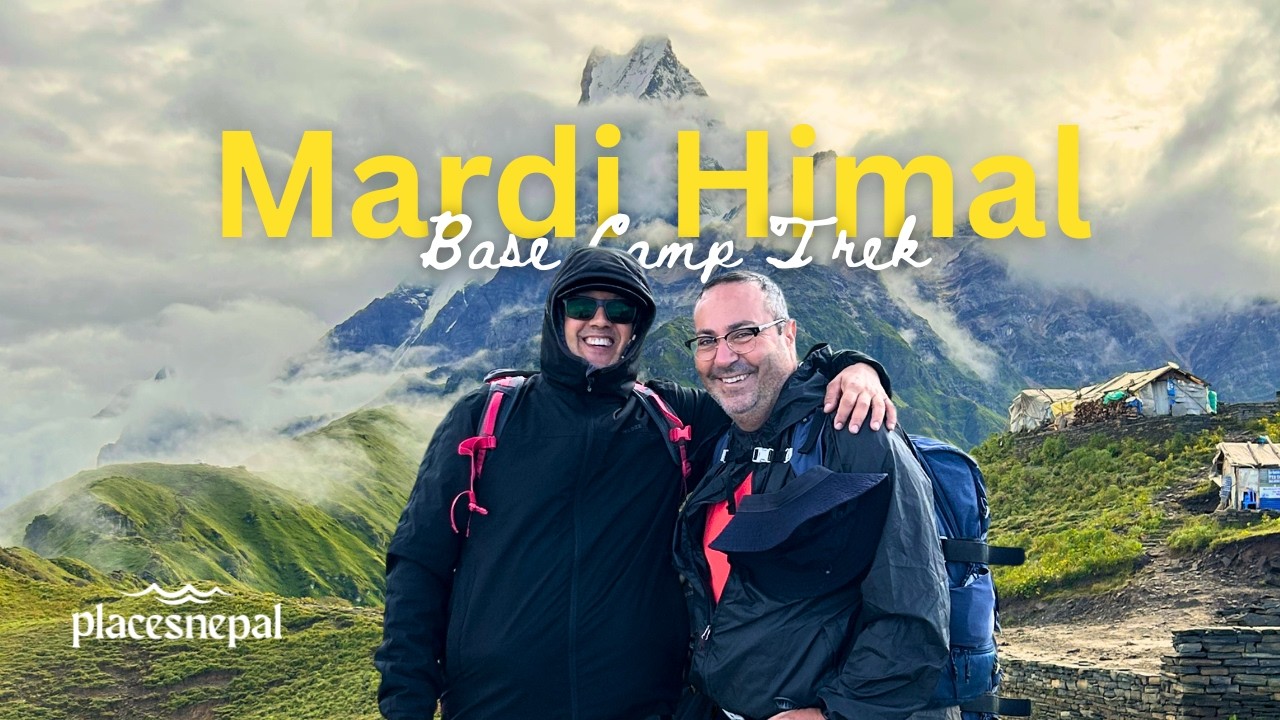
May works for Mardi Himal but asks for tolerance. Mid-hill stations record roughly double April's rainfall and around fourteen rain days. Mornings are often clear, afternoons cloud over, and distant peaks are hazy. Early May is considerably more reliable than late May, when the monsoon can arrive early.
Is May a good time to trek Mardi Himal?
May works for Mardi Himal but asks for tolerance. Mid-hill stations record roughly double April's rainfall and around fourteen rain days. Mornings are often clear, afternoons cloud over, and distant peaks are hazy. Early May is considerably more reliable than late May, when the monsoon can arrive early.
If you've landed here because May is the only window you have, the short answer is go — with your expectations set on the walk rather than the view. If you're choosing between months and May is simply one option, April or October will give you more mountain for the same effort.
The rest of this article is what May actually looks like on this route, and what you're trading away by choosing it. We'd rather you booked knowing that than found out at High Camp.
[trip/mardi-himal-trek]
What May gives you and what it takes
What you gain:
- The longest days of the trekking year. More daylight than April, considerably more than October — real margin on a 7–8 hour summit day.
- Warm walking at lower elevations. No cold starts on Days 1, 2 and 5.
- Fewer people, particularly from mid-month onward as the spring season winds down.
- Green everything. Pre-monsoon growth means the forest is at its most lush, and the terraced fields around Siding are being worked.
- Rhododendrons at the top of their range in early May — the pink and white high-altitude species, not the red ones lower down.
- Easier booking. Teahouse pressure eases, guides are available, and High Camp beds stop being a scramble.
What you give up:
- Rainfall roughly double April's and about two and a half times October's.
- Reliable mountain views. This is the real cost, and it's bigger than the rain.
- Predictability. Afternoon cloud and thunderstorms build earlier and more often than in any other trekking month.
- Dry trail. Mud on the forest sections, and leeches returning as the month goes on.
- Comfort at low altitude. Pokhara and the Phedi climb are hot and humid by late May.
The honest framing: rain on this trek is manageable. It's short showers, mostly in the afternoon, on a five-day trek with teahouses at every stop. The thing May really costs you is the view lottery — you can have a completely dry week and still not see Annapurna properly, because haze and cloud don't require rain.
Early May vs late May
May changes more across four weeks than any other trekking month, and it changes in one direction: toward the monsoon.
The monsoon does not arrive on schedule either
Nepal's Department of Hydrology and Meteorology sets the normal monsoon onset date at 13 June, entering from eastern Nepal. But onset moves considerably year to year — the latest on record is 27 June, and the earliest onsets have come in the last days of May. In 2025 the monsoon entered eastern Nepal on 29 May, fifteen days ahead of normal.
The practical translation: in an early year, the last week of May is already monsoon. Not usually, but often enough that it belongs in your planning rather than your surprise.
Early May (roughly 1st–10th)
The most reliable part of the month and the closest thing to late April. Conditions are still recognisably spring: warm but not oppressive, clear mornings more often than not, and cloud building later in the day than it will in three weeks' time.
Visibility is the best May offers. Not April's, and nowhere near October's, but on a clear early-May morning the view from the Upper Viewpoint is excellent.
Rhododendrons: the tail end. The high band above Low Camp — pink and white species between roughly 3,000 and 3,600 m — can still be flowering. The Day 2 forest lower down has largely gone over.
Crowds: still carrying spring traffic, though noticeably down on mid-April.
Mid May (roughly 11th–20th)
The transition. Humidity climbs, afternoon cloud becomes routine rather than occasional, and the chance of a genuine afternoon downpour rises. Lower elevations get hot — the Phedi climb on Day 1 becomes hard work in a way it isn't in April.
Mornings are still often clear. That's the pattern to plan around: get up, get moving, get high before the sky closes.
Crowds thin out noticeably. Teahouse pressure eases, and High Camp becomes bookable rather than contested.
Late May (roughly 21st–31st)
Pre-monsoon proper, and occasionally monsoon. Cloud, humidity and rainfall all at their spring maximum. Afternoon thunderstorms become a regular feature. Distant mountain visibility is unreliable — you may get a clear morning, and you may get four days of white.
Trail: wet forest sections, mud, and leeches returning to the Day 2 and Day 5 stretches.
What's good about it: the quietest trails of the spring season and the greenest the route ever looks. If you value solitude over views, late May delivers something April can't.
| Early May | Mid May | Late May |
|---|
| Rain risk | Moderate | Moderate–high | Highest of the spring |
| Afternoon cloud | Builds mid-late morning | Builds mid-morning | Builds early, most days |
| Visibility | Best of the month | Variable | Least reliable |
| Thunderstorms | Occasional | More frequent | Regular |
| Heat at low altitude | Warm | Hot | Hot and humid |
| Rhododendrons | High band still flowering | Mostly finished | Finished |
| Leeches | Rare | Appearing after rain | Present on wet forest trail |
| Crowds | Spring traffic easing | Noticeably quieter | Quietest of the season |
| Monsoon risk | Negligible | Low | Real in an early year |
Trek the Mardi Himal Trek
Five days, one ridge, and the closest you'll legally get to Machhapuchhre.
Mardi Himal May weather by altitude
Pokhara sits at 822 m. Base Camp is at 4,500 m. In May that gap produces the widest temperature spread of any month on this trek — and it's the single most common packing mistake people make.
Pokhara (822 m) — hot and humid, and getting hotter through the month. You'll arrive sweating and conclude you've over-packed warm layers. You haven't.
Phedi and the lower trail (1,130–1,650 m) — hot, humid, and the hardest hour of the trek for heat rather than altitude. The stone steps out of Phedi in late-May midday sun are unpleasant.
Pitam Deurali (1,925 m) — warm days, mild evenings. The most comfortable night of the trek in May.
Low Camp (2,985 m) — pleasant by day, cool after dark. The ridge wind here still has bite.
High Camp (3,550 m) — cold. Nights at or close to freezing even in May. This is where people who packed for a hot Pokhara find out that altitude doesn't care what month it is.
Mardi Himal Base Camp (4,500 m) — cold and exposed, reached shortly after sunrise at the coldest point of the day.
May temperature table
| Location | Elevation | Typical May conditions | Daytime | Night / early morning |
|---|
| Pokhara | 822 m | Hot, humid, increasingly so | 27–32 °C | Warm |
| Pitam Deurali | 1,925 m | Warm days, mild evenings | 20–25 °C | 10–14 °C |
| Forest Camp | 2,550 m | Humid under canopy, damp after rain | 15–20 °C | 6–10 °C |
| Low Camp | 2,985 m | Mild days, cool nights | 12–17 °C | 2–7 °C |
| High Camp | 3,550 m | Cool days, near-freezing nights | 8–12 °C | −4 to 1 °C |
| Mardi Himal Base Camp | 4,500 m | Cold, exposed, cloud-prone | 3–8 °C | −8 to −3 °C |
What this table is and isn't. These are typical May ranges based on our own operating experience on this route — not a forecast for any specific date. Early May generally sits at the cooler end of each range and late May at the warmer end, except at High Camp and above where nights stay cold all month.
The spread to notice: Pokhara at 30 °C and Base Camp at −5 °C on the same trip. That's a 35 °C range in five days, and it's wider in May than in any other trekking month.
Does it rain on Mardi Himal in May?
Yes, more than in any other month of the trekking season, and the numbers are worth knowing rather than guessing at.
Regional mid-hill stations show the shape clearly. Tatopani in the Annapurna region records roughly 79 mm in April against 163 mm in May. Okhaldhunga records about 67 mm and 153 mm, with rain days rising from roughly eight in April to fourteen in May. For comparison, October runs around 61–63 mm and five rain days.
So May carries roughly double April's rainfall and about two and a half times October's, spread over roughly three times as many rain days as October. Those aren't Mardi Himal stations, but the seasonal pattern across Nepal's mid-hills is consistent.
Why this ridge catches more than the figures suggest. The Mardi ridge is the first significant barrier that moist air rising off the Pokhara valley meets on its way to the Annapurnas. That orographic lift makes the southern Annapurna foothills among the wettest parts of Nepal. In May, with pre-monsoon moisture building, that mechanism runs almost daily.
The pattern, not the total, is what matters. May rain is mostly afternoon and evening, often as short heavy showers or thunderstorms rather than all-day drizzle. Mornings are frequently clear. A trekker who starts at 07:00 and is at their teahouse by 14:00 has a very different May than one who leaves at 09:30.
What rain means in practice:
- Mud on the Day 2 forest sections, and wet roots that stay slick under canopy for hours after the rain stops.
- A harder Day 4 descent. 1,515 m down on wet rock and roots is the highest-consequence section of the trek, and May is when it's most likely to be wet.
- Lost views, which is the real cost.
- Leeches, returning to the forest as the month progresses.
- Wet kit, which compounds — wet boots on day two are wet boots on day five.
- Road conditions. The Phedi approach and the Siding exit road are both vulnerable in heavy rain, and late May is when that starts to matter.
Can you see the mountains in May?
Sometimes, often in the morning, and less reliably as the month goes on. This is May's genuine weakness and we're not going to dress it up.
The daily pattern: clear or partly clear early morning, cloud building from mid-morning, frequently overcast by afternoon, occasionally clearing at dusk. Get up early and your odds are decent. Sleep in and you'll see cloud.
Haze on top of cloud. Pre-monsoon haze — dust, agricultural burning, static humid air with no monsoon rain yet to wash it out — reaches its annual peak in May. Even on a cloudless morning, distant ranges lose definition. Close peaks stay spectacular: Machhapuchhre (6,993 m) from High Camp is dramatic in any month because it's close enough that haze doesn't matter. It's the long views west along Annapurna I through IV that suffer.
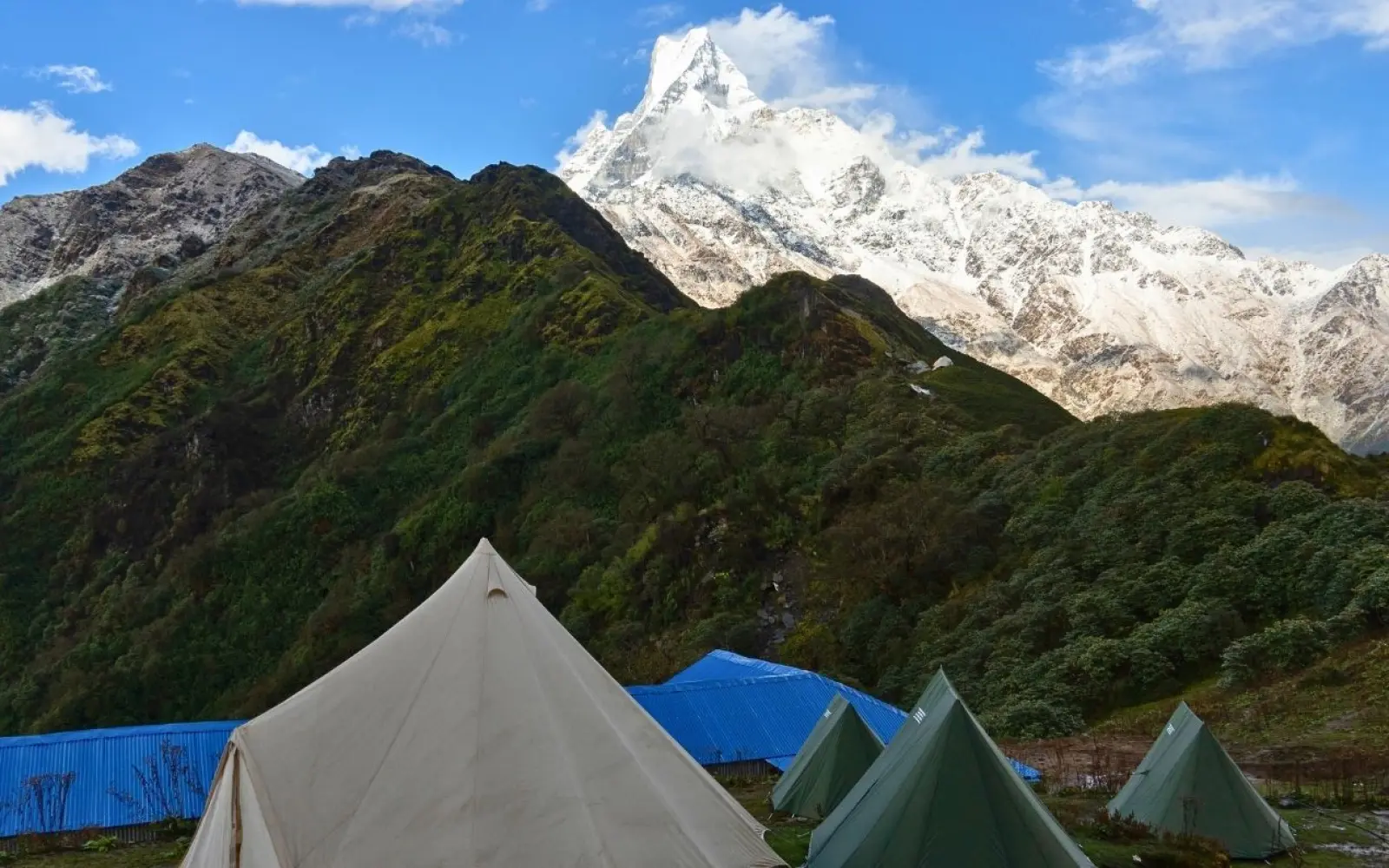
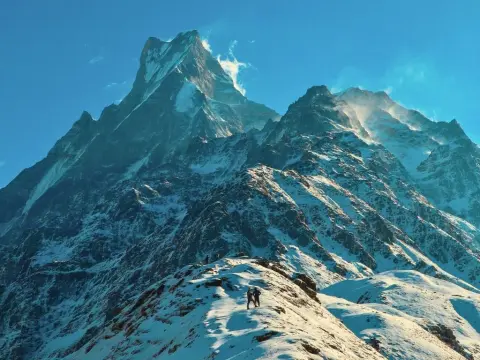
What you can realistically expect to see: Machhapuchhre at close range, Annapurna South (7,219 m) and Hiunchuli (6,441 m) from Low Camp and above on clear mornings, and Mardi Himal itself (5,587 m) above Base Camp. The full Annapurna panorama from the Upper Viewpoint is available on a good early-May morning and unlikely on a late-May afternoon.
Why early starts matter more in May than any other month: the window between sunrise and cloud is narrower and closes faster. The 04:30 departure on Day 4 isn't ceremony — in May it's the difference between the view and a white wall.
The honest expectation to set: on a five-day May trek you're likely to get at least one good mountain morning, quite possibly two. You are not likely to get five. Book May for the walk and treat clear mornings as a bonus, and you'll come home happy.
Does it snow on Mardi Himal in May?
Rarely, and less than in April, but not never.
Below 3,000 m — no. Precipitation at those altitudes in May falls as rain.
Above 3,500 m — fresh snow becomes uncommon as temperatures rise through the month, but an unusual weather system can still deposit snow on the upper ridge, particularly in the first half of May. Any accumulation typically melts quickly at this time of year.
Old snow from the winter is generally gone from the Mardi ridge by May, though shaded gullies on the upper section can hold remnants after a heavy winter.
A distinction worth making at altitude: rain at Low Camp can be snow or sleet at Base Camp on the same afternoon. That's not a snowfall event in the usual sense, but it means precipitation on Day 4 can leave the upper ridge slippery and cold rather than merely wet.
Practical position: microspikes are not standard May kit. If you're trekking early in the month, ask about upper-ridge conditions before the summit push rather than assuming. Otherwise, don't buy them for May.
Are rhododendrons still blooming in May?
Some, in one specific band, and mostly early in the month.
Flowering on this route follows elevation rather than the calendar. The lower band between roughly 2,000 and 2,500 m flowers from late February through March. The main forest band between 2,500 and 3,000 m — the Forest Camp to Low Camp stretch on Day 2 — peaks in March and April. The high band between roughly 3,000 and 3,800 m flowers latest, into April and May, in pink and white species rather than the red lali gurans you get lower down.
On the Mardi route that means:
- Day 2 forest (Forest Camp to Low Camp) — largely finished by May. Green and lush, not flowering.
- Low Camp to Badal Danda (2,985–3,400 m) — the band that can still be in flower in early May.
- Above about 3,600 m — above the treeline. No rhododendron forest at all, in any month.
So May flowers are a narrow, early-month, higher-altitude proposition. Early May gives you a reasonable chance of catching the high band; by late May it's over.
And the caveat that applies in every spring month: peak bloom shifts by one to two weeks year to year with winter temperatures and how early spring warmth arrives. Nobody can promise flowering on your dates.
If rhododendrons are the reason you're coming, May is the wrong month. The forest at its best is a late-March to mid-April event — see Mardi Himal Trek in April for where and when.
Trek the Mardi Himal Trek
Five days, one ridge, and the closest you'll legally get to Machhapuchhre.
What are the trails like in May?
Early May: broadly good. Dry lower sections, firm ridge above the treeline, and the forest damp but manageable.
Mid to late May: increasingly wet. The Day 2 forest between Pitam Deurali and Low Camp holds moisture longest — dense canopy, mossy ground, and tree roots that stay slick for hours after rain. Stone steps low down become greasy when wet.
Vegetation grows fast in the pre-monsoon warmth, so some forest sections feel narrower and more overgrown than they do in autumn.
Leeches return to the damp forest sections as the month progresses. They're unpleasant rather than dangerous — gaiters, socks pulled over trouser cuffs, and checking your legs at breaks handle it.
What actually helps:
- Boots with genuine grip and ankle support, broken in. Worn-down tread on wet roots is how people fall.
- Trekking poles, which matter more in May than any other month. On the 1,515 m Day 4 descent in wet conditions they're the difference between controlled and lucky.
- Slowing down on descent. Most trail injuries on this route happen going down, and wet ground multiplies that.
The route in May
Pokhara → Phedi → Pitam Deurali → Low Camp → High Camp → Mardi Himal Base Camp → Low Camp → Siding → Pokhara
This is the Places Nepal 5-day itinerary. Alternative Mardi Himal routes exist — a Kande and Australian Camp start, exits via Landruk or Ghandruk — and they're labelled here as alternatives, because the day-by-day below refers to this one.
For May specifically, read the altitude ladder as a heat-and-cloud gradient. The bottom two days are hot and humid; the top two are cold and cloud-prone. There's no point on this route where May is simply "mild."
The map shows the recorded route. It isn't a live weather or trail-condition system — check both close to departure, and take your guide's read on the day over anything you looked at before you flew. Full route detail is in our Mardi Himal Trek map guide.
Mardi Himal Trek in May: day-by-day
Day 1 — Pokhara → Phedi → Pitam Deurali (1,925 m)
How it feels: hot. This is the hardest day of the trek for heat in any month, and May is the hottest version of it. The climb out of Phedi at 1,130 m starts on stone steps immediately with no shade for the first stretch, and you gain 1,098 m from Pokhara.
Timing matters more than usual. Be walking by 07:30 if you can. Every hour you delay is hotter, and afternoon showers are more likely the later you're out.
What to wear: the lightest thing you own, plus sun protection. Warm layers stay packed. Shell within reach, not buried.
Trail: dry early in the month, muddier after rain later on. Stone steps get greasy when wet.
Why the lower section feels like a different trek: Pokhara is around 30 °C. High Camp, two days later, is near freezing at night. People pack for the airport and regret it at 3,550 m.
Evening: the mildest night of the trek. You'll want a light layer, not a down jacket.
Day 2 — Pitam Deurali → Forest Camp → Low Camp (2,985 m)
The longest day — around six hours, 10 km, 1,060 m of climbing through rhododendron and oak forest.
The forest in May: dense, green, humid and fully leafed out. The flowers have mostly gone, but the canopy is at its thickest. It's a beautiful walk that happens to have no views.
Trail: this is where May's rain shows up. Wet roots under canopy, mud in the shaded stretches, and slow drying. Watch your footing rather than your watch.
Leeches appear on this stretch after rain from mid-May onward. Not dangerous, just tedious.
Temperature shift: you start warm and finish somewhere that will be cool overnight. Have a fleece accessible before you break onto the ridge at Low Camp, where the wind picks up.
Views: the Annapurnas appear at Low Camp. In May, whether you see them depends entirely on what time you arrive — before the afternoon cloud, and it's excellent.
Day 3 — Low Camp → High Camp (3,550 m)
The transition day, around four hours and 565 m of gain past Middle Camp and Badal Danda onto open ridge above the treeline.
Deliberately short, because it's the acclimatisation step before the highest night. In May there's a second reason to keep it short: being on the exposed ridge in the afternoon is exactly what you want to avoid.
Cloud: in May, Badal Danda — "cloud hill" — usually earns the name by late morning. You may walk the upper half of this day in white.
Wind and exposure: no tree cover from here on. Spring wind is more variable than autumn's, and it turns a mild temperature uncomfortable quickly.
Sun exposure: don't be fooled by cloud. UV at 3,500 m is high even through overcast, and May sun through broken cloud burns fast. Sunscreen before you leave Low Camp.
Arriving: High Camp at 3,550 m, your highest night, at or close to freezing even in May. A sleeping bag rated to −10 °C is still the right call. People routinely under-pack this in spring.
Day 4 — High Camp → Mardi Himal Base Camp → Low Camp
The day May is hardest to plan and most rewarding to get right.
04:30 start, in the dark, at or near freezing. Frost is possible even in May. Headlamp with fresh batteries and a spare set, insulated jacket, warm hat, gloves.
May's one advantage here: the longest days of the trekking year mean sunrise comes soon after you set off, so you spend less of the climb in full darkness than in April or October.
The route: exposed ridge northeast to the Upper Viewpoint at 4,200 m for sunrise, on to Mardi Himal Base Camp at 4,500 m, then back through High Camp to collect your bag and eat, and down to Low Camp at 2,985 m. Total: +950 m, −1,515 m, 7–8 hours.
Why the early start matters more in May than in any other month. The clear window is narrowest now. Cloud can be building by 08:00 on a late-May morning. Reaching the viewpoint at sunrise and Base Camp shortly after is the only reliable way to see anything, and there's no second attempt on a five-day itinerary.
Weather sensitivity is the defining feature of May on this day. Pre-monsoon afternoon convection means the exposed upper ridge is somewhere you want to be early and gone from by midday. If the morning looks wrong, turning around at the Upper Viewpoint — or below it — is the correct call, not a disappointing one. The 4,200 m viewpoint gives essentially the same panorama for meaningfully less exposure.
Possible snow, ice or sleet on the upper section in the first half of the month. Ask the night before.
No food or water between High Camp and Base Camp. Carry at least 1.5 litres and something to eat.
Then the descent, the real crux: 1,515 m to Low Camp on tired legs. In May this is the section most likely to be wet, and wet roots at the bottom of a long descent are where people get hurt. Poles from the top. Slow down when the climbing's over rather than speeding up.
Day 5 — Low Camp → Siding Village → Pokhara
Warming fast. You drop 1,285 m to Siding at 1,700 m and in May the air gets noticeably heavier with every hundred metres. Start in a layer you can shed within the first half hour.
Vegetation: the lushest stretch of the whole trek in May. Terraced fields being planted, orchards in leaf, and everything actively growing.
Trail: wet after rain, and leeches on the lower forest sections. Tired legs plus loose gravel is the standard late-trek hazard — poles out.
Road access: roughly 1.5 hours by road from Siding to Pokhara. The Siding road is the section most affected by heavy rain, and in late May it's worth your operator confirming conditions rather than assuming.
Are May days long enough?
Yes — May has the longest daylight of the trekking year at this latitude, longer than April and considerably longer than October.
Why it matters:
- Day 4 starts in less darkness. You still leave at 04:30, but first light comes sooner than in any other month.
- Real margin on the long days. Six hours on Day 2 and seven to eight on Day 4 leave comfortable buffer even if you're slow.
- Recovery from a weather delay. If rain forces a late start, you have daylight to absorb it.
What long days don't buy you. More daylight is not more viewing time in May, because cloud closes the window regardless of how much sun is technically available. The early start is about beating the cloud, not beating the dark. Treat Day 4 with the same seriousness you would in October.
Thunderstorms and afternoon weather
Pre-monsoon May is when afternoon convective weather is at its most active in Nepal's mid-hills, and the Mardi ridge is a specific place to think about it.
Why afternoons change: warm, humid air rising off the Pokhara valley through the morning hits the first big barrier — this ridge — and builds vertically. That's the mechanism behind the reliable mid-morning cloud, and in May it has enough energy behind it to produce thunderstorms rather than just cloud.
Why the exposed ridge matters: the section from Low Camp to Base Camp is above the treeline, on open ground, with the trail following the high line. That's the least appealing place on the route to be during an electrical storm.
What this means practically:
- Start early, finish early. Being at your teahouse by early afternoon is the single most effective thing you can do.
- Don't push a late summit. If Day 4 has slipped and you're contemplating going for Base Camp at 09:30 in building cloud, don't.
- Take your guide's read. Local guides read this ridge's afternoon behaviour from experience and will move you off exposed ground before you'd think to.
We're not going to overstate this. Thunderstorms on this trek are a scheduling consideration, not a reason to avoid May. But they're the reason May rewards discipline about start times more than any other month.
Is Mardi Himal harder in May?
The trek's difficulty doesn't change with the season. The altitude, the roughly 3,700 m of cumulative climbing, and the 1,515 m Day 4 descent are the same in every month. May changes how those feel.
What makes it harder:
- Heat and humidity on Days 1, 2 and 5. Sweating through a 1,098 m climb is more tiring than the same climb in cool air.
- Wet trail. Mud and slick roots make the forest sections slower and the Day 4 descent riskier.
- Cloud and poor visibility, which is mentally harder than it sounds — climbing for hours toward a view you can't see erodes motivation.
- Wet kit compounding. Damp boots and clothes on day three are a morale problem as much as a comfort one.
- Less predictable planning. More decisions to make on the day.
What makes it easier:
- Long daylight, and real margin on the long days.
- No cold starts at lower elevations.
- Quieter teahouses, which means better sleep before the hardest day.
Net: May doesn't change the route, but it can make a moderate trek feel like a hard one. A trained trekker in dry May weather has a straightforward week; the same trekker in three days of rain has a tough one. Full breakdown in our Mardi Himal Trek difficulty guide.
Is Mardi Himal good for beginners in May?
It can be, but it's the least forgiving of the four main trekking months for a first Himalayan trek.
What still works: a short 5-day itinerary, a well-established teahouse route with everything open, no technical ground, an hour's drive from Pokhara, and the longest daylight of the year.
What makes May harder for a first-timer specifically:
- Wet descent. Beginners are already most at risk on the Day 4 descent because untrained legs and poor pole technique combine badly. Wet roots make that worse.
- Weather decisions. May asks for more judgement calls, and judgement is what experience provides.
- Motivation. A beginner who trains for months, climbs to 4,500 m and sees cloud has a harder time calling it a good trip than someone who's done this before.
- Heat on Day 1, which catches people who trained in cooler climates.
Our honest advice: if May is your only window, go — with a guide, with poles, with proper boots, and with expectations set on the achievement rather than the panorama. If you have any flexibility, April or October will give a beginner a better first experience. Whether the trek suits you at all is a separate question, answered in Mardi Himal Trek for beginners.
Trek the Mardi Himal Trek
Five days, one ridge, and the closest you'll legally get to Machhapuchhre.
Is May good for solo trekkers?
Workable, with more to think about than in the peak months.
What helps: teahouse availability is easy, so the High Camp bed problem that dogs October and mid-April largely disappears. Long daylight gives real margin. And quieter trails are pleasant if solitude is what you're after.
What's harder:
- Fewer trekkers around. Fine most of the time, less good if something goes wrong on the upper ridge.
- Cloud and fog make the one exposed section harder to judge, and judging weather alone is the hardest part of solo trekking anywhere.
- Wet descent with nobody to help if you turn an ankle at 3,500 m.
- Road conditions. The Siding exit is more vulnerable in May, and arranging alternative transport alone is more friction than it's worth.
Backup planning matters more in May. Tell someone your itinerary and expected check-in times, build a buffer day into your schedule, and agree in advance what you'll do if the summit morning is a write-off.
The rules are unchanged: foreign nationals need a licensed guide from a registered agency throughout the Annapurna Conservation Area, in every month. Full detail in Mardi Himal Trek solo.
Is Mardi Himal crowded in May?
Less than April, considerably less than October, and it thins as the month goes on.
Early May still carries spring season traffic — not peak-April busy, but the trail is active and teahouses are working.
Mid to late May is noticeably quieter. Group departures reduce, independent trekkers thin out, and High Camp stops being contested.
What that's worth: the accommodation pressure that defines October and mid-April largely lifts. You can be more flexible about your schedule, you're more likely to get a room to yourself, and the dining rooms are calmer.
What it isn't: empty. Teahouses are open and staffed, other trekkers are around, and the trail is in normal use. May is quieter, not deserted — and the sections of this route that feel remote in May feel remote in October too.
We won't invent visitor numbers. What we can say is that our May departures have space when our October ones don't.
Do you need to book Mardi Himal in advance for May?
Less urgently than for April or October, but still worth doing.
Early May carries enough residual spring demand that High Camp beds and guide availability are worth securing a few weeks out.
Mid to late May is relaxed. Teahouse capacity isn't the constraint it is in peak season, and guides are available.
What still benefits from planning:
- Guides. The best ones are booked in advance regardless of season.
- Transport. Kathmandu–Pokhara flights and buses are quieter than in peak months, but the Siding road is weather-dependent and a pre-arranged vehicle removes a real friction point.
- Group departures. Fewer fixed departures run in late May, so if you want to join one rather than book privately, check dates early.
- Weather flexibility. The single most useful thing you can do for a May trek is build a buffer day into your schedule so a washed-out summit morning isn't the end of it.
Our group departures run on fixed dates through the spring season and are marked as guaranteed to run.
How much does the Mardi Himal Trek cost in May?
The package price does not change in May. Our rates are the same year-round:
| How you book | Price per person |
|---|
| Solo private trek | US$470 |
| Private trek, 2–5 people | US$360 |
| Private trek, 6–10 people | US$340 |
| Private trek, 11–15 people | US$300 |
| Joining a fixed group departure | US$360 |
Included: government-licensed English-speaking guide, ACAP and TIMS permits plus government fees and local taxes, teahouse accommodation, all meals on the trek, private transfer Pokhara to Phedi and shared jeep Siding to Pokhara, and all guide and porter expenses.
Not included: travel insurance covering trekking to 4,500 m and helicopter evacuation, porter service (US$130 for the trek, one porter shared between two trekkers, 20 kg), the Nepal visa, hotels and meals in Kathmandu or Pokhara, and personal spending on the trail — budget NPR 15,000–18,000, cash only, no ATMs past Pokhara.
Government permit fees don't change seasonally. ACAP is NPR 3,000 for foreign nationals and NPR 1,000 for SAARC nationals; TIMS is NPR 2,000 and NPR 1,000.
Where May is cheaper: international flights, Kathmandu and Pokhara hotels, and domestic flights all soften from mid-May as peak season ends. That's outside the trek package but inside your trip budget, and it's a real saving against April or October — often the strongest practical argument for May after "it's the only month I have."
Trek the Mardi Himal Trek
Five days, one ridge, and the closest you'll legally get to Machhapuchhre.
Full breakdown in our Mardi Himal Trek cost guide.
What to wear on Mardi Himal in May
The problem May sets is specific: hot and humid at the bottom, near-freezing at the top, and rain possible at any point in between. A single warm coat doesn't solve it and neither does packing light.
Lower elevations (Phedi to Pitam Deurali): the lightest breathable clothing you have. Moisture-wicking short sleeves, light trekking trousers, sun hat, sunglasses, sunscreen. Shell accessible.
Mid elevations (Forest Camp to Low Camp): breathable long-sleeve layer, light fleece for evenings, and rain protection within reach rather than in the duffel.
High Camp: insulated down jacket, fleece or softshell, thermal base layers, windproof shell, warm hat, gloves. Nights at or close to freezing all month.
Base Camp morning: all of it, on before you leave the teahouse. Thermal base layers, fleece, down jacket, windproof shell, warm hat, insulated gloves, buff.
The May mistake: arriving in a 30 °C Pokhara and deciding the down jacket and the −10 °C sleeping bag are overkill. They aren't. Altitude sets the temperature at High Camp, not the calendar.
May packing essentials
- Trekking boots with genuine grip, broken in and waterproof — grip matters more in May than any other month
- Waterproof jacket — not a shower-resistant windbreaker
- Waterproof trousers
- Moisture-wicking base layers, 2–3 sets
- Fleece or softshell mid-layer
- Insulated down jacket — the item most often left behind in May and most regretted
- Sleeping bag rated to −5 to −10 °C
- Warm hat and sun hat
- Light gloves and insulated gloves
- Spare socks — more than you think. Wet feet are May's defining discomfort
- Sunglasses with UV protection and SPF 50 sunscreen
- Headlamp with spare batteries
- Trekking poles — closer to essential in May than optional
- Water bottles or bladder, 2–3 L, plus purification
- Dry bags and a pack cover
- Power bank
- Personal medication and blister kit
- Gaiters or long socks if leeches bother you
The complete list by category is on the Mardi Himal Trek page.
Do you need rain gear for Mardi Himal in May?
Yes, and this is the one month where the answer isn't hedged.
What you actually need:
- A proper waterproof shell jacket with a hood. Not a softshell, not a windbreaker. It will get used.
- Waterproof trousers. Less glamorous and equally useful, particularly on the Day 4 descent.
- A pack cover, plus dry bags inside the pack. Pack covers fail in sustained rain and in wind. Dry bags are what actually keeps things dry — one for your sleeping bag, one for spare clothes, one for electronics.
- Spare socks, and more than you'd pack for October. Managing wet feet across five days is largely a socks problem.
- Keeping one set of sleeping clothes permanently dry, in a sealed bag, never worn during the day. This single habit is the difference between a bad wet trek and a tolerable one.
- Electronics protection. Phone, power bank, headlamp and camera in a sealed dry bag. Humidity alone will find its way into anything unsealed over five days.
On umbrellas: they work on the lower forest sections, where the trail is sheltered and the rain is vertical — plenty of Nepali trekkers use them. They're much less useful on the exposed ridge above Low Camp, where wind makes them awkward and you want both hands for poles. If you bring one, treat it as a lower-trail tool rather than your rain plan.
What happens if it rains during the trek?
Rain is a normal operating condition in May, not a crisis. What changes is pace and judgement.
- Slow down, particularly on descent and on wet roots. Almost every trail injury on this route is a footing problem, and rain multiplies it.
- Get the shell on before you're wet, not after. Once base layers are soaked they stay soaked.
- Protect electronics first. Phones and power banks are the hardest things to recover.
- Don't rush downhill to get out of it. The instinct to hurry when wet is exactly wrong on the Day 4 descent.
- Allow more time. Wet trail adds a meaningful margin to every day's walking.
- Take local advice. Teahouse hosts and your guide know what this ridge does in this weather, and they've watched it for years.
- Expect timing adjustments. A guide may push a start time, shorten a day, or hold at a lower camp. That's competence, not disruption.
What rain doesn't usually mean: cancelling. In five days of May weather you'll likely get wet at some point and it won't stop the trek. The exception is the summit push — if the Day 4 morning is bad, turning around at the Upper Viewpoint or waiting is a decision worth respecting.
What we won't promise: that the itinerary runs exactly as published regardless of conditions. On a trek that reaches 4,500 m, the plan yields to the weather. Any operator who tells you otherwise before you book is telling you something worth noticing.
How to check Mardi Himal weather before going in May
Seasonal climate — what this article describes — tells you what to pack and which weeks to prefer. It tells you nothing about a specific day.
Extended forecasts, 7–14 days out — broad direction only at this range. Useful for spotting a system, not for planning a summit morning.
Short-range mountain forecasts, 1–3 days out — the useful window. Look for forecasts that model by altitude rather than giving one number for a region. Pokhara's forecast describes Day 1, not Day 4.
Actual local conditions — the best source, and free. Teahouse hosts at Low Camp and High Camp know what the ridge has done for the past week. Your guide will be asking them, and that read beats any app for the 04:30 decision.
The caveat that matters more in May than any other month: pre-monsoon weather changes faster than forecast models resolve, particularly on an exposed ridge at 3,500–4,500 m. Use forecasts to plan and local knowledge to decide.
Mardi Himal in April vs May
| Factor | April | May |
|---|
| Temperature | Warm low down, freezing at High Camp | Hot and humid low down, near-freezing at High Camp |
| Rain | Moderate — around 8 rain days at comparable stations | Roughly double April's, around 14 rain days |
| Cloud | Builds mid-morning | Builds earlier and more reliably, with thunderstorms |
| Visibility | Good early, hazier late | Least reliable of the spring months |
| Flowers | The main forest band at peak — April's defining feature | Tail end, high band only, early month only |
| Snow | Possible on the upper ridge in early April | Uncommon; sleet on the upper ridge possible |
| Trail | Dry, muddy after rain | Increasingly wet; leeches return |
| Crowds | Busy, peaking mid-month | Quieter, thinning through the month |
| Beginners | One of the two best months | The least forgiving of the main four |
| Overall feel | A spring trek through flowering forest with good views | A green, quiet, humid trek where views are a bonus |
Choose April if you want the rhododendrons, more reliable mountain views, and drier trail — and you'll accept crowds and higher travel costs.
Choose May if May is your window, you value quiet over views, you want cheaper flights and hotels, or you'd rather have teahouse space and flexibility than a guaranteed panorama.
Mardi Himal in May vs October
The clearest contrast on the calendar, and worth being blunt about.
| Factor | May | October |
|---|
| Rainfall | Around 150–160 mm and 14 rain days at comparable mid-hill stations | Around 60 mm and 5 rain days |
| Visibility | Haziest of the trekking year; cloud builds early | The clearest air of the year |
| Temperature | Hot at the bottom, near-freezing at the top — the widest spread of any month | Comfortable at the bottom, freezing at the top |
| Crowds | Quiet, especially late in the month | Nepal's busiest trekking month |
| Flowers | Tail end of the high band, early May only | None — amber forest late in the month |
| Trail | Wet, muddy, leeches | Dry and firm from mid-month |
| Weather stability | Least stable of the trekking months | Most stable |
| Daylight | Longest of the year | Roughly an hour less than May |
| Travel cost | Softening from mid-month | Peak pricing on flights and hotels |
October is the better trekking month, and it isn't close on weather. If you're choosing freely and the mountains are why you're coming, book October.
May is the better month if you want quiet trails and cheaper travel, you're coming for the walk rather than the photographs, or May is simply when you can travel. Those are real reasons, not consolation prizes — plenty of people prefer an empty ridge in cloud to a crowded one in sunshine.
Full October picture in Mardi Himal Trek in October.
What about June?
June is where the trekking season ends on this route.
Monsoon onset normally arrives in mid-June, and rainfall roughly doubles again from May's already-elevated levels. Cloud becomes near-constant, mountain visibility largely disappears, the forest trail turns properly slick, leeches are unavoidable, and landslide risk on both the Phedi approach road and the Siding exit becomes a genuine planning factor.
Late May and early June are the same weather in a different month, which is worth knowing if your dates straddle the boundary. If you're looking at 25 May to 5 June, treat it all as pre-monsoon and plan accordingly.
If your only window is June or later, the honest recommendation is a rain-shadow trek rather than this one. Regions north of the main Himalayan range — Upper Mustang and Nar Phu among them — sit in the rain shadow and stay trekkable right through the monsoon. That's a different trip and a different budget, but it's a real option and a better one than a wet week on the Mardi ridge.
May pros and cons
Pros
- The longest daylight of the trekking year, with real margin on the long days
- Quiet trails and easy teahouse availability, especially from mid-month
- Warm walking with no cold starts at lower elevations
- The greenest the route ever looks
- High-altitude rhododendrons still flowering in early May
- Cheaper flights and hotels from mid-month
- More flexibility on dates, schedule and accommodation
Cons
- Roughly double April's rainfall and 2.5 times October's
- The least reliable mountain visibility of the trekking season
- Pre-monsoon haze at its annual peak
- Afternoon cloud and thunderstorms building earlier than in any other month
- Hot and humid on Days 1, 2 and 5
- Wet, muddy forest trail and a riskier Day 4 descent
- Leeches on the forest sections from mid-month
- Real monsoon risk in the last week in an early year
- Widest kit range of any month — hot at the bottom, freezing at the top
Should you trek Mardi Himal in May?
May may suit you if you:
- Can only travel in May, and would rather do this trek than not do it
- Value quiet trails and teahouse space over guaranteed views
- Want cheaper flights and accommodation
- Are comfortable with weather variability and can build in a buffer day
- Are coming for the walking, the forest and the altitude rather than the photographs
- Have flexibility to favour the first half of the month
Consider April or October if you:
- Want reliable mountain visibility above everything else
- Are photographing the Annapurnas seriously
- Prefer drier trail and more predictable conditions
- Are a first-time trekker who'd rather not add weather to the list of unknowns
- Specifically want the rhododendron forest, which is a late-March to mid-April event
And a point worth making for anyone hesitating: a five-day trek is more weather-robust in a marginal month than a two-week one. You have fewer days to lose, and a short window of good weather is more likely to cover your one summit morning than to cover a fortnight. If you're going to attempt anything in the Nepali pre-monsoon, a short Annapurna teahouse route is a sensible thing to attempt.
Permits in May
Nothing changes seasonally. You need an ACAP permit (NPR 3,000 foreign nationals, NPR 1,000 SAARC) and a TIMS card (NPR 2,000 / NPR 1,000), and foreign trekkers need a licensed guide from a registered agency. Both permits are included in our package along with the government fees — send a passport copy and your dates.
May is the easiest month to arrange permits, since the counters in Kathmandu and Pokhara are past the spring rush. Full detail in our Mardi Himal Trek permits guide.
Trekking Mardi Himal this May?
May trekking rewards two things: an early start every day, and a buffer day in the schedule so one bad morning doesn't decide the trip. Both are easier to arrange with someone who watches this ridge's weather for a living.
Planning Mardi Himal this May? Check the current Places Nepal itinerary, inclusions and available departures before choosing your dates.
And if you tell us your dates and what you want most out of the week, we'll give you a straight answer — including when that answer is "come in October instead," or when a rain-shadow trek suits your window better than this one.
Trek the Mardi Himal Trek
Five days, one ridge, and the closest you'll legally get to Machhapuchhre.
Mardi Himal Trek in May: FAQs
Is May a good time to trek Mardi Himal? It's workable rather than ideal. May gives you long days, quiet trails and green forest, at the cost of roughly double April's rainfall and the least reliable mountain visibility of the trekking season. Early May is considerably better than late May.
What is the weather like on Mardi Himal in May? Hot and humid at Pokhara and the lower trail, mild at Low Camp, and near-freezing overnight at High Camp. Mornings are often clear with cloud building from mid-morning, and afternoon showers or thunderstorms are common.
Does it rain on Mardi Himal in May? Yes. Comparable mid-hill stations record around 150–160 mm across roughly fourteen rain days, against about 8 rain days in April and 5 in October. Most of it falls in the afternoon and evening.
Is May rainy season in Nepal? Not yet, but it's the run-up. The monsoon normally arrives around 13 June. May is pre-monsoon — increasing rain, cloud and humidity without the sustained daily rainfall of the monsoon proper.
Is early May good for Mardi Himal? It's the best part of the month — closest to late April in feel, with the most reliable mornings, the last of the high-altitude rhododendrons, and the lowest rain risk.
Is late May good for Mardi Himal? It's the wettest, cloudiest and quietest part of the month, and in an early year the monsoon can arrive before the month ends. Good for solitude, poor for views.
How hot is Mardi Himal in May? Pokhara reaches roughly 27–32 °C. Pitam Deurali sits around 20–25 °C by day and Low Camp around 12–17 °C. The heat is a Day 1 and Day 5 problem, not a high-altitude one.
How cold is High Camp in May? Nights at High Camp (3,550 m) typically run around −4 to 1 °C. Altitude sets that, not the calendar — bring a sleeping bag rated to −10 °C and a down jacket regardless of how hot Pokhara was.
Does it snow on Mardi Himal in May? Rarely. Fresh snow becomes uncommon as temperatures rise, though an unusual system can deposit some on the upper ridge, mainly early in the month. Sleet at Base Camp while it rains lower down is more likely than snowfall.
Can you see the mountains in May? Often in the early morning, less reliably later. Close peaks like Machhapuchhre stay dramatic; distant Annapurna views suffer from pre-monsoon haze. Expect one or two good mornings on a five-day trek rather than five.
Is Mardi Himal cloudy in May? Usually by mid-morning, and earlier as the month progresses. Badal Danda — "cloud hill" on the way to High Camp — generally lives up to its name in May.
Are rhododendrons blooming in May? Only the high band between roughly 3,000 and 3,600 m, in pink and white, and mainly in early May. The main forest bloom on Day 2 is a March-to-April event and has largely finished.
Is Mardi Himal crowded in May? No. Early May carries residual spring traffic, but the trail thins noticeably from mid-month. Teahouse availability is easy and High Camp stops being contested.
Is late May less crowded? Yes — the quietest part of the spring season. That's May's clearest advantage, along with cheaper flights and hotels.
What should I pack for Mardi Himal in May? A layering system spanning 35 °C, a genuine waterproof jacket and trousers, dry bags, extra socks, an insulated down jacket, a sleeping bag rated to −5 to −10 °C, trekking poles and boots with real grip.
Do I need a rain jacket for Mardi Himal in May? Yes — a proper waterproof shell with a hood, not a windbreaker. Add waterproof trousers, a pack cover and dry bags inside the pack. This is the one month where rain gear gets used rather than carried.
Is Mardi Himal suitable for beginners in May? Possible with a guide, poles and proper boots, but it's the least forgiving of the main trekking months for a first Himalayan trek. Wet descent and weather judgement are exactly what beginners find hardest.
Is Mardi Himal safe in May? The route is the same in every month. May adds wet trail on the descent and afternoon thunderstorms on an exposed ridge, both of which are managed by starting early and taking your guide's read on conditions.
Is April better than May for Mardi Himal? For weather, views and flowers, yes. May is better for quiet trails, teahouse availability and travel costs. April is the stronger month; May is the better value.
Is October better than May for Mardi Himal? For weather and visibility, clearly. October has roughly a third of May's rainfall and the clearest air of the year. May wins on crowds, cost and daylight.