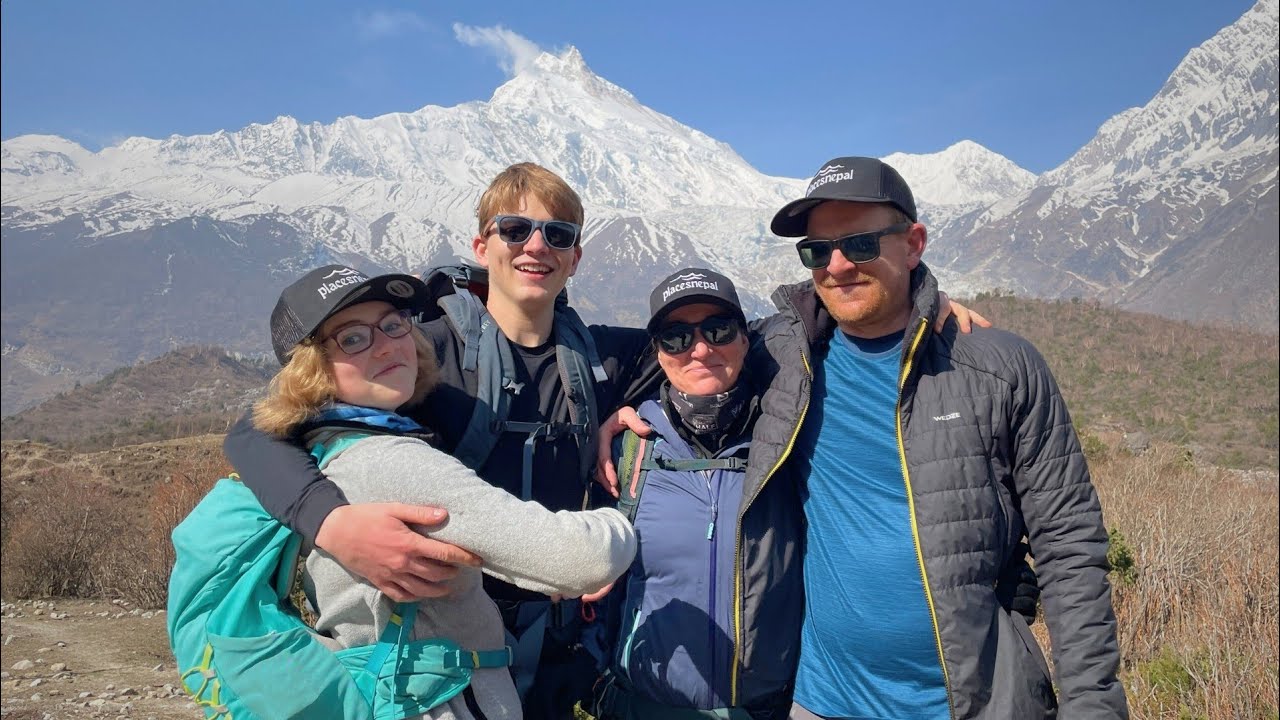
Everest Base Camp Trek cost for 2026/2027 — real package pricing, permits, guide and porter wages, hidden costs, and how to budget accurately.
Everest Base Camp sits on more bucket lists than almost any other trek on earth, and for most people planning it, the first honest question isn't "can I do this" — it's "what will this actually cost me." That question deserves a real answer, not a single number pulled out of the air. The trek's price depends on decisions you make months before you land in Kathmandu: how many days you take, whether you fly back by helicopter, what season you go in, and — more than anything else — which operator you book with and what they actually include.
This guide breaks down every dollar of an Everest Base Camp trek in 2026/2027: the fixed government fees nobody can avoid, the guide and porter wages that make or break a trekking staff's livelihood, the food and lodging costs that quietly climb with every thousand metres of altitude, and the hidden extras that turn a "$1,200 trek" into a $1,600 trip if you don't budget for them upfront. It's written from the ground in Kathmandu, not assembled from other people's blog posts.
Quick Answer: How Much Does Everest Base Camp Trek Cost?
| Trek Style | Approximate Cost Per Person |
|---|
| Budget/Independent (no guide, self-organised) | USD 1,000–1,300 |
| Standard Guided Trek (Places Nepal package) | USD 1,100–1,499 |
| Standard Trek with Helicopter Return | USD 1,830–2,200 |
| Premium/Luxury (upgraded lodges, small private group, senior guide) | USD 2,500–5,500+ |
What each category actually means:
- Budget/Independent means no guide, no porter, and self-arranged permits and teahouses — you're paying only the unavoidable government fees, Lukla flight, and trail costs. It's the cheapest way to see Everest Base Camp, and it carries the most risk.
- Standard Guided Trek is what most trekkers book and what most of this guide is about: a licensed guide, porter, permits, teahouse accommodation, and meals bundled into one transparent price.
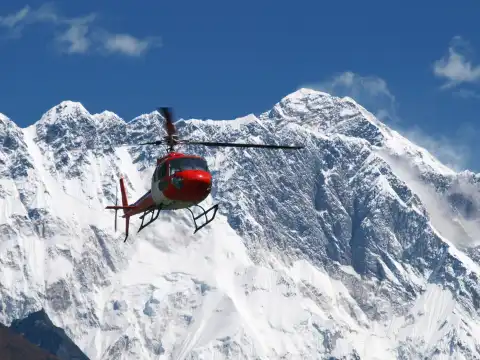
- Helicopter Return swaps the multi-day walking descent for a same-day flight from Gorak Shep, adding a genuine aviation cost on top of the standard package.
- Premium/Luxury covers upgraded lodges (some with private bathrooms and heating at altitude), smaller groups, senior guides, and sometimes a helicopter segment bundled with five-star Kathmandu accommodation either side.
Prices vary this much because of trek style, duration, season, comfort level, and — the biggest lever of all — group size. A solo trekker on a private booking pays meaningfully more per person than someone joining a group of six, because the guide's daily wage, permits paperwork, and ground transport costs are largely fixed regardless of headcount.
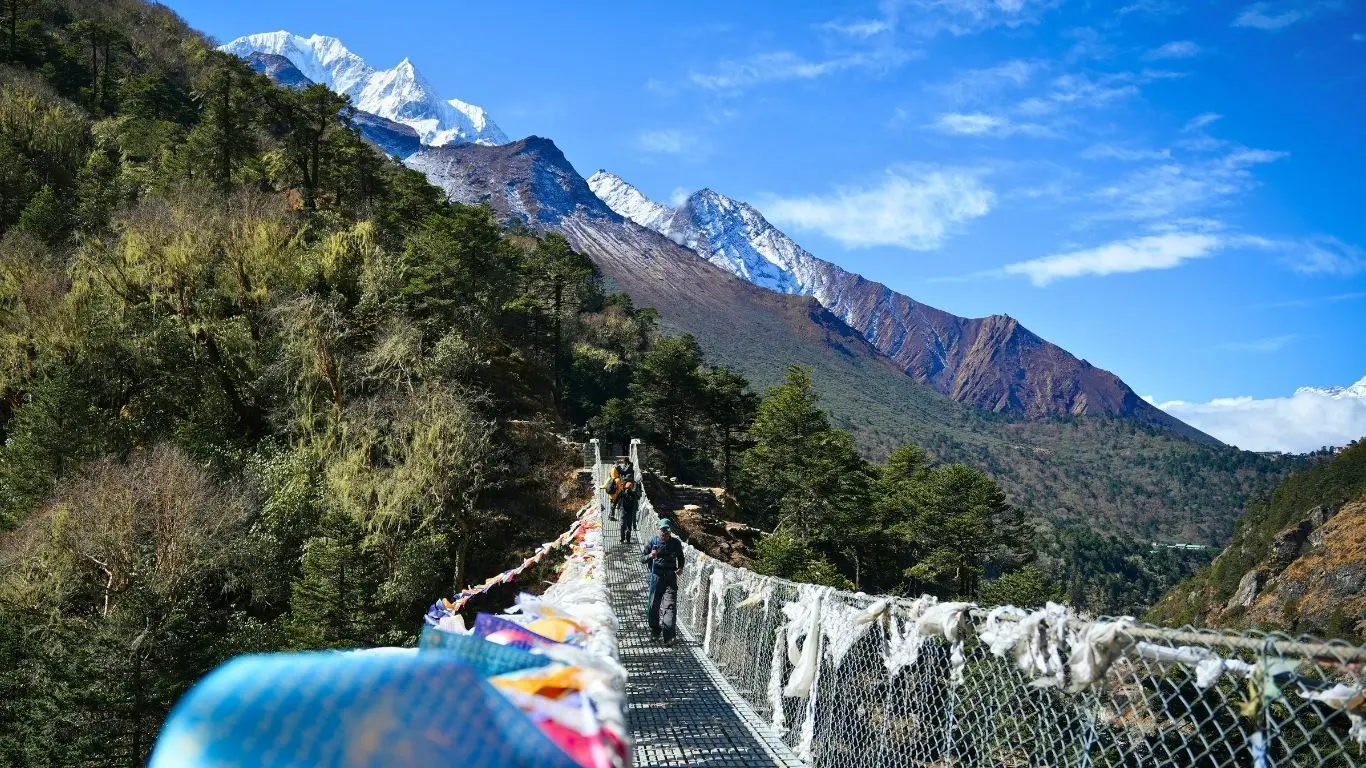 What Everest Base Camp Trek Cost Breakdown
Here is where every dollar of a typical package actually goes, category by category.
1. International Flights
Not included in any Nepal-based trekking package, anywhere — this is your cost to arrange separately. Prices vary enormously by home country and season: expect noticeably higher fares around October–November and March–April, when both peak trekking season and, in many source markets, school holidays overlap. Booking three to four months ahead generally beats last-minute pricing by a wide margin. Budget this as its own line item entirely separate from your trek cost.
2. Nepal Visa Cost
A tourist visa is issued on arrival at Tribhuvan International Airport for most nationalities:
| Duration | Fee |
|---|
| 15 days | USD 30 |
| 30 days | USD 50 |
| 90 days | USD 125 |
Bring exact USD cash and a passport photo to speed up the on-arrival process; an online pre-arrival form can also be completed to shorten the queue.
3. Kathmandu Accommodation
Before and after the trek, you'll want at least one Kathmandu night on each end — more if your international flight timing doesn't line up neatly, or if a Lukla weather delay pushes your return. Thamel, the trekker district, runs the full range: budget guesthouses from roughly $10–20/night, comfortable 3-star hotels from $30–60/night, and boutique or higher-end options above that. This isn't included in most trekking packages, though airport pickup and drop-off typically is.
4. Lukla Flight Cost
The flight to Lukla is one of the most consequential line items on this trek, and it's worth understanding why.
For independent trekkers booking flights on their own, round-trip Kathmandu–Lukla fares for foreign nationals generally run in the $400–500 range as of 2026, a price that reflects the route's short but genuinely difficult operating conditions rather than distance — it's one of the shortest scheduled flights in the world by air time, and among the most expensive per minute.
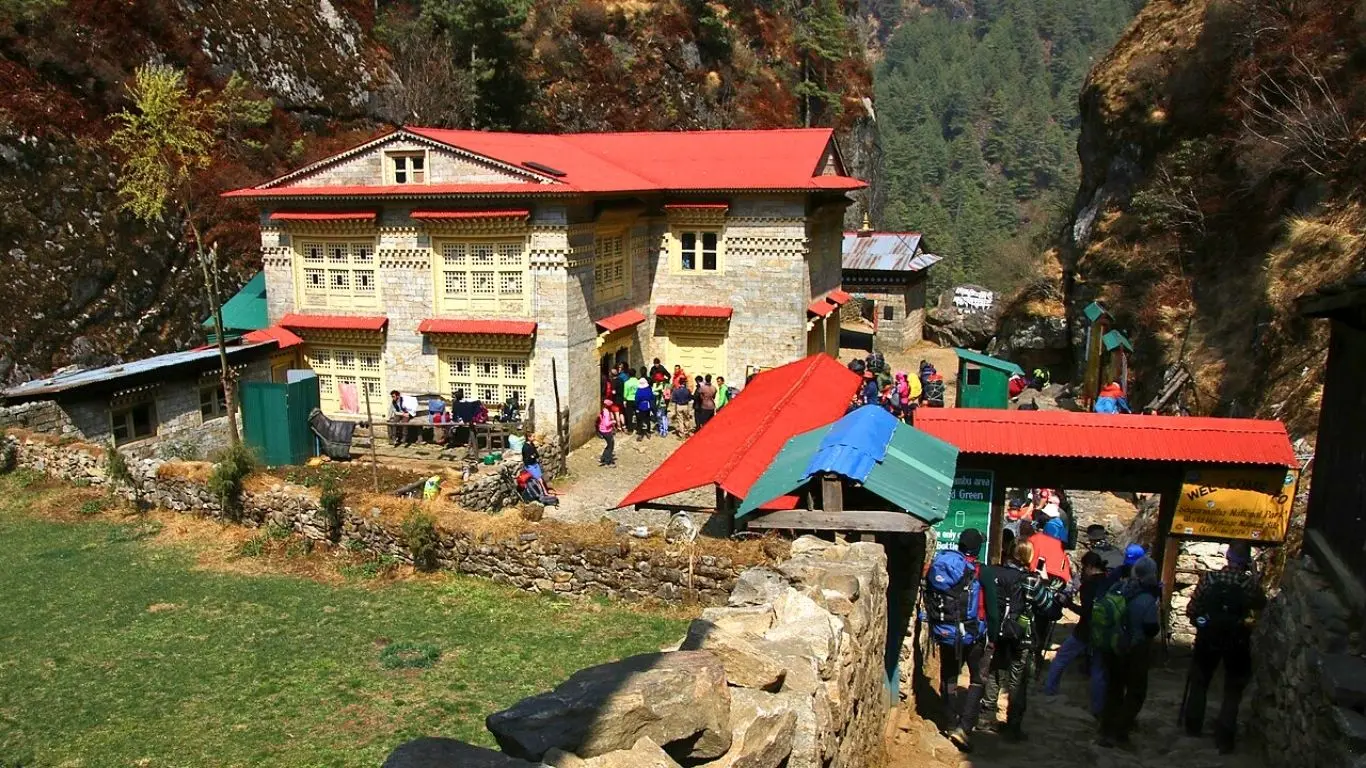
Why it costs what it does: Lukla's Tenzing-Hillary Airport has a short, sloped runway at 2,860m, bordered by a mountainside on one end and a drop on the other — there's no go-around margin for error the way a standard airport offers. Aircraft operating this route are specialised STOL (short takeoff and landing) planes flown by pilots with specific mountain-flying certification, a smaller and more specialised pool than standard commercial aviation. Add genuinely unpredictable Himalayan weather, and you have a route where every seat costs more to fly safely than an equivalent-distance flight almost anywhere else on earth.
Seasonal operations shift, too. During peak trekking months (roughly March–May and late September–November), flights operate out of Manthali Airport in Ramechhap district rather than Kathmandu itself, because Kathmandu's single runway can't absorb the volume of Lukla traffic on top of its regular schedule. This means a 4–5 hour road transfer, typically departing between 1:00 and 3:00 AM, to reach Manthali in time for the first weather window of the day. It's an unglamorous start to the trek, but Ramechhap's lower elevation and clearer morning conditions actually make it the more reliable departure point in peak season, despite the pre-dawn drive. This transfer is included in every Places Nepal package with no peak-season surcharge — worth confirming with any operator you're comparing, since some quote it as an extra.
Weather delays are routine, not exceptional. Flights operate under Visual Flight Rules, meaning pilots need genuine visibility of the mountainous terrain to fly safely — no instrument-only fallback exists at this altitude and topography. Morning flights are prioritised because cloud typically builds through the day. A well-planned itinerary includes at least one buffer day specifically to absorb a weather delay without cascading into a missed international flight.
Trek the Everest Base Camp Trek
This classic trek takes you through the heart of the Khumbu region, past vibrant Sherpa villages, ancient monasteries, and towering Himalayan peaks.
5. Trekking Permits
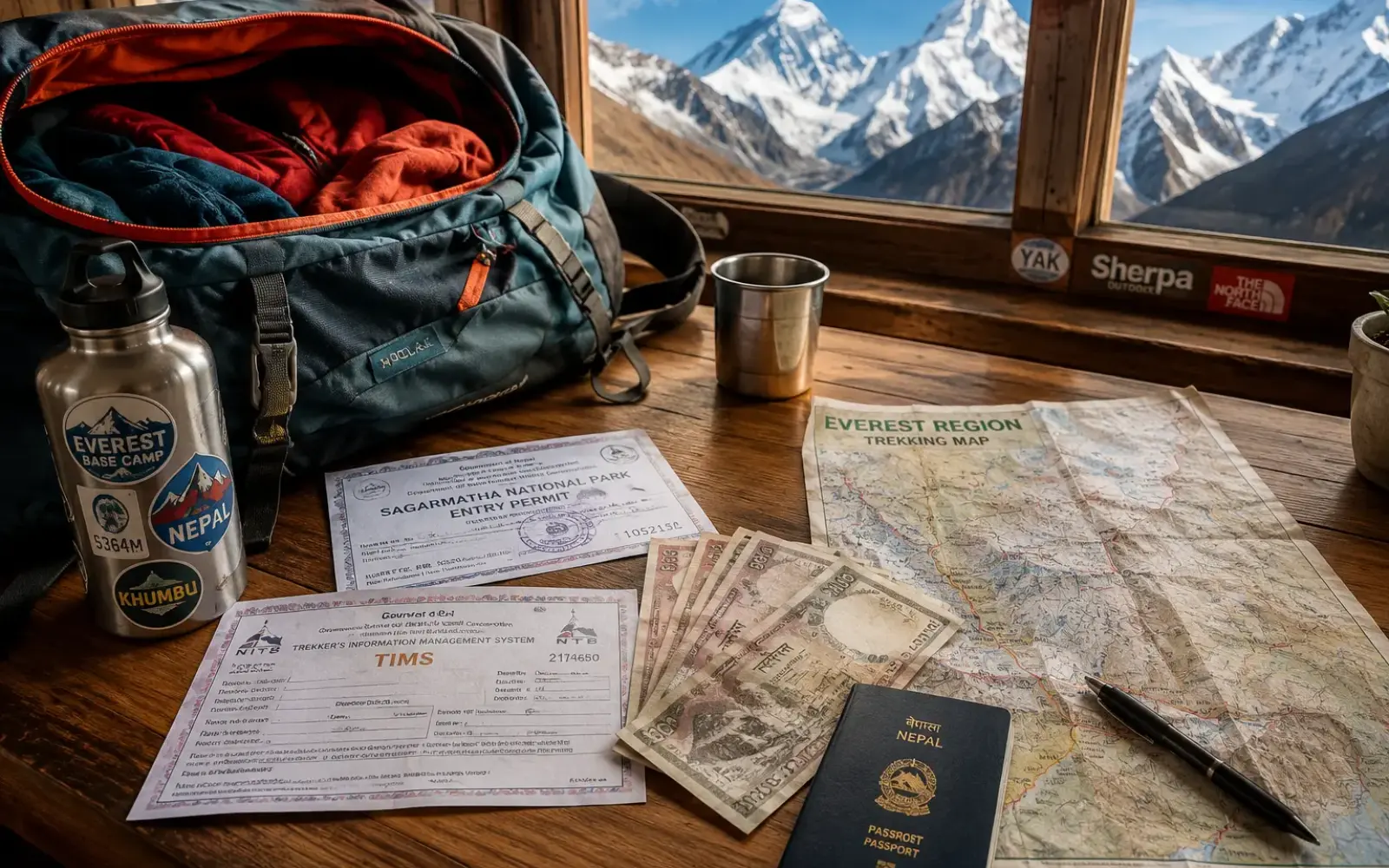
Two permits cover the entire Everest Base Camp route, and — a genuinely important point most cost guides get wrong — TIMS is not one of them.
| Permit | Cost | Notes |
|---|
| Sagarmatha National Park Entry Permit | NPR 3,000 (~$23) for foreign nationals | Checked at the park entrance near Monjo |
| Khumbu Pasang Lhamu Rural Municipality Permit | NPR 2,000 for the first four weeks | The local entry fee, replacing TIMS on this specific route |
Why TIMS doesn't apply here: TIMS (Trekkers' Information Management System) was replaced on the Everest Base Camp route by the Khumbu Pasang Lhamu Rural Municipality Permit back in 2018. If you see a cost breakdown online charging a separate TIMS fee for EBC specifically, that page hasn't been updated in several years — a useful, quick way to judge how carefully any given operator maintains their pricing information. Both permits above are arranged on your behalf as part of every Places Nepal package; you supply a passport copy and photo, and the paperwork is handled before you ever reach Monjo.
6. Guide Cost
A licensed guide is the single most consequential line item on this trek, and it's worth understanding what you're actually paying for.
Market daily rates for a licensed, English-speaking EBC guide through a reputable Nepali agency generally run $25–35 per day as of 2026, which covers the guide's own food, accommodation, and insurance in addition to their wage — you are, in effect, their employer for the duration of the trek. Over a 12–14 day trekking itinerary, that's roughly $300–475 in guide costs before tips, almost always bundled into the total package price rather than billed separately.
What you're actually paying for: altitude monitoring (a good guide checks in daily and recognises early AMS symptoms before they escalate), route-finding and pacing decisions on a trail that changes year to year with weather and landslide damage, permit and checkpoint handling, genuine cultural context on the Sherpa communities and Buddhist sites you pass through, and — critically — a direct line to rescue coordination and helicopter evacuation contacts if something goes wrong. None of this shows up as a separate line item, but all of it is the difference between a guided trek and simply walking the same trail alone.
7. Porter Cost
A porter carries your main duffel, usually up to 20–25kg, letting you walk with just a daypack.
Market daily wages run $20–25 per day, covering the porter's own food, accommodation, and — with any legitimate agency — insurance. Over a 12-day trekking route, that's roughly $240–300 before tips.
Ethics matter here more than on almost any other line item. The International Mountain Explorers Connection and groups like the Khumbu Porters' Clothing Project have spent years pushing for fair porter treatment across the industry — proper wages, insurance, load limits, and appropriate cold-weather clothing. Unfortunately, not every operator complies: some budget agencies pay porters well below fair rates or push loads beyond safe limits to shave their own costs, and the porters bear that risk, not the trekker. A responsible operator pays fair wages and enforces a genuine weight cap; ask any company you're comparing what they pay their porters and what limit they enforce, and treat a vague or evasive answer as a red flag.
8. Accommodation During the Trek
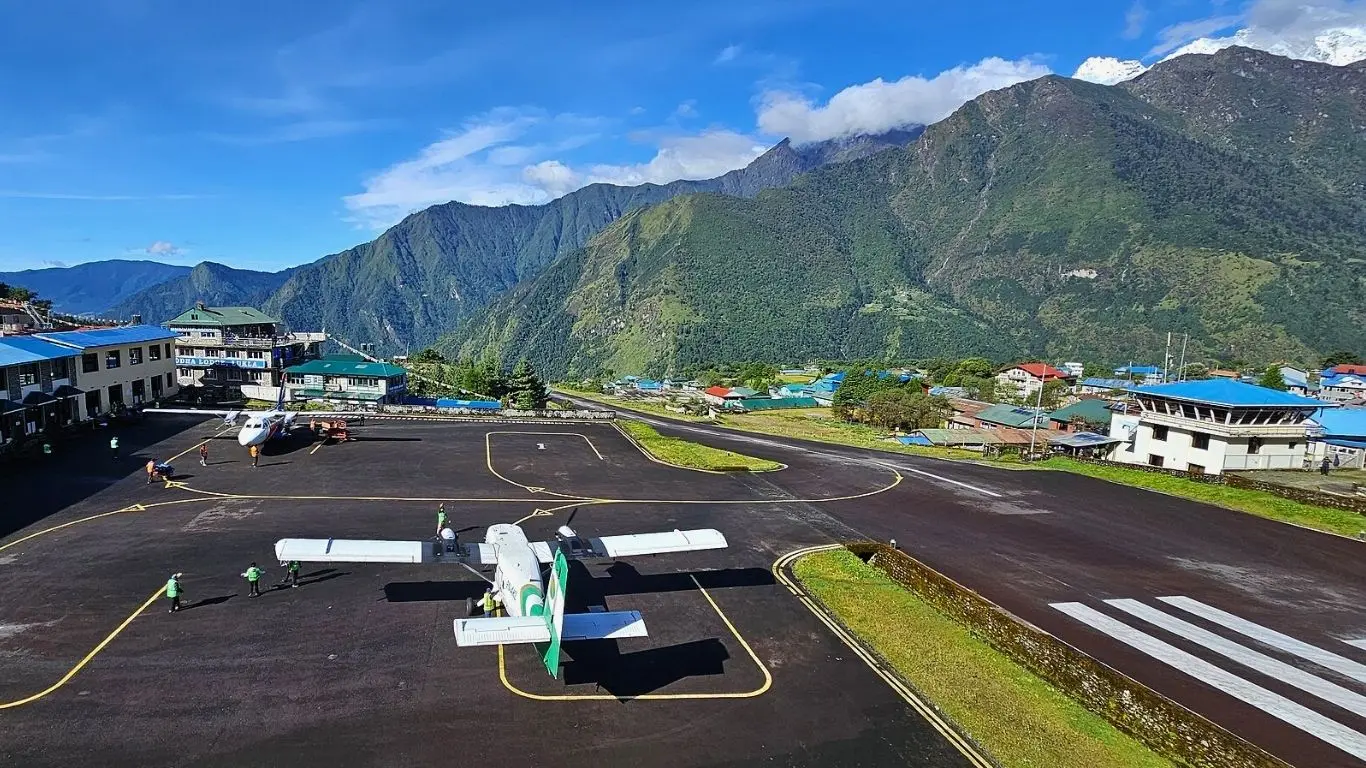
Teahouses along the route are simple: twin rooms, shared bathrooms (increasingly common with attached facilities at lower elevations, shared and more basic higher up), and a central dining room that becomes the social and heating hub of every evening.
Room cost rises with altitude, not because the beds get nicer but because everything above Lukla arrives by yak, mule, or porter, and building materials, fuel, and furnishings all cost more to move up the valley. A guided package typically bundles accommodation into the total price rather than billing per night, which insulates you from this altitude-driven creep — an independent trekker paying teahouse-by-teahouse will notice it directly.
Seasonal variation matters too. In October and November, Namche and Dingboche lodges fill fast, and a trekker without advance booking — or without a guide who has existing lodge relationships — can find themselves in a dining-hall bench rather than a room on a busy night.
9. Food Cost During the Trek
A full day's food (breakfast, lunch, dinner, plus tea and snacks) typically runs $20–40 per person per day for independent trekkers, rising as you go — $20–25/day is realistic from Lukla to Namche, climbing to $30–40/day between Namche and Gorak Shep.
Why food gets more expensive at altitude: there's no road above Lukla. Every sack of rice, every egg, every bottle of cooking gas is carried up by porter, mule train, or (increasingly) yak, over multiple days of travel. A plate of dal bhat that costs a few dollars in Namche costs meaningfully more by Lobuche or Gorak Shep, purely because of what it took to get the ingredients there. This is genuine transport economics, not a markup aimed at trekkers — the same logic applies to hot showers, Wi-Fi, and device charging, all of which climb the same way.
A standard guided package typically includes breakfast, lunch, and dinner on trekking days, which removes this variable from your budget — you're paying one price regardless of how much altitude-driven food inflation happens along the way.
10. Equipment Cost
Break this into three honest categories:
Buy (worth owning if you'll trek again): broken-in hiking boots, a good base-layer system, wool or synthetic hiking socks, sunglasses with genuine UV protection, a headtorch.
Rent (Kathmandu or Namche, cheap and sensible for a one-off trip): down jacket (roughly $1–2/day), sleeping bag rated to at least -15°C, trekking poles. Thamel has dozens of rental and gear shops; quality varies, so check zippers and insulation before committing.
Already own (most travellers have these): daypack, reusable water bottle, basic toiletries, sun protection, a power bank.
Renting the expensive bulky items (down jacket, sleeping bag) rather than buying them for a single trip is one of the more painless ways to cut cost without cutting comfort or safety.
 4. Lukla
Complete Everest Base Camp Trek Budget Calculator
Here's a realistic example for a solo trekker booking a standard Places Nepal guided package in peak season:
| Line Item | Cost |
|---|
| Package Cost (guide, porter, permits, accommodation, meals, Lukla flights) | $1,499 |
| International Flight (varies by origin) | $700–1,200 |
| Nepal Visa (15 days) | $30 |
| Travel Insurance (30 days, altitude + evacuation cover) | $80–150 |
| Gear (rental: down jacket + sleeping bag + poles) | $30–50 |
| Personal Trail Expenses (showers, Wi-Fi, charging, snacks — 12 days at $15–25/day) | $180–300 |
| Tips (guide + porter, ~10% of staff wages, pooled) | $150–250 |
| Total Trip Budget (excluding international flight) | ~$1,970–2,280 |
| Total Trip Budget (including a mid-range international flight) | ~$2,700–3,400 |
A trekker joining a group of 2–5 or the fixed departure, at $1,260 instead of $1,499, brings the non-flight total down by roughly $240 — one of the clearest illustrations of why group size is the single biggest lever on this trek's final cost.
 5. Guide
Places Nepal's Everest Base Camp Trek Package Cost
Places Nepal runs this trek two ways, and — because this is genuinely the most common source of "why do I see different prices" confusion — it's worth being explicit about both.
Private Group Trek (Flexible Dates)
| Group Size | Price Per Person |
|---|
| Solo Trekker | USD 1,499 |
| Private Group of 2–5 | USD 1,260 |
| Private Group of 6–10 | USD 1,180 |
| Private Group of 11+ | USD 1,100 |
Private trips give you your own departure dates, a private guide and itinerary, and more say over pacing — genuinely useful for families, older trekkers who want extra acclimatisation buffer, or groups on a specific schedule.
Fixed Departure (Join a Group)
Price: USD 1,260 per person, regardless of whether you join alone or with a companion — the same rate as the private group-of-2–5 tier, since a fixed departure spreads the guide and logistics cost across whoever else has booked that date. This is generally the best-value option for solo trekkers who'd rather not pay the $1,499 solo-private rate, and it comes with the bonus of trekking alongside other international travellers.
Trek the Everest Base Camp Trek
This classic trek takes you through the heart of the Khumbu region, past vibrant Sherpa villages, ancient monasteries, and towering Himalayan peaks.
The Everest Base Camp Trek Cost Varies Depending on How You Book
Private trips range from USD 1,100 to 1,499 per person depending on group size, while travellers joining Places Nepal's fixed departure can join at USD 1,260 per person. There's no single "real" number — a group of eleven pays $1,100 each; a solo trekker who'd rather not pay the $1,499 solo-private rate joins the fixed departure at $1,260 instead.
What makes this package different isn't a longer inclusions list than every other Kathmandu agency's — most reputable operators cover similar ground on paper. It's a guide who has genuinely walked this route enough times to make good real-time pacing and altitude calls, a porter paid fairly and load-capped honestly, and a Kathmandu-based team reachable if a Lukla weather delay means rearranging your onward international flight. That's the real value difference between a transparent local operator and a reseller with no ground presence in Nepal.
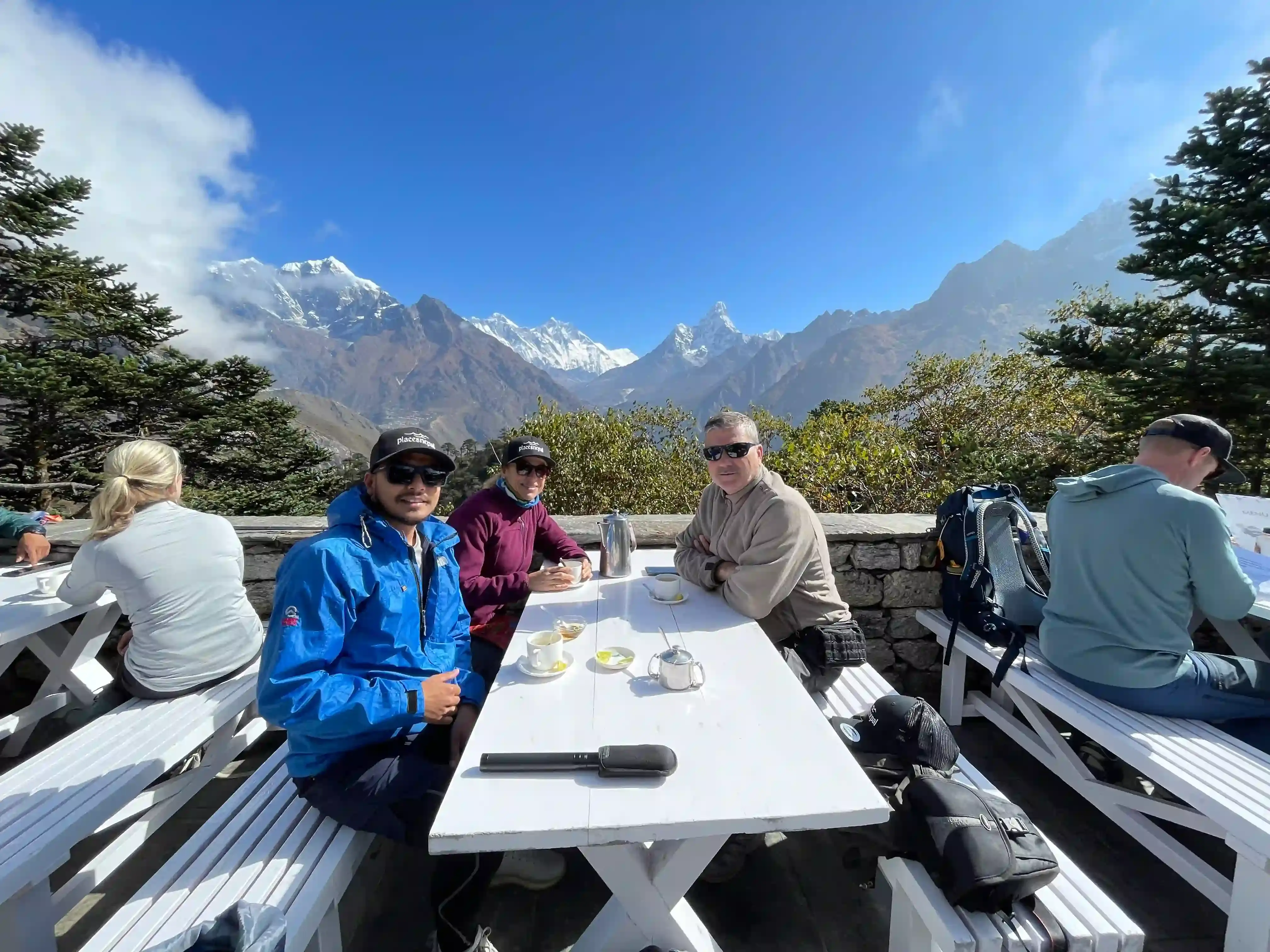
Everest Base Camp Trek Package Cost Comparison
Budget Package
Who it suits: highly experienced trekkers comfortable navigating without a guide, on a tight budget, and willing to accept meaningfully more personal risk. What's included: just permits and teahouse-by-teahouse accommodation and food, self-arranged. Limitations: no altitude monitoring beyond your own judgment, no rescue-coordination relationships if something goes wrong, no porter (you carry your own load at altitude), and — since 2023 regulatory tightening across several Nepal trekking regions — some restricted routes now require a guide by law, though EBC itself still technically permits solo trekking. The savings are real; so is the risk.
Standard Package
Ideal for: the large majority of trekkers — first-timers and experienced alike. What's included: licensed guide, porter, permits, teahouse accommodation, meals, and Lukla flights (with Ramechhap transfer in peak season), all bundled into one transparent price. The balance: this tier gives you genuine safety infrastructure and local expertise without paying for boutique lodges or a private helicopter — the sweet spot for most trekkers' priorities.
Premium Package
What it adds: smaller group sizes (or fully private), a more senior/experienced guide, upgraded teahouse selections where available (some now offer private bathrooms and better heating even at altitude), and better Kathmandu accommodation bookended around the trek. Cost: meaningfully above the standard tier, generally $2,000–3,000+ depending on exactly what's upgraded.
Luxury Helicopter Package
What it adds: a helicopter segment (typically replacing the multi-day walking descent), the highest lodge standard available on the route, and often five-star Kathmandu accommodation either side. Cost: $3,500–5,500+ is a realistic market range for a genuinely luxury version of this trip. This is a different, higher tier than Places Nepal's standard Helicopter Return package (from $1,830/person) — that product swaps the descent for a shared helicopter flight while keeping standard teahouse accommodation throughout, which is why it sits well below full "luxury lodge + heli" pricing. Worth asking any operator specifically which tier their "helicopter package" refers to, since the phrase gets used for both.
Guided vs Independent Everest Base Camp Trek Cost
| Category | Independent | Guided |
|---|
| Permits | Self-arranged at NTB offices, same government fee | Arranged on your behalf, same government fee |
| Flights | Self-booked, market rate (~$400–500 round trip) | Included in package, coordinated around weather |
| Accommodation | Self-negotiated teahouse-by-teahouse | Bundled, often pre-arranged with lodge relationships in peak season |
| Safety | No altitude monitoring beyond your own judgment; no porter | Daily guide check-ins, oximeter monitoring, rescue-coordination contacts |
| Convenience | You handle every logistical decision | Guide handles pacing, permits, lodge booking, weather contingencies |
| Total Cost | $1,000–1,300 | $1,100–1,499 (standard) |
Why the cheapest option isn't always the best value: the price gap between independent and guided trekking is smaller than most people expect — often just a few hundred dollars — while the gap in safety infrastructure and genuine trip insurance (a guide who can act fast on early AMS symptoms, or coordinate a helicopter evacuation without you having to manage it yourself while unwell) is considerable. For a route that reaches 5,364m at Base Camp and 5,545m at Kala Patthar, that trade-off is worth thinking through carefully rather than defaulting to the cheapest number on the page.
 11. Personal
Group Joining vs Private Everest Base Camp Trek Cost
Fixed Departure Group Trek
Pre-scheduled dates, a flat per-person rate ($1,260 with Places Nepal) regardless of solo or paired booking, and the chance to trek alongside other international travellers. Best for solo trekkers and anyone who wants a guaranteed date without assembling their own group.
Private Trek
Your own dates, your own pace, priced by group size ($1,100–1,499 depending on headcount). Best for families, couples, and groups of friends who already know who they're travelling with and want control over the itinerary.
Best choice for different travellers: solo trekkers and those without a ready-made group generally do better joining the fixed departure — same guide standard, same inclusions, lower cost than the solo-private rate. Groups of two or more with flexible schedules should compare both: a private group of 2–5 pays exactly the same $1,260 as the fixed departure rate, so the real decision there is flexibility (private) versus social trekking with strangers (fixed) rather than price.
Hidden Costs on Everest Base Camp Trek
These rarely appear on a headline package price, and they add up:
- Wi-Fi — $3–6/day at most lodges, pricier near Base Camp
- Device charging — $2–5 per charge, rising with altitude
- Hot showers — $3–6, and scarcer above Dingboche
- Extra drinks and snacks — $5–15/day depending on appetite
- Extra luggage storage in Kathmandu — usually free at your hotel if you're returning to the same one, but worth confirming
- Tips — genuinely expected everywhere in Nepal's trekking industry, budget $150–250 total for guide and porter combined
- Emergency expenses — a helicopter evacuation without insurance can cost $3,000–8,000; this is precisely why insurance is non-negotiable, not optional
- Gear purchases mid-trek — forgotten gloves or a failing headtorch cost more in Namche than in Kathmandu
- Extra Kathmandu nights due to flight delays — Lukla weather delays are routine, not rare; budget at least one buffer night's accommodation as a contingency
How to budget properly: take your package price, add $15–25/day in personal trail spending for the full trek duration, add your tip budget, add insurance, and add one contingency Kathmandu night. That combined total — not the headline package figure alone — is your real trip cost.
How Much Cash Should You Carry?
ATMs exist in Namche Bazaar but are frequently unreliable — don't count on them as your primary cash source. Withdraw everything you'll need before leaving Kathmandu.
A sensible on-trail cash amount is $300–500 (or the NPR equivalent) per trekker, covering personal expenses, tips, and a genuine emergency buffer, in a mix of denominations — large notes are hard to break at a small teahouse. Cards are effectively unusable once you're on the trail itself.
Everest Base Camp Trek Cost by Season
Spring (March–May): Peak season, alongside autumn. Stable weather, the highest demand for Lukla flights and lodge rooms, and correspondingly higher accommodation pricing at busy stops. Rhododendron blooms lower down are a bonus.
Summer/Monsoon (June–August): Lower demand, cheaper lodge rates in principle, but genuinely poor trekking conditions — heavy rain, obscured mountain views, and higher flight cancellation risk due to cloud cover. Not generally recommended for EBC.
Autumn (late September–November): The other peak window, and arguably the most popular of the year — the clearest, most reliable weather, but also the busiest lodges and the tightest flight availability. Book well ahead for October and November specifically.
Winter (December–February): The quietest and often cheapest season, with genuinely stunning clear-air views, at the cost of serious cold — nights well below freezing at altitude, some lodges reducing services, and layered gear becoming non-negotiable rather than optional.
How to Save Money Without Sacrificing Safety
- Book directly with a local, registered Nepali operator rather than an overseas reseller layering a markup on top
- Join a fixed departure group instead of a solo-private booking
- Rent expensive bulky gear (down jacket, sleeping bag) in Kathmandu rather than buying it
- Avoid unnecessary luxury lodge upgrades on a standard-package trek — save the splurge for Kathmandu accommodation instead
- Carry a reusable water bottle with purification tablets rather than buying bottled water at altitude prices the whole way up
- Bring a power bank rather than paying to charge multiple devices daily
- Travel in shoulder season edges (early March, late May, early October) for slightly eased demand pricing
- Book Lukla-dependent travel with a genuine buffer day, avoiding costly last-minute rebooking fees if weather delays your flight
- Prepare physically before you arrive — a trekker who needs to bail early due to poor fitness loses the value of the whole package
 Hidden Why Cheap Everest Base Camp Packages Can Be Risky
An unusually low quote for this trek is rarely a sign of superior efficiency — it's almost always a sign that something has been cut, and it's worth understanding what that something usually is, without assuming bad faith on the part of every budget operator.
Missing or improperly arranged permits are the most basic corner to cut, and the cheapest to skip on paper. Underpaid or overloaded porters are a harder-to-see cut, since the trekker rarely sees the wage slip — but it's a real and documented problem in parts of the budget end of this industry, and it's the staff who bear the cost, not the client. Overcrowded groups with a single guide stretched across more trekkers than they can safely monitor reduce the quality of altitude oversight precisely when it matters most. Hidden charges appear at checkout or on the trail itself, once you're not in a position to easily switch operators. Lack of emergency support — no real Kathmandu office, no established helicopter-evacuation relationships, no 24/7 contact — only becomes visible exactly when you need it most, which is the worst possible time to discover it.
None of this means every budget-priced trek is unsafe, or that every well-known operator is beyond reproach. It means the price alone tells you less than the inclusions list does — ask specifically what's covered before assuming a lower number is simply a better deal.
Trek the Everest View Panorama Trek
An easy to moderate yet rewarding journey to Nepal’s most spectacular mountain vistas. Ideal for first-time trekkers, senior citizens, children and family.
What Makes a Good Everest Base Camp Trek Package?
A quality package should include:
- ✓ A licensed guide, with a verifiable government trekking guide licence
- ✓ Proper permits — Sagarmatha National Park and Khumbu Pasang Lhamu Rural Municipality, arranged transparently
- ✓ Teahouse accommodation, clearly specified (twin-share, standard, etc.)
- ✓ Meals, with the exact count specified (breakfast/lunch/dinner, which days)
- ✓ Lukla flights, both directions, including the Ramechhap transfer in peak season with no hidden surcharge
- ✓ Porter support, with a stated fair wage and honest weight limit
- ✓ Insurance for guide and porter, as the trekker's employer for the trek's duration
- ✓ Emergency planning — a real Kathmandu contact, known evacuation coordination
- ✓ Transparent pricing — an itemised quote you can actually compare against a competitor's, not a single bundled figure with no detail
Expert Tips From a Nepal Trekking Company
- Book your Lukla-dependent travel with at least one buffer day built in, always.
- Confirm whether TIMS is charged on your quote — if it is, for the EBC route specifically, ask why.
- Ask any operator directly what they pay their porters, and what load limit they enforce.
- Rent your down jacket and sleeping bag in Kathmandu rather than buying them for one trip.
- Bring more cash than you think you'll need — Namche's ATMs are not reliable.
- Choose a 12–14 day itinerary over a compressed one; the extra acclimatisation day is not padding.
- Confirm your insurance explicitly covers altitude above 5,500m and helicopter evacuation.
- Pool your tips at the end of the trek rather than tipping inconsistently along the way.
- Pack a headtorch with spare batteries — teahouse corridors and early starts both need it.
- A private group of 2–5 costs exactly the same per person as the fixed departure — choose based on flexibility, not price.
- Travel light specifically for your Kathmandu-to-Lukla flight leg; baggage limits are enforced strictly.
- Ask specifically whether your guide holds restricted-area or high-altitude specific credentials, not just a general trekking licence.
- Avoid ultra-cheap quotes that exclude porter support entirely — carrying your own gear at 5,000m is harder than it sounds.
- Bring a water filter or purification tablets rather than buying bottled water the whole way up.
- Confirm your itinerary includes proper acclimatisation days at Namche and Dingboche — don't let anyone compress these to save a day.
- If travelling in October or November, book your dates two to three months ahead; lodges and flights both tighten.
- Bring a genuinely warm sleeping bag rated to at least -15°C, even in "warmer" seasons — nights at altitude are cold regardless of month.
- Ask what happens, specifically, if your Lukla flight is weather-delayed for two days — a real operator has a concrete answer.
- Don't skip travel insurance to save money; an uninsured helicopter evacuation costs thousands more than the policy would have.
- Confirm whether airport pickup is included regardless of your flight arrival time — a good operator doesn't charge extra for a late-night landing.
- Ask for an itemised quote, not a single bundled number, from any operator you're comparing.
- If solo, seriously consider the fixed departure over the solo-private rate — same experience, meaningfully lower cost.
- Carry a physical printed copy of your travel insurance policy and passport photo page, in case connectivity fails when it's needed.
- Train specifically for descents, not just ascents — knee strain on the way down surprises more trekkers than the climb up does.
- Don't assume the most expensive package is automatically the safest — ask the same specific questions (guide credentials, porter wages, insurance, emergency plan) regardless of price tier.
- If gear shopping in Thamel, check zippers and insulation quality in person rather than trusting a shop display.
- Budget for one contingency Kathmandu night on both ends of the trek, even if your schedule looks tight on paper.
Frequently Asked Questions
How much does Everest Base Camp Trek cost in 2026? A standard guided package with Places Nepal ranges from USD 1,100 to 1,499 per person depending on group size, while the fixed departure runs a flat USD 1,260 per person. Independent, unguided trekking runs roughly USD 1,000–1,300, and premium or luxury helicopter options can run USD 2,500–5,500+.
Is $1,500 enough for Everest Base Camp? Yes, for a standard guided package plus a reasonable trail-spending and tip budget, though this typically doesn't include your international flight. Add roughly $400–600 for insurance, gear rental, trail spending, and tips on top of a package in this range for a realistic total.
Can I trek Everest Base Camp cheaply? Yes — independent, unguided trekking is the cheapest route, running roughly $1,000–1,300, though it removes the safety and logistical support a guide provides. Joining a fixed departure group is the cheapest way to get guided, safety-backed trekking.
Is a guide mandatory for Everest Base Camp? Not legally, unlike several of Nepal's restricted-area treks that now require one. Independent trekking remains technically permitted on this route, though a licensed guide adds real safety and logistical value that most trekkers find worth the cost.
How much do guides earn on this trek? Market rates run $25–35 per day, which includes the guide's own food, accommodation, and insurance as part of that rate. Over a 12–14 day trek, that's roughly $300–475 total, almost always bundled into the package price.
How much should I tip my guide and porter? A common approach is roughly 10% of total staff wages, or in practical terms, $10–15/day for a guide and $5–10/day for a porter, pooled and given at the end of the trek.
Are international flights included in the package? No — no Nepal-based trekking package includes international flights. Budget this entirely separately, and book several months ahead for better fares.
How much extra cash should I carry? $300–500 per trekker, in a mix of denominations, since Namche's ATMs are unreliable and cards don't work once you're on the trail.
Is helicopter return worth it? For time-limited trekkers or anyone whose knees would rather not do a multi-day descent, yes. It adds real cost — Places Nepal's helicopter return package starts from $1,830/person — but removes three to four trekking days and the cumulative descent fatigue entirely.
Why is Everest Base Camp expensive compared to other treks? Three structural reasons: the Lukla flight's genuinely difficult operating conditions push its price well above a standard domestic flight, mandatory-in-practice guide and porter costs (even though not legally required), and remote-region logistics where every good, from food to fuel, is carried in rather than trucked.
What's included in a standard Places Nepal package? Licensed guide, porter, Sagarmatha National Park and Khumbu Pasang Lhamu Rural Municipality permits, teahouse accommodation, meals on trekking days, and Lukla flights including the peak-season Ramechhap transfer.
What's not included? International flights, Nepal visa, travel insurance, personal gear, personal trail expenses (Wi-Fi, showers, charging, snacks), and tips.
Do I need a TIMS card for Everest Base Camp? No. TIMS was replaced on this specific route by the Khumbu Pasang Lhamu Rural Municipality Permit in 2018. Any quote still charging a separate TIMS fee for EBC hasn't been updated in several years.
How much does the Lukla flight cost? Roughly $400–500 round trip for independent bookings as of 2026; included in every standard guided package.
Why do flights operate from Ramechhap instead of Kathmandu sometimes? During peak season (March–May and late September–November), Kathmandu's single runway can't absorb the volume of Lukla-bound flights alongside its regular international and domestic schedule, so operations shift to Manthali Airport in Ramechhap, involving a 4–5 hour pre-dawn road transfer.
How much does a porter cost? $20–25 per day in market wages, roughly $240–300 for a full 12-day trek, almost always bundled into a guided package's total price.
What's the ethical weight limit for a porter? 20–25kg is the standard, ethical maximum. A legitimate operator enforces this; an unusually cheap quote with excessive loads is a red flag worth asking about directly.
How many days is the standard Everest Base Camp trek? 12–14 days is standard, giving proper acclimatisation time. A 16-day itinerary adds extra rest days for a more comfortable altitude adjustment, at a proportional cost increase.
Is travel insurance mandatory? Not legally, but effectively yes for any responsible trekker — an uninsured helicopter evacuation from above 4,000m can cost $3,000–8,000 out of pocket, far more than any policy.
How much should I budget for food on the trail? $20–40 per person per day for independent trekkers, rising with altitude; included in most guided packages.
Why does food cost more at higher altitude? Everything above Lukla arrives by porter, mule, or yak train — there's no road. The transport cost of getting ingredients to Gorak Shep is genuinely higher than getting them to Namche, and that shows up in the menu price.
Can I rent trekking gear in Kathmandu? Yes — down jackets, sleeping bags, and trekking poles are all readily rentable in Thamel, generally at a fraction of the cost of buying for a single trip.
What's the difference between private and fixed departure booking? A private trip is your own group on your own dates, priced by group size ($1,100–1,499/person). A fixed departure joins a pre-scheduled group at a flat $1,260/person regardless of whether you join alone or with others.
Why does a solo private trek cost more than the fixed departure? On a private trip, a solo trekker bears the full guide and logistics cost alone. On a fixed departure, that cost is already spread across the other trekkers who've booked that date.
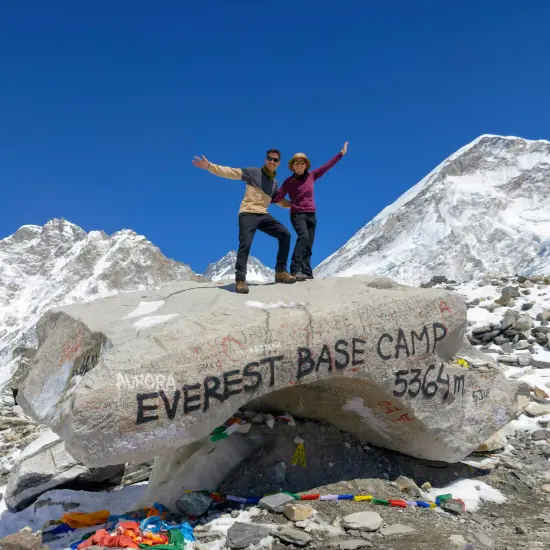
What's the highest altitude on this trek? Everest Base Camp itself sits at 5,364m; Kala Patthar, the popular viewpoint many itineraries include, reaches 5,545m.
Do I need previous trekking experience? No, though genuine cardiovascular fitness matters given both the altitude and daily walking hours. This isn't a technical climb, but it is a serious multi-day physical undertaking.
How far in advance should I book? Two to three months ahead for peak season (spring and autumn), given how quickly both lodge availability and Lukla flight seats tighten as departure dates approach.
Is there Wi-Fi and charging on the trail? Yes, at most lodges, for a fee that rises with altitude — $3–6/day for Wi-Fi, $2–5 per device charge.
What if my Lukla flight is delayed by weather? It's rescheduled to the next available window, typically the following morning. This is why a buffer day in your itinerary matters — it absorbs a short delay without threatening your onward international connection.
Is the Everest Base Camp trek cost negotiable? Package prices from reputable, registered agencies generally reflect fair wages for guide and porter staff and aren't meaningfully negotiable — a large discount usually means a corresponding cut somewhere in staff pay or coverage, not simple generosity.
What's a realistic total trip budget including everything? For a standard guided trek excluding international flights: roughly $1,970–2,280 including package, insurance, gear rental, trail spending, and tips. Add your specific international airfare on top for the true total.
Trek the Everest Base Camp Trek Helicopter Return
Everest Base Camp, Without the Long Walk Back. Reach 5,364m on Foot. Return by Air.
Other Everest Region Treks
If the standard 14-day Base Camp itinerary isn't quite the right fit, Places Nepal runs the rest of the Everest region too:
Want no walking at all, or a serious peak climb instead? The Everest Base Camp Heli Tour covers Base Camp in a single day by air, while Island Peak and Lobuche Peak extend the standard trek into a technical summit. See the full Everest region collection for everything else.
Trek the Everest Base Camp Trek
This classic trek takes you through the heart of the Khumbu region, past vibrant Sherpa villages, ancient monasteries, and towering Himalayan peaks.
Conclusion
A realistic Everest Base Camp trek cost in 2026/2027 runs $1,100–1,499 per person for a standard guided package with Places Nepal, $1,260 flat on the fixed departure, or $1,830+ with a helicopter return — plus international flights, insurance, gear, trail spending, and tips on top of any of those. The best value option, for the overwhelming majority of trekkers, sits squarely in the standard guided tier: it buys genuine safety infrastructure and local expertise without paying for boutique lodges or a private helicopter you may not need.
Choosing quality over the absolute cheapest number on the page isn't about avoiding a bargain — it's about understanding what a very low price usually means for the guide, the porter, and your own safety margin at 5,000m. A transparent, itemised quote from a registered Kathmandu-based operator, with a fair porter wage, a licensed guide, and a real emergency plan, is worth more than the difference in price almost every time.
Ready to see the number that applies to your group and dates? Check current fixed departure availability or request a private group quote on our Everest Base Camp Trek package page.