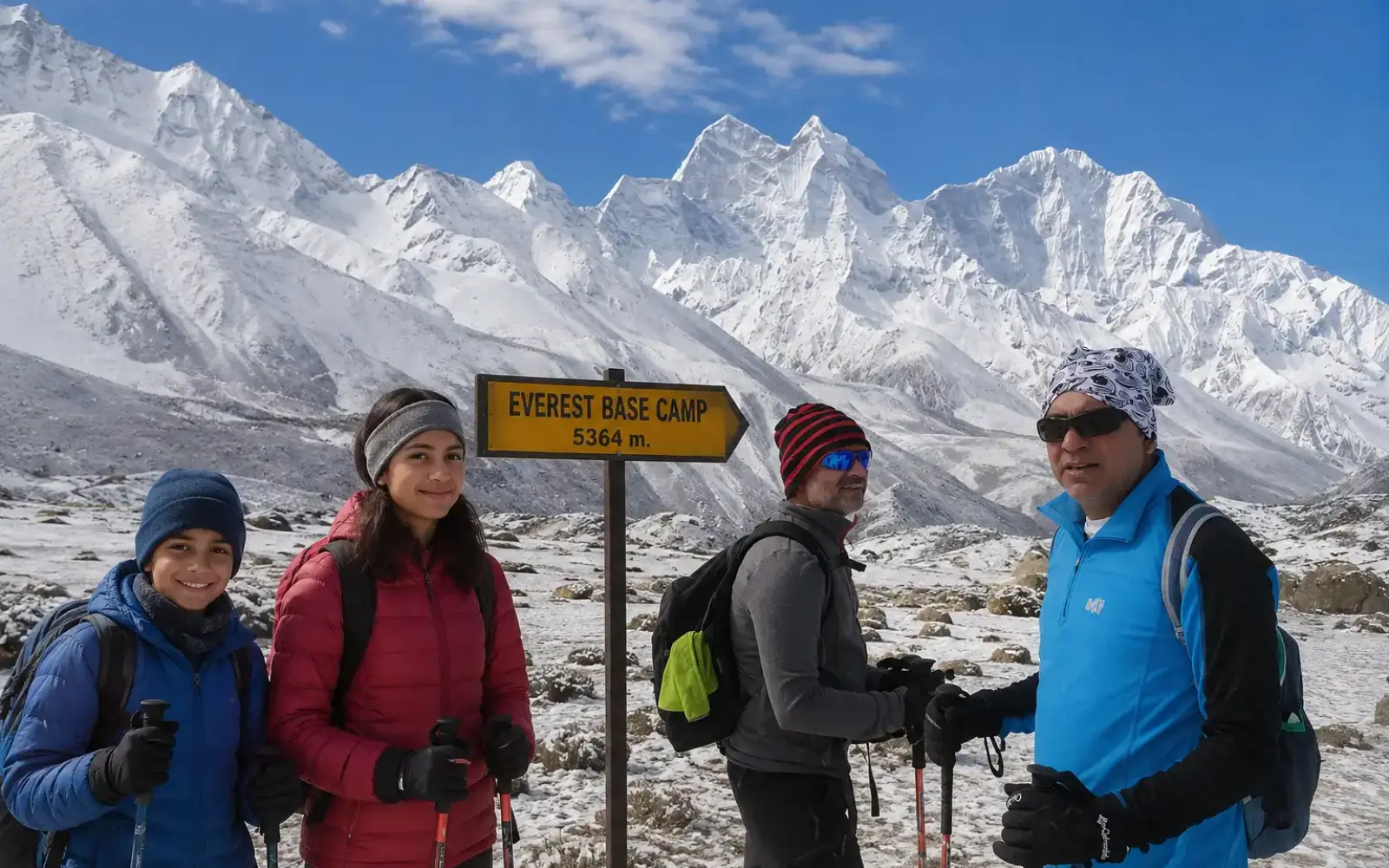
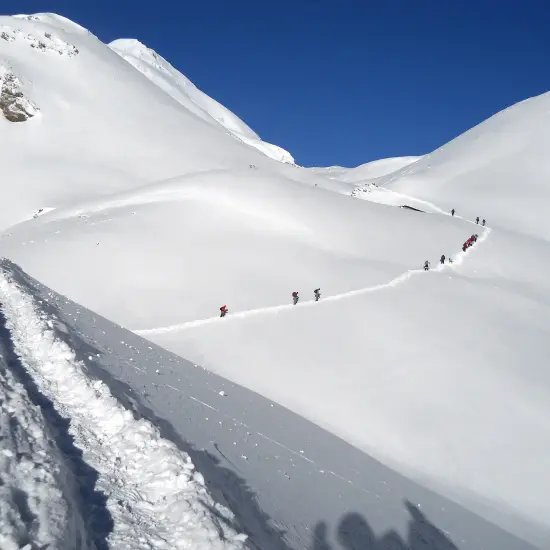
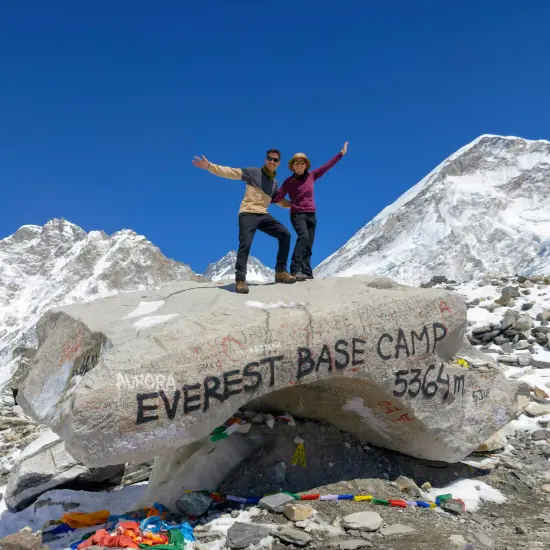
Neither trek is universally better — they're built for different priorities. Everest Base Camp is the more expensive, higher-altitude, single-destination trek to the foot of the world's highest mountain, reached by a weather-dependent flight to Lukla. The Annapurna Circuit is shorter, cheaper, reached entirely overland, and trades one iconic destination for a full loop through four changing climate zones. Choose based on what you actually want from the two weeks, not on which trek "wins."
Both routes are teahouse treks with strong infrastructure, no technical climbing required, and genuine high-altitude risk. Neither is a beginner walk in the park, and neither demands elite fitness. The right choice comes down to your available time, budget, altitude tolerance, and what kind of two weeks you actually want.
Choose Everest Base Camp if you want: the world's most famous trekking destination, direct views of Everest, a deep single-culture Sherpa experience, Namche Bazaar's mountain-town atmosphere, and you're prepared for the higher cost and the Lukla flight's weather risk.
Choose the Annapurna Circuit if you want: greater landscape and climate variety in fewer days, a genuine circuit rather than an out-and-back, the Thorong La pass-crossing experience, more overland transport flexibility, and a lower total cost.
The rest of this guide breaks down exactly why, category by category — with real 2026 numbers, not generic travel-blog claims.
Everest Base Camp vs Annapurna Circuit: Winner by Category
No single trek wins every category below, and that's the point — this table is a starting point for the detailed sections that follow, not the final word.
| Category | Everest Base Camp | Annapurna Circuit | Best For |
|---|
| Overall experience | Iconic single destination | Full circuit, more variety | Depends on your priority |
| Maximum altitude | 5,364 m (5,545 m at Kala Patthar) | 5,416 m (Thorong La) | EBC/Kala Patthar, marginally |
| Difficulty | Sustained high-altitude days | One hard, compressed pass day | Different risk shapes — see below |
| Trek duration | 12–18 days (14 standard) | 10–18 days (10 standard, 14 classic) | Annapurna if time-limited |
| Scenery | Iconic, singular | Varied, transforms daily | Both, for different reasons |
| Mountain views | Everest, Ama Dablam, Nuptse | Annapurna range, Thorong La panorama | EBC for iconic peaks |
| Cultural experience | Deep single-culture (Sherpa) | Broad multi-culture (Gurung, Tibetan-Buddhist, Thakali) | Depends on preference |
| Remoteness | High above Namche; flight-dependent | Overland access; road reaches further in | EBC feels more remote higher up |
| Accommodation | Strong lower down, basic above Dingboche | Strong to Manang, basic above Yak Kharka | Roughly even |
| Food | Wide variety to Namche, simpler above | Wide variety to Manang, simpler above | Roughly even |
| Infrastructure | Well-developed, remoteness increases with altitude | Well-developed, road access lowers logistics friction | Annapurna, marginally |
| Crowds | Busiest Oct–Nov, concentrated at key stops | Busiest Oct–Nov, more socially oriented | Personal preference |
| Cost (Places Nepal, 2026) | $1,100–$1,499 | $720–$990 | Annapurna |
| Altitude risk | AMS in 30–50% on faster itineraries (Places Nepal's own EBC data) | Real risk concentrated at Thorong La | Neither is "safer" — different exposure |
| Weather | Same two prime windows; flight risk adds a variable | Same two prime windows; road can be landslide-affected in monsoon | Tie, different failure modes |
| Beginner suitability | Doable with training; not a first-ever hike | Doable, especially on a longer itinerary | Slight edge to EBC's built-in rest days |
| Experienced trekkers | Extend via Three Passes, Island Peak | Extend via Tilicho Lake, Poon Hill, full 14-day classic | Both extend well |
| Photography | Best for iconic single-peak shots | Best for landscape variety | Different genres of photo |
| Flexibility | Fixed by flight schedule | More overland route options | Annapurna |
Trek the Annapurna Circuit Trek
A legendary high-altitude trek in Nepal that encircles the Annapurna Massif, offering dramatic scenery, diverse cultures, and the iconic crossing of Thorong La Pass at 5,416 meters.
Everest Base Camp vs Annapurna Circuit at a Glance
| Everest Base Camp | Annapurna Circuit |
|---|
| Region | Khumbu, Solukhumbu District | Annapurna Conservation Area, Gandaki Province |
| Starting point | Lukla (reached by flight) | Dharapani/Besisahar (reached overland) |
| Typical duration | 12–18 days industry-wide; Places Nepal runs 14 days (12- and 16-day options exist) | 12–18 days industry-wide; Places Nepal runs a 10-day compressed version (14-day classic on request) |
| Maximum altitude | 5,364 m (Everest Base Camp itself); 5,545 m at Kala Patthar viewpoint | 5,416 m (Thorong La) |
| Highest overnight point | Gorakshep, 5,164 m | Thorong Phedi / High Camp, 4,525–4,880 m |
| Highest pass | None — this is an out-and-back, not a pass crossing | Thorong La, 5,416 m |
| Approximate walking distance | ~130 km round trip (Places Nepal's own 14-day itinerary) | ~100 km over 7 trekking days on the 10-day version; 160–230 km on the full classic loop |
| Accommodation | Teahouses throughout; hotel nights in Kathmandu | Teahouses throughout; one hotel night in Pokhara |
| Permits | Sagarmatha National Park Permit + Khumbu Pasang Lhamu Rural Municipality Permit (~$46 total); no TIMS on this route since 2018 | ACAP + TIMS (~$34 total) |
| Transportation | Kathmandu–Lukla flight (or Manthali road-and-flight combination in peak season) | Overland bus and shared jeep, both directions — no flight |
| Best seasons | Late September–November, March–May | Late September–November, March–May |
| Difficulty | Moderate-to-challenging; AMS affects 30–50% of trekkers on 12-day itineraries per Places Nepal's own data | Rated Challenging (4/5) on the compressed 10-day version specifically because of its shorter acclimatisation window |
| Typical cost (Places Nepal, 2026) | $1,100–$1,499 per person, tiered by group size | $720–$990 per person, tiered by group size |
| Guide/porter considerations | Guide not legally mandatory in Khumbu but strongly recommended and included as standard; porter optional, ~$300 shared between two trekkers | Guide legally mandatory in the Annapurna Conservation Area since April 2023; porter optional, ~$250 shared between two trekkers |
For the full day-by-day breakdown of either route, see the
Everest Base Camp Trek and
Annapurna Circuit Trek itineraries directly — this article compares them, it doesn't replace them.
Trek the Everest Base Camp Trek
This classic trek takes you through the heart of the Khumbu region, past vibrant Sherpa villages, ancient monasteries, and towering Himalayan peaks.
Everest Base Camp Trek Overview
Everest Base Camp is an out-and-back trek up the Khumbu region's single main valley. You fly into Lukla's cliffside airstrip, then walk north following the Dudh Koshi and Imja Khola rivers through Namche Bazaar — the region's Sherpa commercial hub — and on to Tengboche's monastery ridge, Dingboche, and Lobuche. The trek's payoff comes on consecutive days: Everest Base Camp itself at 5,364 m, followed by a pre-dawn climb to Kala Patthar at 5,545 m for the trek's genuinely iconic sunrise view of Everest's summit pyramid. The return trip largely retraces the same trail back to Lukla.
What makes this route unique isn't variety — it's depth. You're inside one continuous Sherpa cultural landscape the entire way, and the trek builds toward a single, world-famous objective rather than a changing sequence of destinations. For the complete daily breakdown, altitude profile, and logistics, see the
Everest Base Camp Trek itinerary or our
12-day vs 14-day vs 16-day comparison if duration is your main open question.
Annapurna Circuit Overview
The
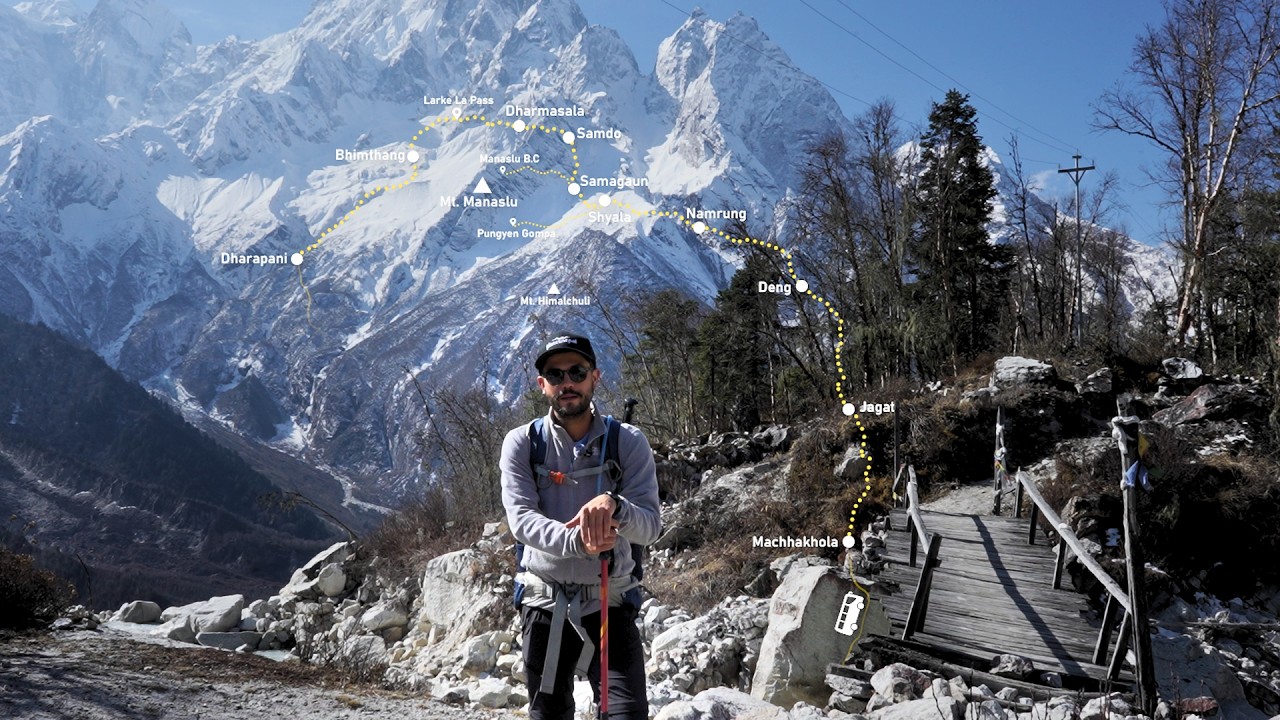
Annapurna Circuit is a loop rather than an out-and-back. Places Nepal's version starts with an overland transfer from Kathmandu to Dharapani, then climbs through Chame and Pisang into Manang — a Tibetan Buddhist valley and the trek's main acclimatisation stop — before pushing over Thorong La at 5,416 m. The descent drops into Muktinath, a site sacred to both Hindus and Buddhists, then continues through Lower Mustang's high desert and the Kali Gandaki Gorge, the deepest gorge on earth, before exiting via Jomsom and Pokhara.
It's worth being direct about something a lot of older trekking content glosses over: road development has genuinely changed this route over the past decade. The lower Marsyangdi valley that trekkers once walked for the better part of a week is now largely accessible by jeep road, which is exactly why most operators — Places Nepal included — now use vehicle transfers on that stretch and preserve the walking days for the sections still worth walking on foot.
The modern Annapurna Circuit is not the untouched wilderness route described in decades-old guidebooks, and any comparison pretending otherwise is out of date. What survives intact is the circuit's essential character: four distinct climate zones, a genuine high-pass crossing, and a cultural transition from Hindu lowlands to Tibetan Buddhist highland to Mustang desert inside a single trip. Trekkers who want to walk the full classic route on foot can still do so — ask about our 14-day full-walking itinerary. For route variations including the Tilicho Lake add-on and the reverse route, see our Annapurna Circuit itinerary and route options guide.
Trek the Annapurna Circuit Trek
A legendary high-altitude trek in Nepal that encircles the Annapurna Massif, offering dramatic scenery, diverse cultures, and the iconic crossing of Thorong La Pass at 5,416 meters.
Which Is Harder: Everest Base Camp or Annapurna Circuit?
This is the question most people actually want answered, so here's the direct version:
neither is harder in a simple sense — they're difficult in different shapes.Everest Base Camp's difficulty comes from sustained exposure. Places Nepal's 14-day itinerary spends the better part of a week above 4,000 m, with two scheduled acclimatisation days (Namche and Dingboche) plus an acclimatisation push to 5,091 m before the final approach. Even with that structure, Places Nepal's own EBC page cites a 30–50% acute mountain sickness rate on faster 12-day Khumbu itineraries — a meaningful number, and the reason we don't recommend compressing the schedule.
The
Annapurna Circuit's difficulty comes from compression. Places Nepal's 10-day version has one scheduled rest day (Manang) before a shorter, harder final push through Yak Kharka and Thorong Phedi or High Camp to the 5,416 m pass — rated Challenging (4/5) specifically because the itinerary is efficient rather than gradual. The pass day itself is also the toughest single day on either trek: a pre-dawn climb followed by a roughly 1,600 m descent to Muktinath, all in one push.
In plain terms: EBC asks your body to function at altitude for longer, across more consecutive days. The Circuit asks for one very hard day, inside a shorter overall trip. A trekker with prior altitude experience above 3,500 m is well-positioned for either; a genuine first-timer is better served by EBC's built-in rest days or by the Circuit's longer 14-day classic itinerary rather than the compressed 10-day version. Fitness alone doesn't prevent altitude sickness on either route — see our
Nepal trekking health and altitude sickness guide for how AMS risk actually works, since it's physiological, not a fitness test.
Altitude Comparison
| Factor | Everest Base Camp | Annapurna Circuit |
|---|
| Highest point | 5,364 m (EBC); 5,545 m (Kala Patthar) | 5,416 m (Thorong La) |
| Highest sleeping elevation | 5,164 m (Gorakshep) | 4,525–4,880 m (Thorong Phedi / High Camp) |
| Major high-altitude section | Namche (3,440 m) through to Gorakshep — nearly a week above 3,400 m | Manang (3,540 m) through Thorong La — roughly 4–5 days above 3,500 m |
| High pass | None — destination trek, not a pass crossing | Thorong La, 5,416 m, crossed in a single pre-dawn push |
| Acclimatisation days | 2 scheduled (Namche, Dingboche), plus a 5,091 m acclimatisation hike | 1 scheduled (Manang), with Ice Lake or Gangapurna Lake day hikes to 4,600 m |
| Altitude-sickness concern | 30–50% AMS rate on faster 12-day itineraries (Places Nepal's own data) | Documented moderate-to-severe AMS cases specifically at Thorong La when trekkers skip acclimatisation or ascend too fast |
Kala Patthar (5,545 m) is technically the higher point reached on either trek — it edges out Thorong La by 129 m — but it's a short there-and-back viewpoint push from Gorakshep rather than a crossing you have to complete to continue the route, so treat that number as a ceiling rather than a fair difficulty comparison on its own. For a full explanation of what AMS actually is, its symptoms, and when to descend, see our
altitude sickness prevention guide for Nepal treks — this article covers the comparison, not the medical detail, deliberately.
Which Has Better Mountain Views?
This depends on what "better" means to you, so here's the specific breakdown rather than a vague answer.
Everest Base Camp delivers proximity to the most famous names in mountaineering: Everest itself, Lhotse, Nuptse, Ama Dablam's distinctive spire, and Pumori looming over the Khumbu Glacier's moraine. The Kala Patthar sunrise — first light hitting Everest's south-west face — is the single most photographed moment on either trek, and it's a view you genuinely cannot get from anywhere on the Annapurna side. Ama Dablam in particular is widely considered one of the most elegant mountain profiles in the world, visible for days on the approach.
The Annapurna Circuit trades a handful of iconic named peaks for range. You get close views of the Annapurna massif itself, along with Gangapurna, Manaslu (visible from a surprise viewpoint near Timang, on the classic route), Dhaulagiri from the Kali Gandaki gorge, and Machhapuchhre from lower sections near Pokhara. Thorong La's summit panorama sweeps across the Annapurna and Damodar ranges simultaneously — genuinely one of the widest single-pass views in Nepal.
Best for iconic Himalayan peaks: Everest Base Camp.
Best for landscape variety: the
Annapurna Circuit. Neither claim cancels the other out.
Landscape and Climate Diversity
This is where the two treks diverge most sharply, and it's worth being specific rather than vague about it.
The Annapurna Circuit crosses genuinely different climate zones inside a single trip: subtropical farmland and forest on the approach, pine and rhododendron forest through the mid-hills, Tibetan Buddhist high valley around Manang, the alpine terrain leading to Thorong La, and — on the far side of the pass — Mustang's rain-shadow high desert, arid and wind-carved, closer in feel to the Tibetan plateau than to the rest of Nepal. Four distinct environments, each with a different feel, temperature, and vegetation, inside 10–14 days.
The Khumbu landscape on the
Everest Base Camp route changes too — pine forest below Namche gives way to alpine scrub above Tengboche, then to the stark glacial moraine around Gorakshep — but it's a single, gradual transition along one valley rather than a series of sharp climate shifts. The change on EBC is primarily vertical: forest to alpine to glacier. The change on the Circuit is both vertical and geographic: wet monsoon-influenced valley to dry rain-shadow desert, on opposite sides of the same mountain range.
If landscape variety specifically is what you're after, this category favors the
Annapurna Circuit. Trek the Annapurna Circuit Trek
A legendary high-altitude trek in Nepal that encircles the Annapurna Massif, offering dramatic scenery, diverse cultures, and the iconic crossing of Thorong La Pass at 5,416 meters.
Which Has Better Cultural Experiences?
Don't think of this as a ranking — it's a choice between two genuinely different kinds of cultural immersion.
Everest Base Camp goes deep into one culture. The entire route sits inside Sherpa homeland: Namche Bazaar's horseshoe of teahouses and bakeries, Tengboche Monastery's evening puja ceremony (one of the more genuinely moving cultural moments available on any Nepal trek), prayer wheels and mani walls the length of the valley, and villages where Sherpa Buddhist tradition and modern trekking infrastructure sit side by side.
The Annapurna Circuit moves through several cultures in sequence. Lower villages are Gurung and Hindu-influenced; Manang is deeply Tibetan Buddhist, with 900-year-old gompas like the one at Braga; Muktinath is sacred to both Hindus and Buddhists simultaneously, one of relatively few sites on earth where that's genuinely true; and Mustang's Thakali communities and architecture feel distinct again from everything earlier on the route.
Choose based on what you actually want: a single culture explored in real depth, or several cultures experienced in sequence as the landscape itself changes.
Accommodation
| Feature | Everest Base Camp | Annapurna Circuit |
|---|
| Teahouses | Well-established throughout; family-run lodges | Well-established throughout; family-run lodges |
| Private rooms | Twin-sharing standard on both; solo supplement possible where available | Twin-sharing standard; solo supplement possible where available |
| Bathrooms | Attached in lower villages (Phakding, Namche); shared above Dingboche | Attached in many lower-to-mid villages (Dharapani through Manang); shared above Yak Kharka |
| Hot showers | Available for a fee to Dingboche; rare or unavailable above | Available for a fee to Manang; basic/limited above Yak Kharka |
| Wi-Fi | Reliable and reasonably fast to Namche; patchy and pricier above, sparse near Gorakshep | Available in most teahouses to Manang; slower and pricier above, often unavailable at High Camp |
| Electricity/charging | Reliable lower down; paid and limited above Dingboche | Solar power common from Chame; free charging common lower down, paid and limited above Manang |
| Accommodation variety | Full range from comfortable (Namche) to very basic (Gorakshep) | Full range from comfortable (Manang) to very basic (Thorong Phedi/High Camp) |
Standards on both routes vary by village and altitude, not by trek as a whole — a blanket "which trek has better teahouses" claim isn't accurate for either. The honest pattern on both: the further from the trailhead and the higher the altitude, the more basic things get, and that's true almost anywhere in Nepal's teahouse trekking network.
Food
Both routes run on the same broad teahouse menu — dal bhat (unlimited refills on both, and the right choice at altitude on either trek), noodle soups, fried rice, momos lower down, pasta, porridge, and eggs for breakfast. Bakeries are a genuine highlight on both: Namche Bazaar on the EBC side and Manang on the Circuit side both have real bakeries doing apple pie and coffee that feel disproportionately good after a week of trail food.
Neither trek has objectively "better" food — what differs is where the good options run out. On EBC, menu variety narrows noticeably above Dingboche, and meat is best avoided above Namche for the same reason it's discouraged above Pisang on the Circuit: multi-day transport without refrigeration. On the Annapurna side, variety holds up well to Manang and then narrows above Yak Kharka. Vegetarian and vegan options are genuinely well handled on both routes with a little advance notice to your guide; gluten-free is manageable but requires more active communication with teahouse kitchens on either trek. For the full breakdown of what's actually on the menu at each altitude on the Everest side, see our
food on the Everest Base Camp trek guide.
Trek the Everest Base Camp Trek
This classic trek takes you through the heart of the Khumbu region, past vibrant Sherpa villages, ancient monasteries, and towering Himalayan peaks.
Cost Comparison
| Expense | Everest Base Camp (Places Nepal) | Annapurna Circuit (Places Nepal) |
|---|
| Typical package price (per person) | $1,100–$1,499, tiered by group size | $720–$990, tiered by group size; $820 flat on fixed departures |
| Permits (included) | ~$46 (Sagarmatha National Park + Khumbu Pasang Lhamu Rural Municipality) | ~$34 (ACAP + TIMS) |
| Transportation (included) | Round-trip Kathmandu–Lukla flights | Kathmandu–Besisahar–Dharapani and Jomsom–Pokhara–Kathmandu overland transfers |
| Guide | Included in every package | Included in every package (legally mandatory) |
| Porter | Optional, ~$300 total, shared between two trekkers | Optional, ~$250 total, shared between two trekkers |
| Food & accommodation | Fully included on trek days | Fully included on trek days |
| Extra personal expenses | ~$300–400 (showers, Wi-Fi, snacks, charging — prices rise with altitude and remoteness) | ~$200–300 (same categories, slightly lower given shorter itinerary and lower peak altitude for overnights) |
meaningfully more at every group size, and it's not padding — the gap comes from real structural differences: round-trip Lukla flights (or the Manthali road-and-flight combination in peak season), a typically longer itinerary, and a more remote Khumbu supply chain where everything above Lukla arrives by plane, yak, or porter rather than by road.
The Annapurna Circuit's overland-only logistics keep costs down without cutting corners on guide quality, permits, or teahouse standard — it's a shorter, less remote trek, not a lower-quality one. For the full line-by-line Annapurna breakdown — daily trail costs, real total-cost scenarios, and how to reduce cost without cutting corners that matter — see our Annapurna Circuit Trek cost guide, and for EBC's private-vs-group pricing structure specifically, see Private vs Group EBC Trek Price.
Transportation: Getting to Each Trailhead
Everest Base Camp starts and ends with a flight to Lukla's Tenzing-Hillary Airport — a short, genuinely thrilling approach onto a cliffside runway. It's also entirely weather-dependent: poor visibility grounds the fleet, delays of a few hours are routine, and full-day cancellations happen several times most seasons. During the busiest months — March through May and September through November, which are also the best trekking months — flights are frequently rerouted through Manthali Airport in Ramechhap instead, adding a 4–5 hour night drive on both ends of the trip. There is no practical walking alternative that fits a normal two-week holiday.
The Annapurna Circuit runs entirely on roads. Every stage — Kathmandu to Besisahar to Dharapani at the start, Jomsom to Pokhara to Kathmandu at the end — is a bus or shared jeep transfer. It's a long transport day (8–10 hours on Day 1), and the Marsyangdi valley road can be landslide-affected in monsoon, but there's no single-morning weather gamble the way there is with Lukla. Road development has also genuinely expanded route flexibility on this trek: several alternative jeep-accessible starting and ending points exist along the circuit depending on time available, which simply isn't possible on the fixed, flight-dependent Everest route.
If unpredictable flight delays are a real source of stress for your specific itinerary — a tight international connection, a hard return-flight deadline, a fixed number of vacation days — this is a legitimate, practical reason to lean toward the Circuit.
Trek the Annapurna Circuit Trek
A legendary high-altitude trek in Nepal that encircles the Annapurna Massif, offering dramatic scenery, diverse cultures, and the iconic crossing of Thorong La Pass at 5,416 meters.
Which Trek Has More Crowds?
Both routes are genuinely busy in peak season, and neither is a solitude trek in October or April. Rather than quote uncertain annual visitor totals, here's the pattern that actually matters for planning:
Everest Base Camp's crowding concentrates around a small number of key stops — Namche Bazaar, Tengboche, and especially Gorakshep, where lodge capacity is limited by the settlement's small footprint and every trekker on a given itinerary window converges on the same overnight point before the Base Camp and Kala Patthar pushes. Trail traffic outside those pinch points is comparatively spread out.
The Annapurna Circuit's peak-season crowding is different in character — Thorong Phedi and High Camp, the two staging points before the pass, fill fast enough that advance booking genuinely matters, similar to Gorakshep. But the Circuit's broader reputation is for a more social atmosphere rather than a congested one: a wider mix of ages and budgets, more solo trekkers who don't stay solo for long, and a trail culture built around shared teahouse dining rooms.
October and November are the busiest month on both routes; late November and February–March see noticeably fewer trekkers on both, at the cost of colder pass and viewpoint conditions.
Which Is More Remote?
Neither trek is genuinely remote by Himalayan standards — that's a fairer description of routes like Manaslu, Kanchenjunga, or Upper Dolpo — but the two differ in where remoteness actually kicks in.
Everest Base Camp is remote in the sense that matters most: once you're past Lukla, there's no road at all, communication weakens progressively above Namche, and any evacuation above Base Camp itself is by helicopter or on foot. The entire route depends on a single flight connection back to the outside world.
The
Annapurna Circuit has more road access built into its structure — jeep roads reach into the lower Marsyangdi valley and toward Jomsom on the far side — which means faster evacuation options and a genuine overland exit at several points along the route, not just at the two ends. Above Manang, though, the same remoteness applies: no road, weakening signal, and rescue that becomes progressively more helicopter-dependent as you approach Thorong La.
Simplified: EBC is more consistently remote throughout; the Circuit is more remote at its highest point but has real road-access options lower down that EBC simply doesn't have.
Trek the Everest Base Camp Trek
This classic trek takes you through the heart of the Khumbu region, past vibrant Sherpa villages, ancient monasteries, and towering Himalayan peaks.
Which Is Better for Beginners?
Neither trek should be labelled "easy," and neither is the right choice for someone with zero hiking or multi-day trekking experience — see our guide on
everyday EBC trek difficulty for what "beginner-appropriate" actually requires on this specific route.
Everest Base Camp offers straightforward trail navigation with a guide, strong trekking infrastructure the entire way, and — critically for a first-timer — two full scheduled acclimatisation days built into the standard itinerary. Altitude is the main concern; the terrain itself is non-technical throughout.
The Annapurna Circuit on the standard 10-day Places Nepal itinerary compresses more altitude gain into fewer rest days, which genuinely rewards trekkers who've handled 3,500 m+ before. A true first-timer is better served by the longer 14-day classic Circuit itinerary, which restores the gradual acclimatisation days the compressed version trades away. See our guide on
whether beginners can trek the Annapurna Circuit for a fuller breakdown of what that actually requires.
Net verdict for a genuine first Himalayan trek: a slight edge to
Everest Base Camp's standard itinerary, purely because of its built-in rest-day structure — but the 14-day classic Annapurna Circuit closes that gap almost entirely if the shorter 10-day version's compression is the concern.
Which Is Better for Experienced Trekkers?
Both routes extend well for trekkers who've done this before and want more.
On the Everest side, natural extensions include the Everest Three Passes Trek (Renjo La, Cho La, and Kongma La in a single circuit alongside Base Camp and Gokyo Lakes) and combining EBC with a non-technical peak climb like Island Peak once you're already acclimatised.
On the Annapurna side, the Tilicho Lake add-on branches off from Manang to the highest lake of its size in the world, and the Poon Hill/Ghorepani finish swaps the Jomsom jeep-out for a greener, different-feeling descent. The full 14-day classic circuit itself — walking the lower Marsyangdi valley on foot rather than by jeep — is itself an extension experienced trekkers often prefer over the compressed 10-day version.
Prior experience doesn't make altitude sickness impossible on either route — it improves your odds and your judgment about symptoms, but AMS affects trekkers regardless of fitness level or trekking history. Treat both extensions as genuine additions to plan for, not automatic upgrades.
Best Trek for Photography
Everest Base Camp is the stronger choice for iconic single-subject mountain photography: Everest's summit pyramid at sunrise from Kala Patthar, Ama Dablam's distinctive spire, the Khumbu Icefall's fractured seracs, and Sherpa village architecture set against an 8,000 m backdrop. If your goal is the photograph everyone recognizes, this is the trek that delivers it.
The Annapurna Circuit is the stronger choice for landscape variety in a single portfolio: subtropical river valleys, Tibetan Buddhist stone architecture at Manang and Braga, the Thorong La pass panorama across two mountain ranges, and Mustang's high desert on the descent — four genuinely different visual environments inside one trip.
Neither is a wrong choice for photography. It depends on whether you're chasing one iconic frame or a broader visual story.
Trek the Annapurna Circuit Trek
A legendary high-altitude trek in Nepal that encircles the Annapurna Massif, offering dramatic scenery, diverse cultures, and the iconic crossing of Thorong La Pass at 5,416 meters.
Best Time: Everest Base Camp vs Annapurna Circuit
| Month | Everest Base Camp | Annapurna Circuit | Better Choice |
|---|
| January | Very cold, very few trekkers, clear skies on good days | Thorong La frequently snowbound; high lodges may close | Neither recommended; EBC marginally more viable |
| February | Still cold, snow at altitude, fewer crowds | Thorong La conditions improve slowly late in the month | Neither ideal; wait for March |
| March | Early spring window opens; some late-winter snow possible early on | Early spring; some deep snow can still linger at the pass | Both improving — late March safer on both |
| April | Peak spring — clear skies, rhododendrons, busy trails, Everest climbing season energy | Recommended spring window — rhododendrons in bloom below Chame | Both strong; EBC has added climbing-season atmosphere |
| May | Warm lower down, pre-monsoon haze can build by late May | Warm, longer daylight, some pre-monsoon haze by month's end | Both good; slight edge to early May over late |
| June | Monsoon begins — clouded views, wetter trails | Monsoon begins — landslide risk on the Besisahar–Dharapani road | Neither recommended |
| July | Full monsoon — heavy rain, poor visibility, leeches at lower elevations | Full monsoon — same road-blockage risk, wet lower sections | Neither recommended |
| August | Monsoon continues, fewer trekkers, mountains often hidden | Monsoon continues; road transfer risk persists | Neither recommended |
| September | Late-monsoon transition; conditions improve through the month | Late-monsoon transition; late September opens the autumn window | Both improving from mid-month |
| October | Peak autumn — crispest air, best visibility, busiest month | Peak autumn — the sweet-spot month for Thorong La conditions | Both excellent; book lodges ahead on either |
| November | Strong autumn conditions early; nights cool sharply late in the month | Strong autumn conditions; late November brings colder pass mornings and rising early-snow risk | Both good; front-load the month if possible |
| December | Extreme cold above 4,000 m; very few trekkers; clear skies on good days | Thorong La frequently snowbound; high lodges often close | Neither recommended |
Both routes share the exact same two prime windows — late September through November, and March through May — so "which is better in October" or "which is better in April" doesn't really have a different answer between them: both are strong in those months, and the deciding factor is lodge availability, not trek quality. For month-by-month detail specific to each region, see the
Everest region weather and temperature guide and the Annapurna Circuit's own
best time to trek section.
Trek the Everest Base Camp Trek
This classic trek takes you through the heart of the Khumbu region, past vibrant Sherpa villages, ancient monasteries, and towering Himalayan peaks.
Winter Comparison
Everest Base Camp in winter means extreme cold above 4,000 m, heavy snowfall at higher elevations, and very few fellow trekkers — genuinely clear skies on good days, but nights at Gorakshep and Kala Patthar drop into the −20°C to −30°C range. Flights to Lukla can still run, but weather delays are, if anything, less predictable than in peak season.
Annapurna Circuit in winter carries a specific structural problem the Everest route doesn't have: Thorong La is frequently snowbound, a single storm can close it for weeks, and there's no alternate route around it — unlike EBC, which doesn't require crossing a high pass at all. Thorong Phedi and High Camp lodges often close entirely mid-winter. Lower sections of the Circuit — Dharapani through Chame — remain more accessible in winter than the high country, but the trek as a whole doesn't work without a pass crossing.
Neither route should be presumed passable in winter without checking current conditions immediately before departure — we never guarantee pass accessibility on any route, on either trek, this far in advance.
Monsoon Comparison
Everest Base Camp isn't in a true rain shadow, despite what some older articles claim — monsoon brings heavy rainfall, clouded mountain views, and leeches at lower forested elevations on this route too. Lukla flights face their own monsoon-specific disruption: low cloud and poor visibility are more consistent through June–August than the shoulder-season delays of peak months.
The Annapurna Circuit's wet lower sections are a genuine monsoon problem, and specifically for Places Nepal's compressed itinerary: the Besisahar–Dharapani jeep road, which the 10-day version relies on for Day 1, is landslide-prone and can be blocked for days at a time during monsoon. Manang and the Mustang side of the range sit in a partial rain shadow and stay drier — but reaching them without the wet Day 1 road transfer isn't realistic on this itinerary, so the route as a whole doesn't work well in monsoon despite that rain-shadow effect further along the trail. Trekkers determined to trek in this window sometimes look at Upper Mustang instead, which benefits more fully from the rain shadow since it doesn't require the wet lower-valley approach at all.
Neither trek is genuinely monsoon-friendly. Both are better postponed to the autumn or spring windows above.
Trek the Annapurna Circuit Trek
A legendary high-altitude trek in Nepal that encircles the Annapurna Massif, offering dramatic scenery, diverse cultures, and the iconic crossing of Thorong La Pass at 5,416 meters.
Which Trek Has Better Infrastructure?
| Feature | Everest Base Camp | Annapurna Circuit |
|---|
| Roads | None past Lukla | Reaches into the lower valley and toward Jomsom |
| Lodges | Strong to Dingboche, basic above | Strong to Manang, basic above Yak Kharka |
| Wi-Fi | Reliable to Namche, patchy above | Reliable to Manang, patchy above |
| Charging | Reliable lower down, paid and limited above | Solar-based from Chame, paid and limited above Manang |
| Shops/bakeries | Namche's gear shops and bakeries are the standout | Manang and Chame both have real bakeries and gear shops |
| ATMs | Reliable in Namche; none beyond | Reliable in Kathmandu only; unreliable past Besisahar, none above Chame on either route |
| Medical services | Himalayan Rescue Association post at Pheriche | Himalayan Rescue Association post at Manang, with a free daily altitude talk in season |
| Communication | NTC/Ncell signal weakens above Namche | NTC signal generally more reliable than Ncell above Chame; both weaken toward the pass |
Infrastructure isn't the same thing as a better trekking experience — a route with more Wi-Fi and shops isn't automatically the more rewarding trek, and both routes' higher camps are deliberately basic simply because of what it takes to supply anything at 4,500 m+. Use this table for practical planning, not for deciding which trek is "nicer."
Solo Trekkers, Couples, and Older Trekkers
Solo trekkers
On the
Annapurna Circuit, a licensed guide has been legally mandatory since April 2023 — there's no independent option, but joining a fixed group departure (Places Nepal's runs at a flat $820/person) is genuinely the better move for solo travellers over booking a private solo trek at $990, and the trail's social reputation means solo trekkers rarely stay solo for long.
On
Everest Base Camp, a guide isn't legally mandatory in the Khumbu, but we'd still recommend one — permit checkpoints, route-finding, and altitude monitoring are real considerations regardless of the legal minimum, and every Places Nepal EBC package includes a guide as standard. Solo trekkers here are typically paired into a twin-sharing room with another solo trekker on group departures.
Couples
Both routes offer twin-sharing as the accommodation standard, with private-room options where available (and typically a surcharge) at lower-altitude teahouses on either trek. Pace-wise, neither route is inherently more "romantic" than the other — what actually varies is how much energy you'll have for conversation by evening, which drops fast above 4,000 m on both trails. If a quieter, less socially busy trek matters more to you as a couple, the Everest side's slightly more purposeful trail atmosphere may suit better than the Circuit's more social one; if you'd rather make friends along the way, the reverse is true.
Trek the Everest Base Camp Trek
This classic trek takes you through the heart of the Khumbu region, past vibrant Sherpa villages, ancient monasteries, and towering Himalayan peaks.
Older trekkers
Age itself isn't the relevant factor on either trek — fitness, prior trekking or altitude experience, and honest medical clearance are what actually matter, and we'd say the same thing to a 30-year-old or a 70-year-old with the same fitness profile. What genuinely helps at any age: previous experience above 3,000 m, a walking pace you can sustain for 5–7 hours without pushing hard, and itinerary flexibility to add rest days if needed.
The Annapurna Circuit's overland access does offer more flexible bail-out points if a trek needs to end early; Everest Base Camp's helicopter evacuation options are well-established but naturally more limited by weather. Neither factor should be the deciding one — a proper pre-trip medical check and honest self-assessment matter more than age on either route.
Which Fits Your Available Time?
| Time available | Realistic recommendation |
|---|
| 7–8 days | Neither EBC nor the full Annapurna Circuit realistically fits in 7–8 days once Kathmandu arrival/departure and acclimatisation are accounted for. Consider a shorter regional trek instead — Ghorepani Poon Hill or a short Annapurna Base Camp itinerary are better fits for this window. |
| 10–12 days | The Annapurna Circuit's compressed 10-day itinerary fits comfortably. Everest Base Camp is technically possible on a fast 12-day itinerary, but with minimal acclimatisation buffer — not our first recommendation for a first-timer at this length. |
| 14 days | Both fit well. Places Nepal's standard EBC itinerary runs 14 days with two rest days; the Annapurna Circuit's full 14-day classic (walking the lower valley rather than jeep transfers) also fits this window comfortably. |
| 16–18+ days | Both routes extend well here — a 16-day EBC itinerary with extra acclimatisation buffer, or the Annapurna Circuit with a Tilicho Lake or Poon Hill extension added on. This is also a realistic window if you're seriously considering doing both treks on the same trip (more below). |
Don't force either trek into a shorter window than it needs — a rushed EBC itinerary is where that 30–50% AMS figure comes from, and a rushed Annapurna Circuit is exactly what the compressed 10-day version already is, deliberately, for trekkers who've done this kind of altitude before.
Trek the Everest Base Camp Trek
This classic trek takes you through the heart of the Khumbu region, past vibrant Sherpa villages, ancient monasteries, and towering Himalayan peaks.
Everest Base Camp vs Annapurna Circuit: Pros and Cons
Everest Base CampPros: The iconic Everest experience and the Kala Patthar sunrise view Ama Dablam and the Khumbu's other named peaks up close Deep, singular Sherpa cultural immersion Excellent, well-established trekking infrastructure throughout A strong, widely recognised sense of achievement on completion
Cons: Higher cost across every group size Sustained high-altitude exposure across nearly a week Lukla flight logistics carry real weather-delay risk Genuinely crowded at key pinch points in peak season Fixed by the flight schedule — limited route flexibility
Annapurna CircuitPros: Exceptional landscape and climate diversity in a shorter trip A genuine pass-crossing experience at Thorong La Broader cultural variety across the route More overland transport flexibility, including partial road-access exit points Multiple route variations (Tilicho Lake, reverse route, full classic circuit)
Cons: The lower valley's road development has changed the trail's character from its classic-era reputation The compressed 10-day version has a longer, harder single pass day with less acclimatisation buffer Thorong La is a genuine single point of failure — no alternate route around it if conditions turn Less of a single, universally recognised "destination" than Everest Base Camp The modern route continues to change as road construction progresses
Who Should Choose Everest Base Camp?
Choose EBC if:
Standing at the foot of Everest, specifically, is the reason you're coming to Nepal You want the single most iconic Himalayan mountain scenery available on a trekking route A deep, singular Sherpa cultural experience appeals to you more than variety You're comfortable with sustained high-altitude exposure and the Lukla flight's weather risk You accept the higher cost as the trade-off for this specific destination You want the trek most people will immediately recognise when you describe it
Who Should Choose the Annapurna Circuit?
Choose the
Annapurna Circuit if:
You want landscape and climate variety over a single iconic destination Crossing a genuine high mountain pass is part of what you're looking for Cultural diversity across the trip matters more to you than depth in one culture You want more overland transport flexibility and less flight-related weather risk A lower total cost matters, without a drop in guide quality or teahouse standard You have 10–14 days rather than two-plus weeks
Trek the Annapurna Circuit Trek
A legendary high-altitude trek in Nepal that encircles the Annapurna Massif, offering dramatic scenery, diverse cultures, and the iconic crossing of Thorong La Pass at 5,416 meters.
Can't Decide? Use This Decision Guide
Choose Everest Base Camp if you answer yes to most of these: Seeing Everest is a genuine, specific dream, not just "a mountain in Nepal" I want a deep, single-culture Sherpa experience I'm comfortable with sustained high-altitude exposure across many consecutive days I accept a higher budget for this specific trek I want the single most iconic, universally recognised trekking destination in Nepal
Choose the Annapurna Circuit if you answer yes to most of these: I want the landscape and climate to keep changing throughout the trip I want to cross a genuine high mountain pass as part of the experience I enjoy cultural variety more than depth in one culture I want more overland route flexibility and less flight-related risk I prefer a circuit that doesn't retrace its own steps, over an out-and-back
If you're genuinely split down the middle after that list, it usually means either trek will satisfy you — at that point, let your available time and budget make the final call, since those are the two factors most likely to actually constrain the decision in practice.
Can You Do Both?
Yes — plenty of experienced trekkers do both routes, just not usually on the same trip unless you have three-plus weeks available and specifically want to. Sequencing two demanding high-altitude treks back-to-back with only a short gap between them isn't something we'd casually recommend without real planning around rest, permits, and how your body actually recovers between two separate altitude exposures — this isn't a decision to bolt on at the last minute. For most travellers, the more sensible approach is choosing one trek for this trip based on the guide above, then returning for the other on a future visit — which also means you get to properly enjoy Pokhara or Kathmandu at the end of each trip rather than rushing straight into a second departure. If you're seriously considering combining both in one extended Nepal itinerary,
get in touch and we'll help you plan the logistics properly rather than guess at them.
If neither quite fits and you're open to alternatives, Manaslu Circuit and Gokyo Lakes are both worth a look — see our
Manaslu vs Annapurna Circuit comparison or
Everest Base Camp vs Gokyo Lakes if either of those is genuinely in the running for you too.
Trek the Everest Base Camp Trek
This classic trek takes you through the heart of the Khumbu region, past vibrant Sherpa villages, ancient monasteries, and towering Himalayan peaks.
Frequently Asked Questions
Is Everest Base Camp harder than Annapurna Circuit? Not in a simple sense — they're difficult in different shapes. EBC sustains altitude exposure across nearly a week with a 30–50% AMS rate on faster itineraries; the Circuit concentrates its hardest effort into one compressed pass day at 5,416 m. Prior altitude experience helps on both.Which is better, Everest Base Camp or Annapurna Circuit? Neither is universally better. EBC wins if Everest itself and iconic mountain scenery are the priority; the Circuit wins if landscape variety, lower cost, and less flight risk matter more to you.Which trek is more expensive? Everest Base Camp, consistently — $1,100–$1,499 versus $720–$990 for the Annapurna Circuit at every comparable group size, mainly due to Lukla flights and a more remote supply chain.Which trek has higher altitude? Kala Patthar on the EBC route reaches 5,545 m, just above Thorong La's 5,416 m on the Circuit. EBC's true destination altitude (5,364 m) is marginally lower than Thorong La.Which has better scenery? EBC for iconic, singular mountain views (Everest, Ama Dablam); the Circuit for landscape and climate variety across the trip. Neither claim cancels the other.Which has better mountain views? EBC delivers the more famous named peaks up close. The Circuit delivers a wider panorama from Thorong La across two mountain ranges simultaneously.Which has better cultural experiences? EBC offers deep immersion in one Sherpa culture; the Circuit offers a sequence of several distinct cultures. This is a preference question, not a ranking.Which has more crowds? Both are busiest in October–November. EBC's crowding concentrates around key stops like Gorakshep; the Circuit's is more socially distributed, with its own pinch point at Thorong Phedi/High Camp.Which is more remote? EBC is more consistently remote throughout, with no road past Lukla. The Circuit has more road access lower down but is equally remote above Manang.Which is better for beginners? A slight edge to EBC, purely because of its two built-in acclimatisation days on the standard itinerary. The Circuit's 14-day classic version closes that gap for beginners who want more variety.Which is better for experienced trekkers? Both extend well — EBC via the Three Passes trek or Island Peak, the Circuit via Tilicho Lake, Poon Hill, or the full 14-day classic route.Which has better accommodation? Roughly even — both are strong to their respective mid-route hubs (Namche/Dingboche on EBC, Manang on the Circuit) and progressively more basic above that.Which has better food? Roughly even, with the same broad teahouse menu on both. Variety narrows earlier on the Circuit (above Manang) than on EBC (above Dingboche), reflecting each route's respective supply-chain distance.Which has better Wi-Fi? Both are reliable to their mid-route hub and patchy above it. Neither route should be relied on for consistent connectivity past the halfway point.Which has more road access? The Annapurna Circuit, clearly — roads reach into the lower Marsyangdi valley and toward Jomsom. EBC has no road access past Lukla at all.Which is safer? Both carry genuine altitude risk and both have well-established rescue infrastructure (Himalayan Rescue Association posts on both routes, helicopter evacuation available on both with proper insurance). Neither is meaningfully "safer" than the other when trekked with a licensed guide and adequate acclimatisation.Which has greater altitude-sickness risk? EBC's risk is spread across more consecutive high-altitude days; the Circuit's is concentrated at Thorong La. Overall documented AMS rates are comparable when itineraries include proper acclimatisation days on either route.Which trek is longer? Places Nepal's standard EBC itinerary is 14 days versus the Circuit's compressed 10-day version — though both routes offer options from roughly 10 to 18 days depending on itinerary choice.Which trek requires more fitness? Both require a genuine cardiovascular base and comfort hiking 5–7 hours daily; neither requires elite fitness. EBC's demand is more about sustained daily effort across more days; the Circuit's is more concentrated around the pass day itself.Which is better in October? Both are excellent in October — it's the peak month for clear skies and stable conditions on either route. The deciding factor is lodge availability, not trek quality; book ahead on both.Which is better in April? Both are strong spring choices. EBC in April adds the atmosphere of the Everest climbing season; the Circuit in April offers rhododendron blooms below Chame.Which is better in winter? Neither is genuinely recommended in winter. EBC remains technically viable with extreme cold and few crowds; the Circuit's Thorong La is frequently snowbound with no alternate route around it, a structural problem EBC doesn't share.Which is better during monsoon? Neither performs well in monsoon. EBC faces clouded views and Lukla flight disruption; the Circuit's compressed itinerary faces landslide risk on the Besisahar–Dharapani road specifically.Can you do both? Yes, most commonly as two separate trips rather than combined into one, unless you have three-plus weeks and plan the logistics and recovery time properly.Which is better for solo trekkers? Both work well for solo trekkers. The Circuit's fixed group departures offer a meaningful price saving over a private solo booking; EBC pairs solo trekkers into twin-sharing rooms on group departures.Which is better for couples? Both offer twin-sharing as standard with optional private-room upgrades where available. The choice comes down to trail atmosphere preference — EBC's more purposeful mood versus the Circuit's more social one — rather than either route being inherently more suited to couples.Which is better for older trekkers? Neither should be chosen or ruled out based on age alone — fitness, prior altitude experience, and honest medical clearance are what actually matter on either route.Which is better for photography? EBC for iconic single-peak shots, especially the Kala Patthar sunrise. The Circuit for landscape variety across four distinct environments in one trip.Which is better if I only have 10 days? The Annapurna Circuit's compressed 10-day itinerary fits comfortably. A 10-day EBC itinerary is tight and not our first recommendation given the reduced acclimatisation buffer it requires.Which trek should a first-time Himalayan trekker choose? Either can work with the right itinerary length. EBC's standard 14-day itinerary has more built-in acclimatisation days; if choosing the Circuit as a first trek, ask about the 14-day classic version rather than the compressed 10-day itinerary.Do I need a guide for either trek? Legally mandatory on the Annapurna Circuit since April 2023. Not legally required on Everest Base Camp, though strongly recommended and included as standard in every Places Nepal package regardless.Which trek has a genuine high pass? Only the Annapurna Circuit — Thorong La at 5,416 m. Everest Base Camp is an out-and-back trek to a destination, not a pass crossing.Which trek retraces its own trail? Everest Base Camp, largely — the return trip follows much of the same route as the ascent. The Annapurna Circuit is a loop and doesn't retrace its steps.Which trek has better acclimatisation built in? Everest Base Camp's standard 14-day itinerary has two scheduled rest days versus the Circuit's compressed 10-day version, which has one. The Circuit's 14-day classic itinerary restores a more gradual acclimatisation schedule.Does either trek require technical climbing skills? No — both are non-technical trekking routes throughout, with no ropes, glacier travel, or mountaineering skills required on either standard itinerary.
Ready to compare live 2026/2027 departure dates and current pricing side by side? See the full itinerary and inclusions for the Everest Base Camp Trek or the Annapurna Circuit Trek. Still deciding? Get in touch and we'll talk through which one actually fits your dates, fitness, and budget.