The Annapurna region is a classic trekking trail within the Nepalese Himalayas, consequently, the Annapurna Circuit Map is consistently among the most searched trekking maps online.
The Annapurna Circuit map shows where the route starts, where the road takes over from the trail, where Manang sits, how high Thorong La is, and where the route ends. The map is the focus, with route details alongside it.
Every route, distance, and elevation figure below reflects the current Places Nepal Annapurna Circuit Trek itinerary — the 10-day, jeep-assisted version we run today. Where the modern route differs from the classic walking circuit, we say so directly, because older maps often show a different route.
Annapurna Circuit Trek Map
The map below shows the full route we use: the road transfer from Kathmandu to Dharapani, the trekking trail from Dharapani through Manang and over Thorong La, and the descent through Muktinath to Jomsom, Pokhara, and back to Kathmandu.
Map controls:
📱 Mobile/Tablet: Use two fingers to move and zoom the map.
💻 Computer: Hold CTRL (Windows) or CMD (Mac) while dragging to move the map.
Interactive Annapurna Circuit Trek map — the current Places Nepal 10-day route from Dharapani to Thorong La and Muktinath.
Before you zoom in, note two things. First, this map shows a jeep-assisted route that starts trekking at Dharapani rather than Besisahar. Second, Thorong La is the main point on the map: everything on the eastern half of the route climbs toward it, and everything on the western half descends away from it into a completely different landscape.
The Annapurna Circuit Route in One Line
Kathmandu → Besisahar (jeep road) → Dharapani → Chame → Pisang → Manang → Yak Kharka → Thorong Phedi → Thorong La (5,416m) → Muktinath → Jomsom → Pokhara → Kathmandu
This is the current Places Nepal route. Other maps may show a different version of the circuit. If you have seen a different version online with more walking days between Besisahar and Chame, that map may simply show an older version of the trek.
Why Annapurna Circuit Maps Don't All Match
This is a common source of confusion for anyone researching this trek, so it helps to clear this up first. Search for "Annapurna Circuit map" and you will find route lines that disagree with each other — different starting towns, different total distances, different day counts. None of them are necessarily wrong. They are drawn from different eras of the same trail.
Three changes have reshaped the map over the last two decades:
Road access. A dirt and gravel road now reaches from Besisahar up the Marsyangdi valley as far as Manang, and a second road runs from Muktinath down through Jomsom toward Tatopani. Neither section is a modern highway — both are rough mountain roads — but they exist, and they carry jeeps where trekkers used to walk.
Starting and ending points. Guidebooks written before the road was built describe Besisahar as the only starting point and Nayapul or Pokhara (via Ghorepani) as the only realistic ending point. Today, trekkers can start walking as far up-valley as Chame and end the trek at Jomsom, without changing what most people mean by "doing the Annapurna Circuit."
Itinerary length. The classic circuit, walked in full, runs somewhere between 160 and 230 kilometers (100 to 140 miles) depending on the exact route and side trips, and takes 12 to 21 days. A jeep-assisted itinerary that skips the lower valley's walking days can complete the same essential route — Manang, Thorong La, Muktinath, the Kali Gandaki — in around 10 days.
Places Nepal runs the second kind: a 10-day itinerary that uses jeep transport between Kathmandu and Dharapani, then walks every step from Dharapani over Thorong La to Muktinath and down to Jomsom. It keeps the main landmarks of the Annapurna Circuit. It skips the lower Marsyangdi valley walking days — a stretch that, today, runs alongside the same road you would be riding anyway.
Note: If you want to walk every kilometre of the classic route, including the lower Marsyangdi villages between Besisahar and Chame, ask us about the full walking itinerary. The map and route logic below still apply — you are simply adding back the days this 10-day version trades for jeep transport.
Places Nepal Annapurna Circuit Itinerary
The map follows the current Places Nepal itinerary. Each day links a start point, an end point, and a key feature you would look for on the map.
| Day | Route | Elevation | Walking / Transport | Overnight | Key Map Point |
|---|
| 1 | Kathmandu → Besisahar → Dharapani | 1,350m → 760m → 1,860m | Bus + jeep, ~8–10 hrs | Dharapani | Roadhead to trailhead transition |
| 2 | Dharapani → Bagarchhap → Timang → Chame | 1,860m → 2,610m | Trek, 15km, 5–6 hrs | Chame | First Manaslu viewpoint (Timang) |
| 3 | Chame → Bhratang → the Swirling Rock → Pisang | 2,610m → 3,300m | Trek, 16km, 5–6 hrs | Pisang | First full Annapurna range views |
| 4 | Pisang → Ghyaru → Ngawal → Braga → Manang | 3,300m → 3,730m → 3,540m | Trek (high route), 15km, 5–6 hrs | Manang | Ghyaru viewpoint, low/high route split |
| 5 | Acclimatisation day in Manang | 3,540m (day hike to 4,600m optional) | Rest day + optional hike | Manang | Ice Lake or Gangapurna Lake |
| 6 | Manang → Tanki Manang → Gunsang → Yak Kharka | 3,540m → 4,060m | Trek, 8km, 3–4 hrs | Yak Kharka | Treeline ends |
| 7 | Yak Kharka → Ledar → Thorong Phedi (or High Camp) | 4,060m → 4,525m (4,880m) | Trek, 8km, 3–5 hrs | Thorong Phedi / High Camp | Pass staging point |
| 8 | Thorong Phedi → Thorong La → Muktinath → Jomsom | 4,525m → 5,416m → 3,800m → 2,720m | Trek + jeep, 17km, 7–9 hrs | Jomsom | The pass itself — the trek's highest point |
| 9 | Jomsom → Marpha → Tatopani → Pokhara | 2,720m → 822m | Jeep, 140km, 6–7 hrs | Pokhara | Kali Gandaki Gorge |
| 10 | Pokhara → Kathmandu | 822m → 1,350m | Bus, 200km, 6–7 hrs | Kathmandu | Trip end (optional flight upgrade) |
See the full Annapurna Circuit Trek itinerary and cost breakdown for day-by-day inclusions, meals, and accommodation detail. This article stays focused on the geography — where the route goes and what the map shows at each stage.
Annapurna Circuit Trek Map: Day-by-Day Route
Here is the route day by day, from the trailhead to Thorong La and down to Pokhara.
Day 1: Kathmandu to Dharapani — the roadhead leg
This day covers what used to be nearly a week of walking. A tourist bus runs the paved Prithvi Highway west from Kathmandu to Besisahar, Lamjung district's roadhead town and the traditional starting point of the Annapurna Circuit. From there, a shared jeep takes the rough mountain road up the Marsyangdi valley, climbing through forested gorges to Dharapani, where the trekking trail begins. On the map, this is the long, winding line running northwest from Kathmandu, following the Marsyangdi River upstream.
Day 2: Dharapani to Chame — into Tibetan-influenced country
The actual trekking starts here. The trail climbs through pine and fir forest past Bagarchhap's Tibetan-style stone houses, then reaches Timang — an unmarked but excellent viewpoint where Manaslu's full 8,163m bulk appears unexpectedly to the east, an unexpected view on a trek named for a different mountain range. From Timang the trail eases into Chame, the Manang district headquarters, with government offices, the best facilities since Besisahar, and a small natural hot spring by the river.
Day 3: Chame to Pisang — the Annapurna range appears
The valley changes character on this stretch: forest gives way to dry, open terrain, and the Annapurna massif comes into view for the first time. Past Bhratang's apple orchards, the trail runs beneath the "Swirling Rock" — a curved slab of pale granite arcing hundreds of metres up the valley wall — before the valley widens into Pisang, where Annapurna II, Annapurna IV, and the pyramid of Pisang Peak are all visible together.
Day 4: Pisang to Manang — the low route/high route split
This is where the map branches. The low route follows the valley floor directly to Manang in roughly three hours. The high route climbs through Ghyaru and Ngawal for the best panorama on the circuit, which also helps with acclimatisation. Ghyaru, at 3,730m, delivers an uninterrupted sweep of Annapurna II, III, IV, and Gangapurna. The trail then passes Braga's 900-year-old cliffside gompa before dropping into Manang, the valley's largest settlement and the trek's base for two nights.
Day 5: Acclimatisation day in Manang
This is the only scheduled rest day and an important part of the Thorong La crossing. Trekkers choose between the gentle Gangapurna Lake walk, the demanding Ice Lake hike to 4,600m, or a shorter climb to Praken Gompa. Whichever option, the standard rule applies: climb high, sleep low, back in Manang at 3,540m.
Day 6: Manang to Yak Kharka — above the treeline
Trees vanish above Manang. The trail enters true high-altitude terrain — open pasture, scattered yak herds, thinning air — and the day is deliberately short, leaving the afternoon free to rest before three consecutive days above 4,000m.
Day 7: Yak Kharka to Thorong Phedi (or High Camp) — staging for the pass
Beyond Ledar, the trail crosses an exposed, occasionally landslide-affected traverse before climbing to Thorong Phedi, the staging point for tomorrow's crossing. Here the map offers a choice — stay at Phedi, or push on another 355m to High Camp.
Day 8: Crossing Thorong La to Muktinath and Jomsom — the key day
This is the longest and hardest day of the trek. A pre-dawn start climbs steadily to the prayer-flag-draped summit of Thorong La, then descends nearly 1,600m to Muktinath before a jeep or bus continues to Jomsom. This is the main challenge of the route.
Day 9: Jomsom to Pokhara — through the Kali Gandaki Gorge
A descent through the Kali Gandaki Gorge, the deepest gorge on earth, squeezed between Dhaulagiri and Annapurna, each rising more than 7,000m above the valley floor. The road passes Marpha's whitewashed apple-growing streets and Tatopani's hot springs before the final run into lakeside Pokhara.
Day 10: Pokhara to Kathmandu — closing the loop
A tourist bus retraces the Prithvi Highway back to Kathmandu along the Trishuli River, or trekkers can upgrade to a 25-minute flight. Either way, this closes a route that started at the same city ten days earlier, having circled the eastern, northern, and western flanks of the Annapurna massif.
Where Does the Annapurna Circuit Trek Start?
The traditional starting point of the Annapurna Circuit is Besisahar, a roadhead town in Lamjung District about 175km from Kathmandu by road. That answer holds up historically, and it is still where the road-accessible trekking region begins. But it is not where most trekkers today take their first trail steps.
On the current Places Nepal itinerary, the jeep continues past Besisahar up the Marsyangdi valley road as far as Dharapani (1,860m), and that is where actual trekking begins. This reflects where the road currently reaches and where the trekking trail takes over. If you see an Annapurna Circuit map showing Besisahar as the first trekking day, it is describing the classic route before this section of road existed, or a version that still walks it deliberately.
Where Does the Annapurna Circuit Trek End?
Our 10-day itinerary ends the trekking portion at Jomsom (2,720m), just beyond Muktinath, where a jeep or bus continues the journey down through the Kali Gandaki Gorge to Pokhara. This is a second point where road access has changed the practical end of the trek: the classic circuit continued walking from Muktinath down through Kagbeni, Marpha, Tatopani, and often over the Ghorepani–Poon Hill ridge before reaching Nayapul and Pokhara.
Both endpoints — the classic walk-out through Poon Hill and the modern jeep descent from Jomsom — are valid ways to finish the Annapurna Circuit. They simply reflect different amounts of walking on the same general line on the map.
How Do You Get From Kathmandu to the Annapurna Circuit?
Fly into: Kathmandu (KTM)
Trek starts: Dharapani (1,860m)
KTM to trailhead: 8–10 hrs
Trek ends: Jomsom → Pokhara
Exit to KTM: Bus from Pokhara
The journey from Kathmandu to the trailhead runs in two stages: a tourist bus covers the paved 175km to Besisahar in around 6–7 hours, then a shared jeep takes over for a slower, rougher 50km climb to Dharapani in another 3–4 hours. Total door-to-door time is roughly 8–10 hours, which is why this is scheduled as its own day on the itinerary rather than combined with any trekking.
We strongly recommend arriving in Kathmandu at least one full day before departure — for jet lag, gear shopping in Thamel, a guide briefing, and withdrawing enough Nepali cash to last the full ten days, since ATMs become unreliable beyond Besisahar and disappear entirely above Chame.
Manang on the Annapurna Circuit Map
Altitude: 3,540m / 11,614ft
Nights: 2 (with rest day)
Landmark: Himalayan Rescue Association post
Facilities: Bakeries, gear shops, paid charging
Manang sits at the point where the map's character changes completely. It is the largest settlement since Besisahar, a trekking hub with bakeries and gear shops, and it is your last stop with reasonably reliable infrastructure before the trail commits to three straight days above 4,000m. It is also home to the Himalayan Rescue Association's aid post, which runs a free, independent altitude sickness talk daily in season.
Strategically, Manang is the acclimatisation anchor for the entire second half of the route. The Ice Lake hike above the village climbs to 4,600m and returns to sleep at 3,540m — the standard "climb high, sleep low" approach that helps prepare for Thorong La five days later. Skip the rest day here and you remove the main safety margin this itinerary has built in.
Thorong La Pass on the Annapurna Circuit Map
Elevation: 5,416m / 17,769ft
Location: Damodar Himal, between Yakawa Kang & Khatung Kang
Nearby peak: Thorong Ri, 6,144m
Highest sleep: Thorong Phedi/High Camp, 4,525–4,880m
Thorong La is a mountain pass sitting on the shoulder of Yakawa Kang and Khatung Kang in the Damodar Himal, the dry, glaciated range just north of the main Annapurna massif you have been walking beneath since Pisang. On a clear morning, three landscapes are visible from the summit: the Annapurna range to the south, the glaciated Damodar Himal around Thorong Ri (6,144m), and the first view of Mustang's rain-shadow desert.
At 5,416m, Thorong La sits higher than Everest Base Camp (5,364m). Trekkers crossing it stand higher than those at Everest Base Camp, with no rope or technical gear required. The terrain is non-technical, but the altitude and cold are serious.
Note: Don't confuse these three points. Thorong Phedi (4,525m) and High Camp (4,880m) are staging villages where you sleep the night before the crossing — not the pass itself. Thorong La (5,416m) is the actual summit, reached the following morning after a 3–4 hour pre-dawn climb. A map or article that uses "Thorong La" and "Thorong Phedi" interchangeably is getting the geography wrong.
Thorong Phedi or High Camp: the pre-pass choice
| Option | Elevation | Distance to pass next morning | Trade-off |
|---|
| Thorong Phedi | 4,525m | ~891m ascent | More oxygen, better sleep, wider lodge choice — but a longer, colder pre-dawn push |
| High Camp | 4,880m | ~536m ascent | Shorter summit day — but a colder night and reduced appetite at the higher sleeping altitude |
There is no universally correct choice between the two — your guide recommends one based on the group's pace, symptoms, and the weather forecast on the day.
The Thorong La map route: approach, crossing, and descent
Thorong Phedi / High Camp → Thorong La (5,416m) → Muktinath (3,800m)
The crossing starts by headlamp between 3 and 5 AM because Thorong La sits in a natural wind corridor. Conditions can become much harder as the morning warms, with winds reaching 60–80 km/h by late morning. Being off the exposed upper section before conditions turn is why the start is early.
The climb to the summit takes 3–4 hours through thin, cold air. Pre-dawn temperatures at the pass can drop to −15°C or colder. The summit is marked by a cairn wrapped in weathered prayer flags.
The descent is the day's main physical challenge: a long, steep drop of nearly 1,600m to Muktinath on loose scree. There are no villages, teahouses, or shelter between Thorong Phedi and Muktinath. Once you start the crossing, the only way off the mountain is to keep moving.
For more detail on safety and altitude, see the full Annapurna Circuit difficulty and altitude guidance on the main trip page.
Annapurna Circuit Map After Thorong La: Muktinath and Lower Mustang
Crossing Thorong La is where the landscape changes. The wet, green Marsyangdi side gives way to Mustang's rain-shadow desert: ochre cliffs, wind-carved rock, and terrain that looks closer to the Tibetan plateau than the lower Annapurna region.
Muktinath: two faiths, one shrine
Muktinath, at 3,800m just beyond the pass, is sacred to both Hindus, who know it as a temple of Vishnu, and Buddhists, who revere it as one of the tantric power places associated with Guru Rinpoche. Its 108 stone water spouts and naturally burning gas flame make it an important pilgrimage site for both traditions. From here, a jeep or bus continues the descent to Jomsom, ending the trekking portion of the current itinerary.
Lower Mustang: Kagbeni, Jomsom, Marpha, Tukuche
These villages define the classic route's final stretch and remain part of the region's identity even where road transport now covers the distance between them:
Kagbeni (~2,804m) — a walled, medieval-feeling village at the confluence of the Kali Gandaki and Jhong rivers, and the historic gateway to Upper Mustang.
Jomsom (2,720m) — the administrative hub of the Mustang region, with an airstrip and the practical endpoint of the current Places Nepal trekking itinerary.
Marpha (~2,670m) — Nepal's "apple capital," known for whitewashed stone streets, apple brandy, and orchards; a worthwhile stop on the Day 9 drive.
Tukuche — a historic Thakali trading village further down the Kali Gandaki, on the classic walking route rather than this itinerary's jeep leg.
The road down through this section runs through the Kali Gandaki Gorge, the deepest gorge on earth, with Dhaulagiri and Annapurna each rising more than 7,000m above the riverbed on opposite sides.
Annapurna Circuit Elevation Map
The elevation chart below plots the current itinerary from Dharapani to Kathmandu. It shows the steady climb, the sharp rise to Thorong La, and the steep descent toward Muktinath.
[Elevation profile image: Annapurna Circuit Trek elevation profile chart, Dharapani to Thorong La]
Elevation profile — Annapurna Circuit Trek, current 10-day Places Nepal itinerary.
Reading it left to right: a gradual, forested climb from Dharapani (1,860m) to Chame and Pisang, a jump up to Manang (3,540m) where the rest day flattens the line for a day, three steady steps up through Yak Kharka and Thorong Phedi, the sharp rise to the 5,416m summit, and then the steepest drop on the chart — nearly 1,600m in one descent — down to Muktinath, before the line flattens out again through Jomsom, Pokhara, and Kathmandu.
Annapurna Circuit Trek Map with Elevation: Key Points Table
| Location | Elevation (m) | Elevation (ft) | Role |
|---|
| Kathmandu | 1,350m | 4,429ft | Start / end city |
| Dharapani | 1,860m | 6,102ft | Trailhead (this itinerary) |
| Chame | 2,610m | 8,563ft | Manang district HQ |
| Pisang | 3,300m | 10,827ft | Low/high route split |
| Manang | 3,540m | 11,614ft | Acclimatisation base |
| Yak Kharka | 4,060m | 13,320ft | Above the treeline |
| Thorong Phedi | 4,525m | 14,846ft | Pre-pass staging (more common) |
| Thorong High Camp | 4,880m | 16,010ft | Pre-pass staging (shorter summit day) |
| Thorong La | 5,416m | 17,769ft | Highest point on the route |
| Muktinath | 3,800m | 12,467ft | Post-pass, sacred site |
| Jomsom | 2,720m | 8,924ft | Trekking ends |
| Pokhara | 822m | 2,697ft | Overnight, Day 9 |
What Is the Highest Point on the Annapurna Circuit?
Thorong La, at 5,416m (17,769ft), is the highest point on the Annapurna Circuit. It sits on the shoulder of Yakawa Kang and Khatung Kang in the Damodar Himal, and it is higher than Everest Base Camp (5,364m). It is not the same location as the highest overnight stop — that is Thorong Phedi or High Camp, at 4,525–4,880m, one day's walk below the summit.
How Long Is the Annapurna Circuit?
This question has two answers, depending on which version of the route you mean.
The traditional, full-length Annapurna Circuit — walked without any jeep transfers — covers approximately 160 to 230 kilometres (100 to 140 miles), depending on the exact route, side trips, and where the trek is considered to start and end. Completing it this way typically takes 12 to 21 days.
The current Places Nepal 10-day itinerary covers roughly 79 kilometres (49 miles) of actual walking, across 6 trekking days plus one rest day, with the remaining distance covered by jeep and bus on Days 1, 8 (partial), 9, and 10. This is the same core route, with road transport replacing the lower valley walking days.
Daily trekking distances on this itinerary run 8–17km, with walking times of 3–9 hours depending on terrain and elevation gain. Day 8, the Thorong La crossing, is both the longest and hardest trekking day at 17km and 7–9 hours.
How Much of the Annapurna Circuit Is Still a Trekking Trail?
This depends on which section of the circuit you mean.
Besisahar to Chame (lower Marsyangdi valley): largely road-accessible today. This is the section this itinerary covers by jeep rather than on foot, and it is also the section most heavily affected by ongoing road construction.
Dharapani to Thorong La: trekking trail throughout, with no road access or vehicle alternative. This is the section every version of the Annapurna Circuit — classic or modern — still walks in full.
Muktinath to Jomsom and beyond toward Tatopani: road-accessible, used by both jeeps and trekkers on foot depending on the itinerary.
In plain terms: the high-altitude heart of the circuit — everything from Dharapani over Thorong La to Muktinath — remains a road-free trekking trail. The lower approaches on both ends have been reshaped by road-building, so current maps and itineraries need to show where vehicles are used.
Classic Annapurna Circuit vs Modern Route
| Feature | Classic Route | Modern Route (Places Nepal, 10 days) |
|---|
| Starting point | Besisahar, walked in full | Dharapani, reached by jeep |
| Road access | Minimal to none at the time it was established | Road-shadowed sections from Besisahar to Chame, and Muktinath toward Tatopani |
| Walking distance | 160–230km | ~79km |
| Transport | On foot throughout, or occasional local buses | Scheduled jeep and bus transfers on Days 1, 8–10 |
| Thorong La | Same crossing, same elevation | Same crossing, same elevation |
| Ending point | Nayapul/Pokhara via Poon Hill, walked in full | Jomsom, then jeep/bus to Pokhara |
| Typical duration | 12–21 days | 10 days |
The pass crossing itself is the main part of the Annapurna Circuit. What changes is how much of the lower-altitude approach and exit you cover on foot versus by vehicle.
Reading the Map in Six Sections
Break the route into six geographical stages:
1. Roadhead transfer — Kathmandu to Dharapani
Paved highway to Besisahar, then rough mountain road up the Marsyangdi valley to Dharapani. Covered by bus and jeep, not on foot, on this itinerary.
2. Lower Marsyangdi / Manaslu-facing valley — Dharapani to Pisang
Forested trail, Tibetan-influenced villages, and the Manaslu viewpoint at Timang. This is where the trek becomes a trail journey.
3. Manang Valley — Pisang to Manang
The high route via Ghyaru delivers the circuit's best panorama; Manang itself is the last well-supplied village and the acclimatisation base for everything above it.
4. Thorong La approach — Manang to Thorong Phedi/High Camp
Treeline disappears, yak pasture takes over, and the itinerary shortens daily distances to manage the altitude gain toward 4,500–4,900m.
5. The crossing — Thorong Phedi to Muktinath
The pass itself: a pre-dawn ascent to 5,416m, followed by the trek's steepest single-day descent to 3,800m. No settlements in between.
6. Muktinath to Kathmandu — Lower Mustang and the return
Jeep and bus travel through the Kali Gandaki Gorge, Marpha, Tatopani, and Pokhara, back to Kathmandu — a major landscape and cultural change covered from a vehicle rather than on foot.
Village-by-Village Map
| Location | Elevation | Why It Matters |
|---|
| Dharapani | 1,860m | Trailhead for this itinerary; where the road ends and the trail begins |
| Chame | 2,610m | Manang district headquarters; hot spring; last major facilities hub |
| Pisang | 3,300m | Low/high route split; first full Annapurna range views |
| Ghyaru | 3,730m | The circuit's best single viewpoint, on the high route |
| Manang | 3,540m | Largest settlement on the route; rest day and acclimatisation base |
| Yak Kharka | 4,060m | First night consistently above 4,000m |
| Thorong Phedi | 4,525m | More common pre-pass staging point |
| Thorong La | 5,416m | Highest point on the entire route |
| Muktinath | 3,800m | Sacred site for Hindus and Buddhists; first stop after the pass |
| Jomsom | 2,720m | Mustang region hub; trekking ends here on this itinerary |
Where Do You Acclimatize on the Annapurna Circuit?
Acclimatisation on this route is not limited to one rest day. It is built into several sections of the route.
Manang (Day 5) is the scheduled rest day, and the Ice Lake hike to 4,600m with a return to sleep at 3,540m is a useful altitude-exposure hike.
The high route via Ghyaru (Day 4) gains extra altitude before dropping back to Manang.
Yak Kharka's short Day 6 is deliberately brief, leaving the body time to adjust.
The Phedi/High Camp choice on Day 7 is an altitude decision as much as a logistics one — sleeping lower with more oxygen, or higher with a shorter summit push.
Altitude response is individual, and no itinerary eliminates the risk of acute mountain sickness (AMS) above 3,000m. Ascend gradually, stay hydrated, avoid alcohol above Manang, and report any symptoms beyond a mild headache to your guide immediately — descending even a few hundred metres resolves most early symptoms.
What Does the Map Tell You About Difficulty?
Rather than using a single "hard" or "moderate" label, the route shows where the trek becomes demanding:
Elevation gain is front-loaded and then relentless. From Dharapani (1,860m) to Thorong La (5,416m) is a 3,556m net gain across six trekking days — a steep average rate that leaves less margin than the classic 14-day circuit's more gradual ascent.
One high pass, no walk-around. Unlike treks with alternative low routes, Thorong La is the only way across on this itinerary — if the pass is closed by weather, the schedule shifts.
The descent is harder than the ascent. The nearly 1,600m drop from Thorong La to Muktinath in a single day is the largest one-day elevation change on the route.
Only one scheduled rest day. The jeep-assisted itinerary compresses the classic circuit's extra acclimatisation buffer into a single Manang rest day, which suits trekkers with some prior altitude experience.
Overall, Places Nepal rates this itinerary Challenging (4 out of 5) on our standard scale — achievable for a fit, prepared trekker, but not a beginner-pace introduction to the Himalaya. For training, gear, and AMS guidance, see the difficulty and altitude sections on the Annapurna Circuit Trek page.
How Weather Shapes the Route
Because this itinerary depends on conditions at a single 5,416m pass, the season has to work for Thorong La first.
Autumn (late September–November) is the prime window: the clearest skies and the most stable pass conditions of the year, with October the best period.
Spring (March–May) is a strong second choice, with rhododendron blooms in the lower forest sections.
Winter (December–February) is not recommended — Thorong La is frequently snowbound, a single storm can close it for weeks, and there is no alternative route across.
Monsoon (June–mid September) is not recommended — the Besisahar–Dharapani jeep road becomes landslide-prone, and cloud cover can obscure the lower, forested sections even where the Mustang side stays comparatively dry.
Two different microclimates exist on either side of the pass: the Marsyangdi approach is greener and catches more moisture, while Mustang's rain-shadow desert begins soon after the crossing. Pack for both.
Permits on the Annapurna Circuit Map
Route-wise, permits matter because they define where checkpoints sit on the map. The current requirement is a single Annapurna Conservation Area Permit (ACAP), plus a licensed guide, who has been mandatory in the Annapurna Conservation Area since April 2023. A TIMS card is no longer required or enforced for Annapurna-region routes.
ACAP costs USD 25 for foreign nationals, USD 7 for SAARC nationals, and is free for Nepali citizens. Places Nepal arranges this in advance for every booking. For the full process, documents, and checkpoint locations, see the Annapurna Circuit Trek Permit Guide.
Is the Annapurna Circuit Suitable for Beginners?
Looking at the map, the parts that matter most for a first-time trekker are the sustained ascent to Manang, the single rest day, and the 5,416m pass itself. This compressed 10-day itinerary suits trekkers who have handled 3,500m+ altitude before, since it moves faster than the classic circuit's gentler acclimatisation schedule.
If this would be your first Himalayan trek, consider building experience first on a route with more built-in acclimatisation days, such as Langtang Valley or the classic 14-day Everest Base Camp Trek, both of which top out lower and ascend more gradually.
Solo Trekkers and the Map
Independent trekking without a licensed guide has not been permitted anywhere in the Annapurna Conservation Area since April 2023, so "solo" here means travelling without a group rather than without a guide. On the map, the practical implications are limited mobile coverage above Manang, no ATMs beyond Chame, and zero settlements between Thorong Phedi and Muktinath.
Annapurna Circuit vs Annapurna Base Camp: A Map Comparison
| Feature | Annapurna Circuit | Annapurna Base Camp |
|---|
| Route type | Point-to-point circuit around the massif | In-and-out approach into the Sanctuary |
| Highest point | Thorong La, 5,416m | Annapurna Base Camp, 4,130m |
| Circuit? | Yes — encircles the Annapurna massif | No — approaches and retreats along largely the same corridor |
| Major pass | Thorong La (mandatory, no walk-around) | None — no high pass crossing |
| Typical duration | 10 days (this itinerary) / 12–21 days classic | 10 days |
| Landscape | Subtropical valley → Tibetan highland → high desert | Forested valley into a glacial amphitheatre ringed by 6,000m+ peaks |
If the pass crossing and the landscape change into Mustang are what draw you, the Circuit is the better fit. If you want to stand inside a ring of Himalayan giants without a high-altitude pass, the Annapurna Base Camp Trek delivers that in the same 10-day window.
Annapurna Circuit vs Manaslu Circuit: A Map Comparison
Geographically, these are close cousins — both are circuit treks around 8,000m-class massifs, both climb through Tibetan-influenced highland villages, and both cross a single high pass.
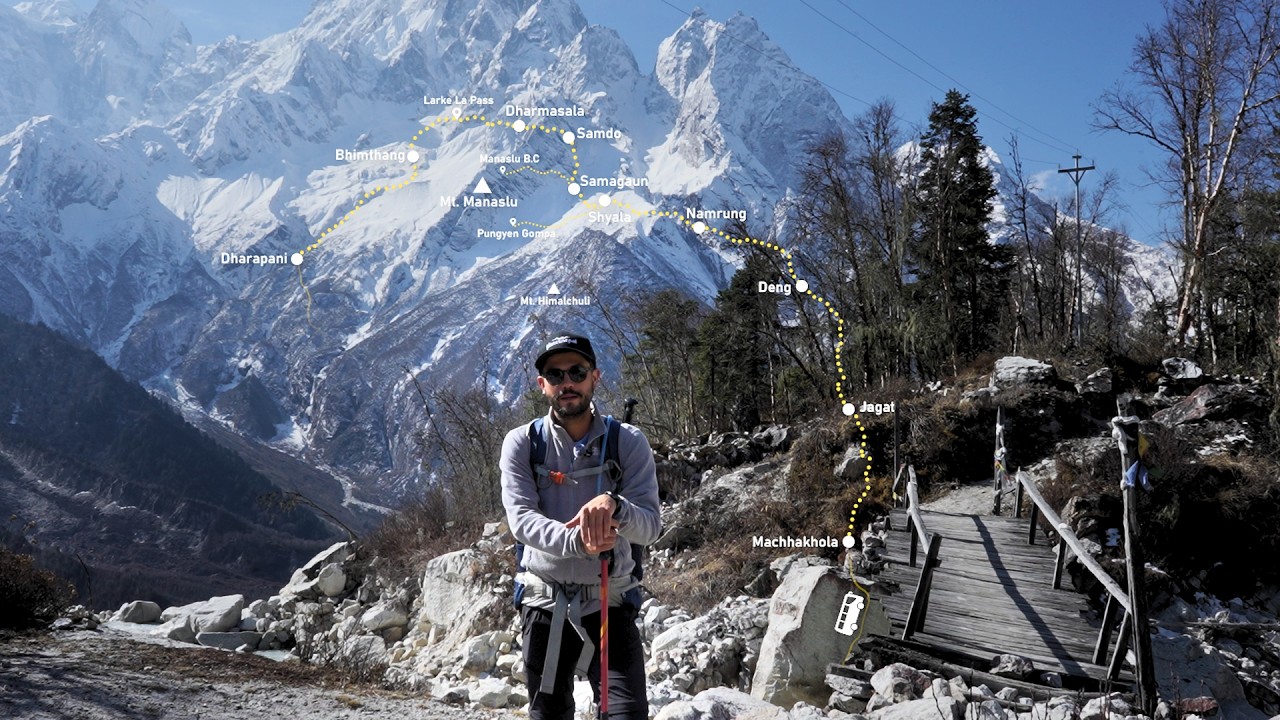
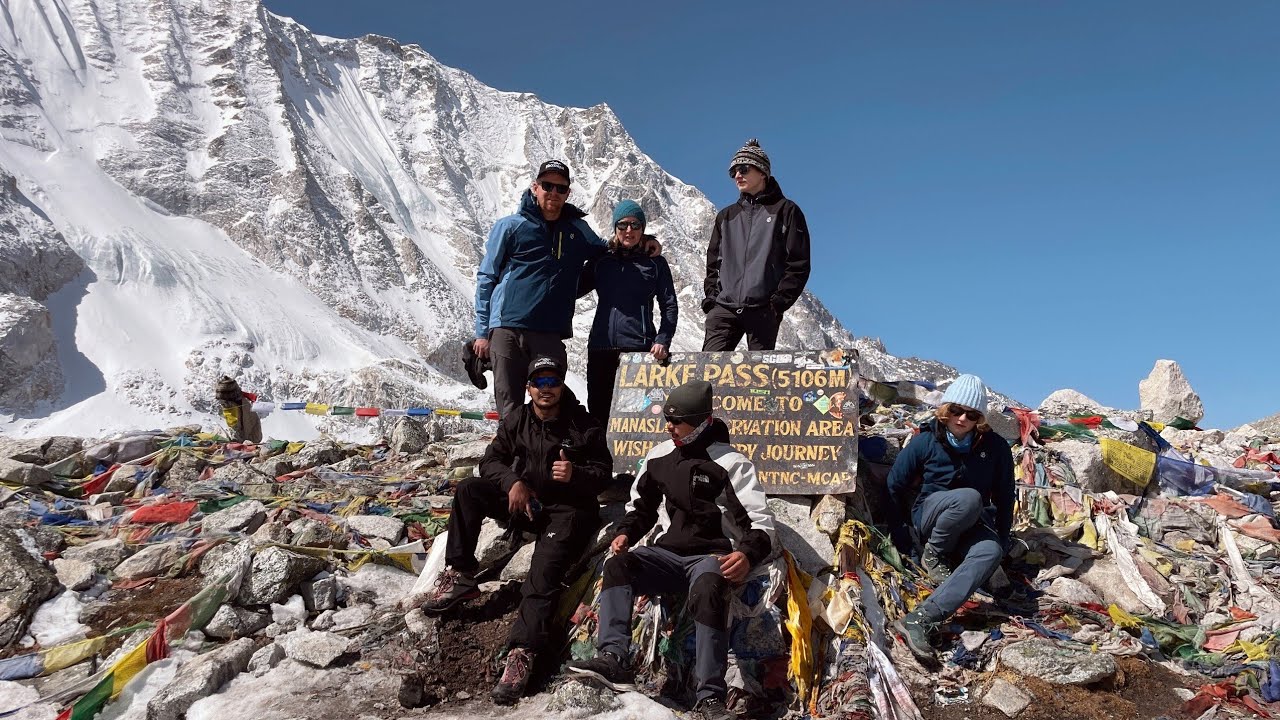
The differences that matter most on a map: Manaslu is a restricted area requiring a Restricted Area Permit and minimum party arrangements, with Larke Pass topping out at 5,106m — 310m lower than Thorong La. Annapurna Circuit's permit stack (ACAP only) is simpler, and its route sees considerably more road access and trekker traffic on the lower approaches. Manaslu, by contrast, remains largely trail-only end to end.
For the fuller side-by-side, see Manaslu vs Annapurna Circuit Trek.
Ready to Trek the Annapurna Circuit?
Now that you can see how the circuit fits together — the road transfer, Manang, Thorong La, and the drop into Mustang — you can compare dates and group sizes on the current itinerary.
The 10-day Places Nepal Annapurna Circuit Trek includes your Annapurna region guide, all teahouse and Pokhara hotel accommodation, all meals on trek, ACAP permits, and every ground transfer from Kathmandu to Dharapani and Jomsom back to Kathmandu. Rates run from $990 solo to $720 per person in a group of 11 or more, with fixed departures year-round at $820 per person.
See dates, pricing, and the full itinerary →
If the Annapurna Circuit Isn't the Right Route
This route is demanding — a 5,416m pass with no walk-around and only one rest day is not the right introduction to the Himalaya for everyone. A few alternatives to consider:
Annapurna Base Camp Trek — the Sanctuary experience without a high pass, topping out at 4,130m.
Ghorepani Poon Hill Trek — a shorter, lower-altitude introduction to the same mountain range.
Mardi Himal Trek — a quieter 5-day route with close-range Annapurna and Machhapuchhre views.
Manaslu Circuit Trek — a remoter, less-trafficked circuit with a comparable Larke Pass crossing.
Nar Phu Valley Trek with Annapurna Circuit — for trekkers who want the Circuit plus a remote restricted-area valley.
Frequently Asked Questions: Annapurna Circuit Trek Map
What is the Annapurna Circuit Trek route?
The Annapurna Circuit runs from the Marsyangdi valley up to Manang, over Thorong La at 5,416m, then down through Muktinath and the Kali Gandaki valley to Pokhara. The current Places Nepal itinerary covers this by jeep from Kathmandu to Dharapani, then on foot through Manang and the pass to Jomsom.
Is there an Annapurna Circuit Trek map?
Yes. The interactive map at the top of this page shows the current 10-day route from Kathmandu to Dharapani, over Thorong La, and back to Kathmandu, with every overnight stop marked.
Where does the Annapurna Circuit start?
Traditionally at Besisahar. On the current jeep-assisted itinerary, actual trekking begins at Dharapani (1,860m), reached by road from Kathmandu via Besisahar.
Where does the Annapurna Circuit end?
On the current itinerary, trekking ends at Jomsom (2,720m), just past Muktinath, with jeep and bus transport continuing to Pokhara and Kathmandu. The classic route continues walking further, often via Ghorepani and Poon Hill to Nayapul.
How long is the Annapurna Circuit?
The full classic route covers 160–230km depending on the exact path taken. The current Places Nepal 10-day itinerary covers roughly 79km on foot, with the rest of the distance covered by jeep and bus.
What is the highest point on the Annapurna Circuit?
Thorong La, at 5,416m (17,769ft) — higher than Everest Base Camp (5,364m).
How high is Thorong La?
5,416 metres (17,769 feet) above sea level.
Where is Thorong La on the map?
On the shoulder of Yakawa Kang and Khatung Kang in the Damodar Himal, between Thorong Phedi/High Camp on the Manang side and Muktinath on the Mustang side.
Where is Manang on the Annapurna Circuit?
Manang (3,540m) sits roughly two-thirds of the way through the trekking portion, four days' walk from Dharapani and the largest settlement on the entire route. It is the scheduled rest day and acclimatisation base before the push toward Thorong La.
Where is Muktinath on the map?
Muktinath (3,800m) sits immediately on the western side of Thorong La, roughly 1,600m below the summit, and is the first stop after the pass crossing.
Does the Annapurna Circuit still have road sections?
Yes. The lower Marsyangdi valley from Besisahar toward Chame, and sections from Muktinath down through Jomsom toward Tatopani, are road-accessible. The core high-altitude section from Dharapani to Muktinath remains trekking trail throughout.
How much of the Annapurna Circuit is walked?
On the current 10-day itinerary, roughly 79km across 6 trekking days is walked, with the lower valley and final descent covered by jeep and bus. The entire Dharapani-to-Muktinath section is walked in full.
Can you still trek the classic Annapurna Circuit?
Yes. Trekkers with more time can walk the full route from Besisahar, including the lower Marsyangdi valley, typically over 12–21 days. Ask Places Nepal about the full walking itinerary.
Why are Annapurna Circuit maps different from each other?
Road construction over the past two decades changed the practical starting point, ending point, and total walking distance of the trek. Maps drawn before the roads existed show a different route than current, jeep-assisted itineraries — both are valid, but they describe different versions of the same trek.
What is the modern Annapurna Circuit route?
A jeep-assisted itinerary, such as the current Places Nepal 10-day version, that uses road transport for the lower Marsyangdi valley and the final descent, while walking the entire high-altitude section from Dharapani over Thorong La to Muktinath.
Does the Annapurna Circuit start from Besisahar?
Besisahar remains the traditional starting point and the roadhead of the region, but most current itineraries, including this one, continue by jeep to Dharapani before trekking begins.
How many days does the Annapurna Circuit take?
The current Places Nepal itinerary takes 10 days door-to-door from Kathmandu. The classic full walking route takes 12–21 days depending on pace and side trips.
Where do you acclimatize on the Annapurna Circuit?
Primarily in Manang (3,540m) on the scheduled rest day, with an optional hike to Ice Lake at 4,600m. Secondary acclimatisation happens on the Ghyaru high route and the deliberately short Yak Kharka day.
Where is the hardest part of the Annapurna Circuit?
Day 8: the pre-dawn climb to Thorong La followed by a nearly 1,600m descent to Muktinath, all in a single 7–9 hour day with no settlements along the way.
Is Thorong La the highest point on the whole trek?
Yes. At 5,416m it is the highest point reached anywhere on the itinerary — higher than any overnight stop, including Thorong Phedi and High Camp.
Is the Annapurna Circuit harder than Annapurna Base Camp?
Generally yes. The Circuit crosses a 5,416m pass with no walk-around and covers more net elevation gain, while Annapurna Base Camp tops out at 4,130m with no high pass crossing.
Is the Annapurna Circuit harder than Poon Hill?
Yes, significantly. Poon Hill treks typically top out around 3,210m over 4–6 days, while the Annapurna Circuit crosses 5,416m and runs 10 days or more.
Is the Annapurna Circuit suitable for beginners?
The compressed 10-day version suits trekkers with some prior altitude experience. First-time Himalayan trekkers may be better served starting with a route that has more built-in acclimatisation days, such as Langtang Valley or the classic 14-day Everest Base Camp Trek.
Can you trek the Annapurna Circuit solo?
Not without a guide — independent trekking without a licensed guide has been banned in the Annapurna Conservation Area since April 2023. Solo trekkers can still join as an individual with a guide, either privately or on a fixed group departure.
What permits are needed for the Annapurna Circuit?
Just one: the Annapurna Conservation Area Permit (ACAP), plus a mandatory licensed guide. TIMS is no longer required for Annapurna-region routes.
Can you drive parts of the Annapurna Circuit?
Yes. The lower Marsyangdi valley toward Chame and the Muktinath-to-Tatopani section are both accessible by jeep, and current itineraries commonly use vehicle transport on these stretches.
What is the best time to trek the Annapurna Circuit?
Late September to November is the prime season, with October the best period for stable conditions on Thorong La. March to May is a strong second choice. Winter and monsoon are not recommended.
Does snow affect Thorong La?
Yes. Fresh snow can delay or close the crossing even in prime season, and the pass is frequently snowbound and closed for extended periods in winter.
Can road construction change the Annapurna Circuit route in the future?
It already has, and further road development in the region is possible. This is why current, verified route information matters more than older guidebook descriptions for this particular trek.
What is the current Places Nepal Annapurna Circuit itinerary?
A 10-day route: Kathmandu to Dharapani by road (Day 1), trekking through Chame, Pisang, and Manang with a rest day (Days 2–5), Yak Kharka and Thorong Phedi (Days 6–7), the Thorong La crossing to Muktinath and Jomsom (Day 8), then jeep and bus back through Pokhara to Kathmandu (Days 9–10). Full details are on the Annapurna Circuit Trek page.