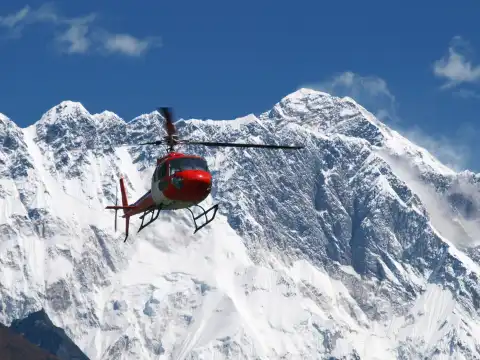
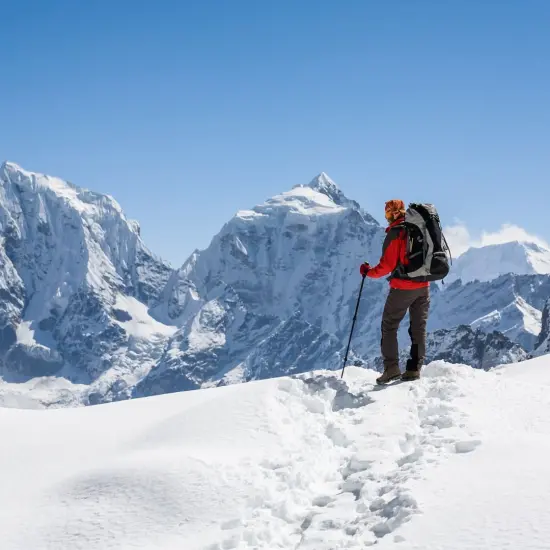
Every year, more trekkers reach Everest Base Camp, stand under Kala Patthar with Everest and Nuptse filling the sky, and then face the same question their legs are already asking: do you really want to walk two more days back down the exact trail you just climbed? The helicopter return exists because the answer, for a growing number of people, is no — not because the descent is dangerous, but because four extra trekking days is a real cost when you've only got two weeks of annual leave, and because flying back down the Khumbu Valley at rotor height, with Everest, Lhotse, Nuptse, and Ama Dablam passing beneath you, is its own reason to come to Nepal.
This guide exists because the pricing around this trek is genuinely confusing, and not by accident. Some websites quote a single number as if it were the only number. Others bury the helicopter cost inside a package without saying whether it's shared or private. A few quote 2024 permit fees that have since changed. We're going to walk through what this trek actually costs in 2026 and 2027, why it costs what it does, where the hidden expenses hide, and — because Places Nepal runs this trek from Kathmandu, not from an affiliate desk somewhere else — how the booking structure actually works when you're the one paying for it.
Quick Answer: Everest Base Camp Helicopter Return Cost
| Package Type | Approximate Cost (USD, per person) |
|---|
| Budget/Fixed Group Departure | $1,990 |
| Standard Private Trek (group of 2–5) | $1,990 |
| Private Trek, Solo | $2,200 |
| Private Trek, Larger Group (6–10+) | $1,830 |
| Luxury/Premium Option (upgraded lodges, private heli segments) | $2,700–3,800+ |
There is no single correct answer to "how much does this trek cost" — and any website that gives you one number without asking about your group size is skipping a step. The real price depends on:
- Group size — a solo trekker absorbs the full guide cost alone; splitting it across four or five people brings the per-person price down meaningfully
- Booking type — a private departure priced by group size versus a fixed departure at a flat per-person rate (more on this below — it's the single biggest source of "why did I see three different prices" confusion)
- Season — spring and autumn carry standard pricing; shoulder-season departures sometimes run cheaper
- Helicopter sharing — a shared 5-seat helicopter from Gorak Shep to Lukla costs a fraction of chartering the whole aircraft
- Accommodation standard — standard teahouses versus upgraded lodges in Namche and Tengboche where they exist
- What's actually included — this is where competitor quotes diverge most, and where hidden costs live
Trek the Everest Base Camp Trek Helicopter Return
Everest Base Camp, Without the Long Walk Back. Reach 5,364m on Foot. Return by Air.
Everest Base Camp Trek with Helicopter Return Cost: Private vs Fixed Departure
This is the section that actually answers "why do I see different prices on different sites," so read it before you read anything else on this page.
Places Nepal runs this trek two distinct ways, and the price depends on which one fits you.
1. Private Group Trek (Flexible Dates)
A private trip is your own departure — you choose the dates, and the itinerary is arranged around your group specifically. Pricing scales with group size, because the fixed costs (guide, permits, helicopter coordination) spread across more people:
| Group Size | Price Per Person |
|---|
| Solo Trekker | USD 2,200 |
| Private Group of 2–5 People | USD 1,990 |
| Private Group of 6–10+ People | USD 1,830 |
Private trips give you:
- Flexible departure dates — leave when your schedule allows, not when ours does
- A private guide and trekking arrangement — the itinerary answers to your group, not a fixed roster
- More control over the itinerary — want an extra acclimatisation day, a slower pace, or a specific lodge? A private trip can accommodate it
- A natural fit for families, couples, friends, and customised groups — people who already know who they're trekking with
2. Places Nepal Fixed Departure (Join a Group)
For travellers who don't have their own group but still want a guaranteed date, Places Nepal runs fixed departures on a pre-scheduled calendar throughout the spring and autumn seasons.
Price: USD 1,990 per person.
Here's what makes fixed departures different, and worth understanding before you book:
- Fixed departures operate on pre-scheduled dates — you're joining a departure that's happening regardless of your booking, not requesting a custom one
- Travellers join other international trekkers — you'll likely be part of a small international group, typically 2–10 people
- The price stays at USD 1,990 per person regardless of whether you join alone or with others — a solo trekker on a fixed departure pays the same as someone who books with a friend, which is the opposite of how private pricing works
- This is often the best-value option for solo travellers and couples who want a guaranteed date without paying the solo private-trip premium, and who are happy to meet other trekkers along the way
Trek the Everest Base Camp Trek Helicopter Return
Everest Base Camp, Without the Long Walk Back. Reach 5,364m on Foot. Return by Air.
So What Does the Trek Actually Cost?
The Everest Base Camp Trek with Helicopter Return cost varies depending on how you book. Private trips range from USD 1,830 to 2,200 per person depending on group size, while travellers joining Places Nepal's fixed departure can join at USD 1,990 per person. Neither number is "the" price — they're two honest answers to two different questions, and the right one depends on whether you're bringing your own group or looking to join one.
Private vs Fixed Departure: Side-by-Side Comparison
| Feature | Private Group Trek | Fixed Departure |
|---|
| Departure Date | Choose your own date | Fixed dates only |
| Group | Your own group | Join other trekkers |
| Price | Based on group size (USD 1,830–2,200) | USD 1,990/person |
| Flexibility | High | Limited |
| Best For | Families, friends, private groups | Solo travellers, couples, budget-conscious trekkers |
Which Everest Base Camp Helicopter Return Option Is Best For You?
Choose a Private Trek if:
- You already have two or more friends or family members ready to trek together
- You need flexible dates — a specific window around work, a wedding, a school break
- You want a personalised experience with more say over pacing and lodges
Choose a Fixed Departure if:
- You're travelling solo and don't want to pay the full solo-private premium
- You want a guaranteed departure without needing to assemble your own group
- You'd genuinely like to meet other international trekkers on the trail — this is one of the most-cited reasons people choose fixed departures over private ones
- You want the simplest possible booking process: pick a date from the calendar, pay the flat rate, show up
We offer both because different travellers have different needs, not because one is the "real" price and the other a discount or an upsell. A family of four wants their own schedule; a solo trekker in October usually just wants a confirmed date and good company on the trail. Both get the same guide standard, the same permits, and the same helicopter arrangement.
Complete Everest Base Camp Helicopter Return Cost Breakdown
Here's exactly what goes into the number, broken into the categories that actually drive the price.
Trekking Expenses (Included in Every Places Nepal Package)
| Item | What It Covers |
|---|
| Licensed trekking guide | Government-licensed, English-speaking, first aid-trained, with you for the full trek |
| Porter service (Optional extra) | Shared between two trekkers, carrying your duffel to and from base camp |
| Accommodation | Teahouse lodging throughout, twin-sharing |
| Meals | Breakfast, lunch, and dinner on trekking days |
| Sagarmatha National Park Permit | NPR 3,000 (~$23) for foreign nationals, arranged on your behalf |
| Khumbu Pasang Lhamu Rural Municipality Permit | NPR 2,000 for the first four weeks, the local entry fee that funds Khumbu infrastructure and waste management |
| Lukla flights (Kathmandu or Ramechhap) | Round-trip, included at no peak-season surcharge |
| Local transportation | Kathmandu ↔ Ramechhap ground transfer during peak-season flight diversions, airport pickup and drop-off |
| Helicopter return (Gorak Shep to Lukla) | Your seat on the return flight, on a shared or arranged basis per your package |
| First aid kit with oximeter | Carried by your guide, daily altitude monitoring |
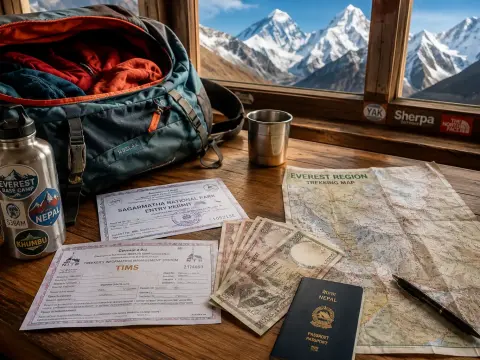
A note on TIMS: you'll see TIMS cards mentioned on some operators' cost breakdowns for Everest Base Camp. It isn't required — TIMS was replaced for this specific route by the Khumbu Pasang Lhamu Rural Municipality Permit back in 2018. Any page still charging you for a TIMS card on the EBC route is either out of date or padding the invoice; a useful test of how carefully an operator has updated its pricing.
Trek the Gokyo Lakes with Everest Base Camp Trek
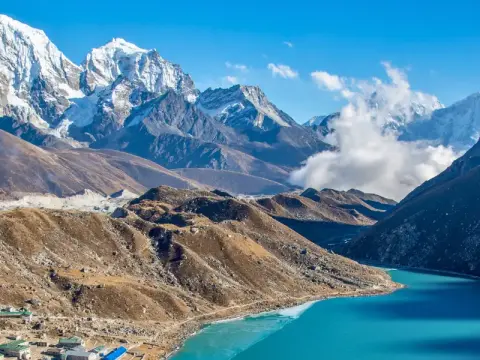
The Gokyo Lakes with EBC Trek is a stunning adventure through one of the most iconic landscapes of Nepal.
Helicopter Expenses: How the Flight Itself Is Priced
The helicopter segment is the single biggest driver of why this trek costs more than the standard walk-down version, so it's worth understanding in detail rather than treating it as a flat add-on.
Shared helicopter (the standard option): you reserve one seat on a helicopter carrying up to five passengers from Gorak Shep to Lukla. Shared per-person pricing on this route generally runs USD 550–750 per person, and this is the arrangement built into standard package pricing — it's the only way the helicopter return makes sense at a per-person rate rather than a charter rate.
Private helicopter charter: if you want the whole aircraft to yourself — for a specific timing, a group that wants to fly together without waiting on other bookings, or simply privacy — a full charter from Gorak Shep to Lukla runs roughly USD 2,200–2,500 for the aircraft, split however many passengers you bring. For a solo flyer, that's the entire cost; for a group of four or five filling the aircraft, it can land close to shared pricing anyway.
Weight restrictions matter more here than on any flight you've taken before. Helicopters operating at Gorak Shep's altitude (5,164m) face genuinely reduced lift capacity — thin air simply doesn't generate as much rotor lift as sea-level air. Aircraft on this route typically operate with a combined passenger-and-luggage weight limit in the 350–500kg range, and pilots will not exceed it regardless of how firmly a booking was confirmed. This is a safety limit, not a customer-service inconvenience, and it's why your duffel weight matters on the return flight in a way it didn't on the trek up.
Weather is the actual final decision-maker. Helicopters in the Khumbu operate under Visual Flight Rules, meaning pilots need genuine visual clearance of the terrain — no exceptions for a tight itinerary or a booked onward flight. Morning windows are typically clearer; afternoon cloud build-up is common at Gorak Shep's altitude. A good operator builds a buffer day into the itinerary specifically for this, rather than promising a fixed helicopter slot as if weather were negotiable.
Why the aviation itself costs what it does: helicopters flying above 5,000m are operating well outside the conditions most commercial aircraft are designed for. Fuel has to be flown or portered in at altitude, adding real logistics cost on top of the fuel itself. Maintenance schedules for high-altitude Himalayan operations are more intensive than standard commercial aviation, because engines and rotors are working harder in thin air on every single flight. Pilots flying this specific route hold specialised high-altitude mountain flying qualifications, which is a smaller, more experienced, and more expensive pool of aviators than standard commercial pilots. None of this is padding — it's the actual cost structure of flying a helicopter safely at 5,000m+ in the Himalaya.
Trek the Everest Base Camp Trek by Road
Experience Everest—No Flights, Just Pure Adventure.
Additional Expenses Not Included in the Package
- Nepal tourist visa — $30 (15 days) or $50 (30 days), paid on arrival at Kathmandu airport
- International flights to and from Kathmandu
- Travel insurance — must explicitly cover trekking to at least 5,550m (Kala Patthar) and helicopter evacuation; read the fine print, because many standard policies cap altitude coverage well below what this trek requires
- Personal trekking gear — see our Everest Base Camp Packing List for the full rundown
- Personal expenses on the trail: hot showers ($3–6), Wi-Fi ($3–6/day), device charging ($2–5), bottled or boiled water ($1–4/litre, pricier at altitude), snacks and extra hot drinks ($5–15/day)
- Tips for your guide, porter, and (where applicable) the helicopter crew — see below
- Extra Kathmandu hotel nights, before or after the trek
Places Nepal's Everest Base Camp Trek with Helicopter Return Package
Our standard itinerary runs a proven route to Everest Base Camp with the helicopter segment replacing the walk back down: fly to Lukla, trek up through Namche Bazaar and Tengboche with proper acclimatisation built in, reach Everest Base Camp and Kala Patthar, then fly out from Gorak Shep to Lukla and connect back to Kathmandu — saving three to four trekking days compared with the full round-trip walking itinerary.
Group options run from solo trekkers joining a fixed departure through to private groups of any size, and pricing follows the structure above: fixed departure at a flat $1,990 per person, or private trips scaled from $2,200 (solo) down to $1,830 (larger private groups).
What makes the package different isn't a longer inclusions list than everyone else's — most reputable Kathmandu operators cover similar ground on paper. It's what sits underneath the list: a guide who has walked this specific route enough times to make good real-time calls about pacing and altitude, a helicopter arrangement coordinated with operators we work with regularly rather than booked cold on the day, and a Kathmandu-based team that's reachable if a weather delay means your onward international flight needs rearranging. That's the actual value of booking with a local operator rather than piecing the trip together yourself or booking through a reseller with no ground presence in Nepal.
Trek the Everest Base Camp Trek
This classic trek takes you through the heart of the Khumbu region, past vibrant Sherpa villages, ancient monasteries, and towering Himalayan peaks.
Why Is Everest Base Camp Helicopter Return Expensive?
Compared to the standard walking trek, the helicopter addition genuinely raises the price — here's the honest reasoning, not a sales pitch for it.
Helicopter operating costs at altitude. As covered above, aircraft performance drops meaningfully above 5,000m, which limits payload and requires more conservative operating margins than lowland helicopter work anywhere else in the world.
Limited landing locations. Gorak Shep and the base camp area have a handful of usable landing zones, all subject to wind, snow accumulation, and ground conditions that shift through the season. This isn't a runway with redundancy; it's a small number of cleared spots that pilots assess fresh each flying day.
Fuel logistics. Aviation fuel for Khumbu helicopter operations is flown or trucked to staging points and then flown onward — every litre burned above Lukla has already been moved at real cost before the helicopter you're on ever takes off.
Weather dependency. Because flights only operate in clear visual conditions, aircraft and crews sit idle on marginal-weather days, which is a cost the operating companies absorb across all their flying, not a cost that disappears when a specific flight is grounded.
Safety requirements. Specialised high-altitude pilot qualifications, more intensive maintenance cycles for engines working harder in thin air, and weight-restriction discipline that leaves capacity margin rather than maximising every seat — all of this is safety infrastructure that costs money and that a responsible operator will never quietly skip to shave the price.
Hidden Costs Others Don't Explain
This is where a lot of quoted "package prices" quietly stop being accurate. Budget for these explicitly:
- Extra Kathmandu hotel nights. If Lukla or the return helicopter is weather-delayed — which happens — you may need an unplanned night in Kathmandu before your international flight. Budget one buffer night's accommodation as a contingency, not a certainty.
- Weather delays generally. Beyond hotel nights, a delay can mean an extra day of trail meals, an extra day of guide/porter costs if your package prices those per day beyond a baseline, or rebooking fees on international connections.
- Flight delays on the Lukla leg itself. Spring and autumn peak season sees real congestion; see the Lukla flight logistics section below.
- Extra meals if your itinerary runs a day longer than planned for any reason.
- Charging and internet, which we've listed above but which genuinely add up — a trekker who charges two devices daily and buys Wi-Fi at every lodge can spend $80–120 across the trek on this alone.
- Showers, same logic — a hot shower every night from Namche upward adds real cost by Base Camp.
- Gear rental, if you arrive under-equipped. Kathmandu and Namche both rent down jackets, sleeping bags, and trekking poles, but rental isn't free and quality varies.
- Tips. Not included in any package price anywhere in Nepal, and genuinely expected. A reasonable total for a trek this length is $150–250 for your guide and porter combined, plus a separate, smaller tip for the helicopter crew if you feel moved to — commonly $10–20 per person, entirely optional.
How to budget properly: take your package price, add a genuine daily trail-spending estimate of $15–25/day for the walking portion of the trek, add your tip budget, add insurance, and add one contingency Kathmandu night. That total — not the headline package figure alone — is your real trip cost.
Trek the Everest Three Passes Trek
Conquer the Three Passes, Experience Everest’s Ultimate Trekking Adventure.
Shared Helicopter vs Private Helicopter
| Feature | Shared Helicopter | Private Helicopter |
|---|
| Cost | $550–750 per person | $2,200–2,500 total charter (per aircraft) |
| Best for | Solo trekkers, couples, standard packages | Groups of 4–5 filling the aircraft, or trekkers wanting full control of timing |
| Flexibility | Fixed to available shared slots and other passengers' schedules | You set the exact departure time (weather permitting) |
| Experience | Same aircraft, same views, shared with up to 4 other trekkers | Private cabin, no waiting on other bookings |
| Availability | Generally easier to arrange on shorter notice in peak season | Should be booked well ahead, especially in peak season |
For most solo trekkers and couples, shared is the sensible default — the views and the flight itself are identical, and the savings are substantial. Private charter earns its premium for groups that can fill or nearly fill the aircraft, or for trekkers with a specific timing need a shared slot can't guarantee.
Is Everest Base Camp Helicopter Return Worth the Money?
| Standard EBC Trek | EBC Trek with Helicopter Return |
|---|
| Duration | 14 days | 9–11 days |
| Physical effort | High — full round trip on foot | High going up, none coming down |
| Experience | Full immersion both directions | Full immersion up, aerial perspective down |
| Cost | Lower — no helicopter segment | Higher — helicopter adds $550+ per person minimum |
| Views | Ground-level throughout | Ground-level ascent plus an aerial view of the entire route on descent |
| Comfort | More cumulative fatigue, especially on tired knees during descent | Descent fatigue and knee strain removed entirely |
| Suitable travellers | Trekkers with more time, or who want the full walking experience both ways | Time-limited trekkers, older trekkers or those with knee/joint concerns, trekkers who want the descent removed as a fatigue and weather-risk factor |
The honest case for helicopter return isn't "the walk down is bad" — plenty of trekkers genuinely enjoy the descent, the extra Namche and Tengboche time, and the lower overall cost of skipping the helicopter. The case for it is time and physical toll: three to four fewer days on a schedule that many international trekkers simply don't have, and a descent-free trip for anyone whose knees have opinions about multi-day downhill walking. It's also, unusually among trek upgrades, its own standalone experience rather than just a convenience — very few people who've flown that particular stretch of the Khumbu describe it as merely functional.
Trek the Everest Base Camp Trek
This classic trek takes you through the heart of the Khumbu region, past vibrant Sherpa villages, ancient monasteries, and towering Himalayan peaks.
15+ Cost-Saving Tips for Everest Base Camp Helicopter Return
- Join a fixed departure instead of booking solo-private. If you're travelling alone, the fixed departure rate ($1,990) beats the solo-private rate ($2,200) without sacrificing guide quality.
- Travel with a group of six or more to hit the lowest private-trip tier ($1,830/person).
- Book your permits and helicopter seat as part of a package, rather than trying to arrange the helicopter independently once you're already at Gorak Shep — last-minute solo bookings at altitude carry the worst pricing and availability.
- Travel shoulder season (late March, early June, late September) where crowd-driven premiums ease slightly and lodges have more room to negotiate.
- Share a helicopter rather than chartering, unless your group genuinely fills the aircraft.
- Avoid unnecessary luxury lodge upgrades in Namche and Tengboche — the standard teahouse network is comfortable and part of the trek's character; save the splurge for Kathmandu.
- Rent gear locally in Kathmandu or Namche rather than buying expensive technical clothing for a single trip, especially down jackets and sleeping bags.
- Bring a power bank rather than paying to charge multiple devices daily at teahouse rates.
- Carry a water filter or purification tablets instead of buying bottled water at altitude prices the whole way up.
- Book early for peak season. Spring and autumn departures, and especially helicopter seats, fill up — early booking avoids the premium pricing that comes with scarce last-minute availability.
- Confirm your insurance before you leave home rather than buying an expensive last-minute policy in Kathmandu that may not even cover the altitude or helicopter evacuation you need.
- Ask what's actually included before comparing prices — a $1,700 quote that excludes the Khumbu municipality permit and charges the helicopter separately isn't actually cheaper than a transparent $1,990.
- Set a realistic daily trail budget and stick to it — hot showers and Wi-Fi every single night add up fast; alternate days if budget is tight.
- Travel light on the return flight specifically — helicopter weight limits mean excess luggage can mean an extra charge or a second rotation; pack deliberately for the descent leg.
- Pool tips with your trekking group rather than each person tipping separately and inconsistently — it's simpler and the guide/porter team ends up better and more fairly compensated.
- Consider a fixed departure even as a couple if your dates are flexible — at $1,990/person flat, two people on a fixed departure pay the same combined total as the private group-of-2–5 rate, so the choice comes down to flexibility, not price.
How to Choose the Right Everest Helicopter Return Company
Given the number of operators quoting wildly different prices for what sounds like the same trip, here's what actually separates a reliable company from a risky one:
- Government registration. Confirm the company is registered with Nepal's Department of Tourism and holds a valid trekking agency licence — ask for the registration number, and check it if you want certainty.
- Licensed guides. Your guide should hold a government trekking guide licence, not just company-issued credentials. For high-altitude routes, first aid training and an oximeter in the kit are baseline, not a bonus.
- Safety record and helicopter partners. Ask which helicopter operator they work with and how long that relationship has run. An operator who can answer this specifically, rather than vaguely, has done this before.
- Transparent inclusions. A trustworthy quote itemises what's covered — permits, which permits specifically, guide, porter, helicopter (shared or private), meals, accommodation standard — rather than a single bundled number.
- Emergency support. Ask what happens if the helicopter is weather-delayed for two days. A company with a real Kathmandu office and 24/7 contact can rearrange things; a booking made through a faceless reseller often can't.
- Real customer reviews, ideally recent ones specifically mentioning the helicopter segment, since that's the part of the trip most prone to operational surprises.
- Local presence in Nepal. A company physically based in Kathmandu, with staff who can act same-day on a weather problem, is a structurally different proposition from an overseas booking platform that's reselling a local operator's trip anyway — often at a markup, with an extra layer between you and the people actually running your trek.
We're not going to tell you Places Nepal is the cheapest option on this list — we're not, and chasing that title usually means cutting corners you won't discover until you're the one standing at Gorak Shep hoping the helicopter shows up. What we'll commit to is clear pricing, permits and guide credentials you can verify, and a Kathmandu team that answers the phone if your flight gets delayed.
Local Expert Sections
Lukla Flight Logistics: Kathmandu vs Ramechhap
Here's an operational reality most generic guides gloss over. During peak trekking season — roughly March to May and late September through November — the Civil Aviation Authority of Nepal shifts Lukla flight operations away from Kathmandu's Tribhuvan International Airport to Manthali Airport in Ramechhap district. Kathmandu's single runway serves both international and domestic traffic, and the volume of Lukla-bound flights during peak months creates congestion the airport can't absorb without disrupting everything else.
What this means for you practically: instead of a short transfer to Kathmandu's domestic terminal, you're looking at a 4–5 hour road journey to Ramechhap, typically starting between 1:00 and 2:00 AM to reach the airport in time for the first weather window. The flight itself from Manthali is shorter than the Kathmandu route — around 15–20 minutes — and Ramechhap's lower elevation (474m, versus Kathmandu's 1,400m) and clearer morning weather patterns actually make it the more reliable departure point during peak season, despite the unglamorous pre-dawn drive.
This transfer is built into our package with no peak-season surcharge, and it's worth confirming any operator you're comparing does the same — some quote a Kathmandu-departure price and add the Ramechhap transfer as a separate peak-season fee.
Everest Region Accommodation: What to Actually Expect
Teahouses along the EBC route are simple but functional: twin rooms, shared bathrooms (increasingly Western-style at lower elevations, squat-style higher up), and a central dining room heated by a stove that becomes the social hub of every evening. Room availability tightens noticeably in peak season — this is one more reason advance booking matters, since a guide with established lodge relationships can generally secure rooms even in a full Namche, where a same-day independent trekker might not.
Higher-altitude challenges are real and worth planning for: heating is limited to the dining room in most lodges above Namche, hot showers become scarcer and pricier, and menus shrink as everything has to be portered or yak-trained up from Lukla. None of this is a flaw in the trek — it's the honest logistics of staying comfortable at 4,000m-plus in the Himalaya, and a good guide manages expectations on it from day one.
Helicopter Operation Reality: Why Schedules Change
The single most important thing to understand about the helicopter segment: weather decisions are made by the pilot on the day, based on conditions at that moment, not by the schedule on your itinerary. Visual Flight Rules mean a pilot needs genuine visibility of the terrain to fly safely at this altitude — there's no instrument-only fallback the way there might be on a commercial jet. Morning departures are prioritised precisely because Himalayan weather at 5,000m+ tends to deteriorate through the day as cloud builds.
Safety is the priority every time, without exception, and a reputable operator will never pressure a pilot to fly in marginal conditions because a client has an onward flight to catch. The practical response is to build a buffer day into your itinerary specifically around the helicopter segment — we do this as standard — so a one-day weather delay doesn't cascade into a missed international flight.
Altitude Considerations: What the Helicopter Doesn't Change
This deserves its own section because it's the point most helicopter-return marketing skips entirely: flying back down does nothing to reduce your altitude risk on the way up. You still climb from Lukla (2,860m) to Everest Base Camp (5,364m) and Kala Patthar (5,545m) on foot, over the same number of ascent days, with the same acclimatisation requirements as the full round-trip trek. The itinerary still needs proper rest days at Namche and Dingboche, gradual altitude gain, and honest attention to symptoms.
The helicopter only removes the descent — it changes nothing about the ascent, where the actual altitude sickness risk lives. Any itinerary that compresses the ascent to "save time" because the return is by air is cutting the wrong days. Our itinerary keeps the full acclimatisation schedule intact regardless of which return option you choose, because that's the part of the trek that actually needs the time.
Trek the Everest Base Camp Trek Helicopter Return
Everest Base Camp, Without the Long Walk Back. Reach 5,364m on Foot. Return by Air.
Frequently Asked Questions
How much does Everest Base Camp helicopter return cost? Private trips range from USD 1,830 to 2,200 per person depending on group size, while Places Nepal's fixed departure runs a flat USD 1,990 per person regardless of whether you join alone or with others.
Is helicopter return included in the trek price? Yes, in Places Nepal's Helicopter Return package the shared helicopter seat from Gorak Shep to Lukla is included in the quoted price — always confirm this explicitly with any operator, since some quote the trekking package separately from the helicopter.
Can I book helicopter only, without doing the trek itself? Yes — standalone Everest helicopter tours from Kathmandu exist for travellers who want the aerial experience without trekking. This is a different product from the trek-with-helicopter-return package; ask us if that's what you're after.
How much is Everest helicopter from Gorak Shep? A shared seat runs USD 550–750 per person; a full private charter runs roughly USD 2,200–2,500 for the aircraft, split among however many passengers you bring (up to five).
Is helicopter return guaranteed? The booking is guaranteed; the exact timing is weather-dependent. Reputable operators build a buffer day into the itinerary specifically to absorb short weather delays without disrupting your onward travel.
What happens if weather prevents flying? The flight is rescheduled to the next available weather window, typically the following morning. This is why a buffer day matters — it's the difference between a minor delay and a missed international connection.
Can beginners do this trek? Yes, with proper preparation. Reasonable cardiovascular fitness and a properly paced itinerary are enough for most healthy adults; this isn't a technical climb. First-time high-altitude trekkers should be honest with their guide about their experience level from day one.
Is insurance mandatory? Effectively yes — no responsible operator will take you to 5,545m without confirmed insurance covering both the altitude and helicopter evacuation, and self-funding an emergency evacuation at this altitude is a financially serious risk to take uninsured.
How many days is the trek? The helicopter-return version typically runs 9–11 days, roughly three to four days shorter than the full round-trip walking itinerary (12–14 days), since the descent is replaced by a same-day flight.
How much cash should I carry? Beyond your package price, plan for USD 300–500 in trail spending (showers, Wi-Fi, charging, snacks, extra drinks) plus USD 150–250 for tips. Nepali rupees only — cards aren't usable once you're on the trail.
What is the best month to do this trek? Late September through November and March through May are the two prime windows, offering the most stable weather for both trekking and the helicopter segment. See our Best Time for Everest Base Camp Trek guide for a full seasonal breakdown.
What's the difference between a private trek and a fixed departure? A private trek is your own group on your own dates, priced by group size (USD 1,830–2,200/person). A fixed departure joins a pre-scheduled group at a flat USD 1,990/person regardless of group size, and is generally the better-value option for solo travellers and couples.
Why does a solo private trek cost more than joining a fixed departure? On a private trip, a solo trekker bears the full guide and logistics cost alone. On a fixed departure, that cost is already spread across the other trekkers joining that scheduled date, which is why the flat rate is lower than the solo-private rate.
Do I need a TIMS card for this trek? No. TIMS was replaced on the Everest Base Camp route by the Khumbu Pasang Lhamu Rural Municipality Permit in 2018. If a quote itemises a TIMS fee for this specific route, it's likely outdated.
What permits are included? The Sagarmatha National Park Entry Permit (NPR 3,000) and the Khumbu Pasang Lhamu Rural Municipality Permit (NPR 2,000 for the first four weeks), both arranged on your behalf.
Do I fly to Lukla from Kathmandu or Ramechhap? It depends on the season. During peak months (March–May, late September–November), flights operate from Ramechhap's Manthali Airport due to Kathmandu runway congestion, involving a 4–5 hour pre-dawn road transfer. Outside peak season, flights typically operate directly from Kathmandu.
Is the helicopter flight safe? Yes — operators flying this route hold specialised high-altitude mountain flying qualifications, and flights only proceed under clear Visual Flight Rules conditions, with weather-based delays treated as routine rather than exceptional.
What's the weight limit for the helicopter? Aircraft on this route typically operate with a combined passenger-and-luggage limit around 350–500kg total, a genuine physics constraint of high-altitude lift rather than a customer convenience.
How many passengers fit in a shared helicopter? Up to five passengers per aircraft on the standard sharing basis.
Should I choose shared or private helicopter? Shared is the sensible default for solo trekkers and couples — same aircraft, same views, meaningfully lower cost. Private charter makes sense mainly for groups large enough to fill or nearly fill the aircraft, or trekkers with a specific timing requirement.
Does the helicopter return reduce altitude sickness risk? No. The ascent — where the actual AMS risk lives — is identical whether you walk or fly back down. The helicopter only removes the descent; acclimatisation requirements on the way up don't change.
Can I extend the trek to Everest Three Passes and still fly back? Yes, with a modified itinerary — talk to us about combining the higher-altitude Three Passes route with a helicopter return; see our Everest Three Pass Trek guide for what that route involves.
What should I pack? See our full Everest Base Camp Packing List, but note the helicopter-specific point: pack deliberately for the return-flight weight limit, since your duffel gets weighed again at Gorak Shep.
Is the trek suitable for older trekkers? Yes, and the helicopter return in particular is popular with older trekkers precisely because it removes the cumulative knee strain of a multi-day walking descent while keeping the full ascent experience.
Do I need previous trekking experience? No, though genuine cardiovascular fitness matters more here than on shorter treks given both the altitude and the daily walking hours. See our Everest Base Camp Trek Difficulty guide for an honest breakdown.
How far in advance should I book? Two to three months ahead for peak season (spring and autumn), given how quickly both lodge availability and helicopter seats tighten as departure dates approach.
Are tips included in the package price? No, tipping is separate everywhere in Nepal's trekking industry. Budget USD 150–250 for guide and porter combined, plus an optional smaller tip for the helicopter crew.
What if I want to change from helicopter return to the full walking trek partway through? This is possible with advance notice to your guide, since itinerary changes affect lodge bookings and permit dates — flag it as early as you can rather than deciding at Gorak Shep.
Is there Wi-Fi and phone signal on the trek? Patchy but present most of the route via NTC/Ncell signal and paid lodge Wi-Fi; treat it as a bonus rather than something to plan around, especially above Dingboche.
What's the honest answer — is helicopter return worth the extra cost? If your time is limited, your knees would rather not do a multi-day descent, or the flight itself is part of why you're doing this trip, yes. If you have the extra days and enjoy the full walking experience both ways, the standard trek is a legitimate and lower-cost choice — this isn't a trek that needs the helicopter to be worthwhile.
Ready to see the Khumbu from the trail and from the air? Check current fixed departure dates or request a private group quote on our Everest Base Camp Trek with Helicopter Return package page.
Trek the Everest Base Camp Trek Helicopter Return
Everest Base Camp, Without the Long Walk Back. Reach 5,364m on Foot. Return by Air.