What are teahouses really like on the Everest Three Passes Trek, and what will you eat at 5,000 metres? This practical guide covers mountain lodge rooms, bathrooms, hot showers, heating, Wi-Fi, charging, drinking water, food choices, meal costs and what changes at high-altitude stops such as Gorak Shep, Dzongla, Thagnak and Gokyo.
The Everest Three Passes Trek is a teahouse trek. You sleep in family-run mountain lodges, in basic twin rooms, and you eat at the lodge where you stay. On the Places Nepal package, accommodation and all three meals are included and your guide settles the bill — but extras like hot showers, charging, Wi-Fi, bottled drinks and snacks are paid by you, in cash. Conditions get more basic, colder and more expensive the higher you go.
That last point is the one worth internalising. A room in Namche and a room at Gorak Shep are both called "a teahouse room," and they are not the same experience. Namche has hot showers, reliable power and Wi-Fi. Gorak Shep at 5,140 m has four very basic lodges, unheated bedrooms, minimal charging and little or no connectivity.
This page maps exactly what you get at each stop on the 17-day route, what's included, and what you still pay for.
Accommodation and Food at a Glance
| Question | Practical answer |
|---|
| Accommodation type | Teahouses / family-run mountain lodges, all 16 nights |
| Room standard | Twin-share; comfortable low down, very basic above 4,700 m |
| Private room? | Depends on lodge, season and group size — not guaranteed |
| Ensuite bathroom? | Some lodges at Phakding, Namche, Lukla. Shared everywhere else |
| Hot shower? | Available to Dingboche and again at Gokyo and Namche; limited or unavailable at the highest stops. Extra cost |
| Electricity? | Yes, but solar-dependent and less reliable with altitude |
| Charging? | Dining room only above Dingboche. Extra cost |
| Wi-Fi? | Good at Namche, Gokyo and the lower stops; patchy to absent above 4,800 m. Extra cost |
| Meals | Breakfast, lunch and dinner — included in the Places Nepal package |
| Vegetarian food | Widely available at every stop |
| Dal bhat | Available everywhere, usually with unlimited refills |
| Bottled drinks | Available; prices climb steeply with altitude |
| Drinking water | Never drink untreated tap or stream water — treat, filter or buy |
| Heating | Dining room only. Bedrooms above ~4,200 m are unheated |
| Sleeping bag | Required — rated to −15°C or lower |
| Cash needed | Yes, for extras and tips. Namche is the last reliable ATM |
The Thing Most Accommodation Guides Get Wrong
Search "Three Passes food cost" and you'll find daily budgets of USD $25–50 for meals and lodging. Those figures are real — but they apply to independent trekkers paying their own way.
On our Three Passes Trek package, they don't apply to you at all. Accommodation and all meals on the trail are included, and your guide handles every teahouse payment. You never negotiate a room rate, never settle a dinner bill, never pay a lodge fee.
What you actually budget for is a much shorter list: showers, charging, Wi-Fi, snacks, bottled drinks, laundry and tips. That's a fundamentally different number, and it's covered properly further down this page.
Keep the distinction in mind whenever you read a Three Passes cost breakdown. Most of them are written for a trekker doing this route unsupported.
Trek the Everest Three Passes Trek
Conquer the Three Passes, Experience Everest’s Ultimate Trekking Adventure.
What Is a Teahouse on the Three Passes Trek?
"Teahouse" is a misleading word. It does not mean tea and a spare room in a family home.
A Khumbu teahouse is a purpose-built mountain lodge, family-owned and family-run for generations. A typical one offers:
- Guest bedrooms, commonly twin-share
- A communal dining room — the heated social centre of the building
- A full cooked menu, prepared to order
- Toilets, usually shared
- Showers at many lodges, for a fee
- Device charging, in the dining room
- Wi-Fi at many stops, usually paid
What it does not offer is hotel service. There's no room service, no heating in your bedroom, no reception desk, and at the highest stops no reliable hot water.
Standards vary enormously along this route — more than on almost any other trek in Nepal, because the Three Passes circuit takes you from a 15-lodge village at 2,610 m to a three-lodge outpost at 5,140 m and back down again. Treating "teahouse" as one category is the fastest way to be surprised.
Where You Sleep: Village by Village
Based on the current 17-day Three Passes route and facility information for each stop.
| Stop | Night | Altitude | Lodges | Bathroom | Hot shower | Charging | Wi-Fi |
|---|
| Phakding | 1, 15 | 2,610 m | 15+ | Some ensuite | Yes (extra) | Reliable | Yes (extra) |
| Namche Bazaar | 2, 3, 14 | 3,440 m | Many | Some ensuite | Yes | Reliable, in rooms | Best on route |
| Tengboche | 4 | 3,860 m | Several | Shared | Yes (extra) | Limited, dining room | Patchy |
| Dingboche | 5 | 4,410 m | 8–12 | Shared | Yes (extra) | Dining room, solar | Patchy |
| Chhukung | 6 | 4,730 m | 3–5 | Shared | Varies by lodge | Dining room, solar | Patchy |
| Lobuche | 7 | 4,910 m | Few | Shared only | Limited or none | Dining room, not guaranteed | Very limited |
| Gorak Shep | 8 | 5,140 m | 3–4 | Shared only | Limited or none | Dining room, not guaranteed | Very limited |
| Dzongla | 9 | 4,830 m | 4–5 | Shared only | Limited or none | Dining room, not guaranteed | Very limited |
| Thagnak | 10 | 4,750 m | 2–3 | Shared | Unlikely | Limited | Limited |
| Gokyo | 11, 12 | 4,750 m | 8–10 | Shared | Yes (solar, weather-dependent) | Available | Available — better than expected |
| Marulung | 13 | 4,210 m | 2–3 | Shared | Limited | Limited | Unavailable |
| Lukla | 16 | 2,840 m | Many | Some ensuite | Yes | Reliable | Yes |
Where a service is marked "varies by lodge" or "limited," treat it as a bonus if you get it rather than something to plan around.
Two patterns jump out of that table.
The comfort curve is not linear. It drops steeply from Dingboche onward, bottoms out across Lobuche–Gorak Shep–Dzongla (Days 7–9), partially recovers at Gokyo, drops again at Marulung, and then returns sharply at Namche on Day 14.
Gokyo is the outlier. At 4,750 m it has 8–10 established lodges, working showers and usable Wi-Fi — better facilities than Chhukung at a similar altitude and far better than Thagnak, which sits at the same elevation a few hours' walk away. You get two nights there. Use them.
What Are the Rooms Like?
A standard Khumbu teahouse room is small, plain and functional:
- Two single beds, occasionally a double at lower lodges
- A foam or thin sprung mattress, usually with a fitted sheet
- Blankets — one or two, quality varies
- A pillow, often firm and thin
- Plywood or thin partition walls — sound carries, bring earplugs
- A window, often single-glazed
- Minimal furniture — sometimes a small table or hooks, frequently nothing
- A simple latch or padlock hasp on the door at many lodges; some have no lock at all
Rooms at lower stops like Phakding and Namche are noticeably better appointed — proper beds, an attached bathroom, better insulation. From Tengboche upward, expect plain twin rooms with shared facilities. From Lobuche upward, expect very basic.
What you won't find anywhere on this route: bedroom heating, carpets, reliable hot taps in the room, or soundproofing. 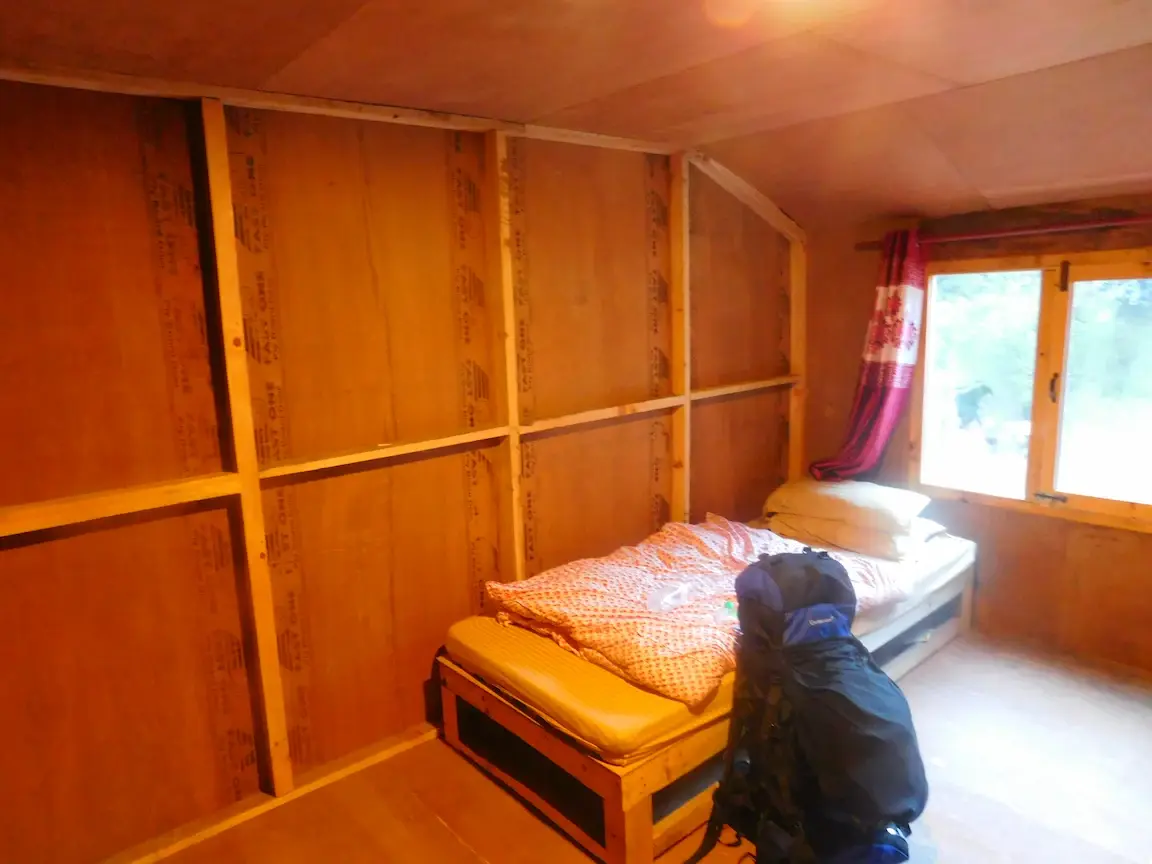
Can you get a private room?
Sometimes. It depends on:
- The lodge — the smallest high stops simply have few rooms
- The season — October and April fill fast
- Group size — a larger group takes more of a small lodge's inventory
- Altitude — Thagnak has three lodges total
- Your booking arrangement — the standard package is twin-share
The Places Nepal package is built on twin-sharing teahouse accommodation. A private room may be possible at the larger lower-altitude stops and is much less likely at Thagnak, Dzongla, Marulung or Gorak Shep. Nobody can guarantee one at those stops, and any operator who does is overpromising.
Solo trekkers and room sharing
A solo traveller joining a group departure will share a twin room with another same-gender group member. If you want a guaranteed single room where lodge inventory allows, raise it at booking rather than on the trail — it's an arrangement to be made in advance, not negotiated at 4,800 m.
How group departures are structured, and what solo trekkers can expect, is covered in how fixed-departure group treks work in Nepal.
Couples and friends
Couples and friends travelling together can request to room together, and at most stops this is straightforward. At the smallest lodges, room configuration sometimes forces a different split for a night. Mention your preference at the pre-trek briefing so your guide can coordinate ahead.
Bathrooms and Toilets
Bathroom arrangements vary more than any other facility on this route.
What you'll encounter:
- Shared bathrooms — the norm from Tengboche upward, usually in a corridor or an outbuilding
- Attached bathrooms — available at some lodges in Phakding, Namche and Lukla only
- Western-style seated toilets — common at lower and mid lodges
- Squat toilets — common at higher and smaller lodges
- Manual-flush systems — a barrel of water and a jug, standard at mid and high altitude where plumbing freezes
- Very basic facilities at the highest stops, sometimes outdoors
Above 4,500 m, water in pipes freezes overnight. That's the practical reason plumbing gets simpler as you climb — not a question of lodge standards.
Practical habits worth adopting:
- Carry your own toilet paper. Lodges often sell it, but rarely stock it in the bathroom, and the price climbs with altitude.
- Carry hand sanitiser and use it before every meal. This matters more than anything else on this page for staying well.
- Bring a headlamp to the toilet at night. Corridors and outbuildings are unlit, and at 5,140 m you do not want to be navigating unfamiliar stairs in the dark.
- Wet wipes have a place, particularly across the high section — but pack them out. They don't break down and the Khumbu has a real waste problem.
Can You Take a Hot Shower?
Yes — but not everywhere, not every day, and not for free.
Hot showers are available at Phakding, Namche, Tengboche, Dingboche, Gokyo, Lukla and, in limited form, at some higher lodges. They're heated by solar, gas or electric systems depending on the lodge, and they cost extra — typically NPR 300–800 (roughly USD $3–6), rising with altitude. At higher stops, a "hot shower" often means a bucket of heated water and a scoop.
The shower map on this route is worth planning around:
| Days | Stops | Realistic shower access |
|---|
| 1–5 | Phakding, Namche ×2, Tengboche, Dingboche | Good — hot showers available throughout |
| 6–10 | Chhukung, Lobuche, Gorak Shep, Dzongla, Thagnak | Poor — limited, unreliable or cold water |
| 11–12 | Gokyo | Usually available, solar and weather-dependent |
| 13 | Marulung | Limited |
| 14–16 | Namche, Phakding, Lukla | Good — full facilities |
Read that as: your last dependable hot shower before the high section is Dingboche on Day 5. The next is Gokyo on Day 11, if the sun cooperates. The next guaranteed one is Namche on Day 14.
That's a realistic planning window of one possible shower across nine days.
A practical note that matters more than comfort: most experienced trekkers stop showering above 4,500 m by choice. Getting wet in an unheated room at −10°C, with no way to dry properly, carries a risk of getting chilled — and feeling cold and run-down at 5,000 m is not a small thing. Wet wipes and a quick wash are the sensible alternative across the Days 7–10 block. This is normal practice, not poor hygiene.
Heating: Dining Rooms Are Warm, Bedrooms Are Not
This is the single most misunderstood thing about teahouse trekking, so it's worth stating plainly.
Teahouse bedrooms are unheated. Only the communal dining room has a stove.
Lobuche can drop below −15°C at night. Gorak Shep at 5,140 m is colder. In autumn, night temperatures at Gorak Shep run −15°C to −20°C.
The dining-room stove is lit in the late afternoon and goes out at night. Many lodges burn yak dung rather than wood, because there are no trees at that altitude. When the stove is lit, the dining room is where everybody is — eating, drinking tea, charging phones, playing cards, and delaying the walk back to a cold bedroom for as long as possible.
That's the rhythm of the evening on this trek, and it's one of the better parts of it.
Do you need a sleeping bag?
Yes. We recommend a four-season sleeping bag rated to −15°C or lower, plus a liner. This is not a soft recommendation on a route with eight unheated nights and multiple stops above 4,700 m.
Teahouses provide blankets, and they help — but warmth, thickness and cleanliness all vary by lodge, and at Gorak Shep in October blankets alone are not enough for most people. A liner adds a few degrees, is easy to wash, and makes borrowed bedding more pleasant.
If you don't own a suitable bag, Kathmandu's Thamel rental shops have them. Rent before you fly to Lukla — not in Namche, where selection is limited and prices are higher.
Electricity and Charging
Every teahouse on this route has electricity. What varies is how much, how reliably, and what it costs.
Power sources are a mix of micro-hydro, solar and small generators depending on the village. The lower Khumbu runs largely on hydro and is reliable. The high stops run mostly on solar, which means output depends on the previous day's weather.
Where you can charge:
- Phakding, Namche, Lukla — reliable, often available in rooms
- Tengboche, Dingboche, Chhukung — dining room only, solar-powered
- Lobuche, Gorak Shep, Dzongla — dining room only, and not guaranteed
- Gokyo — available; Thagnak, Marulung — limited
What it costs: typically NPR 200–600 per device or per hour (roughly USD $2–5), increasing with altitude. Charging is a personal expense, not included in the package.
Practical points:
- Charge everything at Namche on Days 2–3 and again on Day 14. It's the most reliable power on the route.
- Charging is usually by the hour or by the device, so consolidate — charge one power bank rather than three separate items.
- There's often a queue in the dining room at the high stops, with one or two outlets behind the counter.
- Cold destroys battery life. A phone that holds charge all day in Namche can die in two hours at Gorak Shep. Keep devices in an inside pocket, and sleep with your phone and power bank inside your sleeping bag.
Bring a power bank
A 20,000 mAh power bank is one of the highest-value items in your pack on this route. It lets you skip paid charging on the days when it's expensive, unreliable or queued, and gives you a buffer if solar output has been poor for several days.
Your phone matters more here than on a shorter trek — photos, offline maps, and a way to reach your guide or family. A dead phone at Dzongla isn't an emergency, but it's easily avoided.
Is Wi-Fi Available on the Three Passes Trek?
Yes at most stops, but it varies hugely and it's always an extra cost.
Two ways to get online:
- Lodge Wi-Fi — the teahouse gives you a code, usually per device. Typically NPR 200–600 per day.
- Everest Link or AirLink prepaid cards — regional wireless providers covering the Khumbu. A 10 GB card runs around NPR 1,700, and it works across multiple villages rather than one lodge.
For a 17-day trek the prepaid card is usually the better value, because you're not paying a fresh daily fee at every stop.
Mobile coverage comes from Ncell and Nepal Telecom. Both work well in the lower Khumbu around Lukla, Phakding and Namche. Signal generally becomes unreliable above Dingboche and should not be counted on across the high section.
Realistic expectations by stop:
| Stop | Wi-Fi reality |
|---|
| Lukla, Phakding | Available and reasonably reliable |
| Namche | Best on the route — back up photos and call home here |
| Tengboche, Dingboche, Chhukung | Patchy. Treat it as a bonus |
| Lobuche, Gorak Shep, Dzongla | Very limited or unavailable |
| Thagnak | Limited |
| Gokyo | Available and better than most people expect |
| Marulung | Unavailable |
One thing worth knowing: most of the Khumbu's Wi-Fi runs through a single regional provider. When that network has an outage, connectivity goes down across the whole region at once — not just at your lodge. It happens, and it's nobody's fault at the teahouse. Build that into your expectations, and tell people at home that a two-day silence means the network is down, not that something is wrong.
Before you fly to Lukla: download offline maps, save your itinerary and emergency contacts, and tell family that contact will be intermittent between roughly Day 6 and Day 13. That single message prevents a lot of unnecessary worry.
Dining Rooms
The dining room is the centre of teahouse life, and on a cold route like this one it's where you'll spend every evening.
A typical one has benches or cushioned seating around low tables, windows facing the mountains, a stove in the middle, and prayer flags or expedition photographs on the walls. It's where meals are served, where devices charge, where the group debriefs the day and plans tomorrow's start, and where you meet trekkers going the other way — often the best source of current information on pass conditions.
It's also the only warm room in the building above 4,200 m. Expect to sit in it in your down jacket, drinking tea, until you're ready to commit to the walk down the corridor.
What Food Is Available on the Three Passes Trek?
Teahouse menus across the Khumbu are longer than most people expect — and they get shorter as you climb. What's available at Namche and what's available at Gorak Shep are very different lists. 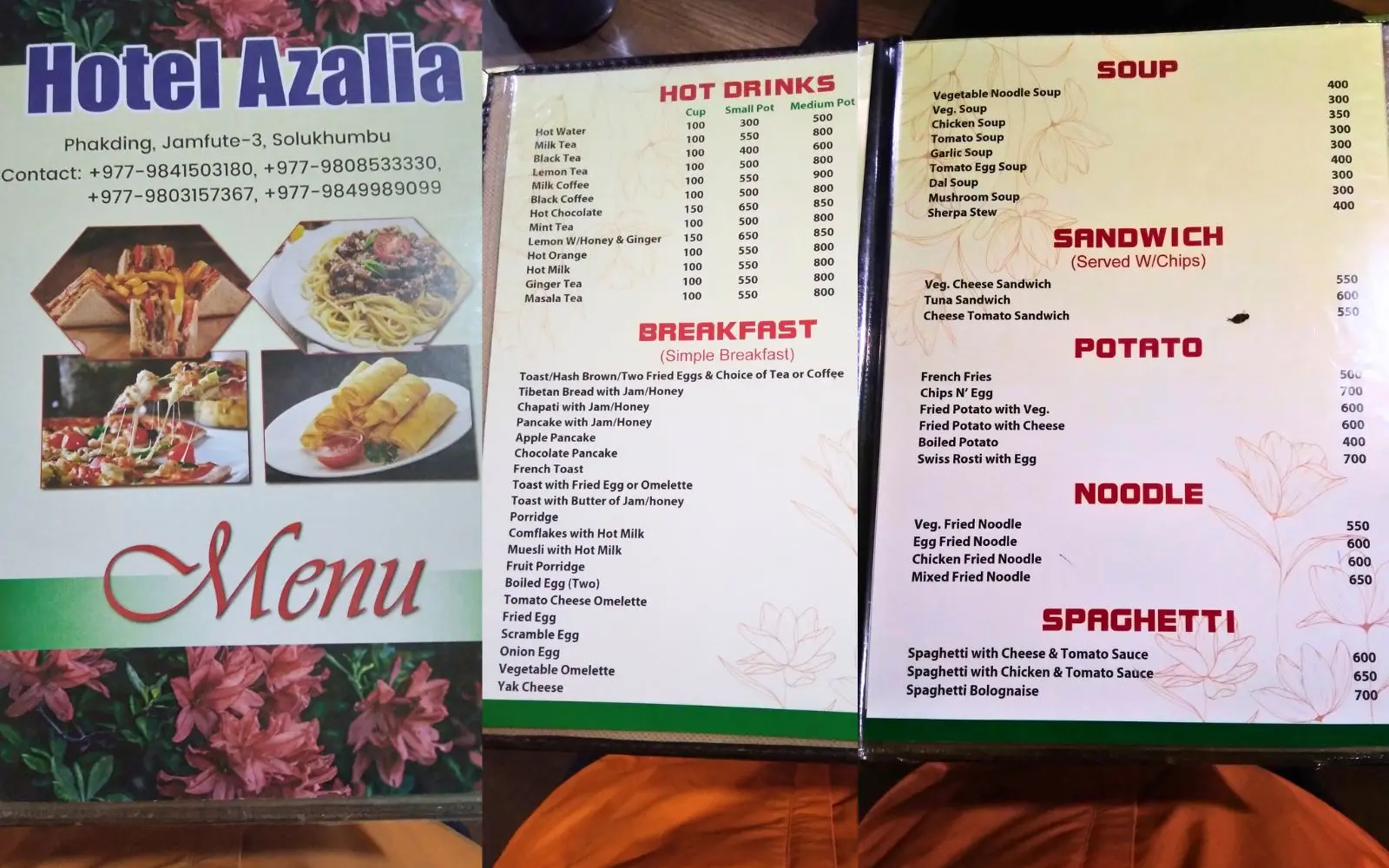
Nepali and Tibetan staples, available almost everywhere:
- Dal bhat — rice, lentil soup, vegetable curry, pickles, papadum
- Thukpa — Tibetan noodle soup, the most warming thing on any high-altitude menu
- Tibetan bread — fried flatbread, usually with jam, honey or peanut butter
- Momos — steamed or fried dumplings, vegetable or meat
- Fried rice — vegetable or egg
- Noodle dishes — fried or in soup
- Soups — vegetable, tomato, garlic, mushroom
International options, mostly at lower and mid stops:
- Pasta and spaghetti
- Pizza (Namche and below, generally)
- Potatoes — boiled, fried, rösti, with cheese
- Eggs — fried, boiled, scrambled, omelette
- Pancakes
- Sandwiches and toast
- Porridge and muesli
- Bakery items at Namche, Lukla and a few others
No menu contains all of this at every stop. Variety contracts sharply above 4,500 m. At Lobuche and Gorak Shep the menu narrows to dal bhat, fried rice, noodle soup, eggs, potatoes and basic snacks — and that's fine, because those are the things that work best at that altitude anyway.
Breakfast
Standard options across the route:
- Porridge with honey, banana or apple — the most common choice
- Eggs — fried, boiled or omelette, usually with toast or chapati
- Tibetan bread or chapati with jam, honey or peanut butter
- Muesli with hot milk
- Pancakes at lower elevations
- Tea and coffee everywhere
Above 4,500 m breakfast simplifies to eggs, porridge and bread.
Eat a full breakfast every day, whether or not you feel like it. Altitude suppresses appetite badly from Dingboche upward, and on pass mornings you're leaving at 5:30 AM for a 7–9 hour day. Breakfast is the meal people most often skip and most often regret skipping.
Lunch
Lunch is eaten wherever the day's route puts you at midday — sometimes a teahouse in a village you're passing through, sometimes a trailside tea shop, sometimes the lodge you're heading to if you arrive early.
Common choices: dal bhat, fried rice, noodle soup, thukpa, momos, potatoes, soup with bread, or a sandwich at lower stops.
On pass days there may be no lunch stop at all. Kongma La, Cho La and Renjo La all cross long stretches with no settlement between the start and finish. Your guide will advise, but plan to carry snacks on Days 7, 10 and 13 specifically.
Dinner
Dinner is served at the lodge you're sleeping in, usually between 6:00 and 7:00 PM, and it's the main meal of the day. Orders are often taken in the afternoon so the kitchen can cook for the whole lodge at once — so decide early rather than at the table.
Most trekkers converge on dal bhat for dinner by the second week, and there's a good reason for that.
Is dal bhat available on the Three Passes Trek?
Yes — at every teahouse on the route, from Phakding to Gorak Shep, and usually with unlimited refills.
Dal bhat is steamed rice, lentil soup, a vegetable curry, pickled greens and often a papadum. It's cooked fresh, it's the meal the kitchen makes every day for the family, and it's the most reliably good thing on any Khumbu menu.
It's also the answer to the specific problem this trek creates. Above 4,500 m, two things happen at once: your appetite drops and the menu contracts. Dal bhat is the one dish that stays available, stays freshly cooked, and comes with refills at virtually every lodge — so if you manage half a plate and then find your appetite returning, you can eat more without ordering again.
Refill practice varies by lodge, so don't treat unlimited refills as a guarantee everywhere. But as a default assumption across this route, it holds.
Is vegetarian food available?
Yes, easily. Vegetarian eating is standard across the Khumbu — dal bhat, vegetable fried rice, noodle soups, vegetable momos, potato dishes, soups and eggs are on every menu from Phakding to Gorak Shep. Vegetarians generally eat better on this route than meat-eaters, because the vegetarian dishes are the ones the kitchen makes constantly.
Vegan requires more care. Dairy and eggs appear in more places than the menu suggests:
- Ghee or butter used in cooking and on bread
- Milk in porridge, muesli, tea and some soups
- Eggs in fried rice and noodle dishes unless specified
- Butter tea and Nepali milk tea (chiya) are both dairy-based
- Cheese in potato dishes and momos
Vegan food is achievable — dal bhat cooked without ghee, vegetable fried rice without egg, black tea, plain porridge made with water — but it needs to be communicated clearly and repeated at each lodge. Tell Places Nepal at booking so your guide can brief each teahouse ahead of arrival, and expect a narrower menu at the high stops.
Gluten-free and food allergies
Gluten-free is manageable with clear communication. Rice-based dishes — dal bhat, fried rice, rice pudding — are naturally gluten-free and available everywhere. What you lose is bread, pancakes, pasta, noodles, thukpa and momos, which is a substantial share of the menu. Disclose the requirement at booking.
Serious allergies must be disclosed to Places Nepal before departure, not on the trail. Your guide carries a written record of allergies in the group and communicates them to teahouse staff at every stop across 17 days.
Two things to be realistic about. Teahouse kitchens are small, busy and shared, and cross-contamination cannot be reliably prevented — the same pans and surfaces do everything. And medical help is hours or days away across the high section. If your allergy is severe, carry your own medication, carry backup food you know is safe, and discuss the route honestly with your doctor before booking. This is a practical limitation of remote mountain lodges, not a reflection on any particular teahouse.
Is meat available?
Meat is available, and whether to eat it is your call.
Where: chicken and yak meat are on most menus below 4,000 m. Above Dingboche, availability drops as supply logistics get harder. Don't expect meat as a reliable option at Lobuche, Gorak Shep or Thagnak.
What to weigh: meat in the upper Khumbu has usually been carried in unrefrigerated, sometimes over several days. Many experienced trekkers choose to stop eating meat above Namche for that reason, and many others eat it throughout without issue.
The blanket rule you'll see elsewhere — "never eat meat above Namche" — isn't a rule, it's a personal risk judgement dressed up as one. Make your own, based on the lodge, how busy it is, and how the dish is cooked. Freshly cooked and served hot is the thing that matters most.
Tea, Coffee and Hot Drinks
Hot drinks are how you stay hydrated on this trek. Cold water is unappealing at −10°C; hot lemon is not.
Widely available:
- Nepali milk tea (chiya) — sweet, spiced, milky
- Black tea — available everywhere, the simplest option high up
- Ginger lemon honey tea — the trail favourite, warming and easy to drink
- Hot lemon — plain and reliable
- Instant coffee — everywhere; proper espresso only at Namche and Lukla bakeries
- Hot chocolate — most stops below 4,500 m
Hot drinks are an extra cost on the package, except tea and coffee served with your included meals.
About garlic soup
Garlic soup appears on nearly every menu above 3,000 m, and you'll be told repeatedly on the trail that it helps with altitude.
Being straight about it: there's no established clinical evidence that garlic soup prevents or treats altitude sickness. It's a long-standing Khumbu trail tradition, not a proven intervention. What it genuinely is: hot, salty, hydrating, easy to eat when your appetite has gone, and cheap. Those are real benefits at 5,000 m.
Order it because it's good and it gets fluid into you. Don't order it instead of following the acclimatization schedule. What actually protects you at altitude is gradual ascent and your guide's judgement — covered in the Nepal trekking altitude sickness and safety guide.
Alcohol
Beer and spirits are available at most lodges on this route. The medical guidance on drinking them is unusually clear.
The CDC Yellow Book advises avoiding alcohol for the first 48 hours at high altitude, and states that respiratory depressants such as alcohol should not be used as a sleep aid at altitude. The reasoning is straightforward: increased breathing is the single most important part of acute acclimatization, and alcohol suppresses exactly that — most dangerously during sleep, when oxygen saturation is already at its lowest.
Alcohol also worsens dehydration and disrupts sleep quality, both of which are already under pressure on this route.
Practically, on a 17-day trek that spends Days 5–13 above 4,400 m: leave it alone through the high section. Places Nepal's own Day 3 guidance is to avoid alcohol entirely at Namche. The celebration beer back at Namche on Day 14, after three passes and at 3,440 m, is a different proposition — and it tastes considerably better for the wait.
What to Order on Long Days
General practical guidance, not a nutrition plan.
The night before a pass (Days 6, 9, 12). Eat a full dinner with plenty of carbohydrate — dal bhat is the obvious choice. Order early so the kitchen isn't cooking for you at 8 PM when you need to sleep.
Pass mornings (Days 7, 10, 13). Eat a real breakfast even at 5:00 AM with no appetite. Porridge and eggs digest well and hold. Fill a flask with tea if the lodge will do it.
During a long day. Carry your own snacks — there's often nowhere to buy anything between the start and finish of a pass day. Eat small amounts regularly rather than waiting to feel hungry, because at altitude you often won't.
Arriving after a hard day. Hot fluids first, then a full meal. Soup, then dal bhat, is the combination most trekkers land on.
Above 5,000 m. Keep it simple — soups, rice dishes, eggs, potatoes. Avoid heavy, fatty or unfamiliar food. Your digestion is working harder than usual and this is not the moment to try the yak steak.
Snacks
Bring your own from Kathmandu. Snacks are sold along the trail but prices climb steeply and selection narrows.
Useful things to carry: energy bars, nuts, trail mix, chocolate, dried fruit, biscuits, boiled sweets, electrolyte or drink-flavour sachets. No single snack is better for altitude than another — the best one is whichever you'll actually eat on a day when nothing appeals.
Buy the bulk of it in Thamel before you fly. Namche restocks well if you run short.
Why Does Food Cost More Higher Up?
Every item in a Gorak Shep kitchen arrived on a porter's back, a yak's back or a helicopter. There is no road anywhere on this route.
The cost stacking is straightforward:
- Transport distance — supplies carried for days from Lukla or Namche
- Human and animal portering — the only ground transport above Lukla
- Cooking fuel — gas cylinders carried up by the same means; there's no firewood above the treeline
- Short operating season — lodges earn across two main seasons and carry costs year-round
- Limited storage — no refrigeration at the highest stops, so waste is higher
The practical marker most trekkers notice: a soft drink that costs around NPR 100 in Kathmandu runs roughly NPR 300 in Namche and around NPR 500 at Gorak Shep. The same multiplier applies to bottled water, snacks, showers, charging and Wi-Fi.
On the Places Nepal package this affects your extras, not your meals — your food is included regardless of altitude. It's the reason your shower at Gorak Shep costs more than your shower at Phakding.
Water on the Three Passes Trek
Do not drink untreated tap or stream water at any point on this route. That applies from Phakding to Gorak Shep and back — including water described as filtered at a lodge.
Your options:
| Option | Cost | Notes |
|---|
| Boiled water from the lodge | NPR 100–500 per litre, rising with altitude | Safe, widely available, warms your bottle |
| Purification tablets | A few dollars for the trek | Light, cheap, reliable. Chlorine dioxide preferred |
| Filter or UV purifier | One-off cost | Effective, no taste. Keep it from freezing |
| Bottled water | NPR 100–500+ per litre | Convenient, expensive, and a waste problem |
A filter or tablets are strongly recommended on this route, for three reasons: they cut a meaningful running cost across 17 days, they remove plastic waste from a region that struggles to manage it, and they mean you're never dependent on whether a lodge has stock.
Refills are available at every teahouse — boiled water is sold everywhere, and you can fill from taps or streams for treatment. Refill at every stop rather than rationing; you need 3–4 litres a day above 4,000 m, which is more than most people drink without deliberate effort.
Two cold-weather points. Above 4,500 m, water left out overnight freezes — sleep with your bottle in your sleeping bag, and a hydration bladder's tube will freeze on pass mornings, so carry bottles on Days 7, 10 and 13. And drinking enough is genuinely hard when it's cold, which is why hot drinks matter so much on this route.
Hydration at altitude is covered more fully in the Everest Base Camp water and hydration guide.
Trek the Everest Three Passes Trek
Conquer the Three Passes, Experience Everest’s Ultimate Trekking Adventure.
Is Teahouse Food Safe?
Generally, yes. Khumbu teahouses are functioning restaurants that feed thousands of trekkers a season, and most trekkers complete this route without any stomach trouble. Standards do vary, and a few simple habits cover most of the risk.
What helps:
- Eat freshly cooked, hot food. Dal bhat is cooked to order and served hot — one of several reasons it's the most popular choice on the trail.
- Wash or sanitise hands before every meal. This does more than any food choice.
- Choose busy lodges where you have the option. High turnover means fresher ingredients.
- Be cautious with raw salads and unpeeled fruit, particularly above 3,000 m where refrigeration is unreliable.
- Never drink untreated water — it's the most common source of trouble, not the food.
- Tell the lodge about allergies, through your guide.
- Carry oral rehydration salts. Light, cheap, and genuinely useful if you do get ill at altitude.
What to keep in perspective: serious food-borne illness is not common on this route if you follow the basics. But getting ill at 5,000 m is a much bigger problem than getting ill at home, because dehydration and altitude compound each other. Tell your guide early if your stomach is off — don't push through it quietly on a pass day.
The Highest Stops in Detail
What is accommodation like at Gorak Shep?
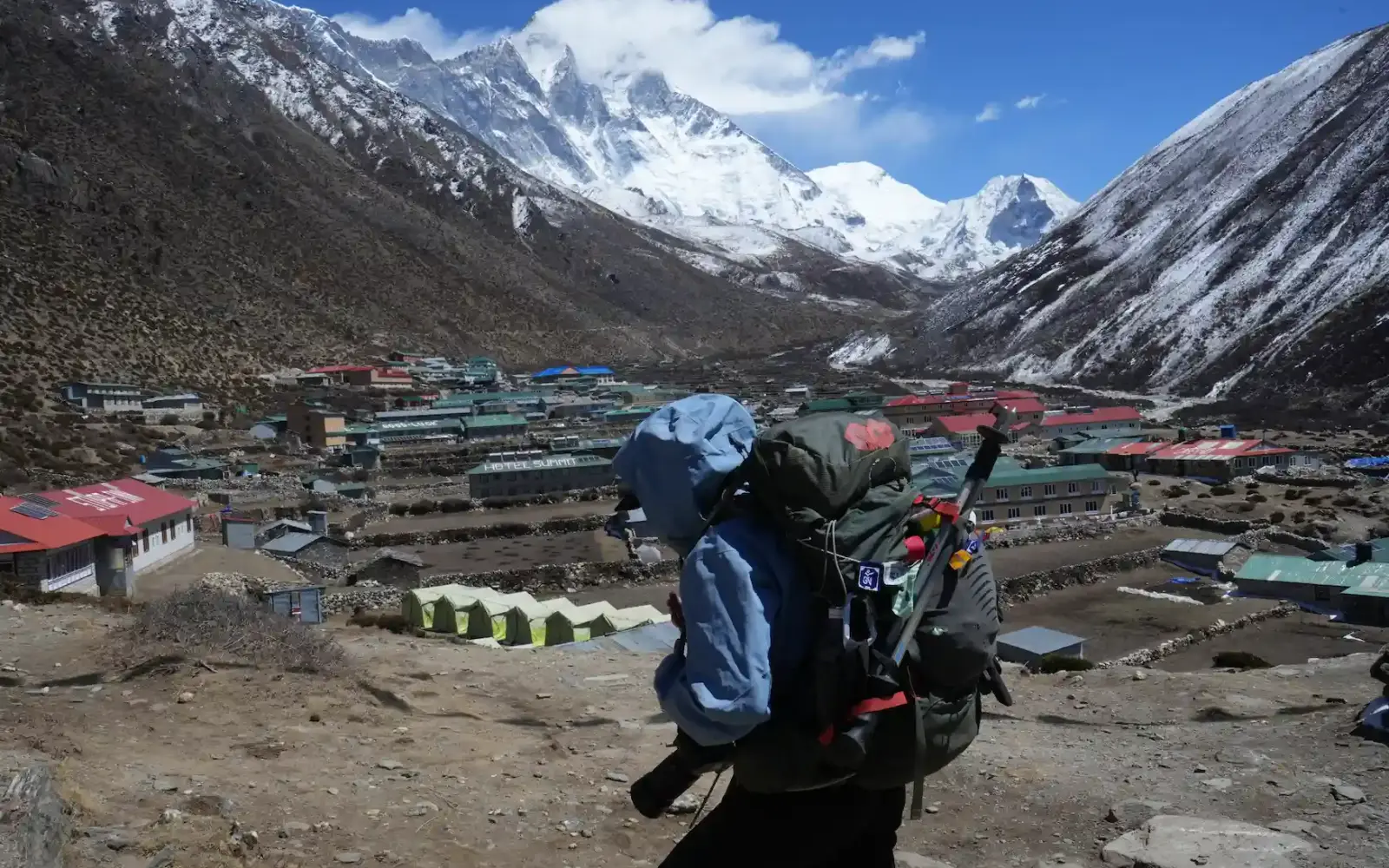
Gorak Shep, 5,140 m, is the highest and most basic overnight of the trek. Three or four very basic lodges sit on a flat sandy former lakebed below Kala Patthar.
What to expect: small, very basic twin rooms; shared bathrooms only; minimal and unreliable charging in the dining room; very limited or no Wi-Fi; hot showers limited or unavailable. Rooms are unheated and night temperatures run −15°C to −20°C in autumn. The lodges fill completely in peak season because everyone walking to Everest Base Camp stops here.
Sleep quality at 5,140 m is poor for almost everyone. Periodic breathing — a pattern of breathing that pauses and restarts during sleep — becomes nearly universal at altitude and causes frequent waking. That's expected physiology, not a sign something is wrong, and no lodge can fix it.
Approach Gorak Shep as a functional place to eat, hydrate and rest for one night before Kala Patthar. Comfort is not on the menu, and it's one night.
What is accommodation like at Dzongla?
Dzongla, 4,830 m, has four or five basic lodges and exists almost entirely to stage the Cho La crossing.
Very basic twin rooms, shared bathrooms only, limited charging, very limited connectivity, unheated bedrooms. Inventory is small and there's nowhere else within reach, so peak-season nights fill up — which is why arriving early in the day matters here more than at bigger villages, and why your guide coordinates ahead.
It's a quiet, stark, spectacular spot below the Cho La approach. One night, then an early start.
What is accommodation like at Thagnak (Dragnag)?
Thagnak — also spelled Dragnag — at 4,750 m has two or three very basic lodges, and it's the smallest stop on the route.
Expect the minimum: basic twin rooms, shared facilities, limited charging, limited connectivity, and no realistic shower. It sits below the Ngozumpa Glacier moraine and exists to catch trekkers coming off Cho La.
Do not expect Namche-level anything here. You arrive after a 6–8 hour glaciated Cho La crossing, you eat, you sleep, and the next day is a short two-hour walk to Gokyo. Thagnak does the one job it needs to do.
What is accommodation like in Gokyo?
Gokyo, 4,750 m, is the best high-altitude stop on the route — and a genuine surprise to most trekkers after four nights of basic lodging.
Eight to ten well-established lodges sit on the shore of the third Gokyo Lake. Facilities include basic but decent twin rooms, shared bathrooms, solar hot showers (weather-dependent), working charging, and Wi-Fi that's better than you'd expect at that elevation. Food variety is reasonable.
You get two nights here, Days 11 and 12, around the Gokyo Ri acclimatization hike. After Cho La, and before Renjo La, that's well placed. Shower, charge everything, get online, eat properly, and sleep as much as the altitude allows.
Marulung and Thame
Marulung, 4,210 m, has two or three basic lodges in the Bhote Koshi Valley — the most remote-feeling stop of the route, and the quietest. Basic rooms, limited shower and charging, no Wi-Fi. After the crowds of the Khumbu trail it's a notably different atmosphere.
Thame is passed through on Day 14 rather than slept in, but it's worth a stop — one of the most historically significant Sherpa villages in the Khumbu, with a monastery above the village and a mountaineering history that runs through many of Nepal's best-known climbers.
From Marulung onward, everything improves steadily: Namche on Day 14 with full facilities, then Phakding and Lukla. Arriving back in Namche after twelve days above it is the moment most trekkers describe as feeling like checking into a hotel.
The Higher You Go, the More Basic It Gets
A summary worth keeping in mind rather than a warning:
- Fewer lodges — from 15+ at Phakding to 2–3 at Thagnak
- Fewer room choices — private rooms become unlikely
- Shared facilities only — no ensuite bathrooms above Namche
- Unheated bedrooms — every night from Chhukung to Marulung
- Colder nights — down to −15°C or −20°C at the highest stops
- Less reliable power — solar-dependent, dining room only
- Less reliable internet — patchy above Dingboche, absent at several stops
- Shorter menus — variety contracts sharply above 4,500 m
- Higher prices on extras — everything arrived on somebody's back
None of this is a problem if you expect it. It becomes a problem when you arrive at Gorak Shep expecting Namche.
What Is Included in the Places Nepal Package?
Verified against the current Everest Three Passes Trek product page.
| Item | Status |
|---|
| 16 nights teahouse accommodation (twin-share) | Included |
| All meals on the trek — breakfast, lunch, dinner | Included |
| Tea and coffee with meals | Included |
| Licensed English-speaking high-altitude guide, 17 days | Included |
| Round-trip Lukla flights (Kathmandu or Manthali) | Included |
| All Everest region permits + Khumbu Municipality permit | Included |
| Private airport transfers, both ways | Included |
| Domestic airport taxes | Included |
| Guide and porter insurance | Included |
| Government taxes and service charges | Included |
| Hot showers | Extra — you pay |
| Device charging | Extra — you pay |
| Wi-Fi | Extra — you pay |
| Bottled water and boiled water | Extra — you pay |
| Soft drinks, extra hot drinks, alcohol | Extra — you pay |
| Snacks and desserts | Extra — you pay |
| Laundry | Extra — you pay |
| Tips for guide and porter | Extra — you pay |
| Porter service | Optional — USD 400 |
| Travel insurance (mandatory, must cover heli evacuation) | Not included |
| Nepal visa, international flights | Not included |
Two meal-day details worth knowing: on Day 1 your breakfast is your own arrangement before the flight, with lunch and dinner included from Lukla onward. On Day 17 breakfast and lunch are included and your final dinner back in Kathmandu is your own.
The key practical point: you never pay a teahouse for a room or a meal on this trek. Your guide settles all accommodation and food directly. You carry cash for personal extras only.
There's no official figure, and the honest answer is that it depends entirely on how much you shower, charge and get online. But you can estimate it from current trail prices.
| Extra | Typical cost | Over 17 days |
|---|
| Hot showers | NPR 300–800 each | 4–6 showers ≈ NPR 2,000–4,000 |
| Charging | NPR 200–600 per device/hour | ≈ NPR 3,000–5,000 |
| Wi-Fi | NPR 1,700 per 10 GB card, or 200–600/day | ≈ NPR 2,000–5,000 |
| Boiled/bottled water | NPR 100–500 per litre | Much less with a filter |
| Snacks, drinks, bakery items | Varies widely | ≈ NPR 5,000–10,000 |
| Laundry | Namche and lower only | ≈ NPR 1,000–2,000 |
Rough total for extras: NPR 15,000–30,000 (roughly USD $110–220), excluding tips. These are calculated estimates from current researched trail prices, not Places Nepal figures — treat them as a planning range, not a quote.
Tips are separate and significant. Customary rates run roughly USD $10–15 per day for a guide and USD $8–12 per day for a porter, usually shared across the group. Over 17 days that's a meaningful sum, so budget for it deliberately rather than discovering it in Lukla.
Carry Nepali rupees. Teahouses above Namche are cash only — no cards, no mobile payment. Namche is your last reliable ATM in both directions. Withdraw more than you think you need on Day 2 or 3, and top up again on Day 14 if you'll want anything in Phakding or Lukla.
Trek the Everest Three Passes Trek
Conquer the Three Passes, Experience Everest’s Ultimate Trekking Adventure.
Laundry and Drying Clothes
Laundry is realistic at Namche, Phakding and Lukla, where lodges offer a paid service, and impractical everywhere else. It's an extra cost and not included in the package.
Drying is the real constraint. Above 4,000 m, nothing dries. Cold air, no heating in bedrooms, and low humidity in the sun but sub-zero temperatures in the shade mean a washed shirt stays wet for days. Washing socks at Dzongla is a mistake you make once.
Practical approach:
- Pack enough to go 8–10 days without washing across the high section — Places Nepal's equipment list suggests 3–5 pairs of trekking socks and 3–5 sets of underwear for exactly this reason
- Use Namche on Days 2–3 and Day 14 as your two laundry points
- Merino base layers resist odour far longer than synthetics — worth the cost on a 17-day trek
- Dry small items in your sleeping bag overnight — body heat works when air doesn't
- Carry a dry bag to keep clean clothes separate
Security and Valuables
Theft is not a common problem in Khumbu teahouses, and the region has a strong reputation for honesty. Sensible precautions still apply:
- Keep passport, cash, cards and phone with you or in your daypack, not left in the room
- Many doors have a simple latch and some have no lock — bring a small padlock if the door has a hasp
- Use a lockable duffel for the gear your porter carries
- Don't leave devices charging unattended overnight in a communal dining room
- Keep cash in two separate places so a single loss isn't total
Booking and Peak Season
The Three Passes route is popular, and October and April fill teahouses fast — particularly at Namche, Dingboche and Gokyo, and most acutely at the small stops with almost no spare capacity: Thagnak, Dzongla and Gorak Shep.
Your guide manages all accommodation on this route and coordinates ahead where possible. What helps in practice is arriving early in the day — the group that reaches Dzongla at 2 PM has more room options than the group arriving at 5 PM.
What no operator can guarantee at a two-lodge village in peak October is a specific teahouse or a private room. Anyone promising that is describing something they don't control. For how season affects both crowding and pass conditions, see the best time for the Three Passes Trek.
Three Passes Trek With Places Nepal
The current Everest Three Passes Trek runs 17 days from Kathmandu, and the accommodation and food side of it is fully covered:
- 16 nights of twin-share teahouse accommodation, coordinated by your guide across every stop from Phakding to Lukla
- All meals on the trail — breakfast, lunch and dinner, plus tea and coffee with meals
- A licensed English-speaking high-altitude guide for all 17 days, who handles every teahouse payment and communicates dietary requirements at each lodge
- Round-trip Lukla flights, all permits, and airport transfers
- An optional porter service at USD 400, which changes what you carry but not what's included
You never handle a lodge bill on the trail. The cash you carry is for showers, charging, Wi-Fi, snacks and tips.
Dietary requirements — vegetarian, vegan, gluten-free or a serious allergy — should be raised at booking and again at the pre-trek briefing at the Thamel office, so your guide carries a written record and can brief each teahouse ahead of arrival.
For the day-by-day route, see the 17-day itinerary. For what the package costs and why, see the Three Passes trek cost breakdown. If you're still comparing routes, see Everest Base Camp vs Three Passes Trek.
See the current 17-day Three Passes itinerary, inclusions and departure options with Places Nepal.
Frequently Asked Questions
What type of accommodation is used on the Three Passes Trek? Teahouses — family-run mountain lodges — for all 16 nights. There is no camping and there are no hotels anywhere on the route.
Are Three Passes teahouses comfortable? At the lower stops, reasonably so. Above 4,700 m they're basic: small unheated rooms, shared bathrooms, limited power. Functional rather than comfortable is the accurate description for Days 7–10.
Can I get a private room? Sometimes at the larger lower-altitude lodges, rarely at the small high stops. The package is twin-share, and nobody can guarantee a private room at Thagnak, Dzongla or Gorak Shep.
Will I have to share a room? Usually yes — twin-share is standard. Solo travellers on a group departure normally share with another same-gender group member.
Do teahouses have bathrooms? Yes, but mostly shared. Attached bathrooms exist at some lodges in Phakding, Namche and Lukla only.
Are bathrooms shared? From Tengboche upward, yes — always. Expect corridor or outbuilding facilities, western or squat style, often manually flushed at higher altitude.
Are hot showers available? At Phakding, Namche, Tengboche, Dingboche, Gokyo and Lukla, generally yes. At Lobuche, Gorak Shep, Dzongla and Thagnak, limited or unavailable. Always an extra cost.
Do showers cost extra? Yes — typically NPR 300–800 (about USD $3–6), rising with altitude. Not included in the package.
Is there electricity? Yes at every stop, from micro-hydro, solar or generators. Reliability decreases with altitude — the high stops run on solar and depend on recent weather.
Can I charge my phone? Yes, but usually in the dining room only above Dingboche, for a fee of roughly NPR 200–600. Bring a power bank and charge fully at Namche.
Is Wi-Fi available? At most stops, for a fee. Best at Namche, good at Gokyo, patchy above Dingboche, unavailable at Marulung and largely absent at Lobuche, Gorak Shep and Dzongla.
Is Wi-Fi reliable? No. Speeds are slow, and because most of the region runs through a single provider, an outage takes the whole route offline at once. Plan for intermittent contact between roughly Day 6 and Day 13.
What food is available? Dal bhat, thukpa, momos, fried rice, noodles, soups, eggs, potatoes, porridge, Tibetan bread, pasta, and pizza at lower stops. Variety contracts sharply above 4,500 m.
Is dal bhat available? Yes, at every teahouse on the route, usually with unlimited refills. It's the most reliable meal available at any altitude here.
Is vegetarian food available? Yes, everywhere and easily. Vegetarian dishes are the staples of the Khumbu teahouse menu.
Can vegans eat on the Three Passes Trek? Yes, with clear communication. Butter, ghee, milk and eggs turn up in more dishes than the menu suggests, so flag it at booking and expect a narrower menu high up.
Can people with food allergies eat safely? With planning. Disclose allergies at booking so your guide can brief each lodge. But teahouse kitchens are small and shared, so cross-contamination can't be reliably prevented — carry your own medication and backup food if your allergy is severe.
Are eggs available? Yes, at every stop on the route — fried, boiled, scrambled or as an omelette. One of the most dependable protein sources high up.
Can I get pasta or noodles? Noodles and thukpa are available throughout. Pasta and pizza are realistic at Namche and below, and become unlikely above Dingboche.
Is meat available? Chicken and yak are on most menus below 4,000 m. Availability drops above Dingboche and meat isn't reliable at Lobuche, Gorak Shep or Thagnak. Whether to eat it is a personal judgement.
How expensive is food at high altitude? On the Places Nepal package, your meals are included at every altitude. Independently, dal bhat runs from around USD $5 low on the route to USD $10–12 at Gorak Shep.
Is bottled water expensive? It climbs from roughly NPR 100 per litre low down to NPR 500 or more at the highest stops. Over 17 days that adds up substantially — a filter or tablets pay for themselves several times over.
Can I refill water? Yes, at every teahouse. Boiled water is sold everywhere, and you can fill from taps or streams for treatment. Never drink it untreated.
Should I bring a water filter? Strongly recommended. It cuts a real running cost, removes plastic waste, and means you're never dependent on lodge stock.
Are breakfast, lunch and dinner included? Yes, throughout the trek, plus tea and coffee with meals. Day 1 breakfast and Day 17 dinner are your own arrangement.
What food is extra? Snacks, desserts, bottled and boiled water, soft drinks, alcohol, and hot drinks outside mealtimes.
Do I need cash for showers and charging? Yes. Teahouses above Namche are cash only, in Nepali rupees. Budget roughly NPR 15,000–30,000 for extras across 17 days, plus tips separately.
What is Gorak Shep accommodation like? The most basic on the route. Three or four lodges at 5,140 m, very basic unheated twin rooms, shared bathrooms, minimal charging, little connectivity, and nights down to −20°C.
What is Dzongla accommodation like? Four or five basic lodges at 4,830 m staging the Cho La crossing. Shared facilities, limited power, unheated rooms, small inventory that fills in peak season.
What is Thagnak accommodation like? The smallest stop on the route — two or three very basic lodges at 4,750 m below the Ngozumpa moraine. Minimal facilities, and adequate for one night after Cho La.
What is Gokyo accommodation like? The best of the high stops. Eight to ten established lodges at 4,750 m with solar showers, working charging and usable Wi-Fi. Two nights there.
Do teahouses have heating? The dining room does — usually a stove lit in the late afternoon, often burning yak dung above the treeline. It goes out overnight.
Do bedrooms have heating? No. Bedrooms above roughly 4,200 m are unheated, every night and every season. On this itinerary that means eight consecutive nights from Chhukung through Marulung.
Do I need a sleeping bag? Yes. A four-season bag rated to −15°C or lower, plus a liner. Blankets alone are not enough at Gorak Shep or Dzongla.
Can I do laundry? Realistically at Namche, Phakding and Lukla only, as a paid service. Not practical at high altitude.
Can I dry clothes? Barely, above 4,000 m. Nothing dries in an unheated room at sub-zero temperatures. Pack enough to go 8–10 days without washing.
Is accommodation booked in advance? Your guide coordinates lodging along the route. In peak season, arriving early in the day matters more than advance booking at the smallest stops, where capacity is genuinely limited.
How does accommodation change as you go higher? Fewer lodges, smaller rooms, shared facilities only, unheated bedrooms, less reliable power and internet, shorter menus, and higher prices on everything you pay for yourself.
Is there an ATM on the trek? Namche Bazaar has ATMs and is the last reliable one in both directions. Everything above Namche is cash only.
The Bottom Line
You're trekking from one mountain lodge to the next, not staying in hotels. The Khumbu teahouse system provides the essentials reliably — a bed, three cooked meals, a warm dining room, basic washing and toilet facilities — and it provides steadily less of everything else the higher you climb.
The lower villages have choice: hot showers, Wi-Fi, bakeries, pizza, ensuite rooms at a few lodges. The highest settlements have two or three lodges, unheated rooms, shared toilets, a contracted menu and prices on extras that reflect the fact that every item arrived on someone's back.
On the Places Nepal package, the part that most trekkers worry about — food and lodging costs across 17 days — is already handled. Your guide pays every teahouse. What you carry cash for is showers, charging, Wi-Fi, snacks and tips.
Pack a proper sleeping bag, a power bank, a water filter and enough clothing to go over a week without laundry, and the accommodation side of this trek stops being something to manage and becomes what it should be: somewhere warm to eat and sleep between three of the best pass crossings in Nepal.
See the current 17-day itinerary, full inclusions and departure options for the Everest Three Passes Trek.