As the guides who run this itinerary through the Khumbu season after season, we get one question more than any other before booking: what does each day actually involve? Below is a full breakdown — altitude, distance, walking time, and what to expect underfoot — for all nine days, followed by the logistics, cost, fitness, and packing detail you need to decide whether this is the right itinerary for your trip to Nepal.
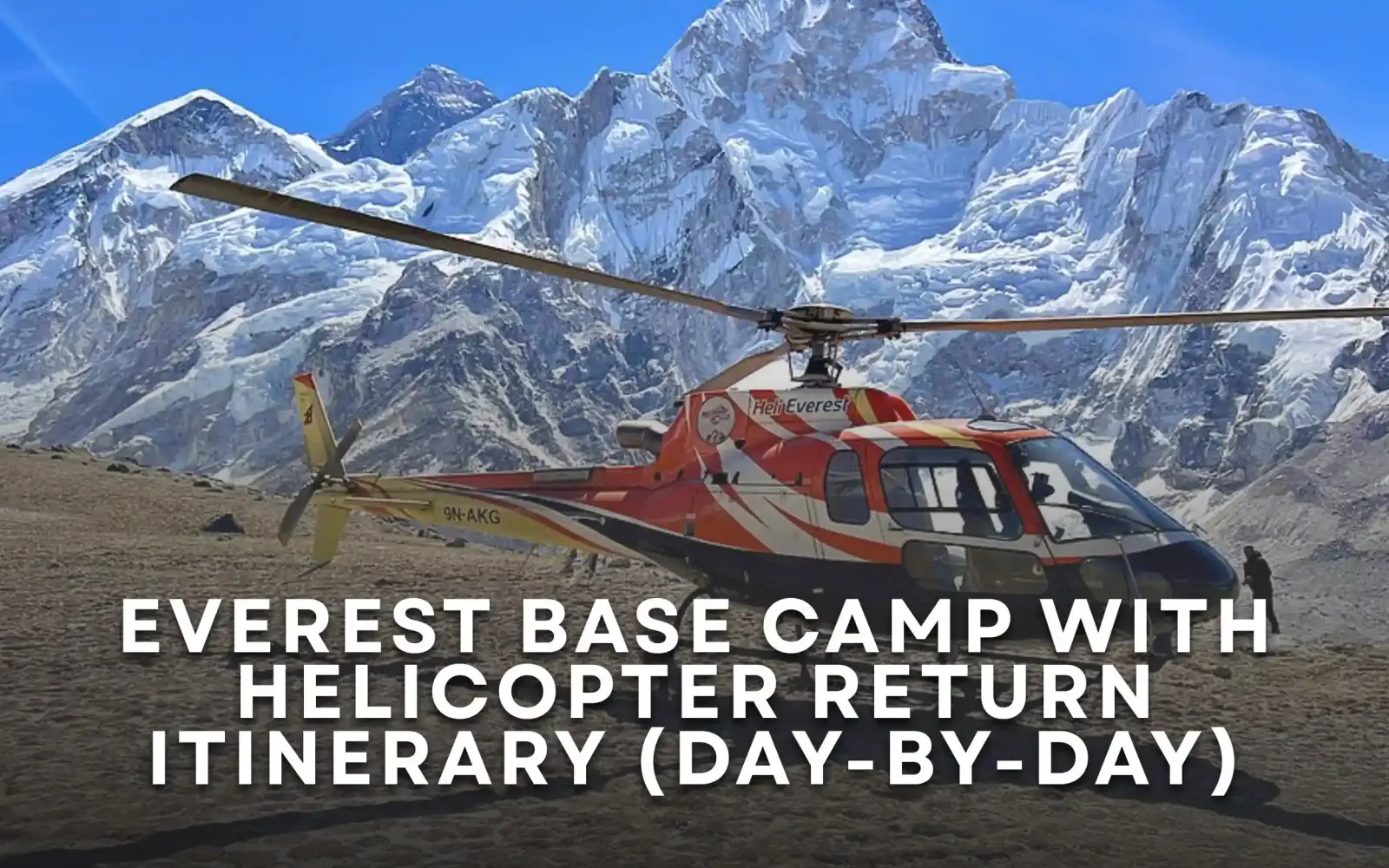
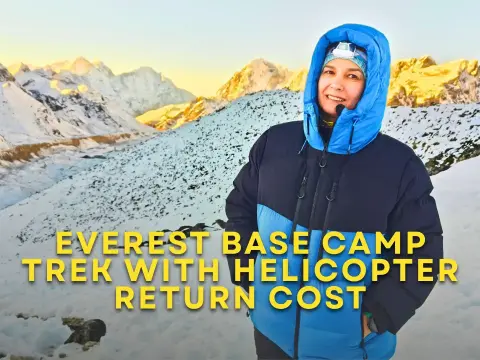
The Everest Base Camp Trek with Helicopter Return covers the same trail as the classic Everest Base Camp trek, then removes the three-day walk back to Lukla. Over nine days you fly into the mountains, walk through Sagarmatha National Park and the Sherpa villages of Namche Bazaar and Tengboche to Everest Base Camp at 5,364 m, climb Kala Patthar at dawn for the clearest possible view of Everest's summit, and fly straight back to Kathmandu the same morning.
Trek the Everest Base Camp Trek Helicopter Return
Everest Base Camp, Without the Long Walk Back. Reach 5,364m on Foot. Return by Air.
What Is the Everest Base Camp Helicopter Return Trek?
In short: you walk in, and you fly out. The trek follows the same route used by Everest expeditions since the 1950s — Lukla, Phakding, Namche Bazaar, Tengboche, Dingboche, Lobuche, Gorakshep, and Everest Base Camp itself — with two built-in acclimatization days at Namche and Dingboche. After the sunrise hike to Kala Patthar on the final morning, instead of retracing three days of trail back to Lukla, a helicopter lifts you off Gorakshep's helipad and flies the entire route home in under an hour, landing you in Kathmandu in time for lunch.
It is not a shortcut to the summit views — every metre to Base Camp and Kala Patthar is still walked, exactly as it is for every other trekker on the mountain. What the helicopter removes is the descent: roughly 40% of the classic itinerary's total walking, and the three most repetitive days of the trip.
Quick Facts
| |
|---|
| Duration | 9 days, Lukla to Kathmandu (plan 10–11 days in Nepal total, including your arrival day and a weather buffer) |
| Trip grade | Moderate to hard — no technical climbing, but sustained walking at altitude |
| Max altitude | 5,545 m / 18,192 ft (Kala Patthar) |
| Everest Base Camp altitude | 5,364 m / 17,598 ft |
| Total ascent | Approximately 2,685 m net gain, Lukla to Kala Patthar |
| Trekking distance | Approximately 65 km / 40 miles one-way |
| Nights above 4,000 m | 4 (Dingboche ×2, Lobuche, Gorakshep) |
| Acclimatization days | 2 (Namche Bazaar, Dingboche) |
| Accommodation | Teahouse throughout the trek; hotel in Kathmandu |
| Return journey | Shared helicopter, Gorakshep to Lukla, connecting to your Kathmandu flight |
| Best seasons | March–May and September–November |
| Starting price | From US$1,830 per person, group-size dependent |
Helicopter Return vs. the Classic Walk-Out
Places Nepal runs both versions of this trek on identical trail as far as Kala Patthar, so the comparison genuinely comes down to one decision: how you want to spend your last three days.
| Helicopter Return (this itinerary) | Classic Walk-Out |
|---|
| Duration | 9 days | 14 days |
| Route to Base Camp & Kala Patthar | Identical | Identical |
| Acclimatization days | Namche, Dingboche | Namche, Dingboche |
| Return journey | ~1 hour by helicopter from Gorakshep | 3 days walking back to Lukla |
| Flights depended on | 2 (Lukla inbound, helicopter outbound) | 1 (Lukla only) |
| Best suited to | Trekkers with 10–11 days who want the full route without repeating the same trail twice | Trekkers who want maximum schedule flexibility, or extra acclimatization margin |
The trade-off is worth stating plainly, because it's the one thing every trekker should weigh before booking. A three-day walk-out is slow, but it is flexible — if bad weather grounds the Lukla flight, you simply keep walking and the schedule barely notices. This itinerary depends on two weather-sensitive flights instead of one: the Lukla flight in, and the helicopter out. We manage that risk by scheduling both for the morning, when Khumbu weather is most stable, and by asking every trekker to keep an extra day free in Kathmandu before flying home internationally. More on exactly how that works further down.
If you're newer to multi-day trekking, or you'd simply rather have more buffer built into the schedule, our classic Everest Base Camp trek covers the same destination at a gentler pace. If you have around ten days and want to stand on Kala Patthar without three more days of downhill walking afterward, this itinerary is built for you.
Trek the Everest Base Camp Trek
This classic trek takes you through the heart of the Khumbu region, past vibrant Sherpa villages, ancient monasteries, and towering Himalayan peaks.
Before Day 1 — Arriving in Kathmandu
Plan to land in Kathmandu at least one full day before Day 1 of the itinerary begins. That's not a suggestion — it's the detail that makes the rest of the schedule work.
Every international trekker arrives at Tribhuvan International Airport (KTM). A Places Nepal representative meets you in the arrivals hall holding a signboard with your name, whatever time you land, and transfers you to your hotel free of charge. Most nationalities receive a Nepal tourist visa on arrival: US$30 for 15 days, US$50 for 30 days, or US$125 for 90 days, payable in cash, with two passport photos required for the paperwork. The 15-day visa comfortably covers this itinerary.
On the evening before Day 1 — we call it Day 0 — you'll attend a pre-trek briefing at our Thamel office. On most Nepal treks this is a formality. On this one, it matters more than usual, for two reasons. First, your Day 1 departure can start as early as 1:00 AM in peak season (more on why below), so the briefing is where you get your exact pickup time. Second, because this itinerary ends with a helicopter rather than a walk, the briefing is where your guide explains exactly how that return flight works, what the weather contingency looks like, and what your insurance needs to cover.
The Day 0 briefing typically covers:
- Confirming your Day 1 flight plan and hotel pickup time
- A final gear check for conditions up to 5,545 m
- Duffel bag handover, if you've hired a porter, plus free storage for anything you don't need on the trail
- How the Day 9 helicopter return works — timings, possible weight shuttles, and the weather protocol
- Verifying your travel insurance covers high-altitude trekking and helicopter evacuation
- A reminder to withdraw cash before you leave Kathmandu, since ATMs become unreliable past Namche Bazaar
Sleep on the Day 0 evening, not on the Day 1 flight. With a possible 1:00–3:00 AM pickup ahead, the night before the briefing — not the night of it — is genuinely the most important sleep of the week.
The Complete Day-by-Day Itinerary
Here is the full nine-day breakdown at a glance, followed by a detailed walk-through of each day below.
| Day | Route | Overnight | Altitude | Distance | Walking Time |
|---|
| 1 | Fly to Lukla, trek to Phakding | Phakding | 2,610 m | 7–8 km | 2–3 hrs |
| 2 | Phakding to Namche Bazaar | Namche Bazaar | 3,440 m | 12 km | 5–6 hrs |
| 3 | Acclimatization — hike to Everest View Hotel (3,880 m) | Namche Bazaar | 3,440 m | — | 3–4 hrs |
| 4 | Namche to Debuche, via Tengboche Monastery | Debuche | 3,820 m | 11 km | 5–6 hrs |
| 5 | Debuche to Dingboche, via Pangboche | Dingboche | 4,410 m | 11 km | 5–6 hrs |
| 6 | Acclimatization — hike to Nangkartshang (up to 5,083 m) | Dingboche | 4,410 m | — | 3–5 hrs |
| 7 | Dingboche to Lobuche, via Thukla Pass | Lobuche | 4,940 m | 9 km | 5–6 hrs |
| 8 | Lobuche to Everest Base Camp (5,364 m), back to Gorakshep | Gorakshep | 5,164 m | 13 km | 7–8 hrs |
| 9 | Kala Patthar sunrise (5,545 m), helicopter to Lukla, flight to Kathmandu | Kathmandu | 1,400 m | 3–4 hrs hike | 1 hr flying |
Day 1: Fly to Lukla and Trek to Phakding
Flight altitude: 2,860 m / 9,383 ft (Lukla) · Overnight: 2,610 m / 8,563 ft (Phakding) · Distance: 7–8 km · Walking time: 2–3 hrs
The trek opens with one of aviation's genuine spectacles: the mountain flight into Lukla's Tenzing-Hillary Airport, a short runway cut into a hillside at 2,860 m. Where that flight departs from depends on your season. In peak months (March–May and September–November), Lukla flights are rerouted through Manthali Airport, roughly 130 km east of Kathmandu, which means a 1:00–3:00 AM hotel pickup for the 5–6 hour shared road transfer, followed by a 20-minute flight.
In quieter months (January, February, June–August, December), flights run directly from Kathmandu's domestic terminal, with a far more civilised 5:00–6:00 AM pickup and a 35-minute flight. Either way, the ticket, transfer, and timing are all arranged for you — you just need the sleep banked the night before.
After landing, your guide handles the Khumbu Pasang Lhamu permit check while porters organise the duffel bags, and the trail leaves Lukla through its stone archway gate. The walking starts gently by design: a 2–3 hour descent along the milky-blue Dudh Koshi River, through pine forest and past the trek's first mani stones and prayer wheels, to the riverside village of Phakding. It's an easy afternoon and, after a pre-dawn start, an early night is the right call.
Prefer to skip the road transfer entirely? Places Nepal also offers a direct helicopter upgrade from Kathmandu to Lukla, available in any season for roughly US$590 per person based on five people sharing — you start the trek the same way you'll end it, by air.
Day 1 tip: Take a left-side seat on the Lukla flight for the best mountain panorama in clear weather, and treat the Day 0 evening's sleep as non-negotiable — not the short flight itself.
Day 2: Trek from Phakding to Namche Bazaar
Altitude gain: 830 m / 2,723 ft · Overnight: 3,440 m / 11,286 ft · Distance: 12 km · Walking time: 5–6 hrs
This is one of the most storied days in world trekking, and the first real physical test of the trip. The trail follows the Dudh Koshi through the villages of Benkar and Monjo, where it enters Sagarmatha National Park — a UNESCO World Heritage Site — and your guide handles the permit formalities at the gate. From there the gorge narrows, the trail traffic of porters, yak trains, and trekkers thickens, and the route crosses the high Hillary Suspension Bridge, strung with prayer flags above the river.
Beyond the bridge comes the day's real work: a sustained 600 m climb through fragrant pine forest, switchbacking up to Namche Bazaar. Around the halfway viewpoint, weather permitting, Everest appears for the first time — a black pyramid and a plume of wind-blown snow, visible above the Nuptse ridge. It's a brief glimpse, and an unforgettable one.
Namche itself is the amphitheatre-shaped Sherpa capital of the Khumbu, its lodges and shops built into a natural bowl beneath sacred Khumbila peak. It's also the last genuinely well-supplied stop on the route — ATMs, bakeries, gear shops, hot showers, and Wi-Fi — and you'll spend two nights here.
A mild headache, reduced appetite, or restless sleep on this first night above 3,400 m is common and usually settles on its own. Hydrate steadily, and mention anything beyond mild discomfort to your guide — that's exactly what they're there for.
Day 3: Acclimatization Day in Namche Bazaar
Acclimatization high point: 3,880 m / 12,730 ft · Overnight: 3,440 m / 11,286 ft · Recommended hike: 3–4 hrs
This is the first of two scheduled acclimatization days, and on a nine-day itinerary that finishes at 5,545 m, it carries real weight in the overall safety plan. The golden rule of acclimatization is active rest, not idle rest: climb a few hundred metres during the day, then sleep back down at the lower altitude.
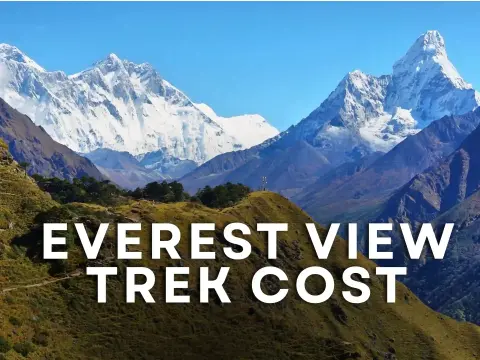
The classic route climbs the ridge above Namche, past the small Syangboche airstrip, to the terrace at Hotel Everest View — one of the world's highest-placed hotels, and the reward is a full panorama of Everest, Lhotse, Nuptse, and Ama Dablam over morning tea. Trekkers with energy to spare loop back through the traditional villages of Khumjung and Khunde; those who'd rather keep it shorter descend directly.
The afternoon is deliberately unstructured. The Sherpa Culture Museum above town is worth the visit, Namche's bakeries are genuinely excellent, and any gear you forgot to pack can still be bought or rented here — it's the last full-service stop of the entire route.
Day 3 tip: Withdraw all the Nepali cash you'll need for the rest of the trek today. Namche's ATMs are the last reliable machines before Base Camp and back. And hike the viewpoint even if you feel perfectly fine — acclimatization is banked in advance, and today's climb pays out three days from now at Lobuche and Gorakshep.
Day 4: Trek from Namche to Debuche via Tengboche Monastery
Altitude gain: 380 m / 1,247 ft · Overnight: 3,820 m / 12,533 ft (Debuche) · Distance: 11 km · Walking time: 5–6 hrs
Ask any guide in the Khumbu which day is the most beautiful on the whole route, and a good number will say this one. A high balcony trail contours out of Namche with Ama Dablam's spire ahead and Everest visible beyond it, before dropping to the river at Phunki Thanga, where water-driven prayer wheels turn beside the trail.
From there the route climbs through rhododendron forest to Tengboche, home to the largest and most important monastery in the Khumbu. The gompa sits on a ridge with a 360-degree panorama — Everest, Nuptse, Lhotse, and Ama Dablam in a single sweep — that has stopped trekkers in their tracks since the first Everest expeditions came through in the 1950s. If your timing allows, sitting quietly at the back of the monks' evening puja, usually around 5 PM, is one of the quieter, more memorable half-hours of the whole trip.
Fifteen minutes below the monastery, in sheltering forest, the lodges of Debuche make a smarter overnight stop than Tengboche itself: quieter, and 40 m lower, which counts for something as the nights get colder.
Day 5: Trek from Debuche to Dingboche
Altitude gain: 590 m / 1,936 ft · Overnight: 4,410 m / 14,469 ft · Distance: 11 km · Walking time: 5–6 hrs
The landscape changes character today. After crossing the Imja Khola, the trail climbs through Pangboche — home to the oldest monastery in the Khumbu, dating to the 17th century — with Ama Dablam's north face rising directly overhead. Beyond the lunch stop at Somare, the last trees disappear and the trail opens into the wide alpine expanse of the Imja Valley.
Dingboche arrives in the early-to-mid afternoon: a scattering of stone-walled barley fields at 4,410 m, with Island Peak and the vast south face of Lhotse filling the view up-valley. This is your second two-night base of the trek, and your first night sleeping above 4,400 m. Lighter sleep and a bigger appetite for water than food are both normal here — anything beyond mild discomfort goes to your guide the same evening, not the next morning.
Day 6: Acclimatization Day in Dingboche
Acclimatization high point: up to 5,083 m / 16,677 ft (Nangkartshang) · Overnight: 4,410 m / 14,469 ft · Recommended hike: 3–5 hrs
This is the second and final scheduled acclimatization day, and arguably the one that makes Base Camp possible at all. The classic hike climbs the ridge directly above the village toward Nangkartshang Peak — go for one hour or three, depending on how you're feeling, with the full route topping out around 5,083 m.
The panorama grows with every switchback: Makalu, the world's fifth-highest mountain, appears to the east, with Lhotse's wall, Island Peak, and the back side of Ama Dablam arranged around the Imja Valley below. Climbing to roughly 5,000 m today and sleeping back down at 4,410 m tonight is precisely the preparation that makes the next three days — Lobuche, Base Camp, and the Kala Patthar summit — feel achievable instead of brutal.
Back in the village by lunchtime, the afternoon is for genuine rest: the bakery, a book, and disciplined water intake. From tomorrow, the itinerary commits fully to the high country — three consecutive days above 4,900 m, ending at the helicopter pad.
Day 6 tip: Push to the full Nangkartshang viewpoint if your body allows it, even though it feels like an odd use of a "rest day." The altitude you bank here is what gets you comfortably through Thukla Pass, Base Camp, and Kala Patthar over the following three days.
Day 7: Trek from Dingboche to Lobuche via Thukla Pass
Altitude gain: 530 m / 1,739 ft · Overnight: 4,940 m / 16,207 ft · Distance: 9 km · Walking time: 5–6 hrs
The trail climbs gradually along the valley shelf to the small settlement of Thukla, where most groups stop for lunch below the day's real challenge: a steep, direct hour up Thukla Hill to the memorial field at its crest. Dozens of stone chörtens stand here, draped in prayer flags, honouring climbers who died attempting Everest — including well-known names like Scott Fischer and Babu Chiri Sherpa. It's one of the most moving places in the entire Himalaya, and groups naturally go quiet here. Give it the time it asks for.
Beyond the pass, the trail levels out and runs alongside the moraine of the Khumbu Glacier to Lobuche, a small huddle of lodges that will be your highest teahouse night before Gorakshep. Step outside after dinner if the sky is clear — the sunset light on Nuptse's fluted wall, five minutes from any dining room, is among the finest sights on the entire route.
Day 7 tip: Pace the Thukla climb deliberately. It's the steepest sustained section before Base Camp, at an altitude where rushing costs you double. And if your guide suggests ordering tomorrow's packed lunch tonight, do it — Day 8 runs long, and Gorakshep's kitchens queue up fast around midday.
Day 8: Trek to Everest Base Camp and Back to Gorakshep
Base Camp altitude: 5,364 m / 17,598 ft · Overnight: 5,164 m / 16,942 ft (Gorakshep) · Distance: 13 km · Walking time: 7–8 hrs
This is the day the whole trip has been building toward, and the longest day on the itinerary. A rolling morning walk along the Khumbu Glacier's lateral moraine — never steep, never quite flat, all of it above 5,000 m — reaches Gorakshep by mid-morning: a sandy basin, once a lake bed, that's the last outpost before Base Camp. Bags go down, a meal goes in, and you head out light for the afternoon push.
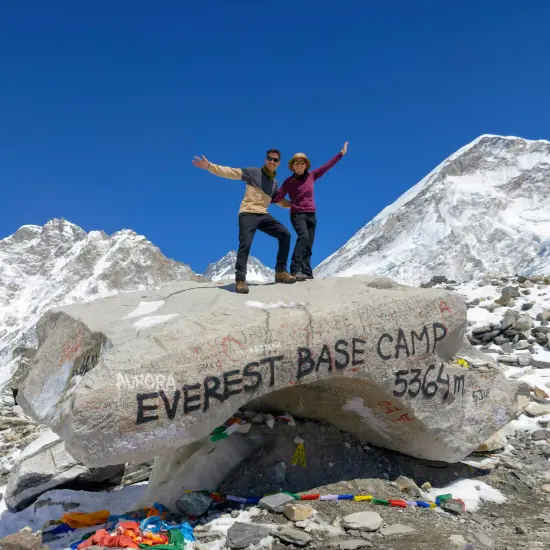
Two hours of rocky, undulating trail across glacial debris lead to the famous boulder and its halo of prayer flags marking Everest Base Camp at 5,364 m. Above, the Khumbu Icefall tumbles out of the Western Cwm in blocks of ice the size of buildings — and in spring, you'll likely be standing beside the sprawling tent city of that season's Everest expeditions. Everest's summit itself stays hidden behind Nuptse from this angle; that view is saved for tomorrow.
By late afternoon you're back at Gorakshep for an early dinner and an early night. Sleep at 5,164 m is thin and broken for almost everyone — that's normal, and it's one night only. Tomorrow's sunrise summit and the flight home are the reward for getting through it.
Day 8 tip: Go light to Base Camp — daypack only, with water, snacks, a down layer, and your camera. The duffels stay behind at Gorakshep. Before bed, lay out every piece of tomorrow's summit kit: headlamp, full layers, gloves, packed bag. Kala Patthar starts around 4–5 AM, and the helicopter follows not long after.
Day 9: Sunrise at Kala Patthar, Helicopter to Lukla, Flight to Kathmandu
Summit altitude: 5,545 m / 18,192 ft, the trip's highest point · Kala Patthar round trip: 3–4 hrs · Flying time, Gorakshep to Kathmandu: approximately 1 hr
This is, without much competition, the single greatest morning in trekking. A pre-dawn climb by headlamp gains the rocky, prayer-flagged crown of Kala Patthar at 5,545 m just as first light strikes Everest's summit pyramid — seen here full-face and completely unobstructed, with Nuptse, the Khumbu Glacier, and Pumori completing the amphitheatre around you. This, not Base Camp itself, is the view that appears on every Everest poster you've ever seen. The climb takes roughly 1.5–2 cold, steady hours.
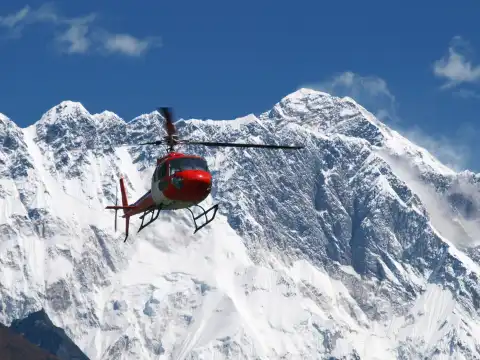
Then the itinerary plays its defining move. After descending to Gorakshep for breakfast and boarding at the helipad, the helicopter lifts off and flies the entire nine-day route home in reverse — Base Camp, the Icefall, Ama Dablam, Tengboche's ridge, Namche's horseshoe of lodges, the Dudh Koshi gorge — compressed into one extraordinary flight. Because aircraft carry less at 5,164 m, this sometimes runs as a brief weight shuttle: two to three passengers per lift down to a lower pad, such as Pheriche, before the group reboards for the continuing flight to Lukla and connects with the return leg of your Kathmandu domestic ticket. It's standard high-altitude flying practice, adds only a little time, and your guide manages every step. Your luggage flies with you throughout.
You'll land in Kathmandu before lunch. A Places Nepal vehicle meets you at the domestic terminal and transfers you to your hotel — the same free service as your arrival. That evening is for a celebration dinner and the genuinely strange sensation of having watched sunrise from 5,545 m and sunset over Kathmandu in the same calendar day.
Day 9 tips: Dress in full layers for the summit — pre-dawn on Kala Patthar regularly runs around −15°C with wind, and you'll be shedding jacket layers by mid-morning back in Kathmandu. Sit on the left side of the helicopter if you can; Everest, Lhotse, and Ama Dablam line up on that side for most of the flight out. And keep your international departure flight for Day 10 evening or later — helicopters are weather-dependent, and a short hold of a few hours is always a possibility in the mountains.
Trek the Everest Base Camp Trek Helicopter Return
Everest Base Camp, Without the Long Walk Back. Reach 5,364m on Foot. Return by Air.
How the Day 9 Helicopter Return Actually Works
Because this is the detail that makes the whole itinerary different, it's worth explaining properly rather than leaving it as a single line on a booking page.
After the Kala Patthar sunrise hike, your helicopter departs from Gorakshep's helipad at 5,164 m — one of the highest scheduled helicopter operations anywhere in the world. At that altitude, thin air reduces how much weight an aircraft can safely lift, so the flight is planned around passenger and cargo limits from the outset. In practice, that usually means a shared helicopter carrying two to three passengers per lift, sometimes routed through a lower intermediate pad such as Pheriche or directly on to Lukla, where the group reunites and reboards the return leg of the same Kathmandu (or Manthali) domestic ticket used on Day 1. Your guide coordinates every leg of this, and your luggage travels with you the whole way — there's no separate baggage handling to think about.
Morning departures are scheduled for a reason. Himalayan weather builds through the day, which is exactly why the itinerary times the Kala Patthar summit for dawn and the helicopter for shortly after: the window is clearest early. In the rare event that weather holds the flight, the standard contingency is a short wait at Gorakshep, or occasionally an overnight at a lower village, with the flight completing the following morning. It's a real possibility on any high-altitude helicopter operation, not a flaw specific to this itinerary — and it's precisely why we ask every trekker to keep Day 10 free rather than booking an international flight for the same evening.
It's also worth being clear about what this scheduled return is not: it is not an emergency evacuation. Rescue flights for altitude sickness or injury are a separate, unscheduled service, arranged if and when they're medically necessary, and billed separately if you're uninsured — commonly US$3,000 to $10,000 or more. The Day 9 helicopter is a planned, weather-permitting transfer that's already built into your trip cost. Comprehensive travel insurance covering both scenarios — scheduled high-altitude flying and emergency evacuation to at least 6,000 m — is a requirement for this trek, and we check every policy at the Day 0 briefing.
The Acclimatization Strategy Behind This Itinerary
Nine days sounds compressed next to the classic 14-day route, and in one sense it is — but not where it matters for safety. The two acclimatization days, at Namche (Day 3) and Dingboche (Day 6), are identical on both itineraries. What the helicopter version shortens is the descent, not the ascent.
The itinerary follows the standard high-altitude principle of climbing high and sleeping low: on both rest days, you hike a few hundred metres above your overnight altitude before returning to sleep lower down, which trains your body to cope with reduced oxygen well before you need it to. Below is how your sleeping altitude progresses night by night.
| Night | Location | Altitude |
|---|
| 1 | Phakding | 2,610 m |
| 2 & 3 | Namche Bazaar | 3,440 m |
| 4 | Debuche | 3,820 m |
| 5 & 6 | Dingboche | 4,410 m |
| 7 | Lobuche | 4,940 m |
| 8 | Gorakshep | 5,164 m |
Notice the gradual step-up: roughly 800 m of gain to reach Namche, then two full nights there before climbing further; a similar pattern at Dingboche before the final push above 4,900 m. This is the same profile used on the classic 14-day itinerary — nothing about the ascent has been rushed to fit nine days. What's different is that once you reach Gorakshep and complete the Kala Patthar summit, you're finished. There's no three-day walk back down through altitudes you've already acclimatized to; the helicopter simply takes you home from your highest point.
The one thing no itinerary can engineer around is individual response to altitude, which varies enormously between trekkers regardless of fitness. Mild symptoms — headache, reduced appetite, disrupted sleep — are a normal and expected part of gaining height this quickly, and they typically settle within a day. Anything beyond mild needs to go to your guide immediately, not at the next scheduled stop. On a nine-day schedule there's genuinely no slack for pushing through worsening symptoms, which is exactly why the two rest days exist and why honest communication with your guide matters more here than on almost any other trek in Nepal.
How Difficult Is This Itinerary?
The Everest Base Camp Trek with Helicopter Return sits at a moderate-to-hard grade — roughly 3.5 out of 5 on the standard Nepal trekking scale. The trail itself is well-maintained and entirely non-technical: no ropes, no crampons, no exposure demanding a head for heights. The challenge is altitude, plain and simple. Seven of the nine days are spent above 3,400 m, and the final three push through 4,900 m to a high point of 5,545 m.
The hardest stretch is Days 7 through 9: the steep climb to Thukla Pass, the long 7–8 hour push to Base Camp and back to Gorakshep, and the pre-dawn Kala Patthar summit. None of it is technical climbing — all of it is slow, cold, thin-air work where pacing and hydration matter more than raw fitness.
What the helicopter changes, honestly: only the descent. It removes roughly three days of knee-jarring downhill walking and a second Lukla flight — about 40% of the classic route's total walking distance. It does not make the ascent any easier; every metre to Base Camp and Kala Patthar is earned exactly as it is on the 14-day version. What it buys you is freshness: you finish the trip at your fittest, most alert moment, rather than three tired days later.
Typical daily walking time runs 5 to 7 hours, with the longest day (Day 8, to Base Camp and back) at 7 to 8 hours. If you can comfortably hike 5 to 6 hours on hilly terrain with a light pack, on back-to-back days, you're in solid shape for this itinerary — including as a first Himalayan trek, provided you commit to proper preparation beforehand. Trekkers who are newer to multi-day hiking, or who'd prefer a gentler pace with more built-in slack, often do better on the classic 14-day Everest Base Camp itinerary, which covers identical terrain with a few extra days folded in.
What's Included and What's Not
One of the most common sources of confusion when comparing Everest Base Camp helicopter packages across different operators is exactly what "included" covers. Here's precisely what's built into the Places Nepal price.
Included in your package:
- Round-trip Kathmandu (or Manthali, in peak season) to Lukla flight
- The shared helicopter flight from Gorakshep to Lukla on Day 9
- Private airport transfers, both arrival and departure, at any time
- Twin-sharing teahouse accommodation for all 8 nights on the trek
- Full-board meals on the trail — breakfast, lunch, and dinner, from Day 1 lunch through Day 9 breakfast
- A government-licensed, English-speaking trekking guide
- Wages, meals, accommodation, insurance, and equipment for your support crew
- Sagarmatha National Park entry permit and Khumbu Pasang Lhamu Rural Municipality permit
- A comprehensive first-aid kit, with daily oximeter checks throughout the trek
- A trip completion certificate
- All government taxes and administrative fees
- A shared tourist vehicle between Kathmandu and Manthali as a backup, in case of flight diversion
Not included:
- Hotel accommodation and meals in Kathmandu
- Porter service — optional, at US$200 for the entire trek
- International flights and airport departure taxes
- Nepal entry visa fees (US$30–125, paid in cash on arrival)
- Travel insurance, including high-altitude emergency evacuation coverage
- Drinks, including bottled and boiled water
- Tips for your guide, porter, and drivers
- Personal trekking gear and equipment
- Any expense not explicitly listed under Price Includes
The daily oximeter checks are worth flagging specifically, since not every operator includes them. Measuring blood oxygen saturation each morning gives your guide an objective, early signal of how your body is coping with altitude — often before symptoms become obvious — and it's one of the simplest, most effective safety tools available on a trek like this.
Trek the Everest Base Camp Trek Helicopter Return
Everest Base Camp, Without the Long Walk Back. Reach 5,364m on Foot. Return by Air.
What Does This Itinerary Cost?
The Everest Base Camp Trek with Helicopter Return costs US$1,830 to $2,200 per person with Places Nepal, priced by group size, or a flat US$1,990 per person if you join one of our guaranteed fixed departures rather than booking privately.
Price by group size
| Group size | Price per person |
|---|
| 1 person (solo) | $2,200 |
| 2–5 people | $1,990 |
| 6–10+ people | $1,830 |
| Fixed group departure, any size | $1,990 |
A private trip and a fixed departure are two different ways of booking the same itinerary, not two different products. Book privately and the per-person price drops as your own group grows, from $2,200 traveling alone down to $1,830 once you're six or more. If you'd rather not organise a group yourself, our fixed departures run at a flat $1,990 per person on an already-confirmed date, alongside trekkers from other countries — see the current departure dates below.
That price is genuinely all-in for the trek itself: both flights, the shared Gorakshep–Lukla helicopter, your permits, your guide, and every night's teahouse and meal on the trail are already covered. Where costs commonly get confused is the word "helicopter" itself — a search for Everest Base Camp helicopter cost turns up wildly different figures online, usually because it's describing one of three different services:
- Your scheduled Day 9 return — already included in the price above. A shared helicopter lifts you from Gorakshep to Lukla, replacing three days of walking, connecting to the return leg of your Kathmandu ticket.
- A fully private helicopter all the way to Kathmandu — a genuinely different, considerably more expensive service that skips Lukla entirely. Our own private Everest Base Camp helicopter package starts near $8,500, and it's the main reason some "helicopter return" quotes elsewhere in the market run from roughly $2,500 up to $3,200-plus for what looks, on the surface, like the same trip.
- Emergency evacuation — never included in any trek price, and not the same service at all. An unscheduled rescue flight for altitude sickness or injury is billed separately, commonly $3,000 to $10,000-plus without insurance.
What can add to your total
| Add-on | Cost |
|---|
| Porter for the entire trek | +$200 |
| Helicopter upgrade, Kathmandu to Lukla (Day 1 inbound) | +$590 per person, based on 5 sharing |
| Trekking solo rather than with a group of 2 or more | +$210–$370 per person |
| Extra nights in Kathmandu before or after the trek | Not included — budget for at least one regardless |
Beyond the package price, budget NPR 1,500–2,000 (roughly $11–15) per day in cash for trail extras — hot showers, device charging, Wi-Fi, bakery stops, and bottled or boiled water, all of which get pricier the higher you climb. Withdraw what you need in Kathmandu or, at the latest, Namche Bazaar — card payment isn't accepted at any teahouse on the route.
Booking terms: a 10% deposit confirms your date, with the balance due on arrival in Kathmandu rather than in advance. Cancel 31 or more days before departure and you'll receive an 80% refund; 15–30 days out, 50%; inside 15 days, bookings are non-refundable, though you can change your dates for a $200 per-person fee if you give 15 or more days' notice. Full terms are on our Terms and Conditions page.
Because this itinerary depends on two weather-sensitive flights rather than one, it's worth understanding upfront what a weather delay actually costs. Under standard unforeseen-circumstances policy, a multi-hour hold on either flight is treated as any weather event would be: your guide gets you on the next available window, prioritising morning departures — but an extra hotel night or a missed onward connection becomes a personal cost, not a refundable one. That's exactly why we ask you to keep Day 10 free and why helicopter-inclusive travel insurance is mandatory rather than optional. Budget both as part of the real cost of this trip.
Best Time of Year to Go
Weather affects this itinerary more than almost any other trek in Nepal, for a simple reason: it depends on two flights instead of one. Here's what to expect by season.
| Season | Lower Khumbu (2,600–3,440 m) | High Khumbu (4,400–5,200 m) | Kala Patthar at dawn | Conditions |
|---|
| Spring (Mar–May) | 10–18°C day / 0 to −5°C night | 0–10°C day / −10 to −15°C night | Around −15°C with wind | Stable and clear; rhododendrons blooming; Base Camp busy with Everest expeditions in April–May |
| Autumn (Sep–Nov) | 10–15°C day / −2 to 5°C night | −5–8°C day / −10 to −18°C night | Around −15 to −20°C with wind | Nepal's clearest, most reliable skies — widely considered the best trekking window |
| Winter (Dec–Feb) | 0–8°C day / −10 to −15°C night | −5–0°C day / −15 to −20°C night | −20°C or colder | Crisp and dry, with the quietest trails of the year; some high lodges reduce services |
| Monsoon (Jun–Aug) | 15–20°C day / 8–12°C night | 8–14°C day / 0–5°C night | Rarely clear enough to see much | Heavy afternoon rain and cloud; the year's highest flight-delay risk |
Spring (March–May) and autumn (September–November) are, for good reason, when most trekkers come. Skies are at their most stable, both the Lukla flight and the Gorakshep–Kathmandu helicopter run close to schedule, and daytime temperatures on the lower trail stay genuinely comfortable. Autumn typically edges out spring for visibility; spring adds blooming rhododendrons and the buzz of expedition teams heading for Base Camp through April and May.
Winter (December–February) is trekkable, and often strikingly clear, but overnight temperatures at Lobuche and Gorakshep regularly drop past −15°C, some teahouses above Dingboche reduce services, and shorter daylight hours compress the walking window. It suits experienced, well-equipped trekkers better than first-timers.
We don't recommend monsoon (June–August) for this specific itinerary. The classic walk-out version only needs one flight to go right, on the way in. This one needs the helicopter to fly too, on the way out — and monsoon cloud cover is exactly what grounds both. Temperature on this route is driven far more by altitude than by season: every 1,000 m of ascent costs roughly 6°C, so expect a swing of 20°C or more within a single day once you're above Dingboche, in any month you travel.
Because a weather hold is always a possibility, we build a buffer into Day 10 regardless of season, and schedule both key flights for the morning, when Khumbu weather is at its most settled.
What to Pack
You'll carry a light daypack yourself — water, snacks, a down layer, camera — while either your own backpack or a porter-carried duffel handles the rest, depending on whether you hire a porter (an optional $200 add-on, not included by default). A few packing details are specific to this itinerary and worth flagging separately from a generic Everest packing list.
The Lukla flight weight limit is strict: 15 kg checked plus 5 kg hand luggage per person, on both the inbound flight and the Day 9 return. Weigh your bag in Kathmandu before you fly — overweight bags are charged extra at the airport counter.
A −15°C-rated sleeping bag is non-negotiable. Teahouse blankets are thin above Dingboche, and the nights at Lobuche (4,940 m) and Gorakshep (5,164 m) demand a proper four-season bag. Quality bags rent cheaply in Kathmandu if you don't want to travel with your own — ask us for trusted shops at the Day 0 briefing.
Because this itinerary skips the descent, your cold-weather layers work harder for longer — you're at your highest, coldest points on Days 8 and 9, right at the very end of the trip, rather than easing back down through warmer villages afterward. An insulated down jacket rated below −10°C, insulated waterproof gloves for summit morning, and a proper headlamp with spare batteries (essential for the pre-dawn Kala Patthar climb) all matter more here than they might on a slower descent-heavy itinerary.
Other essentials worth calling out: trekking poles, a 2–3 litre water bottle or bladder, water purification tablets or a filter, sun protection (SPF 50+, reapplied often at altitude), broken-in waterproof trekking boots, and cash in Nepali rupees — there are no ATMs, and no card payment, anywhere past Namche Bazaar.
Getting Fit for the Trek
You don't need to be an athlete to reach Everest Base Camp, but this itinerary rewards genuine preparation more than the 14-day version does, simply because it has less slack built into the schedule. Every one of the nine days involves walking or hiking, including the two "rest" days, which build in a climb-high, sleep-low hike of several hundred metres rather than true idle time. Four of the nine days run 5 to 6 hours; Day 8, the push to Base Camp and back, runs 7 to 8. All of it happens at altitude, where the same physical effort simply costs more oxygen.
There's no technical climbing involved — no ropes, no crampons — so what you're training for is cardiovascular endurance, leg strength, and the ability to string several demanding days together without a rest day to properly recover on.
Start 8 to 12 weeks out if you can, longer if you're coming from a mostly sedentary routine, less if you already hike or run regularly. Three things matter more than any single workout:
- Cardiovascular base — three to four sessions a week of running, cycling, swimming, or incline walking, building toward 60–90 minutes of continuous effort.
- Leg and core strength — two to three sessions a week of squats, lunges, step-ups, and planks. Stone steps, suspension bridges, and glacial moraine reward strong legs and good balance more than raw speed.
- Load-bearing, back-to-back hiking — the single best preparation available. Train with roughly 5–8 kg on hilly terrain, and try to hike on two consecutive days at least one weekend, to simulate the trek's actual rhythm.
A practical benchmark: if you can comfortably hike 5 to 6 hours on hilly terrain with a light pack, on back-to-back days, you're in good shape for this itinerary.
Fitness will not prevent altitude sickness — that comes down to acclimatization, hydration, and individual physiology, which is exactly why the two rest days at Namche and Dingboche stay fixed on the schedule rather than being cut to save time. What fitness gives you is a stronger margin: faster overnight recovery, more comfort on the long days, and more in reserve if the schedule needs to flex around weather.
If you have a heart, lung, or blood pressure condition, or any concern about high-altitude travel, see a doctor before booking and mention the maximum altitude — 5,545 m.
Permits You'll Need
Two permits cover the entire route, and both are arranged by Places Nepal and included in your package price — your guide carries the paperwork through the checkpoints at Lukla and Monjo, so there's nothing for you to queue for.
- Sagarmatha National Park Entry Permit — NPR 3,000 / US$23 per person, checked at the Monjo park gate on Day 2. Funds conservation of the UNESCO World Heritage national park.
- Khumbu Pasang Lhamu Rural Municipality Permit — NPR 2,000 / US$15 per person, issued at Lukla. This local permit replaced the old TIMS card in the Everest region back in 2018 — a detail a surprising number of outdated trekking websites still get wrong. No TIMS card is required anywhere on this route.
Send us a copy of your passport at booking, and we take care of the rest.Booking and Departure Dates
You can join this itinerary two ways: as a private trip on dates you choose, or as a guaranteed fixed departure alongside other trekkers at the flat $1,990 rate. As of mid-2026, confirmed fixed departures include dates in late September, early October, and early November 2026, with further guaranteed departures already scheduled into March, April, and May 2027 — all marked "guaranteed to run," meaning they'll depart regardless of minimum group numbers. Spots on the nearer dates are limited, so check our current departure calendar for exact dates and availability, since this list updates as seats fill.
Whichever way you book, plan on 10–11 days in Nepal in total — the 9-day itinerary itself, plus your Day 0 arrival day and a Day 10 buffer before any international departure. A 10% deposit secures your date, with the balance settled on arrival in Kathmandu.
Trek the Everest Base Camp Trek Helicopter Return
Everest Base Camp, Without the Long Walk Back. Reach 5,364m on Foot. Return by Air.
Frequently Asked Questions
How many days is the Everest Base Camp Helicopter Return trek? Nine days, from your Lukla flight on Day 1 to your helicopter and flight back into Kathmandu on Day 9. Most trekkers plan 10–11 days in Nepal overall, once you add an arrival day before Day 1 and a weather buffer after Day 9.
Do you walk to Everest Base Camp and fly back, or is any part of the ascent by helicopter too? You walk the entire ascent — every metre from Lukla to Everest Base Camp and up to Kala Patthar is on foot, exactly as it is for every other trekker on the classic route. The helicopter only replaces the descent, flying you from Gorakshep back to Lukla on the final day.
How many acclimatization days does this itinerary include? Two: a full rest day in Namche Bazaar on Day 3, and a second in Dingboche on Day 6. Both are identical to the acclimatization schedule on our 14-day classic itinerary — nothing about the ascent has been compressed to make room for the helicopter.
What is the maximum altitude reached on this itinerary? Kala Patthar, at 5,545 m, on the morning of Day 9. Everest Base Camp itself, reached the day before, sits at 5,364 m.
Is nine days enough to safely reach Everest Base Camp? Yes, provided the two acclimatization days are respected and symptoms are reported honestly. The itinerary keeps the same ascent profile and rest days as the longer classic route — it only shortens the walk back down, not the climb up. What it doesn't offer is much slack for delay, so genuine fitness preparation and honest communication with your guide both matter more here than on a slower schedule.
What happens if the Day 9 helicopter can't fly because of weather? Your guide monitors conditions throughout the trek and rebooks the earliest available window, prioritising morning departures when Khumbu weather is most stable. This is exactly why the itinerary keeps Day 10 free rather than scheduling it as a flight day, and why travel insurance covering flight delays and high-altitude evacuation is a requirement, not an option.
How is this different from the classic 14-day Everest Base Camp trek? The route to Base Camp and Kala Patthar, and the two acclimatization days, are identical on both. The difference is entirely in the return journey: three days of walking back to Lukla on the classic itinerary, versus roughly one hour by helicopter on this one.
Can beginners do this itinerary? It can work well for a first Himalayan trek, provided you commit to serious preparation beforehand — see the fitness section above. Trekkers newer to multi-day hiking, or who'd prefer more built-in schedule flexibility, often find our classic 14-day itinerary a gentler introduction to the same destination.
Is the helicopter really included in the price, or is it a paid add-on? It's included. The Day 9 shared helicopter from Gorakshep to Lukla, plus the connecting flight into Kathmandu, are both built into the quoted price of $1,830–$2,200 per person — there's no separate helicopter fee to settle on the mountain.
Does the price include emergency helicopter evacuation if I develop altitude sickness? No. That's a separate, unscheduled rescue flight, arranged only if medically necessary and typically costing $3,000–$10,000-plus without insurance — a different service entirely from the scheduled Day 9 return, and the reason comprehensive high-altitude travel insurance is mandatory for this trek.
Plan Your Trek With Places Nepal
Places Nepal is a locally owned trekking company based in Kathmandu, run and guided by Nepali staff who work this trail every season rather than reselling someone else's ground arrangements. That's a distinction worth caring about on an itinerary like this one, where the Day 9 helicopter logistics — weight limits, weather calls, shuttle routing — genuinely benefit from a guide who has coordinated that exact flight before, not just walked the trail.
We're a registered company and a member of the Nepal Mountaineering Association, the Trekking Agencies' Association of Nepal, and the Nepal Tourism Board. And if circumstances ever cut your trek short, our Trek Again philosophy means you're welcome to repeat it with us at no extra charge.
If you're ready to see current departure dates or want a private itinerary built around your own schedule, explore the full Everest Base Camp Helicopter Return trip page, or get in touch with our team to talk through dates, group size, or how this itinerary compares with our classic 14-day Everest Base Camp trek. We're happy to help you work out which version fits your trip.