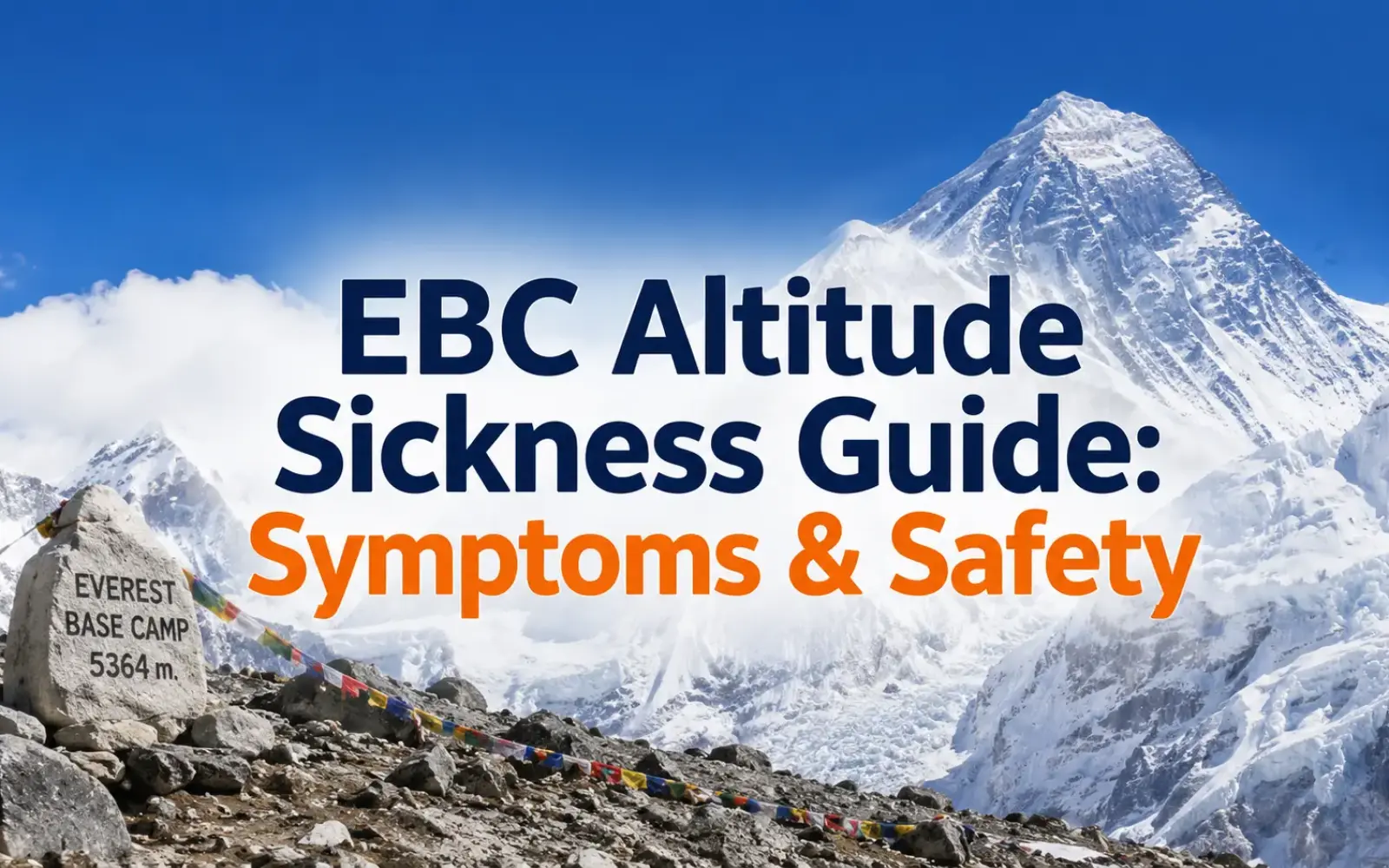
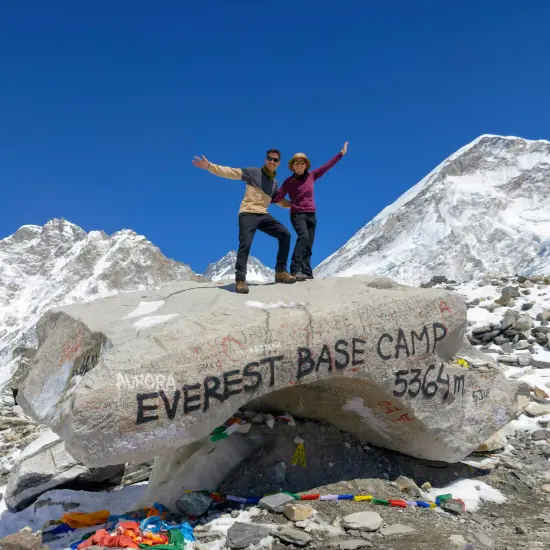
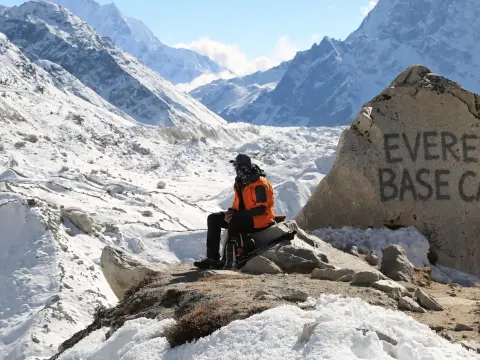
Altitude, not distance, is what actually decides whether an Everest Base Camp trek goes well. The walking itself is well within reach of most reasonably fit adults — the trail is graded, the days are manageable, and porters carry the heavy loads. What separates a smooth trip from a miserable or dangerous one is how your body handles climbing from Kathmandu's 1,350 meters to Everest Base Camp's 5,364 meters in under two weeks, with barely half the oxygen available at the top compared to sea level.
This guide exists because we'd rather you understood altitude sickness before you're standing in Dingboche with a headache, not during. We'll walk through what Acute Mountain Sickness (AMS) actually is, when it typically shows up on this specific route, the two conditions that make it dangerous — HAPE and HACE — and exactly what a well-run itinerary and an experienced guide do to keep you safe. This is educational information, not a substitute for a conversation with a doctor about your own health before you travel.
If you're comparing itineraries, our Everest Base Camp Trek page has the full day-by-day plan this guide is built around, including its acclimatization days.
Quick Answer
Can you get altitude sickness on the Everest Base Camp Trek?
Yes — it's common, and that's normal, not a sign something has gone wrong. Published studies on this exact route report mild AMS symptoms in roughly a third to over half of trekkers, most commonly a headache, poor appetite, or trouble sleeping in the first days above 3,000m. The serious conditions, HAPE and HACE, are far less common — generally cited in the low single digits of trekkers — and almost always preventable with a properly paced itinerary, honest symptom reporting, and a guide willing to stop or turn someone around when needed. The Everest Base Camp Trek is safe for the vast majority of reasonably healthy adults who follow a gradual acclimatization schedule and listen to their body and their guide.
What Is Altitude Sickness?
As you climb, atmospheric pressure drops, which means each breath delivers fewer oxygen molecules even though the percentage of oxygen in the air stays the same. At Everest Base Camp, you're breathing roughly half the oxygen available at sea level. Your body responds by breathing faster and deeper, raising your heart rate, and — over several days — producing more red blood cells to carry what oxygen is available. That adjustment process is acclimatization, and altitude sickness is essentially what happens when you ascend faster than your body can keep up.
There are three related conditions, in increasing order of severity:
- AMS (Acute Mountain Sickness) — the common, usually mild form: headache plus symptoms like nausea, fatigue, or poor sleep. Unpleasant, but not itself life-threatening if you stop ascending.
- HAPE (High Altitude Pulmonary Edema) — fluid builds up in the lungs, making breathing progressively harder even at rest. This is a medical emergency.
- HACE (High Altitude Cerebral Edema) — swelling in the brain, causing confusion, loss of coordination, and in severe cases, unconsciousness. This is also a medical emergency and can progress from AMS with alarming speed.
The reassuring part: both HAPE and HACE are rare on a properly paced trek, and both are strongly associated with ignoring or pushing through worsening AMS symptoms rather than appearing out of nowhere in someone who felt fine the day before.
Everest Base Camp Altitude Profile
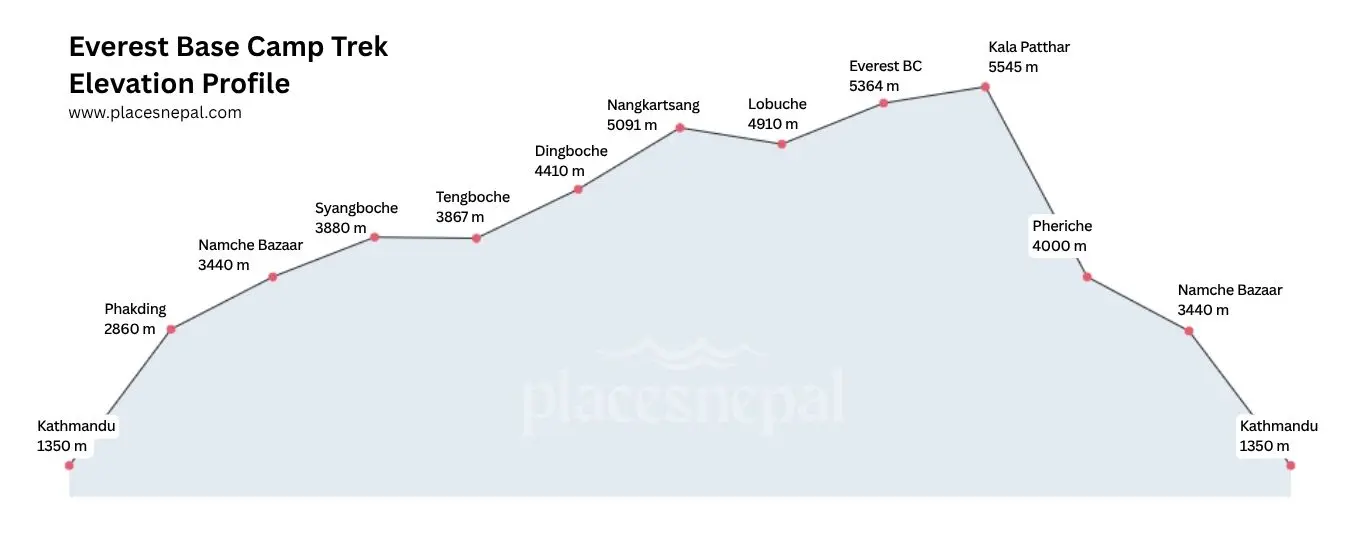 This is a condensed profile of the standard route. For a full day-by-day breakdown of elevation gain and loss, see our dedicated Everest Base Camp elevation and acclimatization guide.
| Location | Elevation | Typical day | Acclimatization note |
|---|
| Kathmandu | 1,350m | Arrival | Comfortable altitude; no acclimatization needed |
| Lukla | 2,840m | Fly in, begin trek | First real altitude exposure |
| Phakding | 2,610m | Day 1 | Slight descent from Lukla; easy first day |
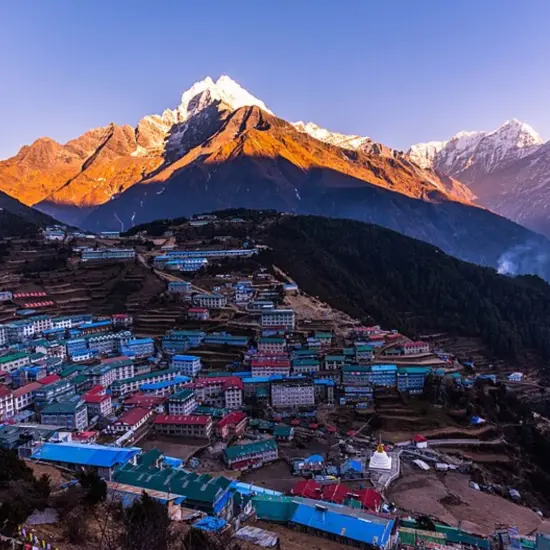
| Namche Bazaar | 3,440m | Day 2–3 | Acclimatization day here — first mandatory rest stop |
| Tengboche | 3,860m | Day 4–5 | Steady climb; monitor for early AMS symptoms |
| Dingboche | 4,410m | Day 6–7 | Second acclimatization day here — critical rest stop |
| Lobuche | 4,940m | Day 8–9 | Symptoms most likely to appear or worsen here |
| Gorak Shep | 5,140m | Day 9–10 | Sleeping altitude for the Base Camp and Kala Patthar push |
| Everest Base Camp | 5,364m | Day 10 | Day visit, not an overnight stop |
| Kala Patthar | 5,545m | Day 10–11 | Highest point most trekkers reach, at dawn |
Two things stand out on this profile. First, the two official acclimatization days — Namche Bazaar and Dingboche — aren't optional extras, they're the structural backbone of a safe itinerary. Second, the steepest risk window is Dingboche through Gorak Shep, where you're sleeping above 4,400m for several nights in a row with less oxygen available to recover overnight.
Why Does Altitude Sickness Happen?
It comes down to oxygen pressure, not fitness. At sea level your lungs are working with roughly 21% oxygen at full atmospheric pressure. At 5,364m, the percentage is the same but the pressure is roughly half, so every breath delivers a fraction of the oxygen molecules your body is used to. Acclimatization — increased breathing rate, elevated heart rate, and over days, more red blood cells — is your body's way of catching up to that deficit.
The problem is that acclimatization takes time, typically measured in days, not hours, and everyone's internal clock for it runs at a slightly different speed. That's the part people find counterintuitive: your acclimatization rate has more to do with individual physiology — something researchers still can't fully predict or test for in advance — than with how many miles you can run at home. Genetics, hydration, sleep quality, and even how quickly you personally produce more red blood cells all play a role, and none of them show up on a fitness test.
Trek the Everest Base Camp Trek
This classic trek takes you through the heart of the Khumbu region, past vibrant Sherpa villages, ancient monasteries, and towering Himalayan peaks.
When Does AMS Usually Begin?
Symptoms can technically start as low as 2,500m, but on the EBC route they typically first appear between Namche Bazaar (3,440m) and Dingboche (4,410m) — which is exactly why those two villages are built into every well-designed itinerary as rest days rather than pass-through stops.
Why Namche Bazaar matters: it's the first point on the trek where you're sleeping above 3,400m, and it's positioned at a natural break before the trail gets noticeably steeper. A day here, often including a short acclimatization hike up to the Everest View Hotel or the Sagarmatha National Park visitor center, follows the "climb high, sleep low" principle — gaining altitude during the day, then returning to sleep at a lower point.
Why Dingboche matters: it's your second sleeping altitude above 4,000m, and it comes right before the push toward Lobuche and Gorak Shep, where oxygen becomes noticeably scarcer. Skipping or shortening this stop is one of the most common — and most avoidable — causes of altitude problems higher up the trail.
Symptoms of Acute Mountain Sickness
Mild Symptoms
| Symptom | What it feels like |
|---|
| Headache | Usually the first and most common sign |
| Fatigue | Tiredness beyond what the day's walking explains |
| Loss of appetite | Food feels unappealing, even favorite meals |
| Mild nausea | Queasiness, not necessarily vomiting |
| Trouble sleeping | Restless or interrupted sleep at altitude |
| Mild dizziness | Slight lightheadedness, especially standing up |
What to do: rest at the same altitude, hydrate, tell your guide, and don't ascend further until symptoms improve.
Moderate Symptoms
| Symptom | What it feels like |
|---|
| Throbbing headache | Doesn't respond well to basic pain relief |
| Vomiting | Not just nausea, but actually being sick |
| Increasing fatigue | Struggling to keep pace even on easy terrain |
| Noticeable dizziness | Affecting balance or coordination slightly |
| Reduced coordination | Slight unsteadiness on flat ground |
What to do: stop ascending immediately. Descent, even a few hundred meters, is often the right call at this stage rather than waiting to see if it passes.
Severe Symptoms
| Symptom | What it feels like |
|---|
| Severe headache | Not relieved by rest or medication |
| Persistent vomiting | Unable to keep fluids down |
| Ataxia | Cannot walk in a straight line — a hallmark HACE warning sign |
| Confusion | Disorientation, unusual behavior, difficulty following conversation |
| Shortness of breath at rest | Breathing heavily while sitting still — a hallmark HAPE warning sign |
| Blue-tinged lips or fingertips | Cyanosis, a sign of dangerously low blood oxygen |
What to do: this is an emergency. Descend immediately, do not wait for morning, and activate evacuation procedures. Any degree of ataxia (inability to walk a straight line, heel-to-toe) is treated as HACE until proven otherwise.
HAPE (High Altitude Pulmonary Edema)
HAPE happens when fluid leaks into the lungs' air sacs, making it progressively harder to get oxygen into the bloodstream — a dangerous spiral, since low oxygen is exactly what's driving the problem in the first place.
Warning signs: breathlessness at rest (not just on exertion), a persistent cough, gurgling or crackling sounds when breathing, chest tightness, extreme fatigue, and in more advanced cases, pink or blood-tinged sputum.
Why rapid descent is non-negotiable: HAPE typically improves quickly once someone descends even 500–1,000m, because lower altitude means more available oxygen and less pressure on the lungs. Waiting to "see if it passes" at the same altitude is the single most dangerous mistake in HAPE cases — supplemental oxygen can buy time, but it is a bridge to descent, not a substitute for it.
HACE (High Altitude Cerebral Edema)
HACE is swelling in brain tissue caused by fluid leakage, and it's the most dangerous altitude condition because it affects judgment — the very thing you'd need to recognize something is wrong.
Warning signs: severe headache unrelieved by rest, confusion, disorientation, hallucinations in advanced cases, and ataxia — a loss of coordination that shows up as an inability to walk heel-to-toe in a straight line. Ataxia is considered the single most reliable field sign of HACE and is checked for specifically by trained guides.
Why immediate evacuation is essential: HACE can progress from mild confusion to unconsciousness within hours. Descent must begin immediately, with the person accompanied at all times — someone with HACE should never be left alone or allowed to continue walking unsupervised, since judgment and coordination are exactly what's compromised.
AMS vs HAPE vs HACE
| AMS | HAPE | HACE |
|---|
| Core symptom | Headache + fatigue/nausea/poor sleep | Breathlessness at rest, cough | Confusion, ataxia |
| Severity | Usually mild, self-limiting with rest | Life-threatening | Life-threatening |
| Onset | Gradual, over hours to a day | Can develop over hours | Can develop over hours, sometimes from worsening AMS |
| Treatment | Rest at same altitude, hydration | Immediate descent, oxygen if available | Immediate descent, oxygen if available, steroids if trained personnel present |
| Urgency | Monitor closely, don't ascend | Emergency — descend now | Emergency — descend now |
| Recommended action | Stop and reassess | Evacuate | Evacuate |
Trek the Everest View Panorama Trek
An easy to moderate yet rewarding journey to Nepal’s most spectacular mountain vistas. Ideal for first-time trekkers, senior citizens, children and family.
How to Prevent Altitude Sickness
- A properly paced itinerary is the single biggest factor. Ascending no more than roughly 300–500m of net sleeping altitude gain per day above 3,000m, with built-in rest days, gives your body time to adjust before the next push.
- Acclimatization days aren't optional. They exist because the data on this route consistently shows AMS clustering right after skipped or shortened rest stops.
- Hydration matters because dehydration mimics and worsens AMS symptoms — you lose more fluid than usual at altitude through faster breathing and drier mountain air, so thirst alone isn't a reliable guide.
- Eating enough, even without much appetite, keeps your body fueled for the increased metabolic demand of both trekking and acclimatizing simultaneously.
- Sleeping well supports the physiological processes your body relies on to adjust — which is part of why disrupted sleep is itself an early AMS symptom worth taking seriously, not dismissing as "just the altitude."
- Avoiding alcohol at altitude is important because it's a respiratory depressant — it slows your breathing exactly when your body needs to breathe faster to compensate for lower oxygen.
- A slow, steady walking pace keeps your body working within a sustainable oxygen demand rather than spiking it, which is why guides often set what feels like an unnecessarily slow pace on the steeper days — it's deliberate, not overly cautious.
- Listening to your guide matters because they're watching for early signs you might dismiss yourself — a guide who's led dozens of groups up this exact route has pattern-recognition you don't have on your first trip.
Acclimatization Days Explained
Namche Bazaar (3,440m): the first mandatory rest day, usually including a hike up toward the Everest View Hotel (around 3,880m) or Khumjung village before returning to sleep in Namche.
Dingboche (4,410m): the second mandatory rest day, often including a hike partway up Nangkartshang Peak for views before descending back to Dingboche to sleep.
Climb high, sleep low: both acclimatization days follow this exact principle — you gain altitude during the day, which stresses your body just enough to trigger adaptation, then return to a lower sleeping altitude, which gives your body a genuine chance to recover overnight. This is more effective than simply staying static at one altitude for a full rest day.
Why skipping these days increases risk: every study on this route we're aware of ties AMS incidence to ascent rate above 3,000m. An itinerary that compresses or removes these two days to save time is, functionally, an itinerary trading your acclimatization margin for a shorter trip — which is exactly why we don't offer compressed versions of this route without those stops built in.
Does Fitness Prevent AMS?
No — and this is the myth we correct most often. Marathon runners, professional athletes, and gym regulars get AMS at rates comparable to less fit trekkers, because cardiovascular fitness and altitude acclimatization are genuinely different physiological processes. Fitness improves how efficiently your body uses the oxygen it has; acclimatization is about how much oxygen your body can extract from thin air in the first place, largely governed by processes — like how quickly you produce additional red blood cells — that training doesn't meaningfully speed up.
What fitness does help with: recovering faster from the physical exertion of trekking itself, carrying a daypack comfortably, and having more reserve capacity if you do need to descend under your own power. It's a real advantage — just not the one people usually assume.
Trek the Everest Base Camp Trek Helicopter Return
Everest Base Camp, Without the Long Walk Back. Reach 5,364m on Foot. Return by Air.
Diamox (Acetazolamide)
Diamox is a prescription medication some doctors recommend for altitude trekking. It works by making the blood slightly more acidic, which stimulates faster, deeper breathing — effectively nudging your body toward the same breathing adaptation it would eventually reach on its own, just sooner.
When doctors may recommend it: commonly discussed for trekkers with a history of AMS, those ascending faster than ideal, or those wanting extra protective margin on a route like this one.
Possible side effects: tingling in fingers and toes, increased urination, and a change in how carbonated drinks taste are the most commonly reported; more significant reactions are possible in people with certain allergies or medical conditions.
Important: Diamox reduces the risk of AMS, it does not eliminate it, and it does not prevent HAPE or HACE. Whether to take it, what dose, and for how long is a decision to make with a doctor familiar with your medical history before you travel — not something to decide based on a blog post or a fellow trekker's recommendation on the trail.
Oxygen on the Trek
Some teahouses and clinics along the route have supplemental oxygen or portable oxygen cylinders available, generally for a fee, and guides on organized treks typically carry emergency oxygen or know exactly where the nearest source is.
Supplemental oxygen can relieve symptoms and buy time in a genuine emergency by improving blood oxygen levels while a descent is arranged.
Emergency oxygen is a bridge, not a fix. This is worth repeating because it's the second-most-common misunderstanding after the fitness myth: oxygen treats the symptom, not the underlying problem of being too high, too fast. Someone with HAPE or HACE who breathes supplemental oxygen but stays at altitude can still deteriorate — descent is what actually resolves the underlying condition.
What To Do If Symptoms Appear
| Symptom stage | Action |
|---|
| Mild (headache, fatigue, poor appetite) | Rest at current altitude, hydrate, tell your guide, do not ascend until improved |
| Worsening (persistent headache, vomiting, increasing dizziness) | Stop ascending entirely, consider descending, guide reassesses continuously |
| Severe (ataxia, confusion, breathlessness at rest, severe headache unrelieved by rest) | Descend immediately, use oxygen if available as a bridge, activate emergency evacuation |
The consistent theme across every stage: informing your guide early changes the entire trajectory. Trekkers who mention a mild headache on day one of symptoms give their guide options — rest, slow down, monitor. Trekkers who push through for two more days before saying anything often remove those options entirely.
Emergency Rescue
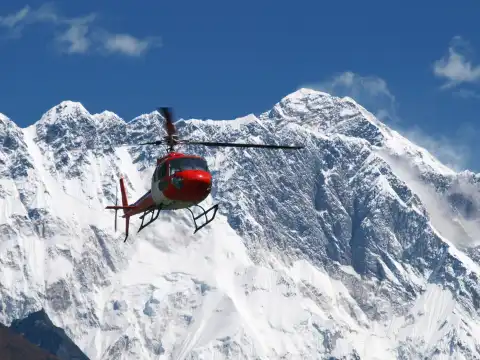
Helicopter evacuation is available throughout the Khumbu and is the standard response for HAPE, HACE, or any altitude emergency that requires rapid descent faster than walking allows. It's expensive without insurance — which is exactly why comprehensive travel insurance covering high-altitude helicopter evacuation up to at least 6,000m is essential, not optional, for this trek.
Medical clinics — notably the Himalayan Rescue Association posts along the route — provide assessment, basic treatment, and evacuation coordination for trekkers experiencing altitude illness.
Guide responsibilities include daily symptom monitoring, making the call to stop or descend even against a trekker's wishes, and coordinating evacuation logistics — this is a core part of what you're paying for with a licensed guide, not an optional add-on.
Communication: guides typically use a combination of mobile signal, radio, and satellite devices to reach rescue coordination, since mobile coverage is inconsistent above Namche Bazaar. For more on staying connected on the route generally, see our Everest Base Camp internet and charging guide. ⚙️ Link live once that page is published.
Weather limitations: helicopters cannot fly in poor visibility or high winds, which is a real constraint at altitude — another reason prevention and early descent on foot matter more than treating rescue as a guaranteed safety net.
How Experienced Guides Reduce Risk
- Daily health assessments — checking in on sleep, appetite, headaches, and general demeanor every morning and evening, not just when someone complains.
- Pace control — deliberately setting a slower pace on ascent days above 3,500m, regardless of how strong the group feels.
- Acclimatization planning — building the itinerary around Namche and Dingboche rest days rather than around the fastest possible schedule.
- Emergency decision-making — having the authority and experience to turn someone around, even if that person disagrees, because guides have seen how quickly moderate symptoms can become severe.
- Local knowledge — knowing exactly where the nearest clinic, oxygen, or evacuation point is at every stage of the route, without needing to look it up.
Common Mistakes Trekkers Make with Altitude
- Ascending too quickly — the single biggest risk factor, and the reason itinerary length matters more than most people initially assume.
- Ignoring a headache — treating it as "just tiredness" delays the point where rest could have prevented it worsening.
- Skipping or shortening acclimatization days to save time, trading safety margin for schedule.
- Drinking alcohol at altitude, which suppresses breathing exactly when your body needs to breathe more.
- Not drinking enough water, letting dehydration mask or mimic AMS symptoms.
- Taking early symptoms lightly because they feel like normal trek fatigue rather than a warning sign.
- Continuing to ascend despite worsening symptoms, hoping they'll pass on their own.
- Sleeping at a higher altitude despite symptoms, ignoring the "climb high, sleep low" principle in reverse.
- Not telling the guide about symptoms, out of embarrassment or a desire not to slow the group down.
- Assuming fitness is protection, and pushing pace based on how strong you feel rather than your actual acclimatization.
- Self-medicating with painkillers to mask a headache without telling anyone, hiding a warning sign from the person best placed to act on it.
- Traveling without altitude-rated travel insurance, discovering the coverage gap only during an actual emergency.
- Skipping meals due to appetite loss instead of eating smaller, easier portions to maintain energy.
- Comparing yourself to other trekkers' acclimatization speed, when individual response varies enormously and isn't a fair benchmark.
- Taking Diamox without medical advice, without understanding dosage, timing, or side effects.
- Assuming oxygen solves the problem, staying at altitude because symptoms improved temporarily with a cylinder.
- Underestimating Dingboche to Gorak Shep, the steepest risk window on the route, by treating it like any other stretch.
- Not packing warm enough layers for acclimatization hikes, discouraging trekkers from actually doing the "climb high" portion properly.
- Rushing to Kala Patthar at the very top of the trip when already fatigued, rather than assessing how the body is doing that morning.
- Choosing the cheapest, fastest possible itinerary without checking whether it actually includes both acclimatization days at appropriate points.
Expert Tips from Guides Who Manage Altitude on This Route Every Season
- Report symptoms the moment they start, not once they've become hard to ignore.
- Treat both acclimatization days as sacred, not optional — actually do the "climb high" hike rather than resting in bed.
- Drink more water than feels necessary; thirst lags behind actual need at altitude.
- Eat something at every meal even without appetite — small portions, but consistent.
- Avoid alcohol entirely above 3,000m, not just "in moderation."
- Walk slower than feels natural on ascent days above 3,500m — your guide's pace is deliberate.
- Sleep as early and as consistently as possible; disrupted sleep both signals and worsens AMS.
- Pack a pulse oximeter if you want objective data, but use it to inform your guide's judgment, not replace it.
- Discuss Diamox with a travel medicine doctor weeks before departure, not the night before you fly.
- Choose an itinerary with both acclimatization days clearly marked, not just a shorter total trip length.
- Learn the ataxia test (walking heel-to-toe in a straight line) before you go, so you recognize it if it matters.
- Carry comprehensive travel insurance with helicopter evacuation coverage to at least 6,000m — verify this specifically, not just "adventure sports" coverage generally.
- Keep hands and feet warm; cold stress adds to your body's overall physiological load during acclimatization.
- Don't compare your symptoms to your trekking partner's — individual acclimatization genuinely varies this much.
- If in doubt, descend — a wasted descent costs a day; an ignored HAPE or HACE case costs far more.
- Bring your own basic first aid and any personal medications, since pharmacy access is limited above Namche.
- Avoid sleeping pills at altitude unless specifically cleared by a doctor — they can mask breathing changes.
- Trust your guide's decision to turn back, even if you feel capable of continuing — they're watching for signs you can't see in yourself.
- Take rest days seriously as rest, not as an excuse to push a side hike too hard.
- Journal your symptoms daily, even mild ones — patterns are easier to spot in writing than in memory.
- Layer clothing appropriately for acclimatization hikes so cold doesn't discourage you from doing them properly.
- Ask your guide directly each evening: "Is there anything about my symptoms today I should be worried about?"
- Don't rely solely on over-the-counter painkillers to manage a worsening headache — treat it as information, not just discomfort to suppress.
- If trekking with a group, agree in advance that anyone can call for a pace change without judgment.
- Remember that turning back is a sign of good judgment, not failure — most trekkers who descend early for symptoms return in later years and succeed with a better-paced plan.
Myths vs Facts
| Myth | Fact |
|---|
| Only unfit people get AMS. | Fitness and acclimatization are different processes; fit trekkers get AMS at similar rates to less fit ones. |
| Diamox prevents all altitude sickness. | Diamox reduces risk and eases the acclimatization process, but does not eliminate AMS and does not prevent HAPE or HACE. |
| Oxygen completely solves altitude problems. | Oxygen relieves symptoms and buys time, but descent is what actually resolves HAPE and HACE. |
| Young people don't get AMS. | Age isn't a reliable predictor; healthy young adults get AMS at comparable rates to older trekkers. |
| You can "push through" symptoms. | Pushing through worsening AMS is the primary pathway toward HAPE and HACE — it's the opposite of safe. |
| If you didn't get AMS before, you won't this time. | Previous trips without symptoms don't guarantee the same result; acclimatization can vary trip to trip. |
| Drinking lots of water prevents AMS entirely. | Hydration helps and dehydration worsens symptoms, but water alone doesn't prevent AMS. |
| A headache at altitude is always just dehydration. | It might be — but at altitude, a headache is treated as a possible AMS symptom first, not dismissed automatically. |
Frequently Asked Questions
Will I get altitude sickness on the Everest Base Camp Trek? Possibly — mild symptoms affect a substantial share of trekkers on this route, most commonly a headache in the days after Namche Bazaar. Most cases stay mild with a properly paced itinerary.
How common is AMS on this trek? Published research on the EBC route reports mild AMS symptoms in roughly a third to over half of trekkers, depending on the study and itinerary pace; severe cases (HAPE/HACE) are far less common.
At what altitude does altitude sickness begin? Symptoms can technically start around 2,500m, though on this route they most commonly first appear between Namche Bazaar (3,440m) and Dingboche (4,410m).
What are the first symptoms of AMS? Usually a headache, along with fatigue, reduced appetite, mild nausea, or trouble sleeping.
How dangerous is altitude sickness? Mild AMS is uncomfortable but not itself dangerous if you stop ascending. HAPE and HACE are medical emergencies requiring immediate descent.
Can altitude sickness be prevented? Risk can be significantly reduced through a gradual itinerary, proper acclimatization days, hydration, avoiding alcohol, and honest symptom reporting — though no method guarantees prevention entirely.
Does Diamox actually work? It reduces AMS risk for many trekkers by encouraging faster breathing adaptation, but it isn't a guarantee and doesn't replace proper acclimatization. Discuss it with a doctor before your trip.
Should I carry my own oxygen? Most trekkers don't need to; guided treks typically have access to emergency oxygen, and portable cylinders are available at some points along the route for a fee.
Is fitness enough to avoid AMS? No. Fitness helps with physical endurance but doesn't meaningfully speed up altitude acclimatization, which is a separate physiological process.
How do guides monitor trekkers for AMS? Through daily check-ins on sleep, appetite, headaches, and general condition, plus close observation during the trekking day itself.
What happens if my symptoms get worse? Ascent stops immediately, and depending on severity, your guide may recommend descending to a lower altitude to recover.
What is helicopter rescue like on this trek? It's a well-established emergency response throughout the Khumbu, weather-permitting, and is the standard for evacuating trekkers with HAPE, HACE, or other serious altitude emergencies.
Can older adults complete this trek safely? Age alone isn't a reliable predictor of altitude sickness risk; many older trekkers complete the route successfully with proper preparation and pacing. A pre-trip medical check is a sensible precaution regardless of age.
Can beginners safely trek to Everest Base Camp? Yes, with a well-paced itinerary and a good guide — this trek doesn't require technical climbing skill, and altitude risk is managed primarily through pacing rather than fitness or experience level.
What is HAPE? High Altitude Pulmonary Edema — fluid buildup in the lungs that causes breathlessness at rest and requires immediate descent.
What is HACE? High Altitude Cerebral Edema — brain swelling that causes confusion and loss of coordination (ataxia) and requires immediate descent.
How is HACE diagnosed in the field? Primarily through the ataxia test — asking someone to walk heel-to-toe in a straight line. Inability to do so is treated as HACE until proven otherwise.
Is a headache at altitude always AMS? Not necessarily — dehydration, sun exposure, or poor sleep can also cause headaches — but at altitude, any headache is treated as a possible AMS symptom until it resolves with rest and hydration.
Can children get altitude sickness? Yes, children can develop AMS, and this route is generally not recommended for very young children given the altitude and remoteness involved.
Does previous trekking experience at altitude help? Some prior high-altitude exposure can help your body respond, but it isn't a guarantee against AMS on a subsequent trip.
What should I pack specifically for altitude management? Comprehensive travel insurance with high-altitude evacuation coverage, any personally prescribed medications, and warm layers for the acclimatization hikes.
Can I take ibuprofen or paracetamol for an altitude headache? Basic pain relief can ease a mild headache, but it should be treated as symptom management, not a reason to ignore worsening symptoms or continue ascending.
Is it normal to lose my appetite at altitude? Yes, this is a common and usually mild symptom, though it's still important to eat what you can to maintain energy for both trekking and acclimatizing.
How long does it take to acclimatize? Individual timelines vary, which is exactly why itineraries build in rest days rather than a fixed number of hours or days per person.
Can I skip the Dingboche acclimatization day if I feel fine? We don't recommend it — feeling fine at Dingboche doesn't guarantee you'll stay fine at Lobuche or Gorak Shep, and the rest day exists precisely for that transition.
What's the difference between AMS and normal trekking fatigue? Fatigue plus a headache, appetite loss, or sleep trouble specifically at altitude — especially appearing or worsening after a gain in sleeping altitude — points toward AMS rather than ordinary tiredness.
Do all trekking companies handle altitude risk the same way? No — itinerary length, number of acclimatization days, and guide training vary significantly between operators, which is worth checking closely when comparing trek packages.
Is travel insurance really necessary for this trek? Yes. Comprehensive coverage including helicopter evacuation up to at least 6,000m is essential given the remoteness of the route and the cost of emergency evacuation without it.
Can I use a pulse oximeter to monitor myself? Yes, many trekkers do, and it can provide useful objective data — but use it alongside your guide's assessment and how you actually feel, not as a replacement for either.
What's the single most important thing I can do to avoid altitude sickness? Choose an itinerary with proper acclimatization days built in, and be honest with your guide the moment you notice any symptom, however minor it seems.
Can altitude sickness happen on the way down too? AMS itself typically resolves with descent, but general fatigue and dehydration can persist — it's still important to eat, hydrate, and rest properly during the descent.
Will everyone in my group get AMS at the same rate? No — individual response varies significantly, and it's common for some trekkers in a group to feel symptoms while others don't, regardless of fitness or age.
Everest Trek Alternatives Based on Your Altitude Experience
Not every trekker wants — or should attempt — the full altitude exposure of the classic Everest Base Camp route, and that's a completely reasonable thing to plan around rather than push through. If you're managing a known sensitivity to altitude, traveling with family members who prefer lower elevations, short on time, or simply want to test how your body handles the Himalayas before committing to a longer high-altitude trip, several Everest-region alternatives offer a genuine mountain experience with meaningfully different altitude profiles.
The Everest View Panorama Trek is the lowest-altitude option on this list, designed specifically for trekkers who want to see Everest up close — including from the famous Everest View Hotel — without spending multiple nights above 4,000m. It's a strong fit for beginners, families, older travelers, or anyone who wants the visual reward of the Khumbu without the extended altitude exposure of the full route to Base Camp.
If you want to reach Everest Base Camp itself but are conscious of time or want to reduce the physical toll of a multi-day descent, the Everest Base Camp Trek with Helicopter Return flies you back to Kathmandu after reaching camp rather than walking back down. It's worth being clear-eyed about one thing: this itinerary still requires you to ascend to full Base Camp altitude on foot with proper acclimatization along the way — the helicopter shortens the descent, not the altitude exposure you experience getting there.
For trekkers on the opposite end of the experience spectrum, the Everest Three Passes Trek pushes higher and stays at altitude longer than the classic route, crossing three demanding high passes. This is a trek for experienced high-altitude trekkers with excellent acclimatization discipline, not a first Himalayan trip.
The Gokyo Lakes with Everest Base Camp Trek combines the classic route with the turquoise Gokyo Lakes and the Gokyo Ri viewpoint, offering quieter trails than the main EBC corridor along with the same Base Camp finish. It's more demanding in both distance and altitude days than the standard route, so it suits trekkers who already feel confident about how their body handles extended time above 4,000m.
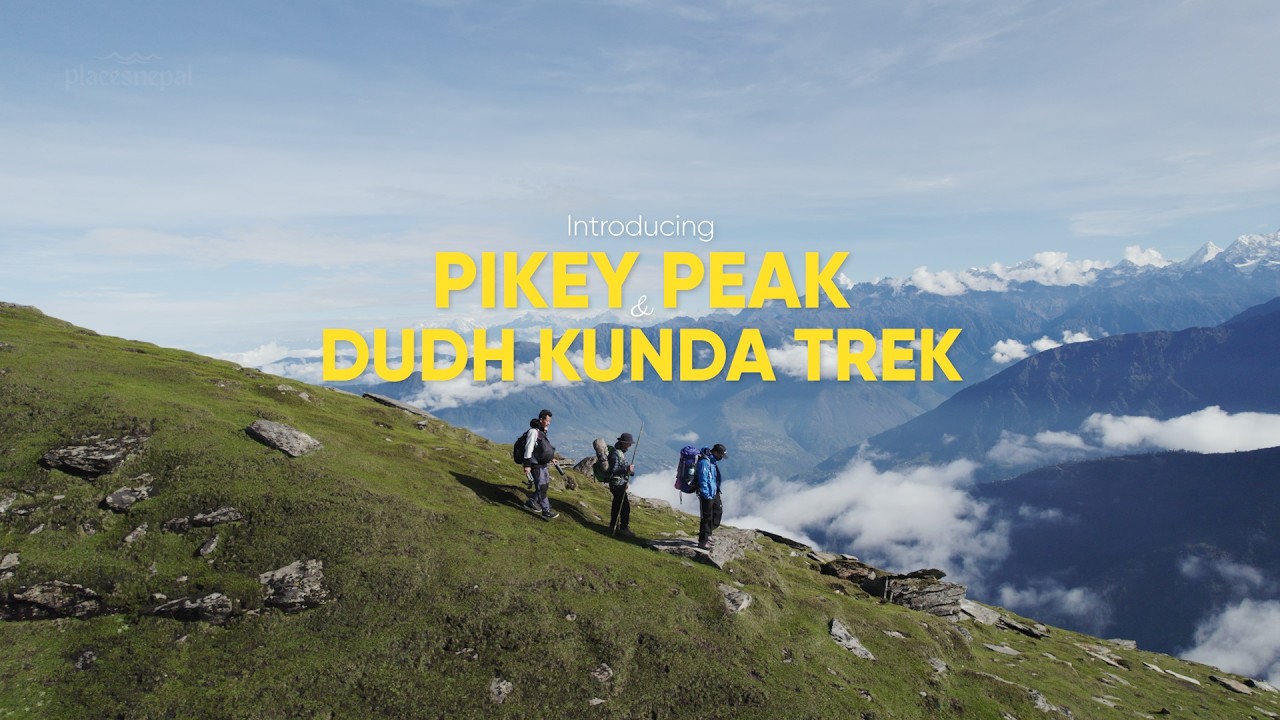
Finally, the Pikey Peak Trek is one of the best lower-altitude alternatives in the wider Everest region — genuinely spectacular Himalayan panoramas, including Everest itself, without the sustained high-altitude exposure of the main trail. For travelers with limited time or a lower risk tolerance for altitude, it's a strong way to experience this part of Nepal.
| Trek | Maximum Altitude | Difficulty | Best For | Why Choose It |
|---|
| Everest View Panorama Trek | 3,880m | Easy | Beginners, families, older travelers | Everest views with minimal altitude risk |
| Pikey Peak Trek | 4,065m | Easy–Moderate | Limited time, lower risk tolerance | Big Himalayan views at lower altitude |
| Everest Base Camp Trek | 5,364m | Moderate–Challenging | First-time high-altitude trekkers | The classic, well-supported route |
| Everest Base Camp Trek with Helicopter Return | 5,364m | Moderate–Challenging | Time-limited trekkers wanting a shorter descent | Same altitude exposure, faster return |
| Gokyo Lakes with Everest Base Camp Trek | 5,483m (Gokyo Ri) | Challenging | Trekkers confident with extended altitude days | Quieter trails, glacial lakes, plus Base Camp |
| Everest Three Passes Trek | 5,535m (Kongma La) | Very Challenging | Experienced high-altitude trekkers | The most demanding classic Everest-region route |
Whichever route fits your experience and comfort level, the same rule applies across all of them: a well-paced itinerary and honest communication with your guide matter more than raw fitness. Compare these options against your available time, prior altitude experience, and how much high-altitude exposure you're genuinely looking for before booking.
Trek the Everest Base Camp Trek
This classic trek takes you through the heart of the Khumbu region, past vibrant Sherpa villages, ancient monasteries, and towering Himalayan peaks.
Conclusion
Altitude sickness on the Everest Base Camp Trek is common, well understood, and — for the overwhelming majority of trekkers — manageable with the right preparation. A properly paced itinerary with real acclimatization days at Namche Bazaar and Dingboche, honest and early symptom reporting, and an experienced guide willing to make the call to slow down or descend are what actually keep people safe on this route, far more than fitness level or trekking experience alone.
The goal isn't to eliminate risk entirely — that's not realistic on a route that climbs to 5,364m — it's to manage it well, recognize the difference between normal discomfort and a genuine warning sign, and know exactly what to do in either case. Most trekkers who prepare properly and trek with an operator who takes acclimatization seriously reach Everest Base Camp and come home with nothing worse than a good story about a headache in Dingboche.
If you're ready to plan a trek built around proper acclimatization from the ground up, our Everest Base Camp Trek page has the full itinerary, and our guides are happy to answer any altitude-specific questions before you book.
Trek the Everest Base Camp Trek
This classic trek takes you through the heart of the Khumbu region, past vibrant Sherpa villages, ancient monasteries, and towering Himalayan peaks.