A practical Annapurna Circuit Trek training plan built around the current 10-day route: hiking endurance, leg strength, downhill preparation and back-to-back walking days — so Thorong La feels demanding, not devastating.
Most people preparing for the Annapurna Circuit ask the wrong first question. They ask "how fit do I need to be?" as if there's a finish line — some 10 km time or gym number that separates the ready from the unready. There's no such line. What there is, is a shape: six walking days, one acclimatization day, three transport days, and a single very long morning at 5,416 m. Train for that shape, and the trek becomes demanding but very doable. Train generically, and you'll be the trekker resting every ten minutes on the climb out of Dharapani.
This guide is built around the current Places Nepal 10-day Annapurna Circuit itinerary — the one that drives Kathmandu to Dharapani on Day 1 and walks from there to Muktinath. Every training recommendation below comes from the actual walking profile of that route, not from a generic fitness template.
How fit do you actually need to be for the Annapurna Circuit?
Let's answer the question directly, because it's simpler than most people expect.
You do not need to be a runner. You do not need a marathon base, a gym membership, or the ability to do anything impressive on a fitness test. The Annapurna Circuit is a non-technical walking route — no ropes, no glacier travel, no climbing skills anywhere on it. Nobody will ever ask you to lift anything heavier than your daypack.
What you do need is reliability. A reasonably prepared trekker on this itinerary should be able to:
- Walk continuously for five to seven hours, most of it on trails rather than pavement
- Climb steadily uphill for an hour or more without stopping every few minutes
- Walk downhill for a long time — over an hour — with control, on tired legs
- Handle uneven, rocky, occasionally loose ground without wobbling
- Carry a loaded daypack (roughly 6–8 kg) for a full walking day
- Do all of the above on consecutive days, recovering reasonably well overnight
- Keep doing it as the air gets thinner above Manang
That's the whole list. Notice what isn't on it: speed. Nobody walks fast on the Annapurna Circuit, and the trekkers who try usually pay for it above 4,000 m. What the circuit rewards is the ability to keep moving at a steady, unglamorous pace — day after day, including the day after your legs are already tired. 
The route tells you how to train
Here's something most training guides skip entirely: the current 10-day itinerary has a very specific physical rhythm, and your training should copy it.
The walking portion runs from Dharapani (1,860 m) like this:
|
2 | Dharapani → Chame | ~15 km | 5–6 hrs |
3 | Chame → Pisang | ~16 km | 5–6 hrs |
4 | Pisang → Manang | ~15 km | 5–6 hrs |
5 | Acclimatization in Manang (optional 3–5 hr hike) | — | — |
6 | Manang → Yak Kharka | ~8 km | 3–4 hrs |
7 | Yak Kharka → Thorong Phedi / High Camp | ~8 km | 3–5 hrs |
8 | Thorong La (5,416 m) → Muktinath → Jomsom | ~17 km | 7–9 hrs |
Look at the shape. The first three trekking days are long, steady, valley-climbing days of 15–16 km each — around 46 km in total before Manang. Then the route deliberately shortens: 8 km to Yak Kharka, 8 km to Thorong Phedi or High Camp, because above 4,000 m the altitude does the work that distance used to do. Then comes the big one — pass day, roughly 17 km and 7–9 hours door to door.
So the trek is not "walk 15 km every day." It's this:
Long steady days → shorter high-altitude days → one very long pass day.
Roughly 79 km of actual walking over six trekking days, averaging about 13 km a day — but the average is meaningless. Nobody walks the average. You walk the shape. And that shape should determine your training plan: build endurance for the long valley days, leg strength for the climbing, downhill control for the descent off the pass, and — the part almost everyone under-trains — the ability to do it all again the next morning. For the full day-by-day breakdown, see our Annapurna Circuit itinerary guide and our distance breakdown.
What actually needs training?
Strip away the fitness jargon and the Annapurna Circuit asks your body for four things.
Walking endurance. The ability to keep moving for hours without falling apart — not at speed, just continuously. Day 2 through Day 4 are each 5–6 hours of steady walking, and there's no opt-out helicopter waiting at Chame.
Uphill strength. Days 2 and 3 each pack around 700 m of climbing into those 15–16 km — sustained grades for a long time, not a sharp hill sprint. You need legs that can climb steadily for an hour or more, over and over.
Downhill strength. This is the one people skip, and it's half the trek. The descent off Thorong La alone drops 1,616 m to Muktinath — the biggest single-day descent on any of our treks, and the reason most pass-day problems happen on the way down, not the way up. Walking downhill is not "resting after the climb." It's a different demand on your legs, mostly the quadriceps, and it needs its own preparation.
Recovery. The ability to wake up the morning after a hard day and walk again. The itinerary has exactly one full rest day in ten. Your fitness at home matters less than your recovery on the trail — and recovery is trainable, mostly by practicing back-to-back walking days before you fly.
Underneath those four sit the supporting cast: balance and ankle stability for rocky sections like the Ledar traverse on Day 7, core strength for carrying a pack hour after hour, and general pack tolerance. Don't treat these as separate gym goals. They're all parts of the same ability — being steady and durable on your feet for a long time.
Walking is the most specific training you can do
If you only have time for one kind of training, walk. Hike, specifically — outside, on real ground, ideally with hills.
Nothing else teaches your body what trekking actually involves: hours on your feet, uneven terrain underfoot, climbing, descending, pacing yourself, managing a pack, dealing with weather, and — the part nobody talks about — the mental tolerance for long, steady, uneventful effort. An hour on a stair machine raises your heart rate. A five-hour hike teaches your feet, your ankles, your hips, your shoulders under a pack, and your head.
Running, cycling, and gym work all help (more on each below), but they support hiking; they don't replace it. This is worth being blunt about: a fit runner who has never walked downhill for two hours with a pack is less prepared for the far side of Thorong La than a moderate walker who hikes every weekend. If you're preparing for Annapurna from a base of regular hiking, you're already most of the way there.
The 8-week Annapurna Circuit training plan
Eight weeks is the sweet spot for most people: long enough to build real, specific fitness, short enough that life doesn't get in the way. This plan assumes a reasonable baseline — you can walk for an hour or two comfortably right now. If you're starting from a lower base, use the 12-week version below.
A note on structure before the weeks start: the plan builds in phases, not isolated workouts. Each phase adds one new demand — consistency, then hills, then trekking-specific volume, then a peak, then rest. Don't jump ahead. The most common way people ruin a training block is doing too much, too soon, and arriving in Nepal with a niggle instead of fitness. 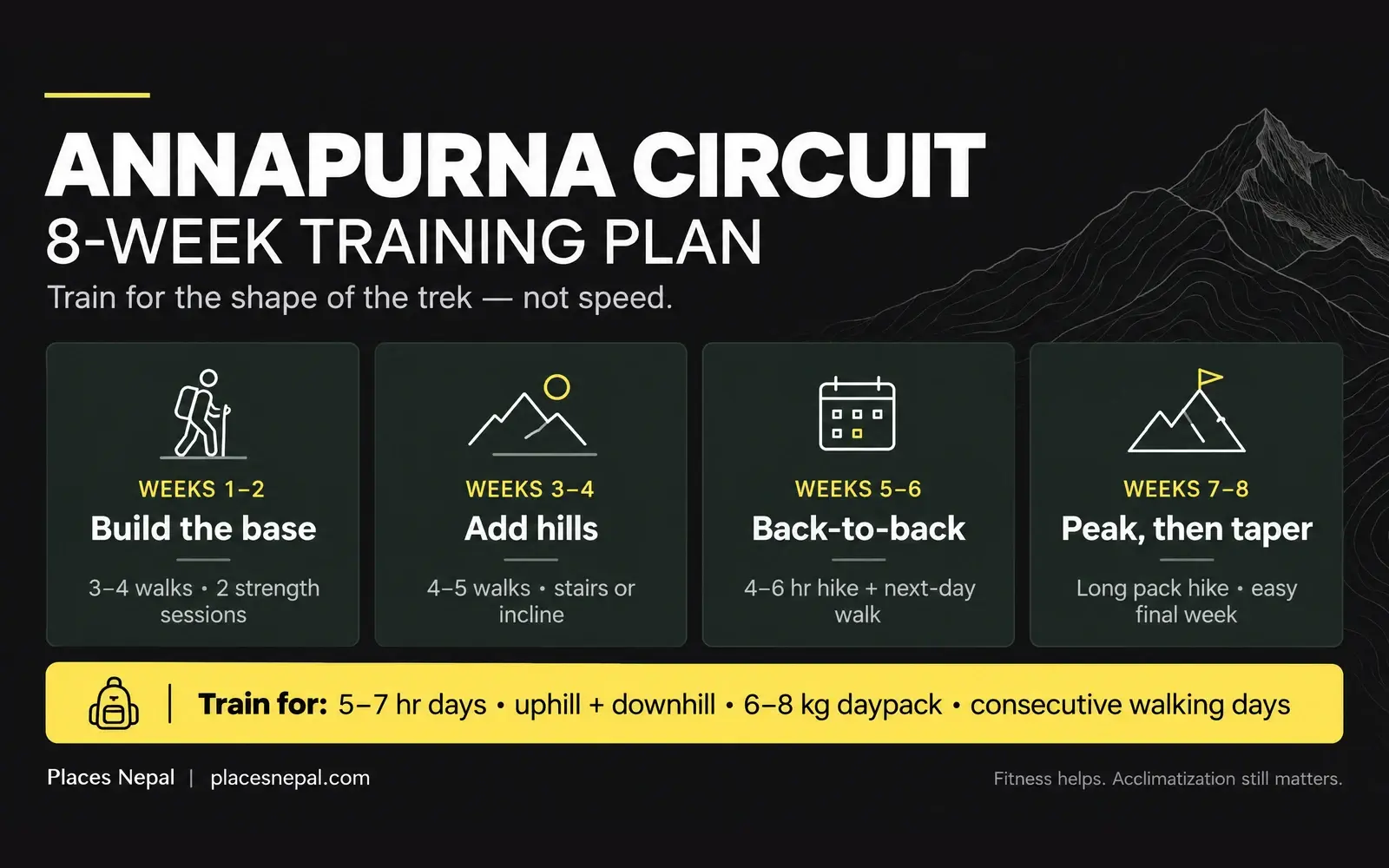
Weeks 1–2: Build consistency
The goal here is simple: make regular exercise normal again. Nothing heroic.
A typical week:
- 2 strength sessions (see the strength section below — 30–40 minutes each is fine)
- 2 easy or moderate cardio or walking sessions of 45–60 minutes
- 1 longer walk or hike of 2–3 hours, comfortable pace, flat-ish ground is fine
- 1 optional recovery activity — easy swim, gentle cycle, yoga
- 1 full rest day
The long walk should feel comfortable, not like a test. You're building the habit of being on your feet, not proving anything. If you're already active — you run, cycle, or hike regularly — you can start two weeks ahead of this schedule: begin with hills in Week 1 rather than waiting until Week 3.
Weeks 3–4: Add hills
Now the training starts to look like the trek.
Introduce uphill work in whatever form your geography allows: actual hills, stairs, an incline treadmill, or repeated step-ups. Add one weekly session of sustained climbing — 30–45 minutes of uphill effort at a moderate, conversational pace. Extend the weekend walk to 3–4 hours and, where possible, make it hilly.
This is also the time to start practicing controlled descents. Downhill walking is a skill — short strides, soft knees, letting your legs absorb rather than fight the slope. Most importantly, add your first back-to-back weekend:
Saturday: longer hilly hike, 3–4 hours
Sunday: shorter easy walk, 1–2 hours
The Sunday walk isn't training volume for its own sake. It's there to teach you how your legs feel on day two — which is exactly what Days 3, 4, 6, and 7 of the trek will ask of you.
Weeks 5–6: Trek-specific training
This is the main preparation phase, where the training starts resembling the trek itself.
Prioritize longer hikes — 4–6 hours — with sustained climbing and sustained descending, on uneven trail where you can find it. Wear the daypack you'll actually carry in Nepal, loaded with 5–6 kg. Keep the two weekly strength sessions going. Most weekends should now be back-to-back:
Saturday: long steady hike, 4–6 hours, hills, loaded pack
Sunday: moderate hike, 2–4 hours, on tired legs
One weekend in this phase should be your most trekking-like rehearsal: a full day on your feet on Saturday, then a deliberately planned second day Sunday, walking the kind of distance you'd walk on the trek while honestly tired. Do not turn this into a race or a personal-record attempt. The goal is familiarity — you want the feeling of "legs like this, walk anyway" to be something you've met before, in your own hills, not something you discover for the first time at 4,000 m.
Week 7: Peak preparation
The most specific week of the block. One long hiking day — five to six-plus hours, hilly, in the boots you'll wear in Nepal, with your realistic daypack weight — followed the next day by a moderate two-to-three-hour hike.
Everything about this week is about the details that make or break a trekking day:
- Time on feet, not speed
- Climbing and descending under control
- Your pack fitted and loaded realistically
- Footwear, socks, and blister management tested
- How you eat and drink during a long day
- How you feel the morning after
Resist the urge to attempt some enormous "Thorong La simulation." You can't recreate 5,416 m at sea level by making a workout longer, and a heroic 40 km weekend mostly teaches you that your knees hurt. What you're building is the confidence of having done the pieces.
Week 8: Taper
Cut the volume roughly in half. Keep moving — easy walking, light strength work, mobility, normal daily activity — but stop building. No very long hikes. No exhausting leg sessions. No last-minute fitness tests, and no aggressive attempts to lose weight before you fly.
The goal of this week is to arrive in Nepal fresh, not to squeeze out one final week of gains. Fitness you build in the final seven days is negligible; fatigue you carry into Day 2 is real.
The 12-week version: more gradual, not harder
If you have three months, don't just stretch the 8-week plan — use the extra time the way it works best: slower progression and better recovery.
Weeks 1–4: General fitness and consistency. Establish the weekly rhythm: two strength sessions, two or three cardio or walking sessions, one longer weekend walk that grows from 2 hours to 3–4. Altitude fitness is built on an enormous base of ordinary fitness. This phase is that base.
Weeks 5–8: Mountain-specific strength and endurance. Now add hills, stairs, or incline work weekly. Weekend hikes grow to 4–6 hours with real elevation change. Start pack training and downhill practice. By the end of this phase, a hilly four-hour hike with a loaded pack should feel normal, not notable.
Weeks 9–10: Back-to-back trekking weekends. Two weekends in a row of the Saturday-plus-Sunday pattern: long steady day, then moderate day on tired legs. These two weekends teach your body the single most important lesson of the trek — recovery overnight is part of the fitness.
Weeks 11–12: Peak, then taper. One peak week (longest hike plus moderate follow-up day), then a full taper week.
The benefit of 12 weeks isn't harder training. It's that every increase is smaller, every adaptation has time to settle, and you arrive with months of consistency behind you rather than a heroic final month. If you have the time, this is the version we'd quietly recommend.
Is 4 weeks enough to train for the Annapurna Circuit?
Honestly: four weeks can meaningfully improve your starting point, but you can't manufacture months of endurance in a month. If your trek is four weeks away, that's the reality — work with it rather than pretending otherwise.
With four weeks, prioritize:
- Frequent walking. Four to five walking sessions a week, mostly easy, some hilly. Frequency beats intensity at this stage.
- Hills or stairs twice a week. Sustained, controlled efforts — 30–45 minutes.
- Two strength sessions a week. Legs and core, moderate weights, good technique.
- A long weekend walk every week. Build from 2–3 hours to 4–5 over the four weeks.
- Gradual pack exposure. Start with 3–4 kg, work toward your realistic daypack weight.
- Sleep and recovery. More important now than any workout. You're consolidating, not cramming.
What not to do: don't train hard every day, don't try to "make up" for lost months, and don't judge the plan by how destroyed you feel — that's fatigue, not fitness. Four honest weeks of the above will take you from underprepared to reasonably prepared. What it won't do is turn a sedentary year into a trained one, and no honest guide should promise otherwise. If your base is genuinely low, the better lever may be a longer itinerary with more acclimatization margin — something we can adjust — rather than a crash program.
What if I have only two weeks?
Then the priority changes completely. With two weeks, you are not building fitness — you're activating what you have and arriving in one piece.
Walk consistently — every day if possible, 45–90 minutes, with hills or stairs mixed in. Do two moderate strength sessions a week. Take one longer weekend walk. Above all, avoid injury: no new exercises, no heroic distances, nothing that leaves you limping. Someone starting from very low fitness cannot safely solve years of inactivity in two weeks of hard exercise, and trying to is how people fly to Nepal with a pulled calf.
If this describes you, be honest with yourself about pacing on the trek, and consider the longer itinerary variants — an extra acclimatization day changes the trip more than two weeks of panic training ever will.
Strength training for the Annapurna Circuit
You don't need a bodybuilding program. You need a handful of movements that resemble what trekking actually asks of your legs and trunk, done consistently, with good technique. Two sessions a week, 30–40 minutes, is genuinely enough.
Step-ups. The single most trekking-specific exercise there is — repeated uphill movement, one leg at a time. Use a box, bench, or stair. Start bodyweight, add your daypack as you progress.
Squats. General leg strength for climbing and for everything else. Bodyweight squats are fine; holding a weight is better as you progress.
Split squats. Single-leg strength and balance together — exactly what rocky trail demands. If you do one unilateral exercise, make it this one.
Reverse lunges. Leg control and stability, particularly useful for uneven ground and stepping down.
Calf raises. Lower-leg endurance for long days and for the continuous small adjustments of rough trail. High reps, controlled tempo.
Romanian deadlifts. Posterior-chain strength — glutes and hamstrings — which does a large share of the work on descents. A kettlebell or two dumbbells at home is plenty; you don't need a barbell.
Step-downs. The downhill counterpart of step-ups: stand on a box or step, lower one foot to the floor slowly, control the return. These teach the eccentric leg strength that long descents demand — more on why that matters below.
Planks and anti-rotation work. Your core's job on the trek isn't visible; it's holding you stable hour after hour while a pack shifts your center of gravity. Side planks, dead bugs, Pallof presses — pick two and be consistent.
One principle matters more than any specific exercise: consistency and technique beat weight. Don't chase numbers in the gym. Chase the version of these movements you can still do well when tired.
Why downhill training matters more than you think
If this article leaves you with one training habit, make it this one: train for the descents.
Trekkers almost always train for climbing. Climbing feels like the hard part, it's what gets your heart rate up, and it's psychologically the "uphill battle." So people stair-climb, hill-repeat, and incline-treadmill their way to strong uphill legs, and then they arrive at the top of Thorong La and discover the day is only half over.
The descent to Muktinath drops 1,616 m. That's more vertical loss in one day than most people descend in a season of hiking — and it comes at the exact moment you're most depleted, after hours of climbing at over 5,000 m, often on loose, uneven ground, with your heart already tired. Downhill walking places a sustained eccentric load on the quadriceps — your muscles working while lengthening — which is precisely the contraction they get least of in normal life and most of on pass day. Untrained, your legs will start to shake somewhere above Muktinath. Trained, you'll walk down with control and still be standing at dinner.
Practical downhill training:
- Step-downs (from the strength section) twice a week
- Stairs — walk down as deliberately as you walk up
- Downhill hiking — seek descents on your training hikes and walk them with intent: short strides, controlled tempo, no pounding
- Split squats and Romanian deadlifts for the underlying eccentric strength
- Gradually longer descents in the final weeks, so the load builds progressively
We won't make medical promises about knee injuries — but we will say this from years of watching trekkers on this route: the people who struggle on Day 8 are almost never the slowest on the climb up. They're the ones who didn't know the descent was coming.
Stair training: the city trekker's best friend
Most of the world's trekkers don't live near mountains. If that's you, stairs are your most accessible training tool, and they're genuinely good — not a consolation prize.
Stairs train the two things this trek demands most: repeated climbing and controlled descent. Almost everything the first half of the itinerary asks for, a stairwell can approximate.
Options:
- A building stairwell. Thirty to forty-five minutes of continuous, controlled laps. Walk up at a steady pace; walk down with the same attention you'd give a trail descent.
- A step machine. Set a moderate pace you can sustain and hold it for 30–60 minutes. Resist the urge to crank the speed — the trek rewards sustained moderate effort, not bursts.
- Step-ups. On a bench, box, or bottom stair, alternating legs, at a slow and steady tempo. Add your daypack as weeks pass.
- Stadium stairs or any long public staircase, if you're lucky enough to have one.
The one thing not to do: don't sprint. The goal is sustained, controlled work at a pace you could hold a conversation at — because that's exactly the pace you'll need between Dharapani and Manang.
Incline treadmill training
An incline treadmill is a legitimate hill substitute, and for flat-country trekkers it's often the most practical one. A few principles make it work:
- Walk, don't run. The trek is a walking event. Treadmill walking on a meaningful incline is more specific than running flat.
- Use a gradual incline. Start where you can maintain a steady effort for 30–45 minutes and build from there. There's no magic number — your breathing and legs, not the display, set the workload.
- Sustain the effort. The useful session is 30–60 minutes of steady moderate work, occasionally a longer one. Intervals and speed work have little place in Annapurna preparation.
- Walk the cooldown downhill. Set a decline for the final five to ten minutes and practice controlled descent. Treadmill descents are gentle, but they keep the downhill pattern in your legs.
- Add your pack in the final weeks. A weighted vest or daypack makes treadmill time noticeably more trekking-like.
Be clear about what this is: a substitute for terrain, not a copy of it. The treadmill gives you the climbing stimulus; it can't give you uneven ground, real descents, or five straight hours on your feet. Pair it with long weekend walks outside and it does real work. Rely on it alone and you'll arrive with good cardio and trail legs you didn't build.
Training for the Annapurna Circuit without mountains
This is one of the most common questions we get: "I live in a flat city. How can I possibly train for a Himalayan pass?"
The honest answer: you can train almost everything the trek actually tests. Altitude acclimatization is the one thing you can't replicate (more on that below) — but the walking fitness? Mostly transferable. Here's the translation:
|
Long uphill walking | Incline treadmill, stairwell, step machine, step-ups with a pack |
Long downhill walking | Controlled step-downs, descending stairs, treadmill decline time |
Uneven, rocky trail | Walking outdoors on varied surfaces — grass, gravel, uneven pavement — plus balance work like single-leg stands and split squats |
A long trekking day | A long weekend walk, whatever your local terrain allows |
Back-to-back trekking days | Saturday hike plus Sunday walk, every week of the final phase |
Carrying a daypack | A gradually loaded backpack on every session |
The reader in flat country should notice something reassuring in that table: almost nothing on it requires a mountain. It requires a staircase, a long weekend, some discipline, and a backpack. Trekkers from the Netherlands, Florida, and the Gulf states cross Thorong La every season on exactly this formula.
Backpack training: carry what you'll actually carry
A few principles, because people get this wrong in both directions.
Start lighter than your trek load. In the first weeks, walk with 2–3 kg or nothing at all. In the middle phase, 4–5 kg. In the final phase, work up to the realistic weight of your Annapurna daypack — for most people on this itinerary, around 6–8 kg of water, layers, snacks, camera, and personal essentials.
Practice with what you'll genuinely carry: a couple of water bottles, a jacket, the small items you'll have in your bag every day. What you should not do is train with the full weight of your main duffel. On this trip, your main bag travels with a porter — one porter carries up to 20 kg shared between two trekkers (10 kg each), and the service runs $250 for the trek — so the load on your shoulders each day is the daypack only. Training with 15 kg on your back doesn't make you tougher; it just teaches you to carry weight you won't be carrying.
Pack training doubles as pack fitting. Use these weeks to adjust the hip belt, sternum strap, and shoulder straps so the weight sits on your hips, not your shoulders. Ten small comfort discoveries at home are worth a lot at 4,000 m.
Whatever boots or trail shoes you choose — and the right answer genuinely varies by person and season — one rule is absolute: do not arrive in Nepal with brand-new boots that have never been tested.
Blisters on Day 2 turn a manageable trek into a miserable one, and they're almost entirely preventable in training. Use your long weekend hikes to test the full system:
- Footwear — do your boots or shoes fit with trekking socks? Any hot spots after two hours?
- Socks — which combination (liner plus outer, or a single thick sock) works for your feet?
- Blister prevention — where do you need tape or lubricant proactively?
- Trekking poles — adjusted to the right height, used correctly on climbs and descents
- Daypack — fitted, loaded, comfortable at hour four, not just hour one
Day 8 is the wrong day to discover your heel lifts.
Trekking poles: worth learning before you need them
Trekking poles earn their place on this trek in three situations: descents (where they share load with your quads), uneven or loose ground (where they're two extra contact points), and long days (where they spread effort across your whole upper body). On the 1,616 m descent to Muktinath, poles are less an accessory and more a piece of sensible equipment.
But only if you've practiced. Poles used wrong are just two things to carry. Learn to adjust the length — longer for descents, shorter for climbs — and practice the basic rhythm on your training hikes so that by Day 8 the poles are doing their share without you thinking about it. They're a tool that multiplies leg strength; they don't replace it.
Cardio: do you need to run?
No. Plainly: running is optional for the Annapurna Circuit.
Running improves cardiovascular fitness, and if you already run and enjoy it, by all means keep it up as part of your base training. But nobody has ever been asked to run on this trek, and walking, hills, stairs, and hiking are more specific to the actual task. The aerobic demand of the circuit is real but modest — it's sustained moderate effort, not speed — and it's trained most directly by sustained moderate walking.
If you're a runner preparing for Annapurna, the gaps to fill are usually the non-running ones: hiking volume, downhill work, pack carrying, and back-to-back days. Your cardio is already fine. Your trail legs may not be.
Cycling and swimming
Both are useful supporting activities. Cycling builds aerobic fitness with minimal impact, which makes it a good tool for adding training volume when your legs need a break from walking. Swimming does the same while being genuinely restorative. Neither fully substitutes for walking — the foot-time, the terrain, the eccentric descent load don't transfer — but as second sessions in a training week, or as recovery-day activities, both earn their place.
Back-to-back hiking: the concept the whole plan is built on
Here's the single most important training idea in this article, so it's worth its own section.
The question is not "can I complete one long day?" It's "can I hike today and still function tomorrow?"
Almost anyone reasonably healthy can gut out one 20 km day. The Annapurna Circuit asks for six trekking days with only one rest day among them, and it asks hardest on the days your legs are already carrying yesterday's effort. That capacity — walking well on tired legs — is only built one way: by doing it.
The pattern is simple:
Saturday: 4–6 hour hike
Sunday: 2–4 hour hike
Start smaller if needed (3–4 hours plus 1–2), and build gradually across your weeks. The Sunday walk should be deliberately easy — this isn't about accumulating suffering. It's about teaching your body the rhythm of trek life: work, recover overnight, work again. If you can finish a Sunday walk feeling like you could walk again on Monday, you've learned the lesson. The exact distances matter far less than the pattern. Don't chase universal kilometre targets; your terrain, your fitness, your calendar are the reference points — the trek asks for hours and recovery, not a specific GPS total.
Training for Thorong La specifically
Thorong La deserves its own section because pass day is genuinely different from the rest of the trek — and because most training guides treat it as "just a bigger hill."
It's not. The day combines, in sequence:
- A pre-dawn start — groups leave Thorong Phedi or High Camp between 3 and 5 AM, deliberately, to beat winds that build toward 60–80 km/h by late morning
- Roughly 891 m of climbing from Phedi (or about 536 m from High Camp) to the 5,416 m summit — climbing before dawn, in the cold, before your body has properly woken up
- Thin air above 5,000 m, where every step costs more than it should
- Pre-dawn temperatures that regularly sit at −15°C or colder in season
- Uneven, sometimes snowy or icy trail near the top
- And then — the part everyone forgets — a 1,616 m descent to Muktinath, the single biggest one-day elevation drop on any of our treks, on legs that have already given the day everything
Total time on the move: typically 7–9 hours. For scale, Thorong La sits higher than Everest Base Camp itself (5,364 m) — yet the fitness it demands isn't exotic. It's a long day of steady climbing, cold management, and a long descent, stacked on top of six previous days of walking.
The training implication is straightforward: train for the whole day, not just the climb. A trekker who trains only uphill is preparing for half of pass day. The other half — the descent, with exhausted legs, at the moment of greatest fatigue — is exactly what step-downs, downhill hiking, and eccentric leg work prepare you for. Our difficulty guide covers the day's logistics in detail, and our Thorong La guide breaks down the crossing hour by hour.
Thorong Phedi or High Camp: does it change your training?
The current route may sleep at Thorong Phedi (4,525 m) or High Camp (4,880 m) depending on conditions, pacing, and the guide's judgment. High Camp shortens the next morning's climb to about 536 m but sleeps higher; Phedi is kinder to sleep and harder on the morning.
Either way, the training implication is the same, and it's worth stating plainly: be comfortable starting early and walking uphill when you're not yet fully warmed up. That's a specific, trainable experience — some of your hill sessions should begin before you feel ready. Which camp you sleep at isn't a fitness decision, and we won't pretend it is; it depends on the itinerary, the guide's assessment, group pace, and conditions on the day. Your job is to be ready for either.
Altitude: training cannot replace acclimatization
Now the section that matters most for your safety, so read it slowly.
Physical training improves your endurance, strength, movement efficiency, and recovery. It does not protect you from altitude illness — and this isn't our opinion; it's the position of the CDC's Yellow Book guidance on high-altitude travel, which states plainly that training and physical fitness do not affect a person's susceptibility to acute mountain sickness. Susceptibility is largely individual and partly genetic; there's no fitness test that predicts it. Some of the strongest trekkers we know have had altitude headaches at 4,000 m. Some gently-fit walkers have crossed Thorong La without a symptom.
Altitude acclimatization happens through altitude exposure and a sensible ascent profile — sleeping altitude gains kept moderate once you're above 3,000 m, and honest attention to early symptoms like headache, nausea, and unusual fatigue — not through gym work.
This matters because of a dangerous assumption we hear regularly:
"I'm fit, so altitude won't affect me."
That's not a reliable assumption. It's the reasoning behind some of the worst decisions we've seen on this route: skipping the Manang rest day because someone "feels fine," pushing through a headache toward High Camp, treating symptoms as weakness. Fitness and altitude tolerance are related — fitter trekkers move more efficiently, waste less energy, and often notice symptoms earlier — but they are not the same thing, and training for one does not buy you the other. Prepare for both, separately.
What fitness can and cannot do
It's worth drawing a clean line, because confusion here causes real problems.
Good fitness can help you:
- Handle the long 15–16 km valley days without arriving destroyed
- Climb more efficiently, using less energy per metre gained
- Recover better overnight and walk well on consecutive days
- Manage your daypack without it becoming the day's main event
- Deal with the general fatigue of ten days of travel and walking
- Keep some reserve for pass day
Fitness cannot guarantee:
- No altitude sickness — fitness does not determine acclimatization
- Successful acclimatization — that's itinerary design, pacing, hydration, and luck of physiology
- Immunity from weather — pass conditions change itineraries regardless of leg strength
- Immunity from injury — a twisted ankle doesn't check your squat numbers
Train hard for the left column. Respect the right column.
How the current itinerary helps you acclimatize
One reason we run the route the way we do is that the schedule itself does real acclimatization work — your training handles the fitness side, and the itinerary handles much of the altitude side.
- Gradual progression. You walk from Dharapani at 1,860 m through Chame (2,610 m) and Pisang (3,300 m) before reaching Manang — the altitude arrives in stages your body can track.
- Manang at 3,540 m. The full acclimatization day here isn't a luxury or a sightseeing extra. It's the load-bearing wall of the whole schedule — the day your body catches up with your itinerary. Our guides will encourage an active rest (the Gangapurna Lake walk, or the harder Ice Lake option up toward 4,600 m), because light activity at altitude acclimatizes better than lying in bed.
- Deliberately shorter days above 4,000 m. Days 6 and 7 total 16 km between them. As altitude increases, the itinerary's volume drops — shorter walking days give your body time at each new altitude before the next step up.
- Thorong Phedi or High Camp before the pass. You sleep at 4,525–4,880 m the night before crossing, so the 5,416 m summit is a day trip from high camp rather than a leap from Manang.
None of this guarantees successful acclimatization — individual physiology has the final vote — but it stacks the odds carefully, and it means the single best "altitude training" you can do is simply: don't skip Manang, don't rush the short days, and tell your guide honestly how you feel each morning.
Can I train for altitude at home?
You can train your body for the physical work of altitude; you cannot train your body's altitude response at sea level. Those are different systems.
Hiking, hills, stairs, and strength work prepare you for the exertion. Acclimatization — the physiological adjustment to lower oxygen pressure — happens through exposure to actual altitude. That's why the itinerary is designed the way it is, and why living at altitude is not a prerequisite: most of our trekkers arrive from sea level and acclimatize on the route, following the schedule above.
As for hypoxic masks, altitude tents, and simulation systems — they're not automatically necessary for a trek like this, and we'd rather you spend the money and attention on eight honest weeks of walking. The route itself provides the altitude exposure, in a controlled, gradual, guided way. If you have specific medical questions about your own altitude risk, that's a conversation for a travel-medicine clinician, not a product page.
Pace matters more than speed
A steady truth about the Annapurna Circuit: it is not a race, and the trekkers who treat it like one are usually the ones with problems.
Above Manang especially — where the air thins, the trail steepens toward the pass, and every unnecessary surge costs you twice — a conservative, sustainable pace is worth more than raw fitness. Conserve energy early in each day. Avoid the burst-and-rest pattern that feels productive and quietly exhausts you. Take sensible breaks. Follow your guide's pacing, because they've watched hundreds of trekkers make exactly this calculation, and they know what a successful Day 8 looks like at 5 AM versus 10 AM.
We won't prescribe a walking speed, because there isn't a correct one. There's only the pace at which you could keep walking all day — find it in training, and rehearse holding it when you feel fresh and want to go faster. That discipline, more than any VO₂ number, is what crosses Thorong La.
Recovery is part of the training
Most training plans treat recovery as what's left over after the workouts. For a trek like this, recovery is the point — the ability to absorb today's work and repeat tomorrow is literally the fitness we're training.
Off the trail, build your preparation around it:
- Sleep. Seven to nine hours, consistently. It's the single highest-leverage recovery tool you have, both in training and on the trek.
- Food. Enough of it, with adequate protein and carbohydrate to support your training load. You cannot recover from a long hike you didn't fuel.
- Hydration. Unremarkable but non-negotiable — most training underperformance is partly a hydration problem.
- Rest days. At least one per week, actually taken.
- Sensible progression. Increase your weekly walking volume gradually. The biggest jumps in the plan above are deliberate and small for a reason.
Learn to read the warning signs that your load is outpacing your recovery: pain that persists rather than fading, unusual fatigue, worsening sleep, sessions that keep getting slower, and that flat feeling where nothing works. Some of these are normal in a hard block; all of them, when persistent, are your body asking for less. For anything significant or persistent, get an appropriate medical assessment — a small problem caught in Week 3 is a story; the same problem at Dharapani is an itinerary.
Training with knee problems or a previous injury
A conservative word for anyone in this position, because this trek will find the weak link: the combination of long descents, uneven trails, stairs, and day after day of walking exposes exactly the things that are already vulnerable.
Nothing in this article diagnoses or treats anything, and no exercise program on the internet can promise to prevent or fix an injury. What we can say honestly is this: the load profile of the Annapurna Circuit — particularly that 1,616 m descent — is worth taking seriously if you have a current injury, a history of knee or ankle problems, or anything else that changes how you move. If that's you, the right move before committing to this itinerary is individualized advice from a qualified physiotherapist or physician who can assess you, not a generic plan. It may also be worth a conversation about trekking poles (genuinely load-reducing on descents), pack weight (a porter changes your daily load significantly), and itinerary length. Those conversations are cheap. Discovering a knee problem at 5,000 m is not.
Should you lose weight before the Annapurna Circuit?
We'll keep this short, because this isn't a diet article: crash dieting in the weeks before a high-altitude trek is a bad trade. You'll arrive with less energy, worse recovery, and a smaller margin for everything the mountain asks.
The sane version of this goal is just good training habits: consistent walking, sensible food, adequate protein and carbohydrate for the work you're doing, normal hydration. Your body composition will respond to that on its own schedule. If you have a significant weight change you want to make for health reasons, do it gradually and with professional guidance — and finish it well before the final month, when the goal shifts entirely to arriving fueled and fresh.
The final 10 days before the trek
The transition from training to travel deserves as much care as any week in the plan.
10 to 7 days out: Train normally but slightly reduced. Keep the easy walks, keep one light strength session, keep the rhythm — just trim the volume by a third. This is not the week for your longest hike or your heaviest squats.
The final week: Cut volume roughly in half. Easy walking only, mobility work, light strength if you enjoy it. Sleep as much as your pre-travel schedule allows. Resist every urge to "test yourself" — there is no fitness gain available this week that outweighs arriving rested.
The final 48 hours: No special workout. Sleep, hydrate normally, check your footwear, lay out your pack, prepare your daypack, charge your power bank, and rest. Walk to the café, not up a mountain. The aim is to step off the bus at Dharapani recovered — the last 1% of fitness was decided weeks ago; the last 1% of freshness is decided now.
How do you know if your training is working?
Skip the fitness tests. You'll know your preparation is working when ordinary outings start feeling different:
- A 4–6 hour hike feels manageable rather than momentous
- Climbs require fewer stops, and the stops are shorter
- Descents feel controlled — your legs brake rather than crash
- You can hike one day and genuinely function the next
- Your pack feels like part of you rather than a punishment
- Recovery is visibly better — you wake up ready instead of rebuilding
- Uneven ground stops demanding your full attention
Notice what isn't on that list: a number. There is no distance you can walk, at home, that guarantees you'll finish the Annapurna Circuit, and any article or trainer who tells you otherwise is selling something. What the training gives you is margin — the difference between a hard day you absorb and a hard day that breaks your itinerary.
Common training mistakes (and how to avoid them)
A short tour of the ways people accidentally under-prepare while working hard:
Only doing cardio. Thirty-minute runs and spin classes build an engine the trek doesn't use at full throttle. Cardio is the base; it's not the building. If all your training happens at heart-rate-zone conversations, add hiking, hills, and descents.
Only training uphill. Climbing feels like the achievement; descending feels like the reward. On this trek, the descent is half the work — literally, on pass day. Uphill-only training is half a preparation.
Doing one huge hike and nothing else. A single heroic 30 km day proves you can have one good day. The circuit asks for seven adequate ones in a row. Consistency beats spectacle, every time, for this particular trek.
Waiting until the final month. Fitness for trekking is mostly the compounding of many ordinary weeks. A month of cramming builds fatigue faster than endurance and arrives injured as often as prepared. Eight weeks is the minimum comfortable window; twelve is better.
Increasing volume too quickly. The classic mistake of enthusiasm: doubling the long hike because the weather was nice. Sudden jumps in walking volume are how tendons and knees file complaints. Progress gradually — roughly, don't add much more than about an hour to your long day from one week to the next.
Training heavily right before departure. The "one last big weekend" a few days before your flight is a net loss: you bank negligible fitness and spend real freshness. The taper week is part of the training. Take it seriously.
Assuming fitness solves altitude. It doesn't, and treating it as if it does — skipping rest days, ignoring headaches, pushing on — is the most dangerous mistake on this entire list. Train your body and respect the altitude. Both, not either.
What should a good training weekend look like?
One concrete example, evolving through the plan:
Early preparation (weeks 1–4):
Saturday: 3–4 hour hike, moderate terrain
Sunday: 1–2 hour easy walk, flat
Mid-program (weeks 5–8):
Saturday: 4–6 hour hilly hike, loaded pack
Sunday: 2–4 hour moderate hike
Peak preparation (weeks 9–10 of a 12-week plan, or week 7 of an 8-week plan):
Saturday: long steady mountain hike — five to six-plus hours, the boots, the pack, the food routine
Sunday: moderate hike on tired legs, deliberately easy pace
The exact distances depend on your starting fitness, your local terrain, and your life — adjust the hours to you. What must stay constant is the pattern: a real day followed by another day. That pattern is the Annapurna Circuit in miniature.
A simple training plan for busy people
If a structured program doesn't fit your life, here's the minimum effective version. Every week, without heroics:
- 2 strength sessions — 30 minutes, the movements from the strength section
- 2–3 walking or cardio sessions — 45–60 minutes each, at least one with hills or stairs
- 1 longer weekend hike — grows gradually from 2 hours toward 5–6 as your trek approaches
- 1 optional recovery session — swim, easy cycle, stretch
- 1 full rest day
Then, over the weeks, two things increase: the long hike gets longer, and the weekend becomes back-to-back. That's it. No spreadsheet required, no app, no heart-rate monitor. This stripped-down version covers everything the trek actually tests, and for many people it's more sustainable than an elaborate plan — which makes it more effective.
Use your training to test your equipment
Every training session is a free rehearsal for something you'll need on the trail. Bring these into your weeks:
- Footwear and socks — the full blister-prevention routine (covered above, worth repeating)
- Daypack — fitted, loaded, comfortable for hours
- Trekking poles — height-adjusted and rhythm-practiced
- Water bottles or hydration — how much do you actually drink on a long day?
- Rain layer — have you worn it in actual rain, or just admired it?
- Warm layer — tested on a cold early start, not just in a warm bedroom
The trekker who has worn every piece of gear for five hours at home arrives with quiet confidence. The trekker who discovers a leaking bottle cap at Thorong Phedi does not.
The realistic bottom line
You do not need to become exceptionally fit for the Annapurna Circuit. You need to become reliable on your feet.
Reliable means: several hours of walking, hills included, descents included, a daypack on your back, another walking day tomorrow — and the calm knowledge, from having practiced it, that you can do that again at 4,000 m with thinner air. That's the entire fitness requirement. It's not small, but it's not exotic, it doesn't require athletic talent, and eight to twelve honest weeks gets most people there.
Train for repeated mountain days, not one impressive workout, and the trek will meet you where you actually are.
What you're training for: the current Places Nepal route
To close the loop, here's the walking you're preparing for, on the route exactly as we currently run it:
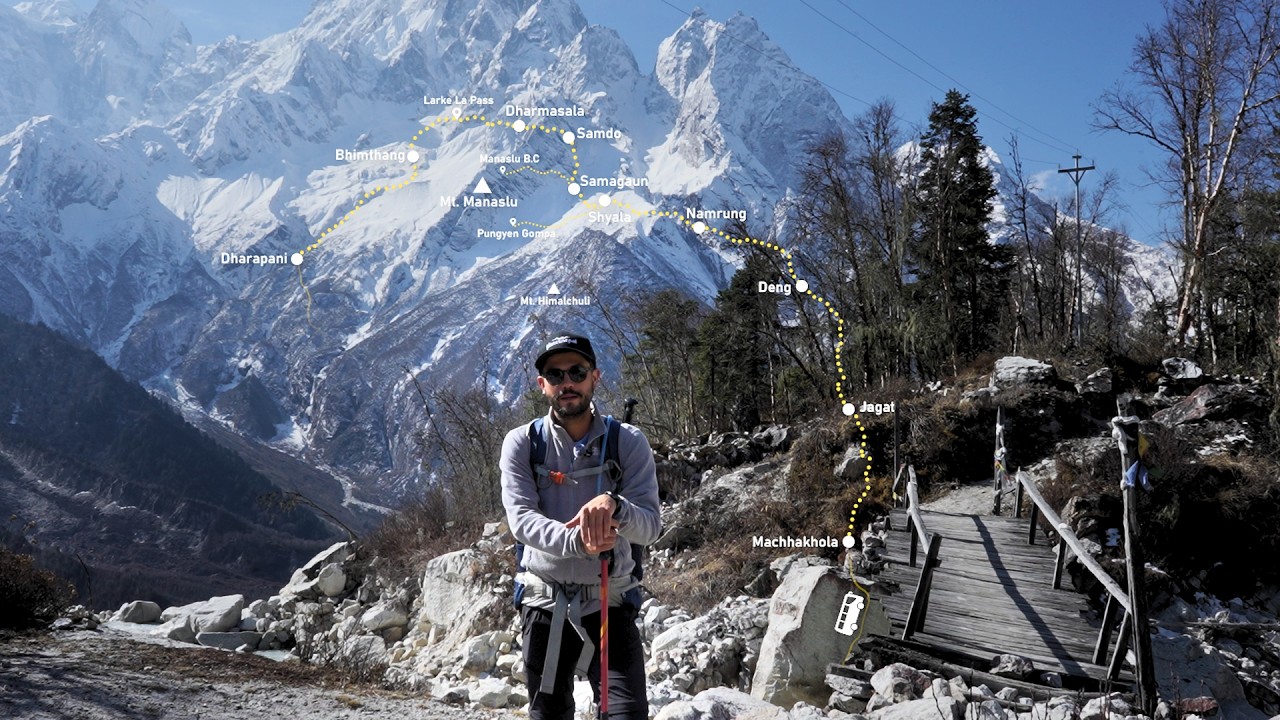
Dharapani (1,860 m) → Chame (2,610 m) → Pisang (3,300 m) → Manang (3,540 m) → Yak Kharka (4,060 m) → Thorong Phedi (4,525 m) or High Camp (4,880 m) → Thorong La (5,416 m) → Muktinath (3,800 m)
Three long valley days, one acclimatization day in Manang, two deliberately short high-altitude days, and the pass-crossing day — then a jeep out to Jomsom, Pokhara, and Kathmandu. Six walking days, about 79 km, and one morning above 5,000 m. The full day-by-day plan, with altitudes and times for every stage, is in our Annapurna Circuit itinerary guide.
If this trek is on your list, the next step is the easy part: see the current dates and pricing on our Annapurna Circuit Trek page, read the honest difficulty breakdown in our difficulty guide, check what the trip costs line by line in our cost guide, and — if this would be your first Himalayan trek — our beginner's guide covers the experience question honestly. Message us with your dates and your honest current fitness, and we'll tell you plainly whether the 10-day version fits — or whether you'd enjoy the longer classic circuit more. And if you're still deciding between routes, our route map guide and the big-picture everything-you-need-to-know guide are good next reads.
Frequently Asked Questions
How fit do you need to be for the Annapurna Circuit?
Fit enough to walk 5–7 hours on consecutive days, climb steadily for an hour or more without constant stops, descend for over an hour with control, and carry a 6–8 kg daypack — all while recovering reasonably overnight. No running, no special athletic background, and no universal fitness test is required. If those abilities describe you, or describe you after 8–12 weeks of training, you're a realistic candidate.
How many weeks should I train for the Annapurna Circuit?
Eight weeks is the comfortable minimum for most people starting from a reasonable baseline; twelve weeks is better because it allows slower, safer progression. Four weeks meaningfully improves your starting point but can't replace longer preparation, and two weeks is about activating existing fitness and arriving injury-free — not building new capacity.
Is 8 weeks enough to prepare for the Annapurna Circuit?
Yes, for most reasonably active people. Eight consistent weeks — walking, hills, strength, and back-to-back weekend hikes — prepares you well for the 10-day itinerary's walking profile. What's essential is consistency across all eight weeks rather than intensity in any one of them.
Is 4 weeks enough to prepare?
Four weeks improves your starting point but cannot manufacture months of endurance. Use them for frequent walking, hills or stairs twice weekly, two strength sessions, a progressively longer weekend hike, and serious sleep. If your base is very low, consider a longer itinerary with more acclimatization margin rather than a crash program.
Do I need to run to prepare for Annapurna?
No. Running is optional. Walking, hiking, hills, and stairs are more specific to the trek. Runners should keep running if they enjoy it but add hiking volume, downhill work, and back-to-back days — the gaps are usually in trail legs, not cardio.
How much should I walk before the Annapurna Circuit?
There's no magic total, but aim to build toward regular 4–6 hour weekend hikes in the final month, plus shorter walks during the week — and at least two or three back-to-back weekend pairs before departure. Hours and consistency matter more than any kilometre count.
How do I train for Thorong La?
Train for the whole day, not just the climb: sustained uphill work (hills, stairs, incline treadmill), long hiking days with a loaded pack, and — most importantly — eccentric downhill strength (step-downs, controlled descents). Practice early starts and walking uphill before you feel fully warmed up, since pass day begins at 3–5 AM.
Is stair climbing good for Annapurna Circuit training?
Yes — it's one of the best city-available tools. Use stairs for sustained, controlled climbing sessions of 30–45 minutes, and walk down with the same care you walk up. Don't sprint; moderate sustained effort is the goal.
Is incline treadmill training useful?
Yes, as a substitute for hills. Walk (don't run) on a gradual incline for 30–60 minutes at a sustainable effort, add your daypack in the final weeks, and include a few minutes of decline at the end to practice descending. Pair it with long outdoor walks — the treadmill can't replicate uneven ground or hours on your feet.
How do I train for downhill walking?
Step-downs from a box or step, controlled stair descents, downhill hiking with short strides and soft knees, and eccentric strength work like split squats and Romanian deadlifts. Build descent duration gradually across your training weeks. The 1,616 m descent off Thorong La is the trek's most under-trained demand.
Should I train with a backpack?
Yes — with your daypack weight, not your full luggage. Start at 2–3 kg, build toward 6–8 kg (your realistic daily load: water, layers, essentials), and use the sessions to dial in fit. Your main duffel travels with a porter on this itinerary, so don't train with weight you won't carry.
What strength exercises are best for the Annapurna Circuit?
Step-ups, squats, split squats, reverse lunges, calf raises, Romanian deadlifts, step-downs, and planks or anti-rotation core work. Two sessions a week of moderate, well-executed work beats occasional heavy sessions. Consistency and technique over load.
How do I train for back-to-back hiking days?
Do a longer hike Saturday (4–6 hours) followed by a shorter, easier one Sunday (2–4 hours), most weekends in your final training phase. Repeat the pattern at gradually increasing duration. The skill being trained is walking well on tired legs — which is exactly what the trek asks from Day 3 onward.
Can I train for the Annapurna Circuit without mountains?
Yes. Almost everything the trek tests can be trained with stairs, an incline treadmill, long weekend walks, varied outdoor surfaces for balance, and a loaded backpack. Only altitude acclimatization requires actual altitude — and that's what the itinerary's gradual profile and Manang rest day are for.
Does being fit protect against altitude sickness?
No. The CDC's Yellow Book guidance on high-altitude travel states that training and physical fitness do not affect susceptibility to acute mountain sickness. Acclimatization depends on ascent profile and individual physiology. Fitness makes the walking easier; it is not a shield against altitude illness, and symptoms should always be reported honestly to your guide.
Can I train for altitude at home?
You can train for the physical effort, but not the altitude response — acclimatization requires actual altitude exposure. You don't need to live at altitude or buy simulation equipment for this trek; the itinerary provides gradual exposure, and most trekkers arrive from sea level and acclimatize on the route.
Should I lose weight before the Annapurna Circuit?
Not rapidly, and not in the final weeks. Crash dieting before a high-altitude trek undermines energy and recovery. If weight change is a health goal, do it gradually with professional guidance, well before your departure month. In the final weeks, fuel your training and arrive fresh.
How much should I train in the final week?
Roughly half your normal volume: easy walks, light strength, mobility. No long hikes, no exhausting sessions, no fitness tests. The taper exists so you arrive in Nepal recovered — fitness gains from the final week are negligible compared with the fatigue cost.
Are trekking poles useful on the Annapurna Circuit?
Yes, especially on the long descent off Thorong La and on uneven sections like the Ledar traverse. Poles share load with your legs, add stability, and spread effort across your upper body on long days. Learn to adjust and use them in training — poles you haven't practiced with are just extra weight.
Is the 10-day Annapurna Circuit difficult?
It's rated Challenging — mostly moderate, well-supported walking, with one genuinely hard day (Thorong La). The 10-day version is compressed compared with the classic circuit, so arriving prepared matters more than on longer versions. See our difficulty guide for the full day-by-day breakdown.
How much walking is there on the current Places Nepal itinerary?
About 79 km across six trekking days plus an acclimatization day in Manang — three 15–16 km valley days, two 8 km high-altitude days, and a 17 km pass-crossing day of 7–9 hours. Daily walking runs 3–6 hours on most days, up to 9 on pass day.
Is Thorong La the hardest day?
Yes, by a clear margin — it's the highest point (5,416 m), the longest day (7–9 hours), a pre-dawn cold start, and the biggest descent. But it's hard in a prepared-for way: steady climbing, then a long, controlled descent. The trek exists to get you across it safely.
Can beginners train for and complete the Annapurna Circuit?
Yes, with honest preparation. Beginners should take the full 12 weeks, respect the acclimatization schedule, and consider whether prior experience above 3,500 m or a longer itinerary would serve them better — this compressed version rewards some altitude familiarity. Our beginner's guide covers the question in detail.