When preparing trekkers for Langtang, the question we hear most isn't "will I make it" — it's "how do I actually train for this." That's the right question. Langtang doesn't require marathon fitness or mountaineering experience, but it does require your body to do something most training plans don't address directly: walk for five to eight hours, gain and lose real elevation, then wake up and do it again the next morning, for six days in a row.
This guide is built around that specific demand, not a generic hiking fitness checklist. It supports our Langtang Valley Trek page, and where a topic deserves its own deep dive — difficulty, altitude sickness, packing — we'll summarize it here and link to the dedicated guide.
Trek the Langtang Valley Trek
An 8-day trek through Langtang villages, forest and high alpine terrain, with a day at Kyanjin Gompa.
How Do You Train for the Langtang Valley Trek?
Focus your preparation on nine things: aerobic endurance, walking/hiking-specific endurance, uphill strength, downhill conditioning, leg and core strength, balance and stability, training with a loaded daypack, recovery capacity, and — critically — consecutive-day endurance. You don't need to be an elite athlete. The actual bar is being able to walk for several hours on trails with real elevation change, on consecutive days, while carrying a daypack. Someone who trains consistently for 8–12 weeks with this specific demand in mind will find the trek meaningfully easier than someone who arrives with general gym fitness but no walking-specific preparation.
How Difficult Is the Physical Training?
Understanding what the trek actually asks of your body makes it much easier to train for the right things.
Daily walking runs 5–8 hours depending on the day and itinerary, with real distance covered rather than a leisurely pace.
Uphill sections are sustained, not just brief inclines — the climb from Lama Hotel to Langtang Village gains over 1,000 m in a single day.
Downhill sections are just as demanding in a different way, particularly the long descent from Kyanjin Gompa back toward Lama Hotel.
Uneven terrain, stone steps, and suspension bridges all demand balance and stability beyond flat-ground walking.
Changing weather adds real variability — training in only ideal conditions doesn't prepare you for a cold, windy trekking day.
Increasing altitude changes how your body responds to exertion, something training at sea level can't fully replicate.
Consecutive trekking days are the demand most training plans miss entirely — this trek isn't one hard day followed by rest, it's six days of real exertion back to back.
For the fuller picture of what makes each specific day demanding, see our Langtang Valley Trek Difficulty guide.
How Many Weeks Should You Train?
12 weeks is our recommendation for beginners or anyone returning to fitness after time away from regular exercise — enough time to build a genuine base before adding trek-specific demands.
8 weeks works well for generally active people already doing some regular exercise — a solid, condensed preparation period.
6 weeks is workable as focused preparation if you're already reasonably fit and simply need to sharpen trek-specific conditioning.
4 weeks is possible for people with an existing reasonable fitness base, but it requires sensible progression rather than trying to compress 12 weeks of adaptation into a third of the time.
2 weeks isn't enough time to build meaningful new fitness safely. At this point, the goal shifts entirely to maintaining what you already have and avoiding overtraining or injury before departure — not attempting a last-minute fitness overhaul.
Trek the Langtang Valley Trek
An 8-day trek through Langtang villages, forest and high alpine terrain, with a day at Kyanjin Gompa.
The 12-Week Langtang Trek Training Plan
This is the centerpiece of this guide — a full progression from base-building through to a sensible taper.
| Week | Cardio | Walking/Hiking | Strength | Stairs/Hills | Long Hike | Main Goal |
|---|
| 1 | 3x, 20–30 min easy | 2x, 30–40 min | 2x, bodyweight basics | — | — | Build consistency |
| 2 | 3x, 25–30 min | 2x, 40 min | 2x, bodyweight basics | 1x, easy | — | Establish the habit |
| 3 | 3x, 30 min | 3x, 45 min | 2x, add light load | 1x, moderate | — | Increase walking duration |
| 4 | 3x, 30–35 min | 3x, 45–60 min | 2x, add light load | 1x, moderate | 1x, 2 hrs, flat–rolling | Increase walking duration |
| 5 | 3x, 35 min | 3x, 60 min | 2x, progress reps | 2x, moderate | 1x, 2.5 hrs | Introduce more hills/stairs |
| 6 | 3x, 35–40 min | 3x, 60 min | 2x, progress reps | 2x, moderate–hard | 1x, 3 hrs, real elevation | Introduce more hills/stairs |
| 7 | 3x, 40 min | 3x, 60–75 min, daypack | 2x, add weighted work | 2x, hard | 1x, 3.5 hrs, loaded daypack | Increase long-hike distance |
| 8 | 3x, 40 min | 3x, 75 min, daypack | 2x, weighted work | 2x, hard | 1x, 4 hrs, loaded daypack | Increase long-hike distance/elevation |
| 9 | 2x, 40 min | 3–4x, 75–90 min, daypack | 2x, maintain | 2x, hard | Back-to-back: 4 hrs Sat, 2.5 hrs Sun | Practice consecutive hiking days |
| 10 | 2x, 40 min | 3–4x, 90 min, daypack | 2x, maintain | 2x, hard | Back-to-back: 5 hrs Sat, 3 hrs Sun | Practice consecutive hiking days |
| 11 | 2x, 30 min | 3x, 60–75 min | 2x, lighter | 1x, moderate | 1x, 4–5 hrs, full gear test | Peak sensibly |
| 12 | Light only | 2–3x, 30–45 min easy | 1x, light | — | — | Taper — rest and pack |
How to use this table: each week builds on the last, but listen to your body over the schedule — if Week 6 feels like Week 5 still does, repeat it rather than pushing forward on a fixed calendar. The two most important columns are Long Hike (your single best rehearsal for actual trek days) and the Week 9–10 back-to-back sessions (your rehearsal for what six consecutive trekking days actually demands). 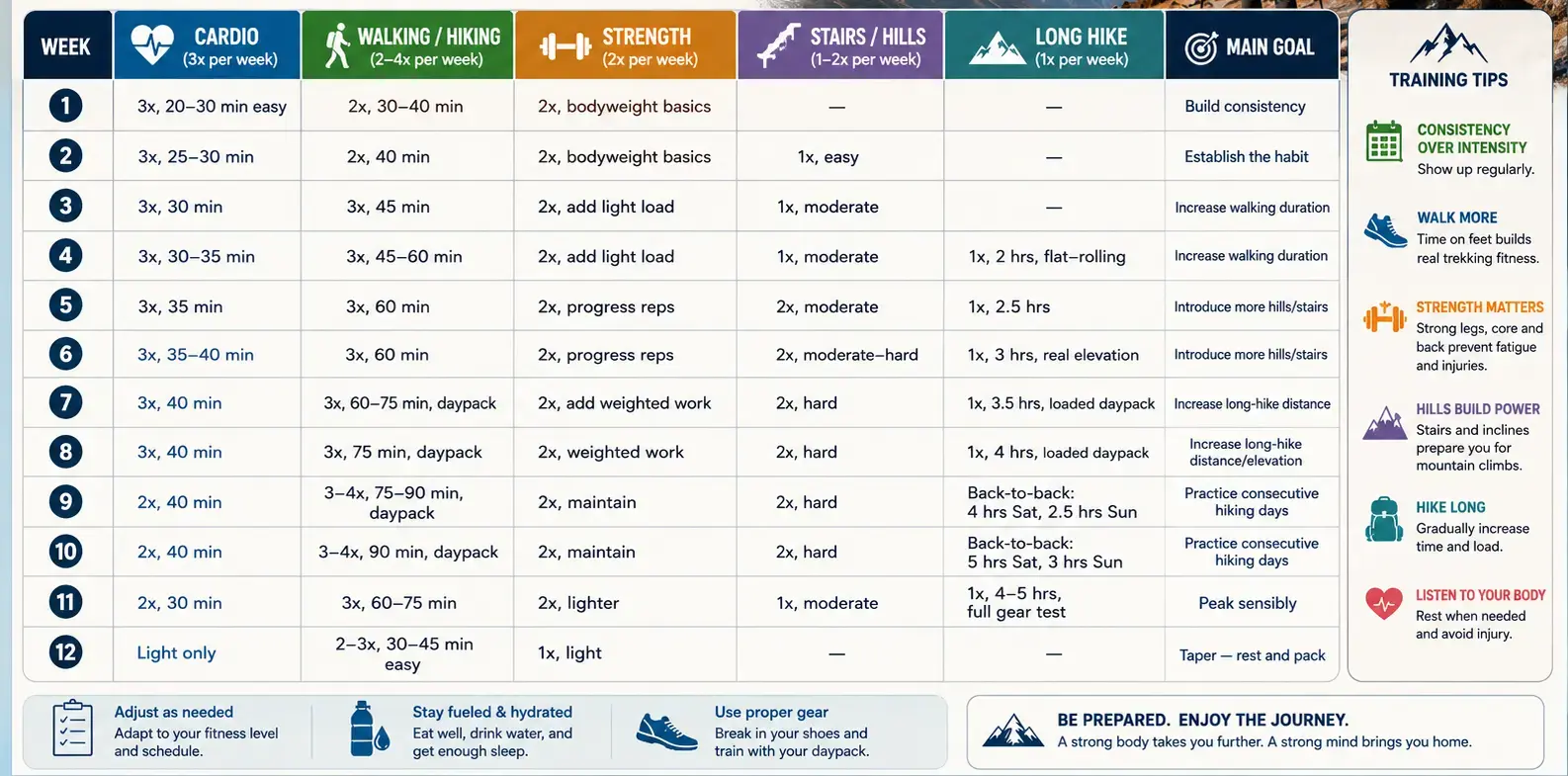
The 8-Week Langtang Trek Training Plan
A condensed alternative for trekkers with less lead time but a reasonable existing fitness base.
Weekly walking target: build from 3x weekly (30–40 min) in Week 1 to 4x weekly (60–75 min) by Week 6, including one longer weekend hike throughout.
Cardio: 2–3 sessions weekly outside of walking — cycling, swimming, or incline cardio machine work, 30–40 minutes each.
Strength: 2x weekly, focusing on the core exercises detailed below, progressing from bodyweight to light-loaded work by Week 4.
Long hike: start at 2 hours in Week 2, building to a single 4-hour loaded hike by Week 6, with one back-to-back weekend (long Saturday, easier Sunday) in Week 7.
Recovery: Week 8 is a taper — reduce volume by roughly half, keep movement light, and prioritize sleep over any final hard session.
Trek the Langtang Gosaikunda Trek
Explore Sacred Lakes and Hidden Himalayas on the Langtang Gosaikunda Trek!
Only Have 4 Weeks to Train?
Be realistic about what four weeks can and can't do. What can realistically improve: your walking-specific endurance, basic leg strength, and familiarity with your gear. What cannot improve much in four weeks: your fundamental cardiovascular base, if you're starting from a genuinely sedentary point — that kind of adaptation takes longer regardless of effort.
How to avoid overtraining: don't try to compress a 12-week progression into four weeks by training harder each session. Instead, prioritize frequency and specificity over intensity — more walking, not harder workouts.
How to prioritize your limited time: walking comes first (aim for 4–5 sessions weekly, building duration each week), hills and stairs second (2x weekly), and strength third (2x weekly, focused on the downhill-specific exercises below, since eccentric leg strength is genuinely trainable fast). Fit one long hike of 3+ hours with a loaded daypack into your final two weeks, then taper in the final week.
We won't promise that four weeks fully prepares you the way 12 weeks does — but consistent, well-prioritized effort in this window genuinely helps, and it's far better than no preparation at all.
Cardio Training
Aerobic fitness is what lets you sustain 5–8 hours of walking without excessive fatigue — it's the foundation everything else builds on.
Good options: brisk walking, hiking, incline treadmill work, cycling, elliptical training, jogging (if you're already accustomed to running), and stair machines.
Running is not required. This surprises some trekkers, but running and trekking fitness overlap only partially — walking-based cardio is more specific to what you'll actually do on the trail.
Frequency and duration: 3 sessions weekly of 30–40 minutes is a solid baseline for most of the training period, building toward longer sessions as you approach your peak training weeks.
Walking Training
This is the single most trek-specific training you can do, and it deserves more attention than any other category.
Why walking is the most specific preparation: no other exercise replicates the exact muscle patterns, joint loading, and cardiovascular demand of actual trekking as closely as walking does, especially on real terrain.
How to increase duration: add roughly 10–15% more time to your walks every one to two weeks, rather than jumping dramatically from one session to the next.
How to practice on uneven terrain: seek out trails, parks, or any surface that isn't flat pavement — your ankles, knees, and stabilizing muscles all need this specific adaptation.
How to introduce hills: once you're comfortable with flat-terrain duration, start choosing routes with genuine elevation change rather than adding hills and duration at the same time.
How to practice carrying a daypack: introduce this once you have a basic walking base, starting light (see the backpack training section below).
Why long walks shouldn't happen every day: your body needs recovery time to actually adapt to the training stress — walking hard daily without variation increases injury risk and doesn't accelerate progress the way alternating harder and easier days does.
Progression example: Week 1–2, 30–40 minute flat walks, 2–3x weekly. Week 5–6, 60-minute hilly walks, 3x weekly, plus one longer weekend hike. Week 9–10, 75–90 minute loaded walks with real elevation, most days of the week, including back-to-back sessions.
Stair Training for Langtang
Stairs are one of the most accessible, genuinely useful training tools available, particularly for trekkers without easy access to real hills.
What stairs are useful for: uphill climbing endurance, leg endurance specifically in the quads and glutes, and cardiovascular conditioning in a compact, repeatable format.
How to start and progress: begin with 10–15 minutes of continuous stair climbing at a sustainable pace, adding duration and, later, a light daypack as your base builds.
Why stair training doesn't perfectly replicate mountain hiking: stairs offer consistent, uniform steps, while mountain trails demand constant adjustment to uneven, unpredictable terrain — stairs build real fitness, but they're a supplement to actual hiking, not a full substitute for it.
Trek the Langtang Gosaikunda Trek
Explore Sacred Lakes and Hidden Himalayas on the Langtang Gosaikunda Trek!
Hill Training
Uphill walking builds the specific cardiovascular and muscular endurance you'll need for sustained climbs like Lama Hotel to Langtang Village.
Downhill walking trains a genuinely different demand — controlled, braking muscle work that flat or uphill training doesn't address at all.
Repeated climbs (hiking the same hill multiple times in one session) are a time-efficient way to build real elevation-gain training without needing a full mountain nearby.
Elevation gain and terrain variation both matter — seek routes with genuine, sustained climbing rather than short, sharp inclines that don't mirror the trek's actual demand.
If you live in a flat city: stairs, a stadium's seating steps, an incline treadmill, or a parking garage (where safe and legal) all substitute reasonably well.
If you live in a hilly area: use your local terrain directly, focusing on routes with at least 200–300 m of elevation gain for your longer sessions.
If you live in a mountainous area: you likely have excellent training terrain already available — focus more on building duration and loaded-pack practice than seeking out elevation specifically.
Strength Training
A focused, practical set of exercises — not a full gym program — is enough to meaningfully improve your trekking readiness.
Squats. Build the fundamental leg strength for sustained climbing and descending. Start bodyweight, progress to a light loaded version as your training advances.
Step-ups. Closely mirror the actual movement of climbing stone steps and steep trail sections — genuinely one of the most trek-specific strength exercises available.
Lunges. Build single-leg strength and stability, directly relevant to uneven trail terrain where your weight shifts constantly between legs.
Calf raises. Support ankle stability and the sustained calf engagement of both uphill push-off and downhill control.
Glute bridges. Strengthen the glutes, which do more work than most trekkers expect on sustained climbs.
Romanian deadlifts / hip hinge. Build posterior chain strength and teach a movement pattern that supports carrying a daypack with good posture over long days.
Planks. Build core stability, which supports balance and reduces fatigue-related form breakdown over long trekking days.
Side planks. Add lateral core stability, relevant to the constant small balance adjustments uneven trail terrain demands.
Single-leg balance. Directly trains the stability you'll rely on constantly on uneven, rocky, or root-covered trail sections.
None of this requires heavy lifting — 2–3 sets of 10–15 reps for most exercises, progressing gradually, is sufficient for trekking-specific strength. This isn't a program built for maximum strength gains; it's built for durable, functional capacity over consecutive long days.
Langtang-Specific Muscle Groups
Quadriceps handle much of the work on both ascents and, especially, controlled descents.
Glutes power sustained climbing more than most trekkers expect, and weak glutes often show up as knee strain on long uphill sections.
Hamstrings support the posterior chain alongside glutes, particularly relevant to the hip-hinge movement pattern of carrying a pack.
Calves absorb constant small adjustments on uneven terrain and drive uphill push-off.
Core stabilizes your whole body under a loaded pack over many hours, reducing fatigue-related strain elsewhere.
Hip stabilizers manage the side-to-side balance demands of uneven trail surfaces, suspension bridges, and stone steps.
Why downhill walking is especially demanding on the quadriceps: descending requires your quads to contract eccentrically — lengthening under load to control your speed and absorb impact — which is a fundamentally different and often more fatiguing demand than the concentric contraction (shortening under load) used in climbing. This is exactly why dedicated downhill training matters, covered next.
How to Train for Downhill Walking
This is an area many competing training guides overlook entirely, despite descents being where a lot of trek-day soreness and injury risk actually comes from.
Why downhill produces muscle soreness. The eccentric loading described above causes more microscopic muscle damage than uphill or flat walking, which is why untrained quads feel disproportionately sore after a big descent day.
Eccentric strength matters specifically. Training your legs to control a slow, loaded lowering motion — not just push through a lift — is the direct preparation for descent control.
Step-down exercises. Standing on a low step or box and lowering yourself slowly to the ground and back, controlled throughout, is one of the most direct exercises for this.
Controlled stair descent. Deliberately walking down stairs slowly and with control, rather than just using stairs for the climb, trains the same eccentric pattern.
Downhill hiking practice. If your local terrain allows it, include genuine downhill sections in your training hikes, not just the climb — many trekkers train only the ascent and are caught off guard by how demanding a long, sustained descent actually feels.
Training with a Backpack
Why you should practice carrying your daypack. Trekking with weight on your back changes your balance, gait, and fatigue pattern — training without it leaves a real gap between your fitness and your actual trek-day readiness.
How to gradually introduce weight. Start with 2–3 kg once your base walking fitness is established, adding roughly 1 kg every one to two weeks as it feels manageable.
Why you shouldn't train with an unnecessarily heavy pack. Loading up beyond what you'll actually carry doesn't build useful extra capacity — it mainly increases injury risk without a corresponding trek-specific benefit.
How to adjust pack fit. Practice adjusting hip belt, sternum strap, and shoulder straps so weight sits properly on your hips rather than your shoulders — this matters as much as the weight itself for comfort over a long day.
What weight is realistic for a trekker using porter support. If a porter is carrying your main gear, your daypack only needs to hold what you actually need during the walking day — water, snacks, a layer, camera, sun protection — typically 3–6 kg, not a full trekking load. Train with roughly this weight, not more.
Long-Distance Hiking
Building toward a genuine long training hike is one of the highest-value things you can do to prepare.
Duration matters more than distance. The goal is time on feet — a slower 4-hour hike on real terrain prepares you better than a fast 4-hour road walk covering more kilometres.
Elevation and terrain should mirror what you'll actually encounter as closely as your local options allow — genuine climbing and descending, not just flat distance.
Backpack should be loaded to your realistic trek-day weight for at least your final few long hikes.
Food and water practice matters too — use your long hikes to test how you'll actually eat and hydrate on trek days, not just how far you can walk.
Footwear should be the exact boots you're bringing to Nepal, well before your longest training hikes — this is your real-world break-in test, not just your gear check.
Back-to-Back Training Days
This is one of the most important and most commonly skipped parts of trek preparation. Langtang is not one long hike followed by a rest day — trekkers walk repeatedly over six consecutive days, and your training should reflect that directly.
Example structure:
- Saturday: Long hike, 4–5 hours, loaded daypack, real elevation
- Sunday: Easier recovery hike, 2–3 hours, lighter effort
Why consecutive-day conditioning matters specifically. Your legs feel different on the second day of sustained exertion than on a single isolated hard effort — how your body handles that specific fatigue is exactly what a single long weekend hike, however impressive, doesn't teach you. Two or three back-to-back training weekends in your final month are worth more than one additional long solo hike.
Training for Kyanjin Ri and Tserko Ri
The optional high viewpoints above Kyanjin Gompa involve steeper climbing, greater altitude, longer sustained effort, and more demanding terrain than the rest of the standard itinerary — this is genuinely the hardest single day most trekkers face on this route.
Fitness helps meaningfully with the physical workload of this specific day — the steep, sustained climb rewards real leg strength and cardiovascular conditioning built through this training plan. But fitness does not eliminate altitude risk, which is a separate consideration entirely (covered next). Train hard for the physical climb; don't assume that training also protects you from altitude-related symptoms on the day itself.
Does Being Fit Prevent Altitude Sickness?
No. This deserves a direct, unambiguous answer, because it's one of the most common misconceptions we encounter.
Physical fitness is your body's capacity for sustained exertion — endurance, strength, cardiovascular efficiency. Acclimatization is a separate physiological process — how quickly your body adapts to reduced oxygen availability at altitude. These are genuinely different systems, and being strong in one doesn't mean you're protected in the other.
Why even highly fit athletes can experience altitude sickness. Acclimatization speed varies between individuals for reasons not well predicted by fitness level, age, or prior trekking experience. A very fit trekker who ascends too quickly carries real altitude risk regardless of how easy they find the physical walking itself.
Your training should prepare you to walk again the following morning, not simply complete one hard workout — and separately, your itinerary's pacing and acclimatization days are what actually manage altitude risk. Both matter; neither substitutes for the other. Full detail on symptoms, prevention, and response is in our Langtang Valley Trek Altitude Sickness Guide.
Training at High Altitude
Most trekkers cannot fully replicate Himalayan altitude conditions at home, and that's genuinely fine — it's not a requirement for successful preparation.
Hill and stair training build the cardiovascular and muscular fitness that supports your performance once you are at altitude, even though they don't simulate reduced oxygen itself.
Aerobic conditioning generally improves how efficiently your body uses available oxygen, a real if modest benefit that carries over to altitude performance.
Hypoxic training (altitude tents, chambers, or masks) exists as a specialized option some serious mountaineers use, but it's not something we'd recommend as necessary or cost-effective for a trek at Langtang's altitude range — standard, consistent training plus respecting your itinerary's acclimatization schedule is genuinely sufficient preparation for this specific trek.
Training for Different Fitness Levels
Complete beginners. Start with the 12-week plan, prioritizing consistency over intensity in the early weeks — building the habit matters more than any single session's difficulty.
Regular walkers. You already have a real base — focus your additional training on hills, loaded-pack practice, and back-to-back long days specifically, since general walking fitness alone doesn't cover these.
Runners. Your cardiovascular fitness likely transfers well, but running and loaded trekking use different movement patterns — add hill walking, downhill-specific strength work, and pack training rather than assuming running fitness alone covers you.
Gym-goers. Strength training experience helps, but add walking-specific cardio and real outdoor terrain practice — gym fitness alone doesn't translate perfectly to hours of uneven-terrain walking.
Older or less-active trekkers. Current fitness level matters more than age itself — a fit 60-year-old is better prepared than an unfit 30-year-old. Follow the same progressive plan, adjusting pace and volume to your genuine current baseline rather than an age-based assumption.
If You Live in a Flat City
Real, practical solutions exist even without natural hills nearby: stairs (stairwells, stadium seating, parking garages where safe and legal), incline treadmill settings, long urban walks to build base duration, and a gradually weighted daypack worn on your regular walks. None of these perfectly replicates mountain terrain, but combined consistently, they build genuinely useful trekking fitness.
If You Already Hike Regularly
Modify rather than starting from zero. Add loaded-pack practice if you don't already hike with weight, prioritize back-to-back training days specifically (since this is what most regular hikers' routines miss), and make sure at least some of your existing hikes include genuine sustained descents, not just climbs — the downhill-specific training covered above is worth adding even to an already-solid hiking routine.
Foot and Shoe Preparation
Break in your trekking boots well before Nepal — a minimum of 4–6 weeks of real use, not just wearing them around the house.
Practice in the actual footwear you plan to use on the trek, not a different pair — even similar models fit and break in differently.
Test your socks too, not just your boots — sock choice genuinely affects blister risk over multi-day wear.
Watch for hot spots during training hikes and address them immediately (moleskin, tape) rather than pushing through — this is exactly how minor irritation becomes a real blister.
Don't introduce brand-new boots on the trek itself — this is one of the most common, entirely preventable causes of a difficult trekking experience. Full gear detail is in our Langtang Valley Trek Packing List.
Recovery and Rest
Recovery isn't separate from training — it's the part of training where actual adaptation happens.
Rest days allow your body to repair and strengthen between harder sessions; skipping them consistently undermines progress rather than accelerating it.
Sleep is when most physical adaptation occurs — prioritize consistent, adequate sleep throughout your training period, not just in the final week.
Hydration supports recovery and training performance alike — build the habit of drinking consistently now, since it's the same habit you'll rely on at altitude.
Nutrition (covered in more detail below) supports both training adaptation and injury prevention.
Mobility work — basic stretching or light yoga — helps manage the cumulative tightness that comes with increasing training volume.
Managing soreness means distinguishing normal training fatigue from something that needs attention — persistent, sharp, or worsening pain deserves rest and, if it doesn't resolve, professional evaluation, not pushing through.
Nutrition for Training
Balanced meals — a mix of protein, carbohydrates, and healthy fats — support both training adaptation and day-to-day energy.
Protein supports muscle repair and adaptation from your strength and endurance training.
Carbohydrates fuel your longer training sessions and long hikes specifically.
Fruits and vegetables support general health and recovery through the training period.
Hydration matters daily, not just during long training sessions.
We're not going to recommend specific supplements, extreme diets, or individualized nutrition plans here — general, balanced, consistent eating is what supports most trekkers well through a training period. If you have specific nutritional needs or concerns, a registered dietitian or your doctor is the right resource, not a training guide.
What Should You Do the Week Before the Trek?
Reduce training volume significantly — this is a taper week, not a chance to squeeze in one more hard session.
Avoid hard new workouts entirely — nothing you do in this final week meaningfully adds fitness, but overdoing it can genuinely leave you fatigued for Day 1.
Prioritize sleep over any remaining training temptation.
Prepare your gear fully, including a final check of boots, pack fit, and everything on your packing list.
Keep walking lightly — short, easy walks maintain movement without adding fatigue.
Avoid arriving in Kathmandu exhausted. A well-tapered trekker in good spirits outperforms an over-trained, fatigued one on Day 1, every time.
Last 48 Hours
Sample Weekly Training Schedule
| Day | Training |
|---|
| Monday | Rest / mobility |
| Tuesday | Cardio + strength |
| Wednesday | Walking |
| Thursday | Hills/stairs + strength |
| Friday | Rest |
| Saturday | Long hike |
| Sunday | Recovery walk |
This is an example structure, not a fixed prescription — adjust the specific days and intensities to your current fitness level, schedule, and how your body is responding as training progresses.
Common Training Mistakes
- Starting too hard. Jumping into intense training in Week 1 invites injury and burnout — build gradually instead.
- Only running, never hiking. Running builds cardio but doesn't replicate loaded, uneven-terrain walking — include real hiking specifically.
- Never training on real terrain. Flat-road walking alone leaves a genuine gap in trail-specific readiness.
- Ignoring downhill training entirely. Most trekkers train the climb and forget the descent, which is often more physically demanding.
- Never carrying a backpack in training. Trek-day fatigue with weight on your back feels meaningfully different from unloaded fitness.
- Training only on flat roads. Elevation change is a core part of what you're preparing for — seek it out deliberately.
- Doing one huge hike every few weeks instead of consistent training. Sporadic hard efforts build less real fitness than steady, progressive training.
- Ignoring recovery entirely. Skipping rest days undermines the adaptation that training is supposed to produce.
- Wearing brand-new boots on the trek. Break-in happens over weeks of real use, not on the trail itself.
- Ignoring strength training in favour of cardio alone. Both matter — strength specifically protects against downhill-related soreness and injury.
- Trying to "train altitude" through exhaustion. Deliberately exhausting yourself doesn't simulate altitude adaptation — it just adds fatigue and injury risk.
- Believing fitness prevents altitude sickness. Covered at length above — it doesn't, and this misconception can lead to under-respecting acclimatization on the actual trek.
- Overtraining immediately before departure. The final week should taper, not peak.
- Not testing gear during training. Boots, pack, and poles all deserve a real trial run well before Nepal.
- Skipping back-to-back training days. Single hard hikes don't prepare you for six consecutive trekking days.
- Increasing training volume too quickly. Roughly 10–15% increases week to week is a safer, more sustainable progression than large jumps.
- Not addressing minor injuries early. Small issues ignored during training often worsen under the trek's actual demands.
- Assuming a gym membership alone is sufficient preparation. Indoor cardio machines don't fully replicate uneven, inclined outdoor terrain.
- Not practicing eating and drinking during long training hikes. This is a skill worth rehearsing, not just figuring out on the trek itself.
- Comparing your training plan directly to someone else's. Individual baselines differ — a plan right for one trekker may be too much or too little for another.
- Not addressing pre-existing health conditions before starting. A doctor's input early can shape a safer, more effective training plan.
- Treating strength training as optional. It's a genuine, specific contributor to trek readiness, not an add-on for people who enjoy the gym.
Langtang Training Checklist
12–8 Weeks Before
8–4 Weeks Before
Final 2 Weeks
Final Week
Before Leaving for the Trail
How Fit Do You Need to Be?
A realistic final assessment: you don't need marathon fitness, mountaineering experience, or gym-level strength to complete the Langtang Valley Trek successfully. What you do need is the capacity to walk for several hours, handle sustained uphill movement, descend comfortably without excessive strain, repeat this activity on consecutive days, and carry a loaded daypack throughout. That's a genuinely achievable bar for most healthy adults who train consistently over 8–12 weeks — not an elite fitness standard, but a real one that rewards actual preparation over assumption.
Places Nepal Treks: Preparing for Your Trek
Places Nepal Treks provides practical pre-trek guidance to every trekker booking with us, but the training itself has to happen before you arrive — we'd rather help you prepare properly in advance than have you attempt to "get fit" during the trek itself, which puts unnecessary strain on both your body and your experience of the route. Our team is happy to answer specific questions about how your current fitness matches this trek's demands when you inquire about our Langtang Valley Trek.
Trek the Langtang Valley Trek
An 8-day trek through Langtang villages, forest and high alpine terrain, with a day at Kyanjin Gompa.
Frequently Asked Questions
How long should I train for Langtang? 8–12 weeks is our general recommendation, with 12 weeks better suited to beginners and 8 weeks workable for already-active trekkers.
Is Langtang Trek suitable for beginners? Yes, with proper training — no prior Himalayan trekking experience is required.
Do I need to run? No — running is one option among several for building cardio, not a requirement.
Is walking enough? Walking is the single most important training activity, but pairing it with strength training and loaded-pack practice produces better trek-day readiness than walking alone.
How many hours should I walk? Build toward 60–90 minute regular sessions, with a long weekly hike extending to 3–5 hours by your peak training weeks.
How often should I hike? 3–4 times weekly during your peak training block, including at least one longer session.
Should I train with a backpack? Yes, introduced gradually from around the midpoint of your training period.
How heavy should my training pack be? Build toward 3–6 kg if you're using porter support, matching your actual expected daypack weight.
Are stairs good training? Yes, particularly for uphill endurance and leg strength, though they should supplement rather than replace real outdoor hiking.
Should I train legs? Yes — dedicated leg strength work, including downhill-specific eccentric exercises, meaningfully improves trek comfort.
How do I train for downhill hiking? Step-downs, controlled stair descents, and including genuine downhill sections in training hikes all build the eccentric strength descending requires.
How do I train if I live somewhere flat? Stairs, incline treadmill settings, parking garages, and a gradually weighted daypack on regular walks all substitute reasonably well.
Can I train in a gym? Yes, for strength and some cardio, but pair it with real outdoor walking for trek-specific terrain adaptation.
Can I do Langtang without hiking experience? Yes, provided you commit to genuine training beforehand — prior experience helps but isn't required.
Does fitness prevent altitude sickness? No — fitness and acclimatization are separate systems; see the dedicated section above for the full explanation.
How do I train for Kyanjin Ri? Focus on sustained uphill strength and cardiovascular endurance through your regular training — the physical climb rewards genuine preparation, though it doesn't protect against altitude risk specifically.
How do I train for Tserko Ri? Similarly to Kyanjin Ri, with slightly more emphasis on sustained effort given its greater length and elevation.
Can I prepare in four weeks? Yes, partially — see our dedicated 4-week section above for what's realistic and how to prioritize limited time.
Can I prepare in eight weeks? Yes, comfortably for most generally active people — see our 8-week plan above.
What should I do during the final week? Taper significantly, prioritize sleep, and finish gear preparation rather than attempting any new training.
Should I rest before the trek? Yes — the final week specifically should reduce volume substantially compared to your peak training weeks.
Do I need to train every day? No — most effective plans include 2–3 rest or light days weekly, since recovery is part of how training actually works.
How much should I walk before Langtang? Build toward comfortable 60–90 minute regular walks and one 3–5 hour long hike weekly by your peak training block.
Is cycling good preparation? Yes, as a cardio cross-training option, particularly useful for building aerobic base with lower joint impact than running.
Is running better than walking? Not necessarily — walking is more specific to trekking, though running can contribute useful cardiovascular fitness if you already enjoy it.
What strength exercises are best for trekking? Squats, step-ups, lunges, calf raises, glute bridges, and planks form a solid, genuinely useful core set.
What's the minimum training timeline? 4 weeks is workable if you already have a reasonable fitness base; less than that leaves little room for meaningful trek-specific preparation.
Can older trekkers follow this same plan? Yes, adjusted to your genuine current fitness level rather than skipped based on age alone.
Should I hire a personal trainer? Optional — this guide's plan is designed to be followed independently, though a trainer can help with technique and accountability if useful for you.
Is swimming good cross-training? Yes, particularly as a low-impact cardio option that complements rather than replaces walking-specific training.
How do I know if I'm ready? A genuine test: can you comfortably complete a 4–5 hour loaded hike with real elevation change, then repeat a shorter hike the next day? If yes, you're well prepared.
What if I get injured during training? Address it promptly — rest, appropriate treatment, and professional evaluation if it doesn't improve — rather than training through pain.
Should I train with trekking poles? Yes, if you plan to use them on the trek — practising the technique beforehand makes a real difference on actual trek days.
How much elevation gain should my long hikes include? Aim for at least 500–800 m of gain on your longer training hikes as you approach your peak weeks, where terrain allows.
Is yoga useful for trek preparation? Yes, as a supplement for mobility, balance, and recovery — not a replacement for cardio or strength training.
What's the biggest mistake first-time trekkers make in training? Skipping downhill-specific training and back-to-back training days — both are commonly overlooked despite being genuinely important.
Can I train indoors only? You can build real fitness indoors, but outdoor terrain training remains the most trek-specific preparation available and is worth including if at all possible.
How do I simulate consecutive trekking days? Schedule back-to-back training days — a long hike followed by a shorter recovery hike the next day — at least twice in your final month.
Should I lose weight before the trek? Not as a blanket rule — focus on building fitness and strength; talk to a doctor if you have specific health-related weight concerns.
What if I miss a week of training? Resume from where you are rather than trying to cram missed weeks — a realistic adjusted plan beats an abandoned ideal one.
Is a fitness tracker useful for training? It can help monitor consistency and progress, though it's a supplement to a real training plan, not a substitute for one.
How do I train for altitude specifically? You largely can't replicate altitude directly through training — focus on genuine physical fitness, and rely on your itinerary's pacing and acclimatization days for the altitude-specific risk.
What's a realistic long-hike distance to aim for? Focus on duration and elevation rather than a specific distance — a 4–5 hour hike with real elevation change is a solid target for your peak training weeks.
Should I train differently for a private trek versus a group trek? Not fundamentally — the physical demands are the same regardless of group size, though a private trek may allow more pace flexibility on the actual trip.
How soon before departure should I stop hard training? About one week out — use your final week for tapering, not one last hard session.
Can I use this training plan for other treks too? The core principles (walking-specific cardio, strength, downhill training, back-to-back days) apply broadly to most moderate Himalayan treks, though specific altitude and duration demands vary by route.
Training for Langtang isn't complicated, but it does need to be specific — walking, real terrain, a loaded pack, and consecutive long days matter more than general gym fitness alone. Start with whichever timeline matches your departure date, and if you want help matching a training plan to your actual trek dates, talk to our team.