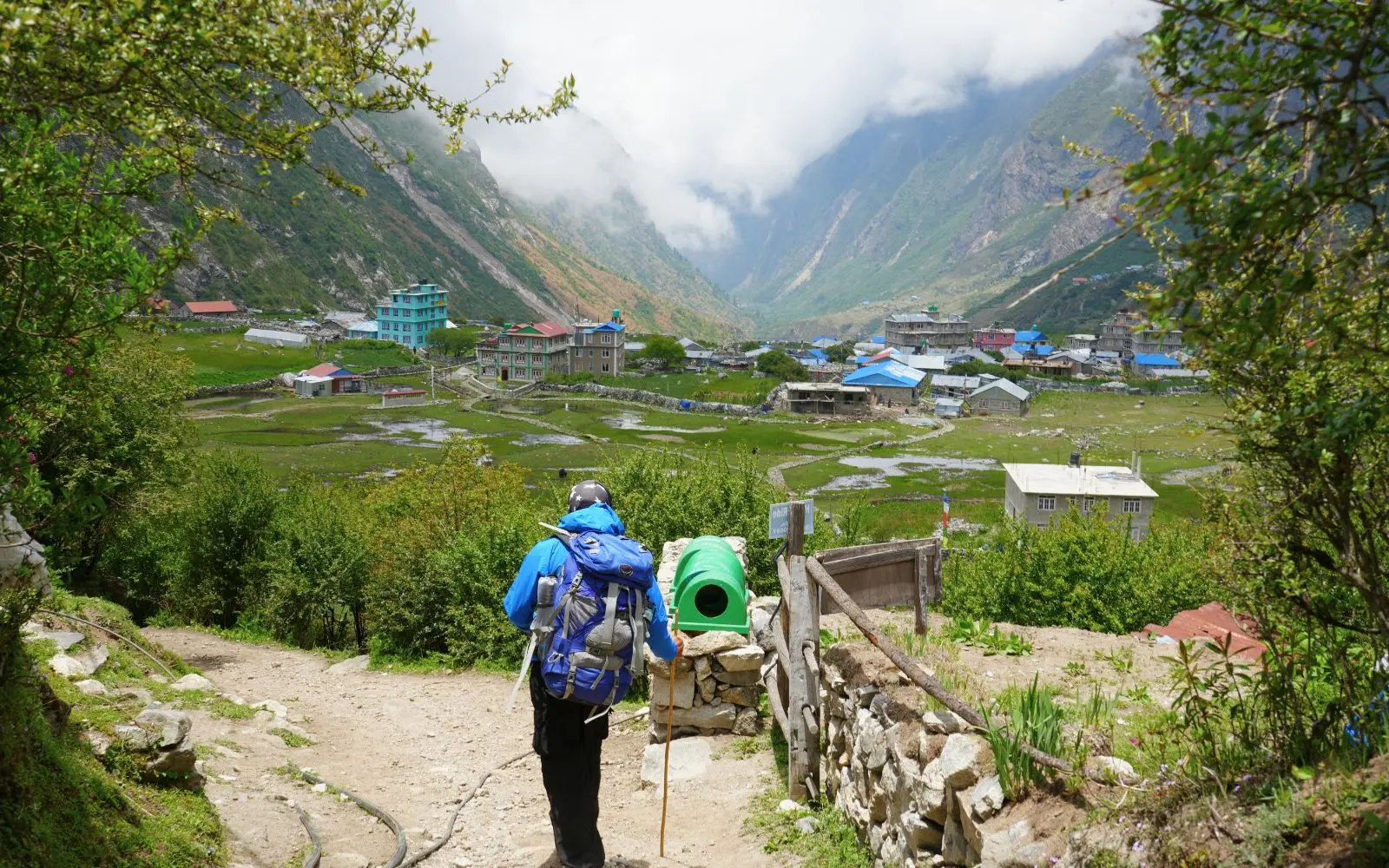
The Langtang Valley Trek is a teahouse trek — you sleep in locally run guesthouses along the trail, not hotels in the conventional sense, and not tents either. A teahouse is a family-operated lodge: a dining room downstairs where everyone gathers to eat and warm up, simple bedrooms upstairs, and shared facilities that get more basic the higher you climb. Expectations from a Kathmandu hotel, or even a budget hotel back home, don't transfer directly here, and that's worth knowing before you go rather than discovering on Day 3.
This guide covers exactly what to expect — village by village, room by room — so you arrive with realistic expectations rather than guesses. It supports our Langtang Valley Trek page, where accommodation is included as part of our standard package.
Langtang Accommodation at a Glance
| Accommodation Question | What to Expect |
|---|
| Type of accommodation | Teahouses (family-run lodges) throughout |
| Private rooms | Often available; not guaranteed everywhere, especially in peak season |
| Twin rooms | The standard room type across the route |
| Dormitory rooms | Uncommon on this specific route, occasionally used in peak-season overflow |
| Attached bathrooms | Sometimes at lower elevations; mostly shared, especially higher up |
| Hot showers | Available at many lodges, usually for a fee |
| Electricity | Generally available, more limited and solar-dependent at altitude |
| Wi-Fi | Available at most lodges through Kyanjin Gompa, usually paid |
| Phone charging | Available at most lodges, usually paid |
| Heating | Mainly in the dining room; bedrooms are usually unheated |
| Blankets | Provided, though quality and warmth vary by lodge |
| Sleeping bags | Not provided — bring your own or rent one in Kathmandu |
| Food | Teahouse dining rooms serve breakfast, lunch, and dinner |
| Booking in advance | Recommended in peak season, especially for Kyanjin Gompa |
| Accommodation cost | Varies by lodge and altitude; included in most organized packages |
| Camping required? | No — this is a teahouse trek, not a camping trek |
Trek the Langtang Valley Trek
An 8-day trek through Langtang villages, forest and high alpine terrain, with a day at Kyanjin Gompa.
What Type of Accommodation Is Available on the Langtang Trek?
Teahouse, lodge, and guesthouse are largely interchangeable terms on this route — all describe the same thing: a small, family-operated building offering simple rooms and meals to trekkers. You won't find international hotel chains or anything resembling a resort anywhere on the trail.
The typical layout: a ground-floor dining room, usually the heart of the building — long tables, a wood stove or heater, and the only genuinely warm communal space most evenings. Bedrooms sit above or behind this main area, generally small and simply furnished. A shared kitchen (not accessible to guests) serves the dining room. Bathrooms are usually a separate shared block, sometimes attached to individual rooms at lower elevations.
Standards vary considerably from lodge to lodge and village to village — this is worth repeating throughout this guide rather than assuming any single description applies everywhere. A well-run teahouse in Syabrubesi and a basic one at Kyanjin Gompa are genuinely different experiences, even though both fall under the same "teahouse" label.
What Is a Langtang Teahouse Actually Like?
A realistic picture, not a romanticized one: most teahouses are simple wooden or stone-and-timber buildings, functional rather than charming, though many do have real character from the families who've run them for years.
The dining room is where trekking life actually happens — meals, conversation with other trekkers, warming up by whatever heat source is available, and often where charging and Wi-Fi are accessed. Expect it to be the warmest room in the building by a wide margin.
Bedrooms are typically small, with two single beds, a thin mattress, a pillow, and a blanket. Walls are often simple wood partitions — not soundproof, and worth knowing if you're a light sleeper. Storage is minimal; keep your gear organized rather than expecting a wardrobe.
Electricity exists in most buildings but isn't guaranteed to be continuous, particularly higher up. Bathrooms, food, and the general social atmosphere are covered in detail in their own sections below.
The honest summary: trekking accommodation on this route is functional, not luxurious. It's clean and comfortable enough for most trekkers when expectations are set correctly, but it's not a hotel experience, and treating it as one is the fastest way to feel disappointed by something that was never meant to be five-star in the first place.
Trek the Langtang Valley Trek
An 8-day trek through Langtang villages, forest and high alpine terrain, with a day at Kyanjin Gompa.
Langtang Trek Accommodation by Village
This is the most useful section for actual planning — what changes as you move deeper into the valley.
Syabrubesi (1,503 m)
The trailhead and by far the most developed accommodation on the entire route. Syabrubesi has the widest choice of lodges, the best odds of a private room with an attached bathroom, generally reliable electricity, and the most consistent Wi-Fi of anywhere on the trek. It's a genuinely good place to settle in the night before you start walking — charge everything, confirm your gear, and get a proper night's sleep before conditions become more basic.
Lama Hotel (2,380 m)
Despite the name, not a single hotel — a small cluster of simple teahouses in forest, named after an early lodge that gave the stop its identity. Facilities here are noticeably more basic than Syabrubesi: smaller room selection, shared bathrooms as the norm rather than the exception, and charging and Wi-Fi that vary meaningfully from lodge to lodge. Still perfectly comfortable, just a clear step down in scale from the trailhead.
Bamboo (forest section, between Syabrubesi and Lama Hotel)
Some itineraries stop here rather than pushing straight to Lama Hotel, depending on pace and daylight. Accommodation is similarly basic forest-lodge style — simple rooms, shared facilities, and a genuinely good chance of spotting a red panda in the surrounding forest, though sightings remain rare.
Ghoda Tabela (3,030 m)
A former Tibetan resettlement and army horse station, now primarily a lunch stop on most itineraries rather than an overnight one, though accommodation does exist here for itineraries that pace differently. Expect basic teahouses with limited facilities compared to the villages before and after it.
Langtang Village (3,430 m)
More developed than Lama Hotel, reflecting its role as a genuine village rather than a trail-side stop — and genuinely significant given it was almost entirely destroyed by the 2015 earthquake-triggered avalanche and has since been rebuilt by returning survivors. Teahouses here offer decent dining facilities, generally available electricity, and Wi-Fi that's often present though not always reliable. Showers exist at some lodges, typically for a fee. This is one of the more meaningful overnight stops on the entire trek — worth spending real time here, not just passing through.
Kyanjin Gompa (3,870 m)
The main accommodation hub at the upper end of the valley, and where most standard itineraries spend two consecutive nights. Multiple teahouse and lodge options exist here — genuinely more choice than you might expect at this altitude, a reflection of how central this village is to the whole trek. Facilities are basic but generally comfortable: shared bathrooms are standard, electricity is solar-dependent and can be inconsistent during cloudy stretches, and Wi-Fi is available at some lodges with real variability in speed and reliability. During peak season (particularly October), the better-located or better-equipped lodges can fill up — advance planning through your operator genuinely helps here, more than at any other stop on the route.
We won't claim that every lodge in any of these villages offers identical facilities — even within the same village, one teahouse can differ meaningfully from its neighbor.
Trek the Langtang Valley Trek
An 8-day trek through Langtang villages, forest and high alpine terrain, with a day at Kyanjin Gompa.
Langtang Accommodation Route Map
| Trek Section | Typical Overnight Area | Accommodation Type | Facilities |
|---|
| Day 1 | Syabrubesi | Teahouse | Best facilities on the route — private rooms, attached bathrooms often available, reliable electricity and Wi-Fi |
| Day 2 | Lama Hotel (or Bamboo) | Teahouse | Basic, mostly shared bathrooms, variable charging/Wi-Fi |
| Day 3 | Langtang Village | Teahouse | More developed, decent dining, electricity generally available |
| Day 4–5 | Kyanjin Gompa (two nights) | Teahouse | Main upper hub, basic but comfortable, solar-dependent power |
| Day 6 | Lama Hotel | Teahouse | Same as the ascent |
| Day 7 | Syabrubesi | Teahouse | Same as Day 1 |
This reflects our standard itinerary, but treat it as a guide rather than a fixed rule — overnight stops genuinely shift depending on pace, weather, group size, and lodge availability on any given trek. Some itineraries stop at Ghoda Tabela or split days differently; your guide makes real-time calls based on current conditions, not a rigid script.
Trek the Langtang Valley Trek
An 8-day trek through Langtang villages, forest and high alpine terrain, with a day at Kyanjin Gompa.
What Are Langtang Trek Rooms Like?
The standard room: two single beds (or one double, depending on the lodge), thin mattresses, a pillow, and a blanket. Walls are typically simple wood construction — functional, not soundproofed. Furniture is minimal, usually just the beds and perhaps a small shelf; storage space is limited, so keep your gear reasonably organized in your own bag rather than expecting drawers or a closet. Windows exist in most rooms, though insulation varies, and doors generally lock, though bring your own small padlock as backup if security matters to you.
Room standards vary by village and by lodge, as covered above — Syabrubesi's better lodges look and feel meaningfully different from a basic room at Ghoda Tabela.
Are Langtang Trek Rooms Private?
Twin rooms — meaning a room to yourself or shared with one trekking companion — are the norm across most of the route, and genuinely private (single-occupancy) rooms are often available too, particularly at lower elevations with more lodge choice. Availability isn't guaranteed everywhere, especially during peak season at popular stops like Kyanjin Gompa, where higher demand can mean less flexibility. Solo trekkers should ask specifically about single-room availability and any associated cost when booking, rather than assuming it's automatically included.
Do Langtang Teahouses Have Private Rooms?
Yes, often — twin rooms are common throughout the route, and private single rooms are frequently available, particularly at lower elevations. Availability genuinely depends on the specific lodge and the season: peak autumn weeks at popular stops can make securing a private room harder than the same request in a quieter shoulder-season week. Solo travelers may pay a small single-occupancy supplement at some lodges rather than the standard twin-sharing rate. We won't guarantee a private room at every single stop — confirm what's actually included in your specific booking rather than assuming.
Do Langtang Teahouses Have Attached Bathrooms?
Attached (en-suite) bathrooms are less common than shared bathrooms on this route, and this becomes more true the higher you climb. Some better-developed lodges, mostly at Syabrubesi and occasionally Langtang Village, offer rooms with a private bathroom attached. Above that, shared facilities are the standard expectation, not the exception.
| Private/Attached Bathroom | Shared Bathroom |
|---|
| Availability | Mainly Syabrubesi, occasionally lower villages | The default from Lama Hotel upward |
| Cost | A Small premium over a standard room | Included in standard room rate |
| What to expect | Closer to what you'd expect from a budget hotel | A shared block, often down the hall or a short walk from your room |
Langtang Trek Bathrooms
Toilet types vary by lodge: Western-style sit-down toilets are more common at lower elevations and better-equipped lodges; squat toilets become more common as you climb and at more basic teahouses. Both are perfectly functional — pack accordingly if you have a strong preference.
Toilet paper isn't always provided — carry your own supply for the whole trek to be safe.
Water availability in bathrooms is generally present but can be cold, especially at higher altitude, and isn't always guaranteed to be running continuously.
Cleanliness varies genuinely by lodge, as covered in more detail below — we won't claim every bathroom on this route meets the same standard.
What to carry: your own toilet paper, hand sanitizer, and a headlamp for nighttime bathroom trips, since hallway lighting isn't always reliable.
Bathroom standards generally become more basic the further you get from Syabrubesi and the road — a realistic expectation to carry with you rather than a complaint to have on the trail.
Are Hot Showers Available?
Yes, at many lodges along the route, though not universally and often at an extra cost. Availability depends on the specific teahouse's setup — solar water heating, gas heating, or occasionally electric systems — which means shower availability can be genuinely affected by weather (cloudy days reduce solar heating capacity) and altitude (fewer reliable hot showers the higher you climb).
We won't publish a single "standard" shower price here, since it varies meaningfully by lodge and altitude — ask directly at each teahouse rather than assuming a fixed rate carries through the whole trek. Don't assume a hot shower is guaranteed at any specific stop; treat it as a welcome bonus when available rather than an expectation for every night. For the fuller picture on charging and connectivity that often ties into the same solar/electricity systems, see our Internet & Charging guide.
Is There Heating in Langtang Teahouses?
Do not expect hotel-style central heating anywhere on this route. The dining room is typically the one genuinely heated common space — usually a wood or gas stove that the whole lodge gathers around in the evening. Bedrooms are generally unheated, which means the temperature in your room closely tracks the outside air, especially at Langtang Village and Kyanjin Gompa. This is exactly why the layering and sleeping bag advice throughout this guide matters — you're dressing and sleeping for the actual room temperature, not an assumed warm environment.
Are Blankets Provided?
Yes, teahouses generally provide blankets, though thickness, warmth, and general condition vary meaningfully by lodge — some are genuinely warm and well-maintained, others considerably thinner. Hygiene standards on shared bedding also vary, which is one more reason most operators, including us, recommend bringing your own sleeping bag rather than relying on lodge blankets alone.
Do I Need a Sleeping Bag for Langtang?
Yes — a sleeping bag is strongly recommended even where teahouses provide blankets. A few real reasons: nights get genuinely cold, particularly at Langtang Village and Kyanjin Gompa; blanket warmth and condition vary lodge to lodge in ways you can't predict in advance; and a sleeping bag gives you personal, hygienic, guaranteed warmth regardless of what a specific teahouse happens to offer that night.
What rating you need depends on season. A bag rated to around -15°C covers most standard autumn and spring departures comfortably. Winter trekkers should consider a warmer-rated bag given the more serious cold at altitude during that season. We won't give you a single blanket rating that covers every trekker in every month — match your bag to your actual travel season, and ask your operator if you're unsure.
Is There Electricity in Langtang Teahouses?
Yes, in most settlements along the route, though reliability varies by location and altitude. Lower villages often draw from grid power or local micro-hydro systems, generally more consistent than what's available higher up. From Langtang Village and especially Kyanjin Gompa onward, solar power becomes the dominant source, which means genuine variability during extended cloudy stretches. Power cuts do happen — this isn't a route where you should assume continuous, guaranteed electricity at every stop.
Can I Charge My Phone?
Yes, at most teahouses, though generally at a shared charging station in the dining area rather than an outlet in your own room, and often for a small fee. Charging can take longer than you're used to, particularly during busy evenings when several guests are competing for the same limited power. We recommend carrying a power bank as backup, particularly for the Kyanjin Gompa stretch — full detail on this, including realistic cost ranges and which network to use for mobile signal, is in our dedicated Langtang Valley Trek Internet & Charging guide.
Is There Wi-Fi in Langtang Teahouses?
Yes, at most lodges through Kyanjin Gompa, usually for a fee, with speed and reliability that varies genuinely by lodge and altitude. Treat teahouse Wi-Fi as adequate for messaging and light browsing, not the equivalent of city broadband — don't plan on video calls or large uploads as a given anywhere on this route. Our Internet & Charging guide covers this in full, including a section-by-section connectivity breakdown — we won't duplicate that detail here.
Mobile Network in Langtang Accommodation
Both NTC and Ncell operate along this route, with signal strength that varies meaningfully by location and mountain terrain — don't rely on continuous connectivity from any single teahouse, even ones that had good signal on a previous night. For the full comparison of the two networks and which one current trekker reports favor at altitude, see our dedicated Internet & Charging guide.
Is Food Included With Accommodation?
This depends on how you're trekking. For independent trekkers booking lodges directly, accommodation and meals are typically charged separately, though many teahouses offer a reduced or free room rate if you eat your meals there — a common, informal arrangement across Nepal's trekking regions. With Places Nepal's package, meals are built directly into the trek — our standard Langtang Valley Trek includes 8 breakfasts, 8 lunches, and 7 dinners across the trek, with vegetarian options available throughout, so you're not negotiating room-and-meal arrangements lodge by lodge.
What Food Is Available at Langtang Teahouses?
A practical overview, not a full food guide: dal bhat (Nepal's staple lentil, rice, and vegetable dish, usually with free refills), noodles, pasta, soups, eggs prepared various ways, potato dishes, Tibetan bread and momos, plus tea and coffee. Menu variety narrows the higher you climb — expect fewer options and simpler dishes at Kyanjin Gompa than at Syabrubesi. For the fuller picture of trail food, drinking water safety, and what to expect meal by meal, see our dedicated Langtang Valley Trek Drinking Water Guide.
How Much Does Langtang Trek Accommodation Cost?
Several factors genuinely affect price: location (Syabrubesi is generally cheaper and more competitive than the more captive market at Kyanjin Gompa), season (peak autumn weeks can push rates up), room type (private versus shared, attached versus shared bathroom), and whether accommodation is booked independently or as part of an organized package.
We won't publish a single "standard nightly rate" as though it applies everywhere — it doesn't, and any article that tells you otherwise is guessing. Prices genuinely shift, both by lodge and over time, so treat any specific figure as indicative rather than fixed.
Independent Trekker Accommodation Cost
If you're booking lodges yourself as you go, expect to pay for the room directly, often at a modest rate, especially if you're also purchasing your meals there — this is where the informal room-discount-for-meals arrangement mentioned above becomes relevant. Costs generally rise somewhat at higher altitude, reflecting the added difficulty of supplying remote lodges.
Accommodation Included in an Organized Trekking Package
With Places Nepal, this consideration mostly disappears — accommodation for every night on the standard route is included in your package price, arranged by our team rather than negotiated lodge by lodge. This is one of the more practical, less glamorous reasons booking through an operator simplifies the trek: you're not calculating room-and-meal costs at each stop, and you're not at risk of arriving somewhere fully booked with no backup plan.
Is Accommodation Included in the Places Nepal Langtang Trek?
Yes. Our current Langtang Valley Trek package includes 7 nights' accommodation in mountain teahouses as standard, alongside your guided 8-day trek, ground transport between Kathmandu and Syabrubesi, permits, and meals on the trail (8 breakfasts, 8 lunches, 7 dinners, with vegetarian options available). Room arrangement follows the twin-sharing standard described throughout this guide.
Not included: your Kathmandu hotel before or after the trek, travel insurance (mandatory, and yours to arrange), a porter (optional, at an additional cost), and personal expenses — Wi-Fi, device charging, hot showers, laundry, and drinks beyond meals are all on you, paid directly to each teahouse as you go.
If you want a private room rather than the standard twin-sharing arrangement, or have specific accommodation preferences, raise this when you book — we'll tell you honestly what's realistically available for your specific dates rather than promising something we can't confirm.
Do I Need to Book Langtang Teahouses in Advance?
It depends heavily on season.
Peak spring (April) and peak autumn (October) see the highest demand, particularly at Kyanjin Gompa — advance arrangement, whether through an operator or your own direct contact with lodges, meaningfully reduces the risk of arriving somewhere fully booked.
Shoulder seasons (March, November) are generally more relaxed, with independent trekkers typically finding reasonable flexibility without advance booking.
Monsoon and deep winter see the lowest demand of the year — availability is rarely a concern, though fewer lodges may be operating at full capacity, and some higher-altitude teahouses can close entirely during the coldest winter weeks.
Organized groups, including every Places Nepal departure, have accommodation arranged in advance as standard practice — this is one of the practical advantages of booking through an operator rather than trekking independently during a busy season, since you're not personally racing other trekkers for the same limited rooms at Kyanjin Gompa on a busy October evening.
We won't guarantee room availability at any specific lodge on any specific date — even advance arrangement can occasionally be affected by unexpected closures or capacity issues, which is exactly why route-experienced guides and established lodge relationships matter.
Can I Book a Private Room?
Usually, yes, subject to availability — twin-sharing is the standard arrangement, and a private room typically means either trekking alone in a twin room (sometimes at a small supplement) or specifically requesting single occupancy when you book. Peak season can limit this flexibility at the more popular stops, particularly Kyanjin Gompa. Raise this preference directly with your operator at the time of booking rather than assuming it's automatic.
Accommodation for Solo Trekkers
Solo trekkers can generally expect either a private room (sometimes with a small supplement) or a shared twin room, depending on lodge availability and your specific arrangement. Cost and the exact arrangement vary by season and operator. As of February 2025, a licensed guide is legally mandatory for all trekkers on this route regardless of group size — this affects your overall trek arrangement, though not directly your accommodation itself. The social atmosphere on this route is genuinely welcoming to solo trekkers; teahouse dining rooms are a natural place to meet other trekkers each evening.
Accommodation for Couples
Twin or private double rooms are generally available for couples throughout most of the route, subject to the same lodge-by-lodge and seasonal availability described above. Shared bathrooms are the norm rather than the exception at most stops, so set expectations accordingly rather than assuming a private ensuite is guaranteed. Peak season at popular stops can occasionally mean less flexibility than a quieter shoulder-season week.
Accommodation for Families
Room arrangements can generally be adapted for families, though this is worth discussing directly with your operator rather than assuming a standard twin-room setup automatically works for your specific group size. Bathroom access, heating, and food all follow the same general patterns described throughout this guide — not every lodge is set up with young children specifically in mind, so raise any particular needs when booking. Walking-day pacing is a separate consideration covered in our Difficulty guide and worth reviewing alongside your accommodation planning if you're trekking with kids.
What Is Accommodation Like at Kyanjin Gompa?
This deserves its own detailed answer, given how central this village is to the whole trek and how often trekkers ask specifically about it.
Teahouses: genuinely more choice than you might expect at 3,870 m — Kyanjin Gompa is the trek's upper hub, and multiple lodges operate here to meet demand.
Room quality: basic but generally comfortable — simple twin rooms, thin mattresses, blankets, and the same functional standard described throughout this guide, without the added comfort of Syabrubesi's better-equipped lodges.
Bathrooms: predominantly shared; don't expect attached bathrooms to be common here.
Electricity: solar-dependent, which means real variability during extended cloudy periods — this is the point on the route where power reliability drops most noticeably.
Wi-Fi: available at some lodges, genuinely inconsistent — treat it as a possible bonus, not a guarantee.
Food: the most limited menu variety on the standard route, reflecting the logistics of supplying a village this remote.
Cold temperatures: genuinely cold, especially at night — this is the highest overnight stop on the standard itinerary, and it feels like it.
Peak-season demand: real, particularly in October — the better lodges here fill up faster than anywhere else on the route, which is exactly why advance arrangement through an operator matters more at this specific stop than any other.
Why many itineraries spend two nights here: this is the trek's core acclimatisation point, positioned before the Kyanjin Ri or Tserko Ri viewpoint hike — not every itinerary requires two nights, but our standard route does, and it's a genuine safety and comfort benefit, not just a scheduling choice.
What Is Accommodation Like at Langtang Village?
A meaningfully more developed stop than Lama Hotel before it, reflecting its status as a genuine, rebuilt village rather than a trail-side lodge cluster. Teahouses here offer decent dining facilities and generally available electricity, with Wi-Fi present at some lodges though not universally reliable. Showers exist at select lodges, typically for a fee, and bathroom standards are a step up from what you'll find further up the valley, though still predominantly shared. Given the village's history — almost entirely destroyed by the 2015 earthquake-triggered avalanche and rebuilt since by returning survivors — this stop carries real weight beyond its practical facilities; most trekkers find it worth genuine time and attention, not just a night's sleep en route to somewhere else.
What Is Accommodation Like at Lama Hotel?
A forest setting with a smaller selection of lodges than either Syabrubesi or Langtang Village — genuinely basic, functional rooms with shared facilities as the standard. Heating is limited to the dining room, as it is everywhere on this route, and electricity and charging availability vary meaningfully from one lodge to the next. This is a comfortable, unremarkable overnight stop rather than a highlight in itself — most trekkers pass through without much complaint, since expectations are already calibrated to "basic" by this point in the trek.
Is Langtang Trek Accommodation Safe?
Generally, yes, within the normal expectations of trekking lodge accommodation — but no lodge on this or any trekking route can honestly be called "100% safe," and it's worth approaching accommodation security with the same sensible caution you'd use anywhere while traveling.
Basic security: keep valuables — passport, cash, electronics — with you or in a lockable bag rather than left visible in an unlocked room. A small padlock for your duffel or daypack is a reasonable, low-cost precaution.
Fire safety: teahouses often rely on wood or gas heating, and basic caution around open flames and heaters is sensible, as it would be anywhere.
Weather: structural quality varies by lodge and altitude; in genuinely severe conditions, follow your guide's judgment on whether a specific stop or route section is safe to proceed through.
Follow your guide's advice on lodge choice, room security, and general safety practices — this is exactly the kind of local, current knowledge a licensed guide provides beyond simply walking the trail with you.
What Should I Expect From Cleanliness?
Honestly: it varies, and we'd rather tell you that plainly than oversell every lodge as spotless. Bedding is generally clean but not hotel-standard sterile — bringing a sleeping bag, as recommended throughout this guide, sidesteps most concerns here. Bathrooms range from genuinely well-kept to basic and worn, depending on the specific lodge. Dining areas are usually reasonably tidy, given how central they are to the daily operation of the teahouse. Personal hygiene on a multi-day trek is largely on you — wet wipes and hand sanitizer go a long way between showers. Wet gear and trash management are generally handled reasonably by lodges, though don't expect daily housekeeping service of the kind you'd get at a hotel.
None of this is a criticism of the local businesses running these teahouses — they're operating in a genuinely remote environment with real logistical constraints, and most manage a comfortable, welcoming standard given those conditions.
Can I Dry Clothes at Teahouses?
Drying space varies by lodge — some have a designated area, often near the dining room where heat concentrates; others offer little beyond whatever warmth the main room provides overnight. Bring quick-drying layers specifically for this reason, and don't count on being able to fully dry heavier items (like a soaked rain jacket after a genuinely wet day) overnight, particularly at higher, colder stops where drying conditions are worse regardless of what space is available.
Langtang Teahouse Etiquette
- Remove muddy boots before entering the dining room or bedrooms — most lodges expect this without needing to ask.
- Respect shared spaces, particularly during busy meal times when the dining room is at capacity.
- Ask before photographing lodge staff or other guests.
- Keep noise reasonably low in the evening — walls are thin, and other trekkers are often up early the next morning.
- Don't waste hot water, especially at higher, more resource-limited stops.
- Follow each lodge's specific house rules, which can vary.
- Be patient during busy meal periods — kitchens serving a full dining room of trekkers at once genuinely take time.
- Understand that mountain logistics differ fundamentally from city hotels — a slow evening or a delayed meal usually reflects real supply and staffing constraints, not poor service.
- Small courtesies like these go a long way in a route where you're sharing genuinely limited space and resources with both other trekkers and the families running these lodges.
Teahouse vs Hotel: What Should Trekkers Expect?
| Feature | Kathmandu Hotel | Langtang Teahouse |
|---|
| Private bathroom | Usually | Variable — common lower down, less so higher up |
| Heating | Usually | Limited to dining room, bedrooms mostly unheated |
| Wi-Fi | Usually stronger and more reliable | Variable, generally paid |
| Electricity | Reliable | Variable, more limited at altitude |
| Hot shower | Usually included | Often available, frequently an extra fee |
| Room service | Possible | No |
| Dining | Restaurant, à la carte | Shared common dining room, set trekking menu |
| Luxury | Higher | Basic, functional |
| Mountain atmosphere | None | The genuine draw — communal, local, part of the experience itself |
Understanding this gap in advance is really the whole point of this guide — trekkers who arrive expecting a Kathmandu-hotel experience are the ones most likely to feel let down by facilities that were never meant to match it.
Teahouse Trek vs Camping in Langtang
Most standard Langtang itineraries, including ours, use teahouses exclusively — camping isn't necessary or standard practice on this specific route, unlike some more remote treks in Nepal.
| Teahouse Trek | Camping Trek |
|---|
| Equipment | Minimal — no tent or cooking gear needed | Significant — tent, sleeping pad, cooking equipment |
| Comfort | Better — a real bed and roof each night | Basic, weather-exposed |
| Logistics | Simpler — lodges already exist along the route | More complex — full camping crew and supply chain required |
| Food | Lodge kitchens prepare meals | A dedicated trekking kitchen crew cooks on-site |
| Cost | Generally lower given existing infrastructure | Generally higher given the equipment and crew required |
| Flexibility | Constrained by lodge availability at each stop | More flexible on exact overnight location |
For a route as well-established as Langtang, teahouse trekking is the practical, standard choice — camping isn't something we'd recommend here given how well-developed the lodge network already is along this specific trail.
Best Accommodation Strategy for the Langtang Trek
- Arrange accommodation through a reliable operator, particularly if trekking during peak spring or autumn season.
- Confirm your room arrangement (twin-sharing versus private) before departure, not on arrival.
- Carry a sleeping bag regardless of what blankets your specific lodges provide.
- Carry a power bank, given genuinely variable charging access at altitude.
- Don't expect an attached bathroom at every stop — plan for shared facilities as the norm above the lower villages.
- If trekking independently, don't wait until late evening to secure a lodge, especially during busy weeks.
- Keep your expectations realistic and calibrated to what this guide describes — this alone prevents most accommodation-related disappointment on this route.
Langtang Accommodation Packing List
A focused list for sleeping and room comfort specifically — not the full trek packing list.
- Sleeping bag (rated to at least -15°C for standard seasons; warmer for winter)
- Sleeping bag liner (optional, adds warmth and hygiene)
- Headlamp with spare batteries
- Earplugs (optional, given thin walls and shared spaces)
- Power bank
- Quick-drying sleep clothes
- Warm base layer for cold nights
- Small padlock for your bag
- Basic toiletries
- Toilet paper
- Small quick-dry towel
For the complete, season-by-season trek packing list, see our Langtang Valley Trek Packing List — we won't duplicate that full detail here.
Common Accommodation Mistakes Trekkers Make
- Expecting hotel-standard facilities. This is a teahouse trek — calibrate expectations accordingly from Day 1.
- Assuming every room has an attached bathroom. Shared facilities are the norm above the lower villages.
- Not carrying a sleeping bag. Blanket quality and warmth vary too much to rely on lodge bedding alone.
- Assuming Wi-Fi is guaranteed. It's available at most stops, not all, and never guaranteed to be fast or reliable.
- Forgetting cash for extras. Charging, Wi-Fi, and hot showers are all paid separately at most teahouses.
- Waiting too late to secure accommodation in peak season. Kyanjin Gompa specifically fills up fast in October.
- Expecting 24-hour electricity. Solar-dependent power at altitude means real variability, especially in cloudy weather.
- Not bringing a power bank. A genuinely useful backup given inconsistent charging access higher up.
- Assuming hot showers are always included or available. Confirm at each specific lodge rather than assuming.
- Overpacking unnecessary luxury items. This is a functional trek, not a resort stay — pack accordingly and travel lighter.
Final Verdict: What Is Accommodation Really Like on the Langtang Trek?
Langtang is a classic teahouse trek. Accommodation is basic but generally comfortable enough for most trekkers, with private or twin rooms available across much of the route and increasingly limited facilities the higher you climb.
Realistically, expect a simple, clean-enough room, a shared bathroom more often than not, a genuinely warm dining room in the evenings, and facilities that thin out from Syabrubesi's relative comfort down to Kyanjin Gompa's basic, functional standard. None of this should be treated as a downside — it's simply what trekking accommodation in a remote Himalayan valley actually looks like, and most trekkers who arrive with these expectations set correctly come away describing the teahouse experience as one of the genuinely memorable parts of the trip, not a hardship to get through.
If you'd rather not manage lodge-by-lodge bookings, room negotiations, or availability risk yourself, our Langtang Valley Trek package includes accommodation for every night on the standard route as part of a complete itinerary — permits, guide, and meals included alongside it.
Trek the Langtang Valley Trek
An 8-day trek through Langtang villages, forest and high alpine terrain, with a day at Kyanjin Gompa.
Frequently Asked Questions
Where do you sleep on the Langtang Trek?
In teahouses — family-run lodges along the trail — for the entire trek. No camping is required on the standard route; every overnight stop from Syabrubesi to Kyanjin Gompa and back offers established lodge accommodation.
Are there hotels on the Langtang Trek?
No conventional hotels once you leave Syabrubesi — teahouses are the accommodation throughout. Syabrubesi itself has the most developed, hotel-adjacent lodges on the route; everything beyond it is teahouse-style.
Are Langtang teahouses comfortable?
Yes, generally, within realistic expectations of basic trekking accommodation. Comfort is functional rather than luxurious — clean enough beds, a warm dining room, and facilities that become more basic with altitude.
Are private rooms available?
Often, yes, particularly at lower elevations — not guaranteed everywhere, especially in peak season. Twin-sharing is the standard default; single occupancy is frequently possible on request.
Are rooms shared?
Twin-sharing is the norm across the route. Solo trekkers can often secure a private room, sometimes at a small supplement, depending on lodge availability.
Do Langtang teahouses have attached bathrooms?
Sometimes, mainly at lower elevations — shared bathrooms are the standard from Lama Hotel upward. Syabrubesi offers the best odds of an attached bathroom on the whole route.
Are showers available?
Yes, at most teahouses, though not universally and often for a fee. Availability depends on each lodge's specific heating setup and can be affected by weather and altitude.
Are hot showers free?
Usually not — expect a small fee at most lodges offering hot showers. We won't quote a single universal price, since it varies genuinely by lodge and altitude.
Is electricity available?
Yes, in most settlements, though reliability declines with altitude. Lower villages generally have more consistent power; Kyanjin Gompa's solar-dependent system means real variability.
Can I charge my phone?
Yes, at most teahouses, typically at a shared station for a small fee. Full detail on charging costs and reliability is in our Internet & Charging guide.
Is Wi-Fi available?
Yes, at most lodges through Kyanjin Gompa, usually paid. Speed and reliability vary meaningfully — don't expect city-level broadband anywhere on this route.
Is there mobile network?
Yes in parts of the route, becoming increasingly patchy above Lama Hotel. See our Internet & Charging guide for the full network comparison.
Do I need a sleeping bag?
Yes, strongly recommended even where blankets are provided. A bag rated to at least -15°C covers most standard departures; winter trekkers should go warmer.
Are blankets provided?
Yes, generally, though warmth and condition vary by lodge. This is exactly why a personal sleeping bag is worth bringing regardless.
Is accommodation expensive?
No, generally affordable by international standards, though costs rise somewhat with altitude. We won't publish a single "standard" nightly rate, since it varies by lodge, season, and location.
How much does a teahouse cost?
Prices vary by lodge and altitude, and we won't quote a fixed universal figure. With Places Nepal, accommodation is included in your package price rather than paid lodge by lodge.
Can I book accommodation in advance?
Yes, and it's genuinely worth doing during peak spring and autumn, particularly for Kyanjin Gompa. Organized groups, including all our departures, have this arranged as standard.
Is accommodation included in a Langtang trekking package?
Yes, with Places Nepal — 7 nights' teahouse accommodation is included in our standard package. See the full inclusion list in the "Is Accommodation Included" section above.
What is accommodation like at Kyanjin Gompa?
Basic but comfortable — the trek's main upper hub, with genuine lodge choice but predominantly shared bathrooms and solar-dependent power. Full detail in the dedicated section above.
What is accommodation like at Langtang Village?
More developed than Lama Hotel, with decent dining and generally available electricity. A genuinely significant stop given its post-earthquake rebuilding.
What is accommodation like at Lama Hotel?
Basic forest-lodge style, with shared facilities as the standard. A comfortable, functional overnight stop rather than a highlight in itself.
Can couples get private rooms?
Generally yes, subject to lodge availability and season. Shared bathrooms remain the norm at most stops regardless of room privacy.
Can solo trekkers get private rooms?
Often yes, sometimes with a small single-occupancy supplement. Ask directly when booking rather than assuming it's automatic.
Is accommodation available in winter?
Yes, though some higher-altitude teahouses may reduce capacity or close during the coldest weeks. Confirm current winter operating status with your operator before a winter departure.
Is accommodation available during monsoon?
Yes, and availability is rarely a concern given lower overall demand. Fewer lodges may be operating at full capacity compared to peak season.
Do teahouses have heating?
Mainly in the dining room — bedrooms are generally unheated. Dress and sleep for the actual room temperature, not an assumed warm environment.
Can I dry clothes at teahouses?
Sometimes, depending on the lodge's designated drying space. Bring quick-drying layers and don't count on fully drying heavier items overnight.
Is Langtang accommodation safe?
Generally yes, within normal trekking-lodge expectations — no lodge can be called 100% safe. Basic precautions (locking valuables, following your guide's advice) apply as they would anywhere.
Is camping necessary?
No — this is a teahouse trek, and camping isn't standard or required on the route.
Can I get vegetarian food?
Yes, widely available at every teahouse on the route. Dal bhat and most trail staples are naturally vegetarian.
Can I get hot water?
Yes, generally, for drinking and often for showers, though availability and cost vary by lodge. See our Drinking Water Guide for the full picture on trail water specifically.
Yes — Wi-Fi, charging, hot showers, and any extra snacks or drinks are typically paid in cash directly to each teahouse. There are no ATMs past Syabrubesi, so carry enough for the full trek.
What's the difference between a teahouse and a lodge?
Functionally, none on this route — the terms are used interchangeably. Both describe the same family-run guesthouse model found throughout the Langtang Valley.
Are dormitory rooms available?
Uncommon on this specific route — twin and private rooms are the standard. Dormitory-style overflow occasionally appears during exceptionally busy peak-season stretches at popular stops.
Is there a curfew or check-in time at teahouses?
No formal curfew, though most lodges expect reasonable quiet in the evening. Check-in generally happens on arrival each day as part of your itinerary, not a separate formal process.
Can I request a specific room?
You can ask, though availability depends on what's actually free at that lodge on that night. We won't guarantee a specific room type at a specific stop — raise preferences with your operator and we'll do what's realistically possible.
What happens if a teahouse is fully booked?
Your guide arranges an alternative at the same or a nearby stop. This is one of the practical reasons route-experienced guides and established lodge relationships genuinely matter, especially in peak season.
Is bedding hygienic?
Generally clean but not hotel-standard sterile — this is exactly why we recommend bringing a personal sleeping bag. It sidesteps most hygiene concerns regardless of individual lodge standards.
Do teahouses accept credit cards?
No — assume cash-only for the entire trek. There are no card readers or ATMs once you leave Syabrubesi.
What's the best village to stay in for comfort?
Syabrubesi, by a clear margin, offers the most developed facilities on the route. Beyond that, Langtang Village generally offers a step up in comfort compared to Lama Hotel or Kyanjin Gompa specifically.
Accommodation on this trek is genuinely part of the experience, not just a logistical necessity — the shared dining rooms, the local families running these lodges, and the gradual shift from Syabrubesi's relative comfort to Kyanjin Gompa's basic mountain simplicity are part of what makes a teahouse trek feel different from any hotel-based trip. If you'd rather have accommodation, permits, and your guide all arranged as one straightforward package, our Langtang Valley Trek covers all of it — or talk to our team if you have specific room preferences or questions before you book.