Planning to book the Manaslu Circuit? Learn how to compare trekking operators, fixed groups and private trips, guide requirements, permits, inclusions, prices and the key questions to ask before paying.
1. Booking Manaslu starts with a different question
Booking the Manaslu Circuit is not like booking an ordinary open-route trek in Nepal.
On the Annapurna Circuit or the Everest trails, the trekking agency is a service you buy for convenience. On Manaslu, the agency is part of the permit system itself. The route enters a government-controlled restricted area, which means your trek operator, your licensed guide and your paperwork are legal requirements — not optional extras.
That single fact changes how you should compare Manaslu operators. You are not just buying a guide and some logistics. You are choosing the company that will process your restricted-area permit, take legal responsibility for your trek, and coordinate help if something goes wrong above 5,000 metres.
And one thing has changed recently that you should know before you read anything older: on 22 March 2026, Nepal's Department of Immigration removed the old minimum-two-trekker rule for restricted-area permits. A single foreign trekker can now obtain an individual Manaslu Restricted Area Permit. But the licensed-guide and registered-agency requirements, like Places Nepal, remain fully in place, and the new rules cap one guide at seven trekkers.
Much of what Google still shows you — "you need a partner or a ghost permit to trek Manaslu" — is now outdated. This guide reflects the current 2026 rules.
2. The seven things to verify before you book anything
Before you compare prices, compare what you are actually getting. A legitimate Manaslu booking decision should come down to these seven checks:
- Is the operator legally registered?
Places Nepal is a government-registered Nepali trekking company, registered with the relevant tourism authorities and permitted to operate trekking services in restricted areas such as Manaslu. - Is the guide properly licensed?
All our trekking guides are properly licensed and experienced for high-altitude trekking. We also provide insurance coverage for our staff, including guides and porters, as part of our operating standards. - Who arranges the restricted-area permit?
We arrange the required Manaslu restricted-area permits and other necessary trekking permits before the trek. You provide your passport and insurance details; our team handles the permit process. During the trek, your guide also manages the required permit and checkpoint checks along the route.
See our legal and registration documents. - What exactly is included in the price?
We clearly list what is included in our Manaslu Circuit Trek price, including permits, transportation, accommodation, meals, guide, and other scheduled services. If you need a porter or a different itinerary, we can also arrange this as a private trip. Always compare the complete package rather than comparing the headline price alone. - How large is the actual group?
Our fixed Manaslu group departures are kept small, with a maximum of 7 trekkers per group. This allows our guide to manage the group properly on the trail and makes communication and acclimatization easier. - What happens if weather, road conditions or altitude disrupt the itinerary?
We operate Manaslu as a real mountain journey, not a fixed schedule that ignores conditions. Road delays, weather, landslides and altitude can affect the itinerary. Our Trek Advisor and guide monitor conditions and discuss practical alternatives when changes are necessary. Before booking, you can also contact our team on WhatsApp to ask about the latest route and road conditions. - Who is responsible if you become ill or need evacuation?
Your safety is managed by our local team throughout the trek. Our guide is your first point of contact if you become unwell, and we coordinate the necessary logistical support and emergency arrangements with the appropriate local services. Trekkers must have valid travel insurance that covers trekking at the planned altitude and emergency evacuation.
The rest of this article walks through each of these in detail — and shows how to apply them to any operator you are considering, including us.
3. How to choose a Manaslu trekking operator
There is no objectively "best Manaslu trekking company." Anyone who tells you there is — including us — is oversimplifying. What exists is a clear difference between operators whose paperwork, staffing and emergency planning are transparent, and operators whose offer falls apart the moment you ask a specific question.
A legitimate Manaslu operator should be able to show, without hesitation:
- Check that the business is legally established.
Places Nepal Pvt. Ltd. is a legally registered Nepali company based in Kathmandu. We operate trekking and expedition services in Nepal and maintain the registrations required for our business. - Look beyond a company name and check its tourism credentials.
We are registered with the Nepal Tourism Board and are a member of the Trekking Agencies' Association of Nepal (TAAN). These credentials show that Places Nepal operates within Nepal's established tourism and trekking framework. They are not, by themselves, a guarantee of how every trek will run, which is why we also encourage travellers to check our actual itineraries, inclusions and operating practices. - Ask for verifiable company information.
We make our company and legal information available to travellers. You can also review our published legal and registration documents before booking.
View Places Nepal's legal documents - Find out who will actually guide you.
Your trek is led by a licensed trekking guide rather than an unnamed or unconfirmed guide. Our team can provide the relevant guide information before departure, and our guides are responsible for managing the group throughout the route. - Make sure you can reach the company directly.
We have a Kathmandu-based team and provide direct communication before and during your trek. You can speak with our Trek Advisor and team by email, phone or WhatsApp rather than relying solely on a third-party booking platform. - Read the complete itinerary before making a booking.
Our Manaslu Circuit itinerary explains the route day by day, including the acclimatization stop in Samagaun. We can also arrange private and alternative itineraries where the standard schedule does not suit your travel plans. - Check the price against the actual services included.
We specify what is included in the Manaslu package, including accommodation, meals, transportation, permits, guide services and other planned services. This makes it easier to compare operators on the actual cost of the trek rather than on a headline price alone. - Read the booking and cancellation conditions before paying.
Our booking conditions explain the terms that apply to your reservation, including cancellation provisions. We recommend reading these before making your deposit.
Read our terms and conditions - Ask what happens when something goes wrong.
Mountain trekking does not always follow the original schedule. If a trekker becomes sick, injured or requires assistance, the guide communicates with our Kathmandu team and we coordinate with the appropriate local services for the necessary response. Trekkers should also have insurance that covers trekking at the planned altitude and emergency evacuation. - Confirm who handles your Manaslu permits.
Our team handles the required Manaslu Restricted Area Permit and other necessary paperwork through the appropriate authorities. After receiving your passport and insurance information, we arrange the permit process before departure. On the trail, your guide also manages the required permit checks at the designated checkpoints.
If an operator can produce all of this quickly and clearly, you are dealing with a serious company. If they become vague the moment you ask who your guide is or what the emergency plan is, that vagueness is your answer.
4. What credentials should you actually ask for?
You do not need to become a licensing expert. The point is transparency — a professional operator answers these questions in one email.
Agency: "Are you a legally registered trekking company in Nepal, and can you arrange restricted-area permits?" The Manaslu Restricted Area Permit can only be processed through a registered agency, so this is the gatekeeping question.
Guide: "Does my guide hold a valid trekking guide license?" Under the 2026 rules, a licensed guide is mandatory, and the guide-to-trekker ratio is capped at 1:7.
Restricted-area permit: "Which agency is processing my MRAP, and is it included in the quoted price?" You should never arrive in Kathmandu wondering whether your permit has been applied for.
Insurance: "Are your guides and porters insured?" Staff insurance is a mark of a professional operation, and it matters if something happens to the people responsible for your safety.
Emergency support: "Who coordinates evacuation if I need it, and who do I contact?" Since March 2026, the Department of Immigration has explicitly stated that the facilitating agency is fully responsible for emergency rescue and logistical arrangements. Ask how that responsibility works in practice for the operator you are considering.
5. Can you trek Manaslu solo in 2026?
Yes — but you need to define "solo" precisely, because the 2026 rule change has created a genuine misunderstanding.
Since 22 March 2026:
- The old minimum of two trekkers per restricted-area permit has been removed. A single foreign trekker can obtain an individual permit.
- A licensed guide remains mandatory. No exceptions.
- The trip must still be arranged through a registered trekking agency.
- One guide may lead a maximum of seven trekkers.
So there are two very different things people mean by "solo":
Solo traveler = one customer traveling with a licensed guide through a registered agency. This is now fully permitted and straightforward.
Independent solo trekker = no guide, no agency, walking the restricted area alone. This is still not permitted. The permit system is designed to prevent it, and checkpoints on the route verify guide documentation.
The practical impact of the change: solo travelers no longer need to find a permit partner or fund a second "ghost" permit. The cost of a solo trip is now honest — you pay for one permit, one guide arrangement, and one seat in the vehicle. We cover the full rule change, including what it means for solo women travelers and first-time visitors, in our guide to the new solo trekking rules for Manaslu.
6. Fixed group vs private Manaslu trek: the central decision
Once legality is settled, this is the booking decision that shapes everything else: do you join a fixed departure, or book a private trip?
|
Departure date | Fixed to published schedule | Flexible — you choose |
Group composition | Shared with other travelers | Your own party only |
Pace | Group pace | More control |
Route changes | Limited | Easier to customise |
Solo traveler | Can join a group | Your own guide and dates |
Price | Usually lower than solo private | Depends on group size |
Social experience | Higher | Depends on your group |
Accommodation | Standard package | Can customise within availability |
Transport | Shared/standard arrangement | More flexibility |
Side trips | Limited | Easier to add |
Neither is objectively better. A fixed group is better for some travelers; private is better for others. The sections below help you decide which one you are.
7. Who should join a fixed departure?
A fixed group departure makes sense if you:
- have flexible dates that match published departure dates,
- want to reduce your individual cost by sharing fixed expenses,
- enjoy meeting other trekkers from around the world,
- are happy following the standard route and pace,
- do not need significant itinerary customisation.
Fixed groups exist because many trip costs are fixed or semi-fixed regardless of how many people show up: the guide's salary, the vehicle, permit handling, agency logistics and operational overhead. When those costs split across more travelers, the per-person price falls. That is why a fixed group seat is normally cheaper than a solo private trip — and it is not a trick, it is simple arithmetic.
Places Nepal currently runs the 12-day Manaslu Circuit with fixed group joining at US$980 per person. Fixed departure dates and availability change through the season, so confirm current dates directly before planning around them.
8. Who should book private?
A private trip is useful if you are:
- a couple or two friends traveling together,
- a family with mixed ages or fitness levels,
- a group of friends with specific dates that don't match fixed departures,
- a traveler who wants to set your own pace — shorter walking days, extra rest, later starts,
- planning side trips such as Manaslu Base Camp or Pungen Gompa,
- someone with specific acclimatization needs,
- a solo traveler who wants the guide entirely to yourself.
One clarification matters: private does not automatically mean luxury. Private means control and flexibility. Your comfort level still depends on the package you buy — teahouses on the Manaslu route are modest at every price point, and the difference between packages is usually logistics, staffing and inclusions, not thread counts.
9. What a solo private Manaslu trek actually means in 2026
Under the old rules, a solo private trek was a paperwork workaround: you paid for a second permit you didn't use, or an agency paired you on paper with a stranger. That era ended in March 2026.
Today, a solo private trek simply means: one traveler, one licensed guide, arranged through a registered agency, with porter support if you request it.
What you pay for as a solo traveler:
- the guide's salary, food and insurance for the full trek,
- your restricted-area permit, conservation permits and local fees,
- your ground transport to and from the trailhead,
- your teahouse accommodation and meals,
- the agency's permit processing and operational overhead.
Why does solo cost more per person than joining a group? Because every fixed cost above is carried by one person instead of being split. A vehicle from Kathmandu costs the same whether it carries one trekker or six. The guide's twelve days cost the same either way. Solo pricing is not a penalty — it is what unshared fixed costs look like.
10. Why two people is the sweet-spot booking size
Here is a detail worth knowing before you decide, and it is specific to how Places Nepal currently structures pricing.
At the current published rates:
- 1 traveler (private): US$1,150
- Fixed group joining: US$980 per person
- 2–4 travelers (private): US$980 per person
Read those numbers together: a couple or two friends booking privately currently pay the same per-person rate as a fixed-group joiner — US$980 each — while keeping full control of dates, pace and itinerary. You get the private structure at the group price.
This is not a permanent promise. Prices change with seasons, fuel costs and permit fees. But it is a strong reason to check current pricing before assuming private is out of reach. For a couple, two minutes of arithmetic can be worth several hundred dollars.
11. What a good Manaslu package actually includes
Using the current Places Nepal product as the reference (verify the live page before booking, as inclusions can change), a properly structured Manaslu package includes:
- A licensed trekking guide for the full route — the legal and practical core of the trip,
- Mountain teahouse accommodation — twin-sharing rooms in village lodges along the route,
- Meals on trek — breakfast, lunch and dinner at the teahouses,
- The Manaslu Restricted Area Permit (MRAP/RAP) — processed through the Department of Immigration via the agency,
- The Manaslu Conservation Area Permit (MCAP),
- The Annapurna Conservation Area Permit (ACAP) — required because the circuit exits through Dharapani into the Annapurna area,
- Local taxes and municipal fees (such as the Chumnubri Rural Municipality fee) where applicable,
- Ground transfers between Kathmandu and the trailhead,
- Trekking logistics — itinerary planning, checkpoint handling, teahouse coordination.
One permit question deserves special care in 2026: the Nepal Tourism Board's current TIMS guidance lists the Manaslu Circuit among routes requiring a TIMS card arranged through a government-registered trekking agency. Some operator materials — including some older content on our own site — state that the restricted-area permit replaces TIMS. Until official guidance is reconciled, treat TIMS as possibly required, to be confirmed by your agency immediately before permit processing, and ask any operator to confirm the current requirement in writing. (We have flagged our own money page for correction on this point.)
The general lesson stands regardless: "included" means it is in your written quotation. "Available" means you will pay for it later. Learn to tell the difference line by line.
12. What is commonly NOT included
Whatever operator you choose, budget separately for the items that trekkers most often forget:
- International flights to and from Kathmandu,
- Nepal visa fees,
- Travel insurance — currently required to cover trekking up to 5,500 m including helicopter evacuation (verify the exact wording on your operator's page before purchase),
- Personal expenses — snacks, bottled water or purification, soft drinks, beer,
- Charging electronic devices (typically NPR 200–500 per charge at higher villages),
- Wi-Fi where available and charged,
- Hot showers where charged,
- Tips for guide and porter — customary in Nepal and a real budget line (see our Manaslu Circuit cost breakdown for typical amounts),
- Optional transport upgrades — private jeep instead of shared bus,
- Porter — if not included in your package and you want one.
Not every operator follows the same inclusion list. That is exactly why comparing quotations line by line matters more than comparing headline prices.
13. How to compare two Manaslu quotes
This is where most booking mistakes happen. A traveler receives two quotes:
- Operator A: US$800
- Operator B: US$1,000
…and books A, assuming both offers describe the same trip. They rarely do.
Before comparing numbers, compare the contents behind them:
- Number of trekking days — 10, 12 and 14-day itineraries are not interchangeable; a shorter itinerary may compress acclimatization.
- Guide salary and insurance — is the guide properly paid and insured, or is the quote lean because the guide's costs are squeezed?
- Porter arrangement — included, available at extra cost, or absent?
- Permit inclusions — MRAP, MCAP, ACAP, local fees, and TIMS if currently applicable. Ask each operator to list every permit and confirm it is included.
- Transport — shared local bus, tourist bus, or private jeep? The road to the trailhead is long and rough; vehicle type changes both comfort and cost.
- Accommodation standard — basic teahouse twin-sharing is the norm, but confirm there is no surprise "camping supplement."
- Meals — three meals daily, or breakfast only with lunch and dinner payable on trail?
- Acclimatization day — does the itinerary include the Samagaun acclimatization day before Larkya La?
- Group size — how many trekkers per guide? Under the 2026 rule, never more than seven.
- Airport support — pickup and drop included?
- Emergency support — what is the evacuation coordination process?
- Cancellation terms — what happens to your deposit if plans change?
Once you have listed both offers side by side, the price difference usually explains itself. Sometimes Operator A is genuinely cheaper for the same trip — larger groups, lower overhead, promotional pricing. Sometimes Operator A is cheaper because it excludes US$150 of permits and the porter you will end up hiring anyway. You cannot know which until you compare contents.
14. Why is one Manaslu operator so much cheaper?
Low quotes have a psychology: they make higher-priced operators look like they are padding margins. Sometimes they are. Sometimes the cheaper quote simply describes a different trip.
Legitimate reasons one Manaslu quote can be much lower than another:
- Different itinerary length — fewer days, less food, less guide time.
- Different transport — shared local bus instead of a jeep.
- Larger groups — fixed costs split more ways.
- Fewer included services — no porter, no airport pickup, meals only partially included.
- Accommodation differences — modest but real.
- Promotional pricing — early-bird or low-season discounts.
- Lower overhead — a lean local operation without international marketing costs.
What should you do with a suspiciously cheap quote? Not assume it is unsafe — that would be unsupported. Instead, ask what is different. Walk through the comparison list in the previous section. A legitimate operator will answer every question patiently. The question "what is different?" is not an accusation; it is the single most useful sentence in Manaslu booking.
15. The guide is not just someone who walks in front
One of the biggest misconceptions in trekking is that a guide's job is wayfinding on a marked trail. On the Manaslu Circuit, wayfinding is almost the least of it.
A licensed Manaslu guide handles:
- Permit and checkpoint handling — presenting documentation at Jagat, Philim, Namrung, Samagaun, Samdo and the Dharapani exit,
- Route decisions — reading trail conditions and choosing the safe line, especially on the long Larkya La day,
- Pace management — setting a sustainable rhythm from day one, which is the single most effective altitude-sickness prevention tool that costs nothing,
- Altitude awareness — watching the group for symptoms and knowing when to stop ascending,
- Group coordination — keeping mixed-ability walkers together and managing the 1:7 guide-to-trekker structure,
- Teahouse coordination — arranging rooms and meals in villages with limited beds, especially in peak season,
- Weather judgment — knowing when an early start matters and when a delay is the right call,
- Road and transport coordination — the Manaslu trek begins and ends with long road journeys that are subject to landslides, construction and seasonal conditions,
- Emergency response — initiating the evacuation chain and communicating with the agency,
- Local interaction — bridging language and cultural gaps in villages where few people speak English.
One honest limitation: a guide can observe symptoms, make conservative decisions and coordinate help — but a guide is not a doctor. Good operators are clear about this boundary rather than blurring it.
16. What makes a good Manaslu guide?
When you ask an operator about their guide, listen for specifics rather than adjectives. Qualities that actually matter:
- A valid license — the legal baseline.
- Experience specifically on Manaslu — a guide who has crossed Larkya La many times reads that pass differently than a first-timer.
- Familiarity with the whole route — the road access, the lower villages, the acclimatization rhythm, not just the high section.
- Clear communication — in your language, at your pace, without you needing to ask twice.
- Mixed-ability group management — keeping a strong walker and a slower walker safe on the same itinerary.
- Appropriate first-aid equipment — carried and maintained.
- Emergency coordination ability — knowing exactly who to call and what information to relay.
There is no magic number of years that makes a guide good, and we will not invent certifications for our own team. What we can tell you: ask any operator, including us, "How often does your guide lead Manaslu?" The answer, and the confidence behind it, tells you more than a framed certificate on an office wall.
17. Why Manaslu-specific experience matters
Not every licensed trekking guide is a Manaslu guide. Nepal has dozens of major routes, and guide experience is route-specific.
Manaslu is a particular case because it combines:
- Restricted-area logistics — permits, checkpoints, legal ratios,
- Rough road access — long, landslide-prone drives to the trailhead,
- Remote villages — limited communication and thin infrastructure,
- High-altitude camps — Dharamsala/Larkya Phedi at ~4,460 m is a cold, basic stop before the pass,
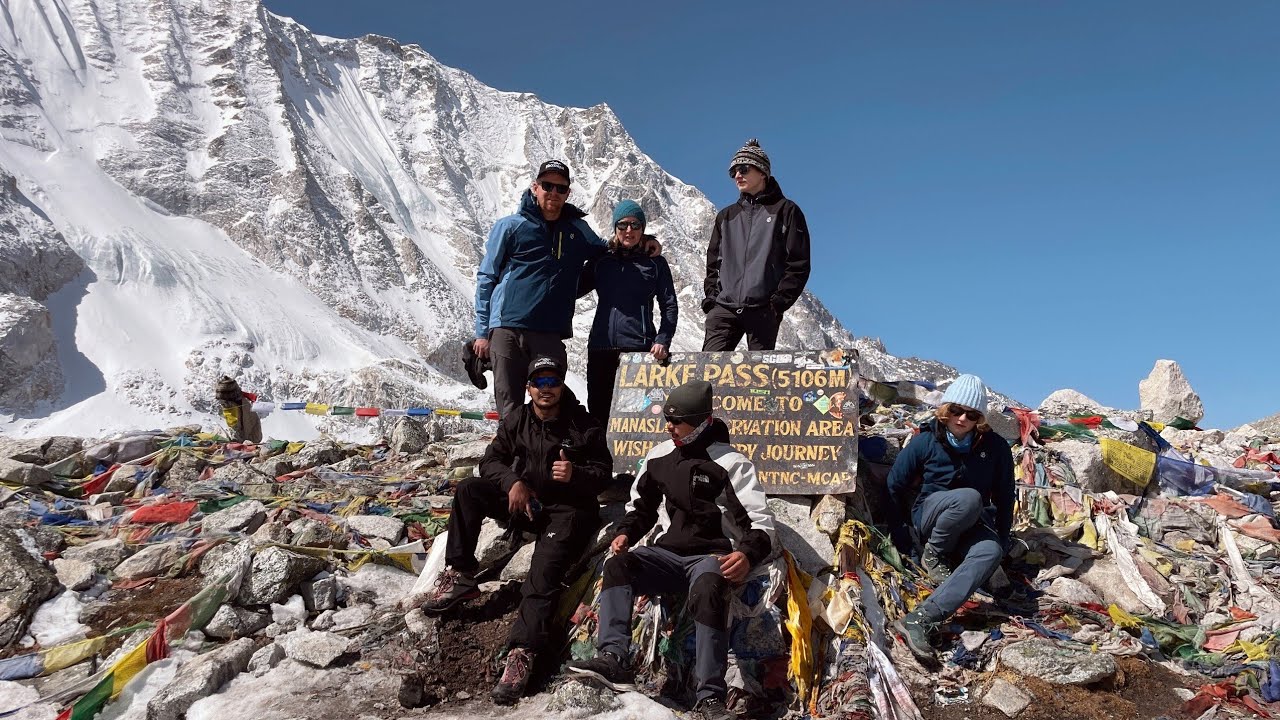
- Larkya La at 5,106 m — a long summit day over glaciated terrain where weather windows matter,
- Rapidly changing conditions — trail damage, bridge issues, snow at the pass outside peak windows.
A guide who leads Everest or Annapurna treks most of the year may be excellent — and still be learning Manaslu's specifics. "Is your guide licensed?" and "How often does your guide lead Manaslu?" are both legitimate questions, and the second one is arguably the more important.
18. Group size: what actually changes?
Group size changes the texture of the trek, and under the 2026 rules it also has a legal dimension.
Small group (2–5 trekkers):
- Easier coordination and faster decisions,
- Pace tailored closely to the group,
- Higher per-person cost (fewer people sharing fixed costs).
Larger group (6–15 trekkers):
- More social energy and lower per-person fixed costs,
- More variation in walking pace,
- More complex logistics — rooms, meals, teahouse space in villages with limited capacity.
The legal dimension: under the revised restricted-area rules, one guide may lead a maximum of seven trekkers. So a 12-person private group is never led by one guide — it requires at least two licensed guides, and a 15-person group may require three, depending on how the operator staffs it. At Places Nepal, the published "maximum 7 trekkers per guide" applies to every group size we run, and larger private groups are staffed with additional licensed guides accordingly.
If an operator quotes you a 12-person group with a single guide, that is not a savings — it is a compliance problem that will surface at the first checkpoint.
Note also: "small group" is not automatically "better service." A well-run eight-person group with two experienced guides often outperforms a disorganized four-person trip. Group size is one variable, not the verdict.
19. Fixed group vs private: a cost example with current Places Nepal rates
Using the currently published Places Nepal pricing (verify the live page before booking — rates change):
|
1 traveler / private | US$1,150 |
2–4 people (private) | US$980 per person |
5–10 people (private) | US$850 per person |
11–15 people (private) | US$750 per person |
Fixed group joining | US$980 per person |
Three things worth noticing:
- The solo private premium is real but bounded — US1,150vsUS1,150 vs US980 is a US$170 difference for total control of dates and pace. For some solo travelers that is money well spent; for others, joining a fixed group makes more sense.
- Two people erase the premium entirely — at current rates, a private trip for two costs the same per person as the fixed group.
- Larger groups drop further — at five people the rate falls to US850,andateleven−plustoUS850, and at eleven-plus to US750, because fixed costs spread across more shoulders. Remember that groups above seven trekkers require additional licensed guides, which is part of what the pricing covers.
These are today's published rates, not promises. Treat them as the current snapshot they are.
20. What happens after you book
A professional booking process should look roughly like this — here is how it works when you book the Manaslu Circuit with Places Nepal:
- Inquiry — you send your preferred dates, group size and any custom requests.
- Confirmation of availability and itinerary — we confirm the current 12-day itinerary and any variations.
- Deposit — you pay the required deposit to secure the booking. The exact deposit amount and payment schedule are set out in our booking and cancellation terms; read them before paying anything.
- Booking confirmation — you receive written confirmation with your itinerary and inclusions.
- Documents — you provide your passport copy, photos and insurance details for permit processing.
- Permits arranged — the agency processes your MRAP, MCAP, ACAP and other applicable permits before departure.
- Pre-trek logistics confirmed — pickup time, transport mode and any last questions settled.
- Guide briefing — you meet your guide before the trek begins and walk through the plan.
- Trek begins.
Any operator that skips the written-confirmation or documents steps is skipping the parts that protect you.
21. What documents should an operator ask for?
Expect any legitimate operator to request:
- Passport copy — valid for at least six months beyond travel,
- Passport-size or digital photo — for permit applications,
- Nepal visa details — the 2026 digitized system allows applications using a valid visa number, or an "Application Submission ID" for those applying from abroad,
- Travel insurance — currently required to cover trekking to 5,500 m including helicopter evacuation; verify the exact requirement on your operator's page,
- Emergency contact — someone not on the trek,
- Relevant health information — only what is genuinely needed for trip operations, such as conditions that affect altitude decisions.
A note on data: you should not be asked for unnecessary sensitive information — bank passwords, unrelated medical history, family documents. Professional operators collect what permits and safety require, and no more.
22. Insurance: what to verify before booking
Insurance is the piece of paperwork that becomes most important exactly when everything else has gone wrong. Before booking, verify your policy covers:
- High-altitude trekking — not just "hiking" or "walking," which some policies exclude above 3,000 m,
- The trek's actual maximum altitude — Larkya La is 5,106 m; policies with a 4,000 or 5,000 m ceiling are insufficient,
- Helicopter evacuation — including from remote trail sections, not just "medical evacuation" by road,
- Medical treatment in Nepal,
- Trip cancellation/interruption — relevant given the road and weather variables on this route,
- Baggage and loss — secondary, but useful.
Two honest caveats: insurance does not guarantee evacuation — helicopters fly when weather and operational conditions allow — and we deliberately do not recommend specific insurers here, because policy terms change and the right policy depends on your home country and health profile. Read the altitude and evacuation clauses yourself, in writing, before you pay a deposit.
23. Permits: what your operator should handle
For the standard Manaslu Circuit in 2026, the paperwork bundle generally comprises:
- Manaslu Restricted Area Permit (MRAP/RAP) — issued by the Department of Immigration, only through a registered trekking agency; seasonal pricing applies (USD 100 for the first 7 days September–November, USD 75 December–August, with per-day additions),
- Manaslu Conservation Area Permit (MCAP) — around USD 20–30 for most foreign nationals,
- Annapurna Conservation Area Permit (ACAP) — same approximate range, required for the Dharapani exit,
- TIMS card — Nepal Tourism Board's current guidance lists the Manaslu Circuit among routes requiring a TIMS card arranged through a registered agency; operator practice varies, so have your agency confirm the current requirement in writing before processing,
- Local municipal fee — the Chumnubri Rural Municipality fee collected in the lower valley.
TIMS is currently not being enforced on the Manaslu Circuit trail. You may still find older or conflicting information online because TIMS requirements and enforcement have changed over time.
Places Nepal Treks: We monitor the current permit and trekking requirements before each departure and follow the requirements being applied at the time of your trek. If the authorities reinstate or change the TIMS requirement for Manaslu, Places Nepal will arrange the TIMS card for our trekkers at no additional charge.
For the most current information, you can also contact our Trek Advisor directly before your permit is processed.
24. Why permit handling matters when choosing an operator
Permit handling is not clerical trivia — on a restricted-area trek it is the skeleton of the whole trip. A proper operator:
- collects the correct passport details and photos at the right time,
- processes the correct permits for your exact dates and route,
- assigns a licensed guide whose details accompany the application,
- keeps permit records organized for checkpoint presentation,
- manages corrections quickly if a detail is wrong,
- builds the permit timeline into your booking so nothing is rushed.
The single best permit question you can ask any operator: "Are all required Manaslu permits — MRAP, MCAP, ACAP, local fees, and TIMS if currently applicable — included in your quoted price, and will you confirm that in writing?" The answer sorts professionals from intermediaries in one exchange.
25. What happens if your guide is unavailable?
Guides are human: illness, family emergencies and injuries happen. The question is not whether your operator has a backup plan — it is whether they can describe it in one sentence.
Ask before booking:
- Who is the backup guide if mine becomes unavailable?
- Who manages the trek if the lead guide becomes ill on the route?
- Who do I contact after hours during the trek?
- Is there an office contact monitoring the trek in Kathmandu?
This is not about dramatic scenarios. It is operational resilience — the difference between a company with a staff bench and a company with one overworked guide and a prayer.
26. What happens if weather or road conditions disrupt the trek?
Every Manaslu trek starts and ends with substantial road travel — Kathmandu to the trailhead at Machha Khola or Soti Khola, and out from Dharapani via Besisahar. These roads are mountain roads: monsoon rain, landslides, roadworks and seasonal closures can change conditions with little notice.
A good operator should:
- monitor current road conditions in the days before your departure,
- communicate changes proactively — you should not learn about a blocked road at the bus station,
- adjust transport — switching between bus and jeep options where needed,
- discuss schedule options with you honestly, including the trade-offs of each,
- prioritize safety over the printed itinerary,
- explain any extra costs before they are incurred, not after.
No operator can promise the road will be clear — anyone who does is guessing. The credible promise is about response: monitoring, communication and options. For current road conditions and transport logistics, see our dedicated Manaslu transport and road-status guide: [INSERT THE FINAL VERIFIED URL FOR THE MANASLU TRANSPORT / ROAD STATUS ARTICLE].
27. What happens if you get altitude sickness?
The honest answer: the same thing that should happen on every well-run high-altitude trek, and it starts with your guide.
The standard, evidence-based chain is:
- The guide watches — appetite, sleep, headache, nausea, coordination, unusual fatigue.
- The ascent stops — no higher sleeping elevation while symptoms are present.
- Reassessment — symptoms improving at the same altitude means rest; worsening means descent.
- Agency communication — the guide contacts the office, which activates support.
- Descent or evacuation — coordinated by the agency, which, under the 2026 rules, carries explicit responsibility for rescue and logistical arrangements.
Guides observe and coordinate; they do not diagnose every illness, and no article — including this one — replaces medical advice. For a full treatment of altitude on this route, see our Manaslu difficulty and altitude guide. What you are evaluating in an operator is whether this chain exists, is written down, and has been used before.
28. Questions to ask an operator before paying
Print this table. Use it with any operator, including us.
|
Is your agency registered to arrange Manaslu trekking? | Restricted-area compliance |
Is my guide licensed? | Legal requirement |
How many trekkers will be with one guide? | Legal ratio is max 1:7 |
Is my trip fixed-group or private? | Determines flexibility |
What exactly is included? | Prevents surprise costs |
Which permits are included — MRAP, MCAP, ACAP, TIMS, local fees? | Avoids paperwork problems |
What happens if the road is blocked? | Logistics |
What is the emergency plan? | Remote-route preparedness |
What happens if I need to leave the trek early? | Medical/logistical clarity |
What is your cancellation policy? | Financial protection |
Who is my guide? | You know who is actually leading |
Is porter service included? | Luggage planning |
Are your guides and porters insured? | Staff welfare, professionalism |
What insurance do you require from me? | 5,500 m + helicopter evacuation is the current standard |
An operator worth booking answers all fourteen without defensiveness.
29. Red flags when comparing operators
Evidence-based warning signs — none of these involve price:
- Refuses to explain the permits — which ones, whose name, included or not,
- Cannot identify the guide — "we'll assign someone later" with no staffing detail,
- Unclear inclusions — a quote that says "all included" but will not itemize,
- A large group with too few guides — more than seven trekkers per guide violates the 2026 rule outright,
- No written cancellation terms — your deposit has no documented status,
- Impossible promises about road travel — guaranteed timings on landslide-prone mountain roads,
- Refuses to explain emergency procedures — no answer to "who do I call?",
- Changes the itinerary only after payment — the classic bait structure,
- Pushes payment before providing basic trip information — deposit pressure is a data point.
Notice what is not on this list: a low price. Cheap is not a red flag; opaque is.
30. Places Nepal: how the current Manaslu product is structured
Transparency works both ways. Here is our current product, stated plainly — verify it all on the live page before booking:
Standard Manaslu Circuit: 12 days, Kathmandu to Kathmandu, crossing Larkya La at 5,106 m with a Samagaun acclimatization day.
Fixed group: current published joining rate US$980 per person; dates vary by season — check current departures.
Private: current published pricing is US1,150foronetraveler,US1,150 for one traveler, US980 per person for 2–4, US850perpersonfor5–10,andUS850 per person for 5–10, and US750 per person for 11–15. All pricing is subject to change.
Included: licensed guide, mountain teahouse accommodation, meals on trek, permits (MRAP, MCAP, ACAP as applicable, plus local fees), ground transfers, and trekking logistics. The current insurance requirement is coverage to 5,500 m including helicopter evacuation. Verify the full live inclusion list on the trip page.
Guide and group size: every trip runs with a licensed guide, and never more than seven trekkers per guide. Private groups above seven trekkers are staffed with additional licensed guides.
We are not claiming this is the best product on the market — we are claiming it is specific, current and checkable, and we would encourage you to hold every operator you consider to exactly this standard of specificity. See the full current details on our Manaslu Circuit Trek page. If you are short on time, we also run a short Manaslu Circuit option — though the standard 12-day itinerary is the safer acclimatization profile for most people.
31. Why a local operator matters — without the sales pitch
A Nepal-based operator can offer genuine, structural advantages on a route like Manaslu:
- Direct communication in Nepal — your operator is in the same time zone as the problem,
- Local transport coordination — relationships with jeep and bus operators on the Kathmandu–Arughat–Machha Khola corridor,
- Faster response to road and trail changes — when a landslide blocks the road, a local office hears about it first,
- A local guide network — guides hired and known directly, not subcontracted through a chain,
- Permit processing — walking the application into the Department of Immigration is a local errand, not an international correspondence,
- Local emergency coordination — helicopter operators, clinics in Besisahar and Kathmandu, and trail contacts are working relationships, not phone-book entries.
What we will not claim: that overseas agencies are inherently worse, or that "local" automatically means "safer." What we will say, because it is verifiable, is this: local presence makes real-time logistics easier on a route where road and weather conditions can change overnight. That is a structural fact, not a marketing slogan.
32. Booking direct vs through an overseas trekking company
Both structures can work. The questions differ.
Booking direct with a Nepal operator tends to offer:
- direct local communication once you arrive,
- simpler local logistics with fewer hand-offs,
- fewer intermediaries between you and the people actually running the trek,
- easier customization, because the operator controls the itinerary.
Booking through an overseas company tends to offer:
- communication in your home market, language and time zone before travel,
- one familiar point of contact for the whole package,
- arrangements that may bundle international flights or home-country payment protections.
Neither is universally better. What matters is what sits behind the brand. Ask any overseas company: who actually operates the trek? Who employs the guide? Who processes the permits? Who handles the emergency? Who do I pay, and whose cancellation terms apply? If the overseas company is a reseller of a local operator, you want to know which local operator — and then evaluate that company by everything in this article. If the overseas company runs its own Nepali operation with its own guides, evaluate that operation directly.
The best booking structure is the one where you can answer, before paying: who is operating my trek, who is my guide, and who helps me if something goes wrong.
33. Compare your Manaslu trek quote
Use this blank framework with any quotations you receive. We have deliberately not filled in competitor data — it is yours to complete with real quotes.
[OPERATOR COMPARISON TABLE]
|
Registered agency |
|
| Yes — verify registration on request |
Licensed guide included |
|
| Yes |
Trekkers per guide (max 7) |
|
| Max 7 |
MRAP included |
|
| Yes |
MCAP included |
|
| Yes |
ACAP included |
|
| Yes |
TIMS / local fees |
|
| Confirm current requirement in writing |
Transport (type) |
|
| Ground transfers included |
Accommodation |
|
| Teahouse twin-sharing |
Meals |
|
| Included on trek |
Porter |
|
| Optional / confirm current package |
Insurance responsibility |
|
| Trekker policy to 5,500 m + heli evacuation; staff insured |
Cancellation terms |
|
| See Places Nepal terms |
Price |
|
| See current rates |
Fill it in, line by line. The right operator is usually obvious by row seven.
34. Manaslu Circuit route map
[INTERACTIVE OSM/UMap EMBED]
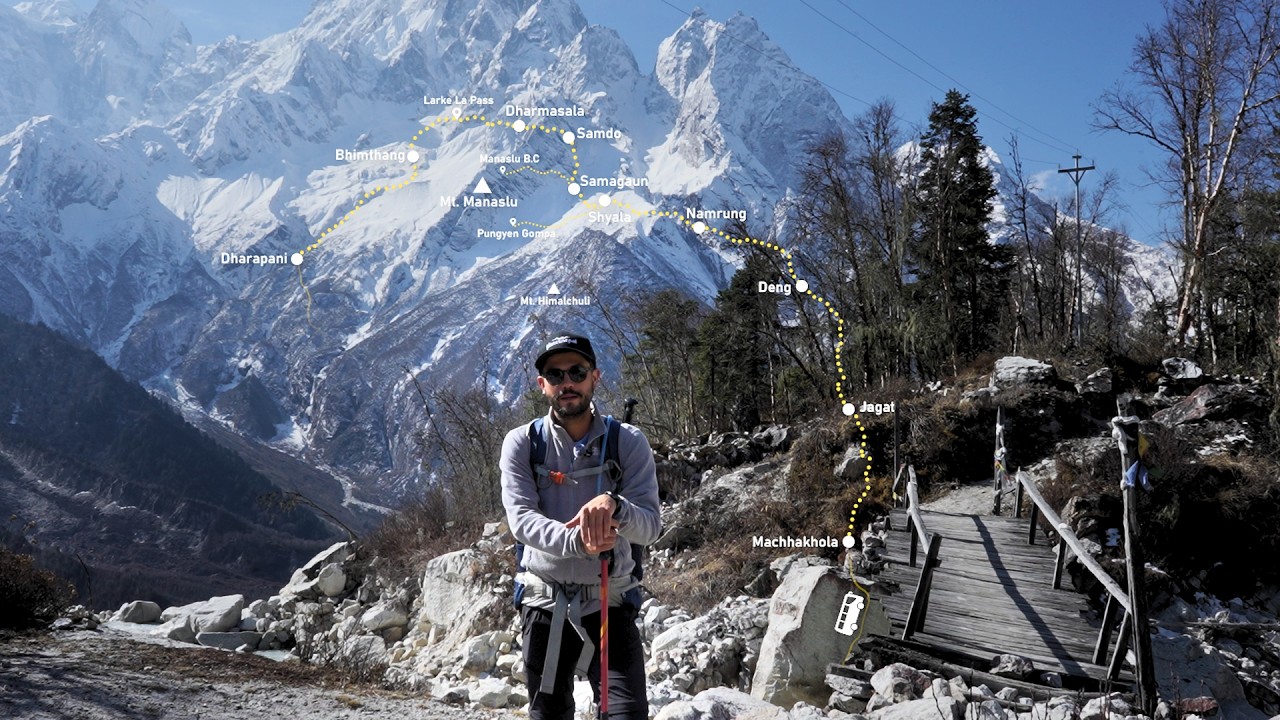
The route runs west to east through the restricted valley, crossing Larkya La before descending to the Annapurna side: Machha Khola → Jagat → Deng → Namrung → Lho → Samagaun → Samdo → Dharamsala/Larkya Phedi → Larkya La (5,106 m) → Bhimthang → Dharapani. For day-by-day detail, see our complete Manaslu Circuit guide.
35. FAQ
Can I trek Manaslu solo in 2026?
Yes — solo travelers can now obtain an individual restricted-area permit following the Department of Immigration's 22 March 2026 rule change. You must still travel with a licensed guide through a registered agency. "Solo" means solo with your own guide, not guideless.
Do I still need a guide for Manaslu?
Yes. The licensed-guide requirement did not change in March 2026 and is enforced at checkpoints along the route. A porter cannot substitute for a licensed guide.
Do I need to book through a registered agency?
Yes. The Manaslu Restricted Area Permit can only be processed through a registered Nepali trekking agency — individual applications are not accepted, and the agency carries responsibility for your trek's logistics and emergency arrangements.
How do I choose a Manaslu trekking operator?
Verify registration, guide licensing, permit handling, written inclusions, group size (max seven trekkers per guide), emergency procedures and cancellation terms. Choose the operator whose answers are clear and documented, not the one with the loudest claims. See the seven-check framework in this article.
Should I join a group or book privately?
Join a fixed group if your dates are flexible and you want the lowest per-person cost plus a social experience. Book privately if you have specific dates, want your own pace, or are traveling as a couple, family or friend group. At current Places Nepal rates, two people booking privately pay the same per-person rate as the fixed group.
Is a private Manaslu trek more expensive?
Per person, usually yes for solo travelers — fixed costs are unshared. But the premium is bounded: currently US1,150soloprivateversusUS1,150 solo private versus US980 for two people private or fixed-group joining. Larger private groups drop to US850andUS850 and US750 per person at current published tiers.
How much does the Manaslu Circuit cost with Places Nepal?
Current published rates are US1,150forasoloprivatetrek,US1,150 for a solo private trek, US980 per person for 2–4 people, US850for5–10,US850 for 5–10, US750 for 11–15, and US$980 per person for fixed group joining. Verify live pricing before booking. Our full cost breakdown covers the extras beyond the package price.
How many people can one guide lead?
A maximum of seven trekkers per licensed guide under the 2026 restricted-area rules. Larger groups require additional guides — a 12-person group needs at least two.
What should be included in a Manaslu trek package?
At minimum: licensed guide, teahouse accommodation, meals, MRAP, MCAP, ACAP, local fees, ground transfers and logistics. TIMS may also be required under current NTB guidance — confirm in writing with your agency. Read our trekker reviews for how this looks in practice.
What permits does the Manaslu Circuit require?
MRAP (restricted-area permit), MCAP, ACAP and the Chumnubri municipal fee; TIMS is listed by the Nepal Tourism Board as required for Manaslu, though practice varies — have your agency confirm before processing. If you add Tsum Valley, a separate Tsum restricted-area permit applies.
How do I verify that an operator is legitimate?
Ask for their Nepal company registration details, TAAN membership, guide licensing, written itinerary and cancellation terms. Legitimate operators answer quickly and completely. Registration proves legality; pair it with references or reviews for service quality.
Should my guide be experienced specifically on Manaslu?
Yes — Manaslu combines restricted-area logistics, rough road access, remote villages and a 5,106 m pass. Ask any operator, including us, how often their guide leads Manaslu specifically, not just whether the guide is licensed.
What happens if the road is blocked?
A professional operator monitors road conditions, communicates changes, adjusts transport and discusses schedule options with you before decisions are made. No honest operator guarantees road timings on this route.
What happens if I get sick during the trek?
Your guide stops the ascent, monitors symptoms, communicates with the agency, and coordinates descent or evacuation if needed. Under the 2026 rules, the facilitating agency is formally responsible for rescue and logistical arrangements. Your insurance should cover evacuation to 5,500 m.
Should I book directly with a Nepal operator?
Direct booking offers simpler local logistics and easier customization; overseas companies offer home-market communication. Either can work — the decisive questions are who actually operates the trek, who employs the guide, and who handles emergencies.
What questions should I ask before paying a deposit?
The fourteen-question table in section 28 of this article covers the essentials: registration, licensing, guide ratios, inclusions, permits, road contingencies, emergency plans, early-exit procedures, cancellation terms and porter arrangements.
How far in advance should I book Manaslu?
Ideally 4–6 weeks before your preferred start date, to allow permit processing, guide assignment and buffer time for road or schedule changes. Peak-season fixed departures (October–November) can fill earlier. Last-minute bookings are sometimes possible but reduce your options.
36. Before you pay for your Manaslu trek
Everything in this article compresses into five confirmations. Make them before any deposit leaves your account:
- Who is operating my trek? A named, registered, checkable company — not a brand reselling an unknown local operator.
- Who is my guide? Licensed, Manaslu-experienced, and assigned — not "to be decided."
- What exactly does my price include? Every permit, every meal, every transfer — in writing.
- What happens if the road, weather or altitude changes the plan? A described process, not a shrug.
- What are the cancellation and refund terms? Documented before payment, in writing.
Only after those five answers should the headline price enter your comparison. Price is the last thing to compare, not the first — because a cheap trek you cannot verify and a fairly priced trek you fully understand are not the same product.
If you are at the stage of comparing real itineraries, current inclusions and live departure options, take a look at the Manaslu Circuit Trek as we currently run it — and hold us to every standard in this article when you do.