Not sure which Mardi Himal Trek itinerary is right for you? Compare 3 to 9-day routes, discover what each itinerary includes, and choose the perfect trek based on your schedule, experience, and travel style.
Quick answer: The best Mardi Himal Trek itinerary for most people is the 5-day version from Pokhara — up via Kande and Forest Camp, two ascending nights before High Camp, a sunrise push to the Upper Viewpoint or Base Camp (4,500 m), and a descent through Sidhing. Choose the 3–4 day versions only if you are fit and short on time, and the 6–9 day versions if you want a gentler pace, photography time on the ridge, or village extensions through Ghandruk and Australian Camp.
Here is a conversation we have in our Thamel office almost every week. A trekker sits down, says they have found the Mardi Himal Trek online, and then asks the question that every operator answers differently: "So… how many days is it, actually?"
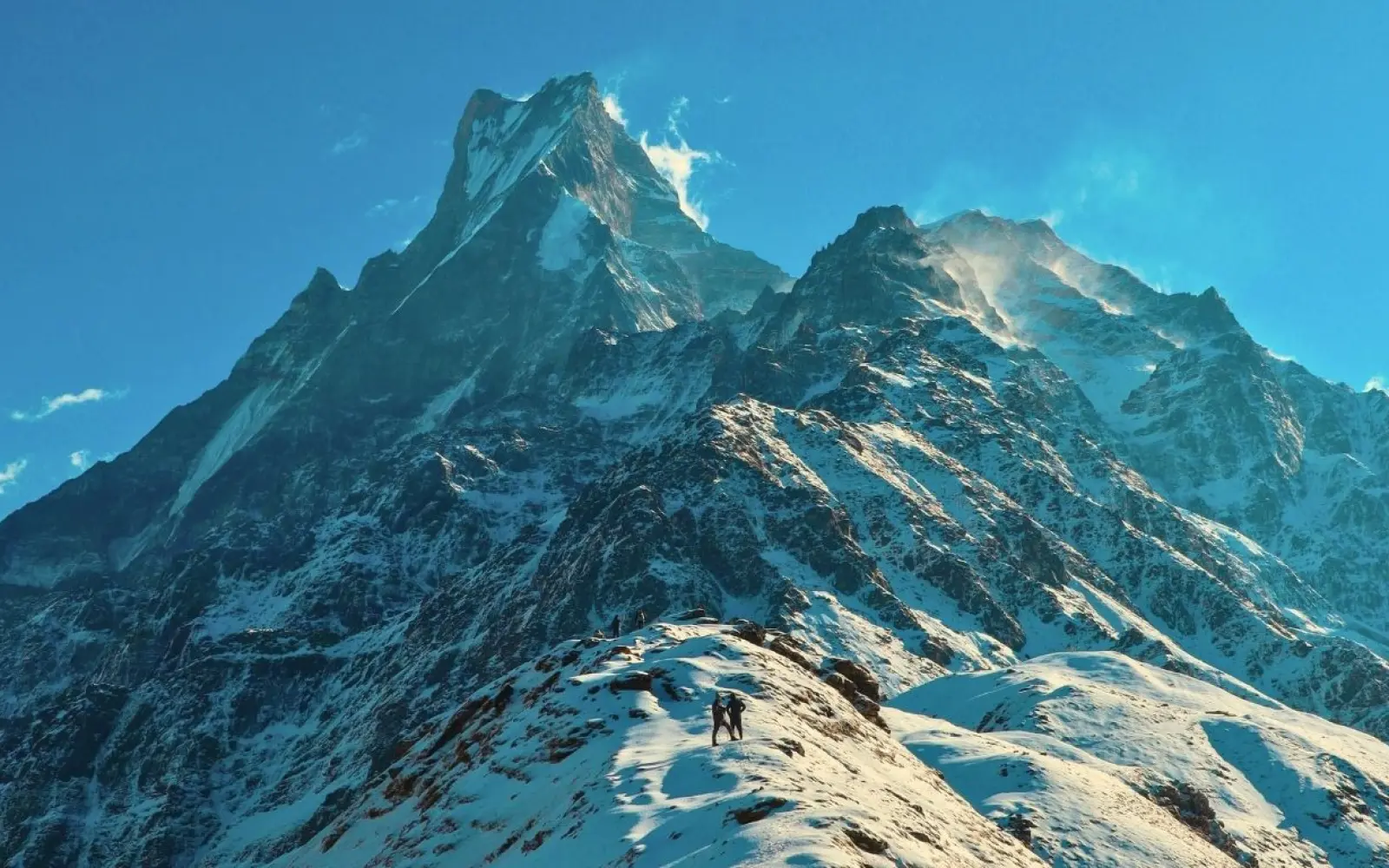
And the honest answer is: it depends who you ask. Search for a Mardi Himal itinerary and you will find 3-day sprints, 4-day loops, 5-day classics, 7-day "relaxed" versions, and 9-day packages that start and end in Kathmandu. None of them are wrong. They are all walking the same ridge — a long, beautiful spur of forest and alpine grass that climbs straight toward the west face of Machhapuchhre. The difference is simply how the days are cut: where you start walking, where you sleep, how much buffer you give the altitude, and whether the itinerary counts your travel days.
That flexibility is exactly why Mardi Himal has become one of Nepal's most booked short treks. But it is also why so many people choose the wrong version for their fitness, their schedule, or the season they are travelling in — and either burn out on a 3-day push or feel under-walked on a padded 9-day package.
This guide compares every common Mardi Himal itinerary from 3 to 9 days, day by day, and then gives you a simple decision framework based on what we see actually work on the trail. Our guides walk this ridge in every season, so alongside the schedules you will find the practical details that rarely make it into brochures: where the water sources dry up, which nights get cold enough to matter, where the 3-day version goes wrong, and why we almost always route the descent through Sidhing.
If you just want the trek handled end to end, our Mardi Himal Trek package runs on the 5-day framework described below and can be stretched or compressed to any of the variants in this article.
Why the Number of Days Matters More on Mardi Himal Than You'd Think
On paper, Mardi Himal looks forgiving. Total trekking distance is modest — roughly 40–55 km depending on your start and end points — and there are teahouses at convenient intervals the whole way up the ridge. So why does itinerary length matter so much?
Because of the altitude profile. Mardi Himal is a short trek that climbs high. The trail starts near Kande at 1,770 m and tops out at Mardi Himal Base Camp at 4,500 m — a vertical gain of more than 2,700 m. On a classic long trek like the Annapurna Circuit, that kind of gain is spread over a week or more. On Mardi Himal, a 3-day itinerary asks your body to absorb it in about 48 hours.
The general rule of altitude acclimatization — once above 3,000 m, avoid raising your sleeping elevation by much more than 500 m per night — is easy to respect on a 5-day itinerary and almost impossible to respect on a 3-day one. High Camp sits at 3,580 m. Whether you sleep well there, and whether you enjoy the pre-dawn climb to the viewpoint instead of surviving it, is largely determined by how many nights you spent getting there.
The second reason length matters is the weather window. The famous Mardi Himal views — Machhapuchhre filling the sky ahead of you, Annapurna South and Hiunchuli stacked to the west — are a morning phenomenon for much of the year. Clouds typically build from late morning, especially in spring. Longer itineraries buy you more mornings on the upper ridge, which is why photographers almost never book the short versions.
So when you compare the itineraries below, don't just count days. Look at two things: how many nights you sleep above 2,500 m before High Camp, and how many mornings you get above Badal Danda. Those two numbers predict your experience better than the total duration does.
Mardi Himal Itineraries Compared: 3 to 9 Days at a Glance
All durations below are counted from Pokhara unless stated otherwise. Every version requires the same permits and reaches the same viewpoint — what changes is pace, acclimatization, and how much of the lower trail you walk versus drive.
| Itinerary | Route summary | Highest sleep | Daily walking | Difficulty | Best for |
|---|
| 3 days | Jeep to Sidhing/road-head → Low Camp → High Camp → viewpoint → jeep out | High Camp (3,580 m) | 6–8 hrs | Demanding | Very fit, altitude-experienced trekkers on tight schedules |
| 4 days | Kande → Forest Camp → High Camp → viewpoint → Sidhing → jeep out | High Camp (3,580 m) | 5–7 hrs | Moderate–demanding | Fit hikers who want the full trail on a short break |
| 5 days ⭐ | Kande → Forest Camp → Low Camp/Badal Danda → High Camp → viewpoint → Sidhing | High Camp (3,580 m) | 4–6 hrs | Moderate | Most trekkers — the balanced classic |
| 6 days | Adds a night at Australian Camp/Pothana or a second upper-ridge night | High Camp (3,580 m) | 4–5 hrs | Moderate | First-time trekkers, photographers, relaxed pace |
| 7 days | Slow ascent with nights at Deurali, Forest Camp, Badal Danda, and High Camp | High Camp (3,580 m) | 3–5 hrs | Easy–moderate | Families, older trekkers, anyone prioritizing acclimatization |
| 8 days | The 5–6 day trek packaged from Kathmandu with travel days both ways | High Camp (3,580 m) | 4–6 hrs | Moderate | Travellers landing in Kathmandu who want everything handled |
| 9 days | Mardi ridge plus a village extension via Lwang or Ghandruk, from Kathmandu | High Camp (3,580 m) | 4–6 hrs | Moderate | Trekkers who want mountains and Gurung culture in one trip |
⭐ The 5-day itinerary is the version we recommend to the majority of trekkers and the framework our standard Mardi Himal Trek departures follow.
First, Understand the Trail: The Stops Every Itinerary Is Built From
Every Mardi Himal itinerary — whether 3 days or 9 — is assembled from the same short list of overnight stops. Once you know what each one is like, the differences between the itineraries become obvious. Here is the ridge from bottom to top, as our guides describe it to clients.
Kande (1,770 m) — the classic trailhead
A roadside settlement about 45 minutes to an hour's drive west of Pokhara on the Baglung Highway. Almost every full-length itinerary starts walking here. The first hour is a steady stone-step climb to Australian Camp, and it is honest work — many trekkers are surprised that the "easy" trek opens with its steepest sustained staircase.
Australian Camp (2,060 m) and Pothana (1,990 m) — the soft first night
A grassy shelf with wide views back over the Pokhara valley and, on clear evenings, a first proper look at Machhapuchhre. Longer itineraries sleep here on night one to keep day one short and to catch the sunrise; shorter itineraries walk straight through. Pothana, twenty minutes further, is where your permits are checked and registered.
Pitam Deurali (2,100 m) — where the ridge trail leaves the crowds
At Deurali the Mardi trail splits away from the busier Annapurna Base Camp and Ghandruk routes and turns north onto the ridge itself. From this junction onward the character of the trek changes completely: fewer trekkers, denser forest, and a trail that follows the crest almost the entire way to base camp.
Forest Camp / Kokar (2,600 m) — the deep-forest night
Exactly what the name promises: a clearing of teahouses inside old-growth rhododendron and oak forest, with moss on everything and no mountain views at all. In late March and April the surrounding forest is one of the best rhododendron displays in the Annapurna region. Nights here are mild, food is good, and it is the standard first night for 4- and 5-day itineraries.
Low Camp (2,970 m) — first glimpse of the wall
An hour and a half to two hours above Forest Camp, still in trees but thinning. From the upper teahouses you get your first framed view of Machhapuchhre's summit through the branches — the moment most trekkers' cameras come out for the first time.
Badal Danda (3,210 m) — "the hill of clouds," and our favourite secret
Thirty to forty-five minutes above Low Camp, the forest ends abruptly at the treeline and the ridge opens into alpine grassland. Badal Danda's teahouses sit right on the crest with unobstructed sunrise views of Annapurna South, Hiunchuli, and Machhapuchhre — views very nearly as good as High Camp's, at 370 m lower altitude. On itineraries of 5 days and up, we often sleep here instead of Low Camp: you sleep better, and you wake up already above the clouds that give the place its name.
High Camp (3,580 m) — the launchpad
The highest teahouses on the ridge and the base for the summit-morning push. Expect dormitory-style or basic twin rooms, cold nights (well below freezing from late autumn through spring), and a 4:00–5:00 a.m. start the next morning. Every itinerary, regardless of length, sleeps here the night before the viewpoint.
Upper Viewpoint (approx. 4,200 m) and Mardi Himal Base Camp (4,500 m) — the payoff
From High Camp a narrow trail climbs the grassy crest for two to three hours to the Upper Viewpoint, where the ridge delivers its full amphitheatre: Machhapuchhre close enough to feel, the Annapurna wall running west, and Mardi Himal itself overhead. Base Camp is another hour or so beyond, along an exposed section of trail. Our guides' honest take: the view from Base Camp adds drama and bragging rights, but the panorama at the Upper Viewpoint is essentially the same. In snow or high wind, the viewpoint is where sensible parties turn around.
Sidhing (1,700 m) — the back-door descent
Instead of retracing the ridge, most itineraries descend High Camp's eastern flank through forest to the village of Sidhing, where jeeps run to Pokhara in about two and a half to three hours. This turns the trek into a loop, saves a full day, and ends the walk in a genuinely quiet farming village. The descent is long — around 1,800 m of downhill in one day — so trekking poles earn their keep here more than anywhere else on the route.
With those pieces in mind, here is how each itinerary assembles them.
The 3-Day Mardi Himal Itinerary: The Sprint
The concept: use the Sidhing road to skip the lower forest entirely, sleep just two nights on the mountain, and be back in Pokhara on the evening of day three. This version only became practical in recent years as the jeep track toward Sidhing and the lower ridge improved.
Day-by-day
- Day 1: Pokhara → Sidhing road-head by jeep, trek to Low Camp (2,970 m). Drive 2.5–3 hours, then climb steeply through forest for 4–6 hours depending on where the jeep can drop you. You sleep at nearly 3,000 m on your first night out of Pokhara (820 m).
- Day 2: Low Camp → High Camp (3,580 m), optional afternoon walk toward Badal Danda viewpoints. A shorter walking day of 3–4 hours, deliberately, because the altitude is stacking up fast. Early dinner, early sleep.
- Day 3: Pre-dawn climb to the Upper Viewpoint (approx. 4,200 m), descend all the way to Sidhing, jeep to Pokhara. This is a huge day: 2–3 hours up, then roughly 2,500 vertical metres of descent, then the drive. Most parties are walking for 9–10 hours.
Who the 3-day version is for
Trekkers who are genuinely fit — not gym-fit, but hill-fit — and ideally coming off recent time at altitude. We see it work well for people who have just finished another trek (Annapurna Base Camp, Poon Hill, or even Manaslu) and want a fast second objective while already acclimatized. It also suits trail runners and experienced hikers who treat long days as normal.
Where it goes wrong
Sleeping at Low Camp on night one means jumping more than 2,000 m of elevation in a single day. That is well outside conservative acclimatization guidance, and every season our guides meet 3-day trekkers at High Camp with headaches, nausea, and a summit morning they don't enjoy. There is also zero weather buffer: if your one viewpoint morning is clouded in or snowed out, the trek is over. And you skip the rhododendron forest, which in spring is half the reason to be here.
Our verdict: A legitimate option for the right trekker, but the version we recommend least often. If you have three days and average fitness, do Poon Hill or Australian Camp–Dhampus instead, and save Mardi for a trip when you can give it four or five.
The 4-Day Mardi Himal Itinerary: The Efficient Classic
The concept: walk the full ridge from Kande, but compress the ascent into two nights and exit via Sidhing. This is the shortest version that includes the whole trail, and it has become the default for fit trekkers on a one-week Nepal trip.
Day-by-day
- Day 1: Pokhara → Kande by road (1,770 m), trek to Forest Camp (2,600 m). Around 5–6 hours of walking through Australian Camp, Pothana, and Deurali, then the long forested traverse to Forest Camp. A solid but reasonable first day.
- Day 2: Forest Camp → High Camp (3,580 m). The big ascent day: roughly 1,000 m of gain over 5–6 hours, passing Low Camp and Badal Danda. You break out of the treeline mid-morning and walk the open crest all afternoon — on a clear day, one of the finest half-days of trekking in the Annapurna region.
- Day 3: High Camp → Upper Viewpoint (approx. 4,200 m) or Base Camp (4,500 m) → descend to Sidhing (1,700 m). Pre-dawn start for sunrise, back to High Camp for a late breakfast, then the long knee-testing descent to Sidhing. About 8–9 hours of total walking.
- Day 4: Sidhing → Pokhara by jeep. A 2.5–3 hour drive, back at the lakeside by late morning. Some operators compress this into the evening of day three; we prefer the overnight in Sidhing — the village is peaceful, the food is farm-fresh, and finishing a viewpoint day with a three-hour jeep ride is nobody's idea of fun.
Who the 4-day version is for
Regular hikers with good fitness who are comfortable with back-to-back 5–6 hour days and a 1,000 m ascent day. It is also the sweet spot for trekkers who have already spent a few days above 2,500 m earlier in their trip.
Trade-offs to know about
The jump from Forest Camp (2,600 m) to a night at High Camp (3,580 m) is nearly 1,000 m of sleeping-altitude gain in one hop — right at the edge of what most bodies handle smoothly. Most people manage it with nothing worse than a light headache; some don't. Like the 3-day version, you also get only one morning on the upper ridge, so a single bad-weather day can cost you the views.
Our verdict: The best short version. If you are fit and your schedule genuinely cannot fit five days, do this rather than the 3-day sprint — the Kande start earns you the forest, the full ridge walk, and a far saner first night.
The 5-Day Mardi Himal Itinerary: The One We Recommend Most ⭐
The concept: the full trail with three ascending nights instead of two. That one extra night is the highest-value day you can add to this trek: it splits the big ascent, keeps every walking day between four and six hours, and puts you at High Camp rested instead of wrecked.
Day-by-day
- Day 1: Pokhara → Kande (1,770 m) by road, trek to Forest Camp (2,600 m). 5–6 hours through Australian Camp, permit check at Pothana, lunch at Deurali, then the ridge-forest traverse. Night among the rhododendrons.
- Day 2: Forest Camp → Badal Danda (3,210 m). A deliberately short day of 3.5–4.5 hours through Low Camp and up to the treeline. Arriving at Badal Danda by early afternoon means you get the sunset and — the real prize — sunrise from the crest with the whole Annapurna wall turning pink. Sleeping here rather than pushing to High Camp is the single best pacing decision on this trek.
- Day 3: Badal Danda → High Camp (3,580 m). Just 1.5–2.5 hours of open ridge walking, leaving the afternoon free. Strong parties use it for an acclimatization walk partway toward the viewpoint — climb high, sleep low, exactly what the textbooks order. Everyone else drinks tea and watches clouds form below their feet.
- Day 4: High Camp → Upper Viewpoint (approx. 4,200 m) / Base Camp (4,500 m) → descend to Sidhing (1,700 m). The summit morning: headlamps at 4:30 a.m., sunrise at the viewpoint, the optional push to Base Camp if conditions and energy allow, then back to High Camp for breakfast and the long descent to Sidhing. A big day, but you are doing it acclimatized and rested.
- Day 5: Sidhing → Pokhara by jeep. Morning drive out, back at the lake for lunch.
Why this pacing works
Look at the sleeping altitudes: 2,600 m → 3,210 m → 3,580 m. Two gains of roughly 600 m and 370 m — both comfortably inside conservative acclimatization guidance. Compare that to the 4-day version's single 1,000 m jump. The result on the trail is visible: 5-day trekkers at the viewpoint are taking photos and eating chocolate; a good share of the compressed-itinerary trekkers around them are counting the minutes until descent.
The short day-3 walk to High Camp also builds in a hidden weather buffer. If your summit morning dawns cloudy, a 5-day itinerary can often flex — wait an hour for the clouds to lift, or in some cases swap the rest afternoon and viewpoint morning around. The compressed versions have no such slack.
Who the 5-day version is for
Almost everyone: first-time trekkers with reasonable fitness, mixed-ability groups, couples, and anyone whose goal is to enjoy the ridge rather than merely complete it. This is the framework our standard Mardi Himal Trek departures follow, and after years of running every variant, it is the one that produces the happiest trekkers per rupee spent.
Our verdict: The best all-round Mardi Himal itinerary, full stop. Unless your schedule forces the 4-day version or your travel style calls for the slower ones below, choose this.
The 6-Day Mardi Himal Itinerary: The Comfortable One
The concept: take the 5-day framework and add one more night — either at the start (Australian Camp or Pothana) for a gentle warm-up, or on the upper ridge for a second high morning. Which extra night you choose changes the character of the trek, so it's worth deciding deliberately.
Option A: the soft-start version
- Day 1: Pokhara → Kande, short trek to Australian Camp (2,060 m). Barely two hours of walking — the steep staircase from Kande and then you're done. Sunset and sunrise over the Annapurnas from the meadow, and a relaxed shake-down for boots, poles, and daypacks.
- Day 2: Australian Camp → Forest Camp (2,600 m). 4–5 hours through Pothana and Deurali.
- Day 3: Forest Camp → Badal Danda (3,210 m).
- Day 4: Badal Danda → High Camp (3,580 m), with an acclimatization walk in the afternoon.
- Day 5: Summit morning, descend to Sidhing (1,700 m).
- Day 6: Sidhing → Pokhara by jeep.
Option B: the second-high-morning version
Follow the 5-day plan exactly, but after the summit morning descend only as far as Badal Danda or Low Camp and sleep there, finishing the descent to Sidhing the next day. This gives you two sunrises above the treeline and breaks the brutal single-day descent into two civilized halves. Photographers should default to this option without hesitation — the evening and dawn light at Badal Danda after a viewpoint morning is the best photographic value on the entire route.
Who the 6-day version is for
First-time trekkers who want margin everywhere, travellers who value evenings in camp as much as hours on the trail, photographers (Option B, always), and anyone whose knees have opinions about 1,800 m descent days. It is also the right call for spring trekkers who want unhurried time in the rhododendron zone.
Our verdict: The best "holiday-pace" version. You give up nothing except one extra day, and you gain a warm-up night or a second summit-zone morning — both excellent trades.
The 7-Day Mardi Himal Itinerary: The Gentle Ascent
The concept: the slowest practical version of the trek, with no walking day longer than about five hours and sleeping-altitude gains held to a few hundred metres at a time. This is the itinerary we build for families with teenagers, trekkers in their sixties and seventies, and anyone with a history of struggling at altitude.
Day-by-day
- Day 1: Pokhara → Kande, trek to Pothana (1,990 m) or Pitam Deurali (2,100 m). 2.5–3.5 hours, ending at the ridge junction. Sleeping at Deurali sets up a beautifully short day two.
- Day 2: Deurali → Forest Camp (2,600 m). 3.5–4 hours of rolling forest trail — the loveliest low-effort day on the mountain.
- Day 3: Forest Camp → Low Camp (2,970 m). Under two hours of walking. Yes, really. The afternoon is for resting, reading, and the first framed views of Machhapuchhre. This deliberately tiny day is what makes the whole profile work for altitude-sensitive trekkers.
- Day 4: Low Camp → Badal Danda (3,210 m) or High Camp (3,580 m), depending on how the group is feeling. A flexible pivot day — this is where a good guide earns their salary, reading the group and choosing the right stop.
- Day 5: Move to High Camp (if not already there); acclimatization walk toward the viewpoint.
- Day 6: Summit morning at the Upper Viewpoint or Base Camp, descend to Sidhing (1,700 m).
- Day 7: Sidhing → Pokhara.
Who the 7-day version is for
Multi-generational families, older trekkers, anyone returning from injury, and people who simply do not want to be tired on holiday. It is also quietly the best version for trekkers who have had altitude sickness before: with three nights between 2,600 m and 3,580 m before the summit push, the acclimatization profile is about as forgiving as this mountain allows.
Trade-offs to know about
Some fit trekkers find the middle days too short and get restless — if you regularly hike five-plus hours at home, choose the 5- or 6-day version instead. Costs also rise with each teahouse night and guide day, though on Mardi Himal the increments are modest (more on cost below).
Our verdict: The right tool for a specific job. If anyone in your group is over 60, under 15, or altitude-anxious, this is the version that gets everybody to the viewpoint smiling.
The 8-Day Mardi Himal Itinerary: The Kathmandu-to-Kathmandu Package
The concept: this isn't a different trek — it's the 5- or 6-day trek wrapped in travel logistics. When you see "Mardi Himal Trek – 8 Days" advertised, read the fine print: it almost always means arrival logistics in Kathmandu, a travel day to Pokhara, the standard trek, and the return journey. Understanding this prevents the most common itinerary-comparison mistake trekkers make: comparing a 5-day Pokhara-based price against an 8-day Kathmandu-based price as if they were different products.
Day-by-day
- Day 1: Kathmandu → Pokhara. Tourist bus (6–8 hours along the Prithvi Highway, longer when roadworks are active) or a 25-minute flight. Evening by Phewa Lake, final gear checks in the Lakeside shops.
- Days 2–6: The 5-day trek as described above — Kande to Forest Camp, Badal Danda, High Camp, summit morning, descent to Sidhing.
- Day 7: Sidhing → Pokhara. Jeep out by mid-morning, afternoon free — boating on the lake, the Peace Pagoda, or simply a long lunch with the mountains you just stood under on the skyline.
- Day 8: Pokhara → Kathmandu.
Who the 8-day version is for
International travellers landing in Kathmandu who want a single booking that handles everything: airport pickup, hotels, transport, permits, guide, and the trek itself. It is the natural format for first visits to Nepal, and the way most of our overseas clients book Mardi Himal.
One honest tip from our operations desk
If your international flight lands late or you are prone to jet lag, add a buffer day in Kathmandu before day one. The Kathmandu–Pokhara road journey is long, and starting a trek on the back of a red-eye arrival plus an eight-hour bus is a rough opening 48 hours. Flying to Pokhara instead buys back most of a day for a modest fare difference.
Our verdict: The most convenient format for visitors starting from Kathmandu. Just be clear you are buying the 5-day trek plus logistics — and compare prices accordingly.
The 9-Day Mardi Himal Itinerary: Mountains Plus Villages
The concept: the Kathmandu-based package with a genuine extension — usually a cultural detour that the shorter versions have no room for. Two extensions dominate, and they suit different people.
Option A: exit through Lwang village
Instead of descending from Sidhing directly to the road, continue to Lwang, a Gurung village on the eastern flank famous for its terraced tea gardens — one of the few places in Nepal where you can walk through working tea fields with Machhapuchhre on the horizon. A night in a Lwang homestay, with home cooking and often a spontaneous cultural evening, is consistently the moment 9-day clients tell us they remember most. From Lwang, jeeps run to Pokhara.
Option B: start through Ghandruk
Reverse the usual direction of approach: drive toward the Modi Khola valley, spend a night in Ghandruk (1,940 m) — one of the largest and most beautiful Gurung villages in Nepal, with its stone houses, traditional museum, and grandstand views of Annapurna South — then cross to the Mardi ridge via Landruk and Forest Camp. This threads two classic Annapurna experiences into one trek and adds a half-day of trail almost nobody else is walking.
9 Day Mardi Trek day-by-day (Lwang version)
- Day 1: Kathmandu → Pokhara.
- Day 2: Pokhara → Kande → Forest Camp (2,600 m).
- Day 3: Forest Camp → Badal Danda (3,210 m).
- Day 4: Badal Danda → High Camp (3,580 m), acclimatization walk.
- Day 5: Summit morning — Upper Viewpoint / Base Camp — descend to Badal Danda or Low Camp.
- Day 6: Descend to Sidhing (1,700 m).
- Day 7: Sidhing → Lwang village; tea gardens and homestay night.
- Day 8: Lwang → Pokhara by jeep; free afternoon.
- Day 9: Pokhara → Kathmandu.
Who the 9-day version is for
Trekkers who want their one Nepal trip to include both a high ridge and real village life; slower travellers who dislike same-day summit-and-sprint descents; and repeat visitors looking for the corners of the Annapurna region the standard itineraries skip.
Our verdict: The richest version of the trek. If the mountains are only half of why you're coming to Nepal, this is your itinerary — and the Lwang tea gardens remain one of the region's most under-visited highlights.
Which Mardi Himal Itinerary Should You Choose? A Simple Decision Framework
Strip away the day-by-day detail and the choice comes down to four questions. Answer them honestly and the right itinerary usually picks itself.
Question 1: How many full days do you actually have?
Count only days you can spend trekking from Pokhara — not arrival days, not the Kathmandu–Pokhara journey. If the answer is three, take the 4-day trek and trim the Sidhing night, or choose a lower trek instead. If the answer is five or more, you have no reason to compress anything.
Question 2: When did you last sleep above 3,000 m?
Within the past two weeks: the 3- and 4-day versions are open to you — your acclimatization carries over. More than a month ago, or never: treat yourself as unacclimatized and choose 5 days minimum. Altitude fitness is not the same as gym fitness, and Mardi Himal punishes the confusion between the two more than any other short trek we run.
Question 3: What is the view actually worth to you?
If you would be gutted to reach High Camp and get clouds, buy weather insurance the only way the mountains sell it: extra mornings. The 6-day Option B (two nights on the upper ridge) roughly doubles your chances of a clear summit-zone sunrise compared to any single-morning itinerary. Photographers, honeymooners, once-in-a-lifetime travellers: this question matters more for you than the other three combined.
Question 4: Who is the weakest walker in your group?
Not the strongest — the weakest. A group moves at the pace of its most tired member, and the itinerary should be chosen for them. Mixed-fitness groups are the single biggest reason we upgrade bookings from 4 days to 5, and from 5 to 7.
Shortcut answers by trekker profile
| Your situation | Choose | Why |
|---|
| First trek in Nepal, average fitness | 5 days | Balanced pace, safe altitude profile, full trail |
| Fit hiker, tight schedule | 4 days | Full route, one big ascent day you can handle |
| Already acclimatized from another trek | 3–4 days | Your acclimatization makes the compressed profile safe |
| Photographer or view-obsessed | 6 days (Option B) | Two summit-zone mornings, best light of the trip |
| Family, older trekkers, altitude worries | 7 days | Short days, gentlest altitude curve on the mountain |
| Flying into Kathmandu, want it all arranged | 8 days | The 5-day trek with travel and logistics included |
| Want culture as much as mountains | 9 days | Adds Lwang tea gardens or Ghandruk village |
Still unsure between two options? Book the longer one. In fifteen years of running treks we have heard "I wish we'd had a day less" almost never, and "I wish we'd had a day more" every single season. If plans change on the trail, a longer itinerary can always be walked faster; a short one cannot be stretched once the guide's schedule and rooms are set.
Altitude and Safety: How Itinerary Length Changes Your Risk
Mardi Himal has a deceptive reputation as an "easy" trek, and the reputation is half-earned: the trail is well made, teahouses are frequent, and no day requires technical skill. But 4,500 m is 4,500 m. The oxygen available at Base Camp is roughly 60% of sea level, and the body does not care how short or scenic the trail was on the way up.
Acute Mountain Sickness (AMS) on this route follows a predictable pattern our guides see every season: it clusters at High Camp, it clusters among trekkers on compressed itineraries, and it almost always traces back to a single oversized jump in sleeping altitude — usually Pokhara-to-Low-Camp (the 3-day version) or Forest-Camp-to-High-Camp (the 4-day version). The symptoms are the standard set: headache that doesn't respond to water and rest, nausea, poor sleep, and unusual fatigue.
Three rules keep the statistics on your side, whatever itinerary you choose:
- Protect the Badal Danda night if you can. Sleeping at 3,210 m before High Camp is the single most protective decision available on this route. It is built into every itinerary from 5 days up.
- Treat the viewpoint as optional and the descent as mandatory. The Upper Viewpoint delivers essentially the full panorama; Base Camp is a bonus, not the goal. Any AMS symptoms at High Camp mean the bonus is cancelled — a call your guide will make with you, not for you, but one worth agreeing on before the trek starts.
- Build your summit morning around weather, not schedule. In wind or fresh snow the exposed section between the viewpoint and Base Camp changes character entirely. Longer itineraries can wait a day; shorter ones must be willing to turn around.
All Places Nepal departures carry an oximeter and follow morning check-ins above 3,000 m, and our guides are trained in AMS recognition and descent protocols. It is unglamorous machinery that, on a well-paced itinerary, you will never notice working.
How the Season Should Influence Your Itinerary Choice
The same itinerary is a different trek in different months, and the right duration shifts with the calendar.
Autumn (late September – November): any itinerary works
The most stable weather of the year — crisp air, long clear mornings, and cloud build-up arriving later in the day than in spring. This is the one season in which the compressed 3- and 4-day itineraries carry the least weather risk, because a single summit morning has the best odds of being clear. Teahouses on the upper ridge are busiest now; on 4- and 5-day itineraries in October we reserve High Camp rooms well in advance.
Spring (March – May): favour 5–6 days
Rhododendron season transforms the Deurali–Low Camp forest into the best flower walk in the Annapurna region, peaking from late March through April. Afternoons haze over earlier than in autumn, which quietly penalizes single-morning itineraries — another reason the 6-day double-morning version is the spring photographer's default. Warmer nights make High Camp noticeably more comfortable than in autumn.
Winter (December – February): go longer, aim lower
Cold, clear, and quiet — Badal Danda under fresh snow with nobody else on the ridge is a genuinely special experience. But snow above High Camp regularly closes the Base Camp section, and the viewpoint itself can require care. Choose the 6- or 7-day pacing, pack for nights well below freezing, and hold the summit plan loosely. The reward for flexibility is the clearest air of the year and teahouses to yourself.
Monsoon (June – early September): the honest answer
Leeches in the forest, clouds on the ridge, and slippery descents. Mardi Himal is walkable in monsoon and the green is extraordinary, but the odds of a clear viewpoint morning are poor on any itinerary length. If monsoon is your only window, take the longest itinerary you can and treat any mountain view as a gift. Otherwise, trek in the rain-shadow regions instead — this is the season we point clients toward Upper Mustang.
What Each Itinerary Costs: How Length Changes the Price
The economics of Mardi Himal are simple once you see the structure. Some costs are fixed regardless of duration; others scale with each day on the trail.
Fixed costs (same for every itinerary)
- ACAP permit (Annapurna Conservation Area): NPR 3,000 for foreign trekkers.
- TIMS card: NPR 2,000 for foreign trekkers (NPR 1,000 for SAARC nationals).
- Pokhara transfers: the Kande drop-off and Sidhing pickup cost the same whether you trek for three days or seven.
- Guide (and porter, if hired): licensed guides are paid per day, so each additional day adds a day of wages, food, and insurance coverage.
- Teahouse accommodation: modest per night, rising with altitude — rooms at High Camp cost more than at Forest Camp, and in peak season some upper-ridge teahouses expect guests to take meals where they sleep.
- Meals and extras: three teahouse meals a day, plus the classic altitude surcharges — hot showers, device charging, and Wi-Fi all get pricier the higher you sleep.
In practice, each additional trekking day adds roughly USD 60–90 per person to a fully organized trek, which is why the gap between a 4-day and a 6-day package is smaller than most people expect. The big price jumps come from format changes, not day counts: Kathmandu-based packages carry two travel days and extra hotel nights, and flights to Pokhara cost more than the tourist bus.
For a complete line-by-line breakdown — including guide and porter rates, teahouse price ranges by altitude, and the budget-vs-comfort trade-offs — see our full Mardi Himal Trek cost guide.
Permits and Current Rules (Same for Every Itinerary)
Whichever duration you choose, the paperwork is identical:
- ACAP (Annapurna Conservation Area Permit): NPR 3,000 for foreign nationals, NPR 1,000 for SAARC nationals, free for children under 10. Mandatory — the entire route lies inside the conservation area, and permits are checked at Pothana and registered again on the ridge. Buying at a checkpoint instead of in advance incurs a double fee.
- TIMS card (Trekkers' Information Management System): NPR 2,000 for foreign nationals, NPR 1,000 for SAARC nationals. Issued through the Nepal Tourism Board system; when you book through a registered agency, your agency processes it alongside the ACAP.
- Guide requirement: under Nepal's current trekking regulations, foreign trekkers in the Annapurna region must trek with a licensed guide. Solo travellers are welcome on Mardi Himal — the rule simply means hiring a guide rather than walking unaccompanied — and guided groups are capped at seven trekkers per guide.
- Local municipality fee: a small Machhapuchhre Rural Municipality fee may be collected at trail checkpoints; when you trek with us it is handled within your package.
When you book any Places Nepal itinerary, all permits are arranged before you reach the trailhead — we need only your passport copy and a passport-sized photo.
Mix, Match, and Customize: These Itineraries Are Starting Points
Everything above describes the standard cuts of the trek, but on a route this flexible, the best itinerary is often a hybrid. Recent custom trips we have run include a 5-day itinerary with the 9-day trek's Lwang exit bolted on; a 4-day trek for two acclimatized clients fresh off the Manaslu Circuit; and a 7-day family version with a rest day at Badal Danda purely because the twelve-year-old wanted another sunrise there. All of it is possible, because the teahouse spacing on this ridge makes almost any recombination workable.
Our Mardi Himal Trek runs on the 5-day framework with fixed group departures through spring and autumn, and every version in this article — 3 to 9 days — is available as a private departure on your dates. Tell us your timeframe, your group, and what you want out of the ridge, and we will cut the days to fit.
Frequently Asked Questions
How many days do you need for the Mardi Himal Trek?
Most trekkers need 4 to 5 days from Pokhara to complete the trek comfortably, including the sunrise visit to the Upper Viewpoint. It can be compressed to 3 days using jeep access via Sidhing, or extended to 7–9 days for a slower pace, better acclimatization, and village extensions.
Which Mardi Himal itinerary is best for beginners?
The 5-day itinerary from Pokhara. It keeps daily walking to 4–6 hours and spreads the altitude gain across three ascending nights — Forest Camp, Badal Danda, then High Camp — which is the safest realistic profile on this route for a first-time trekker.
Can you really do Mardi Himal in 3 days?
Yes, by jeep to the Sidhing side and a direct ascent of the ridge — but you gain over 2,700 m of altitude in about 48 hours, which is only sensible for fit trekkers with recent altitude experience. For everyone else, the 4-day version is the shortest we recommend.
What is the highest point, and do I have to reach Base Camp?
Mardi Himal Base Camp sits at 4,500 m, but the Upper Viewpoint at roughly 4,200 m delivers essentially the same panorama of Machhapuchhre, Annapurna South, and Hiunchuli. Many trekkers — and most parties in snow or high wind — sensibly turn around at the viewpoint.
Is the descent via Sidhing better than returning via Kande?
For most itineraries, yes. The Sidhing exit turns the trek into a loop with no repeated trail and saves a full day. Returning via Kande only makes sense if you want extra forest nights or plan to finish with a sunrise at Australian Camp or Dhampus.
Do I need a guide for the Mardi Himal Trek?
Yes. Under Nepal's current regulations, foreign trekkers in the Annapurna region must trek with a licensed guide. Solo travellers simply hire a guide rather than joining a group, and group sizes are capped at seven trekkers per guide.
Roughly USD 60–90 per person per day for a fully organized trek, covering guide wages, teahouse accommodation, and meals. Permit costs — ACAP at NPR 3,000 and TIMS at NPR 2,000 — are the same regardless of itinerary length.
What is the best month to do this trek?
October and November for the most stable weather and clearest views, or late March through April for the rhododendron bloom between Deurali and Low Camp. Winter treks are rewarding but snow-dependent above High Camp, and monsoon offers poor viewpoint odds on any itinerary.
Can the Mardi Himal Trek be combined with other treks?
Easily. Common combinations include Ghandruk or Australian Camp extensions (covered in the 9-day itinerary above), a Poon Hill link via Ghandruk, or using Mardi Himal as an acclimatization warm-up before a bigger objective such as the Annapurna Base Camp trek.
The Bottom Line
There is no single "correct" Mardi Himal itinerary — there is only the correct one for your legs, your lungs, and your calendar. If you take one thing from this comparison, make it this: the trek rewards days, not speed. The 5-day version is the best answer for most people; the 6- and 7-day versions buy comfort, safety margin, and extra mornings on one of the most beautiful ridgelines in the Annapurna region; and the compressed versions are tools for the fit and the already-acclimatized, not shortcuts for the busy.
Whichever number you land on, the ridge is the same: rhododendron forest giving way to open grassland, Machhapuchhre growing larger with every hour, and a sunrise at 4,000-plus metres that makes every itinerary debate feel very small indeed.
View the Mardi Himal Trek — dates, pricing & full details →