| No of people | Price per person |
|---|---|
| 1 - 1 | $1,150 |
| 2 - 5 | $980 |
| 6 - 10 | $850 |
| 11 - 15 | $750 |
Manaslu Region Expert Guide
Mountain Teahouse x11 nights
Breakfast x11, Lunch x12, Dinner x11
Permit for MRAP, MCAP and ACAP
All Local Government Taxes
All needed ground transfers as per the itinerary.
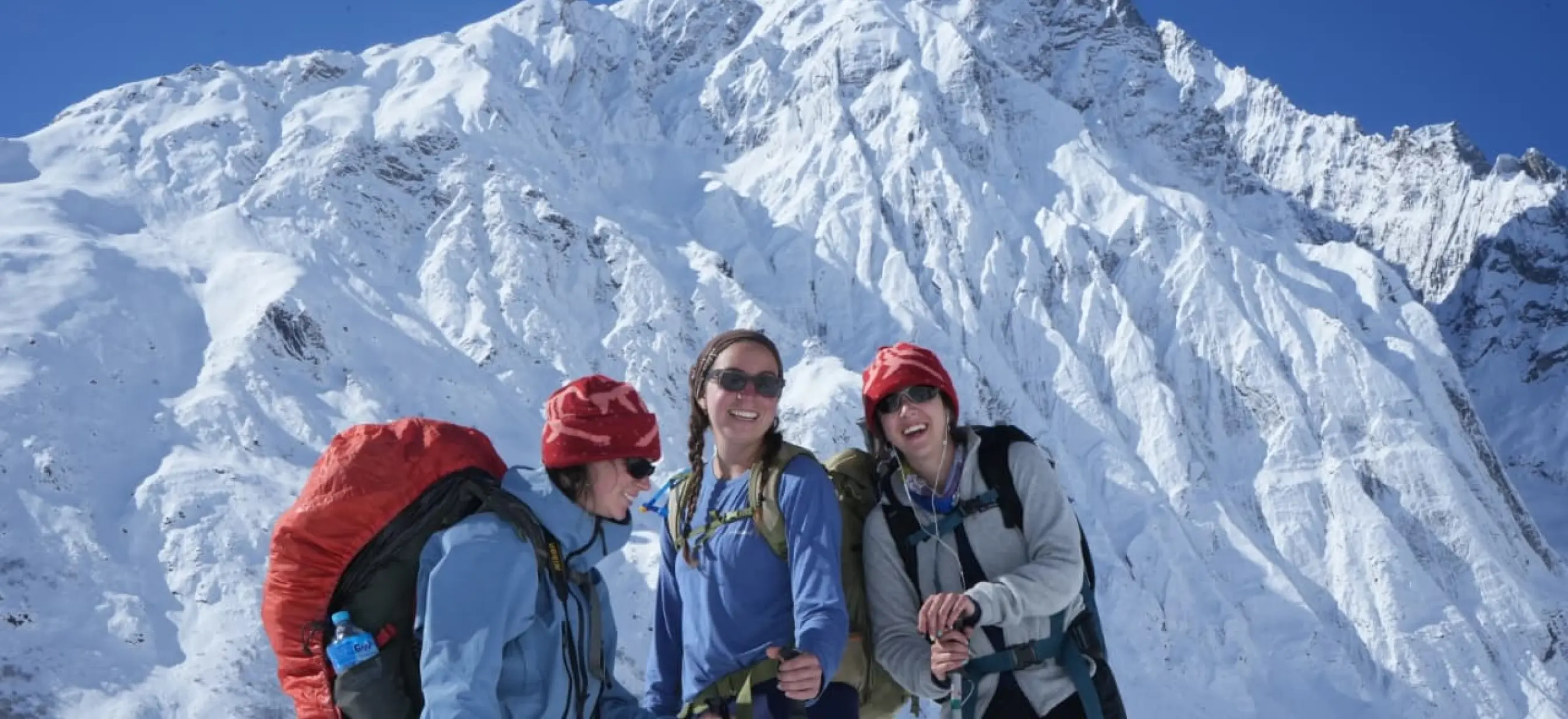
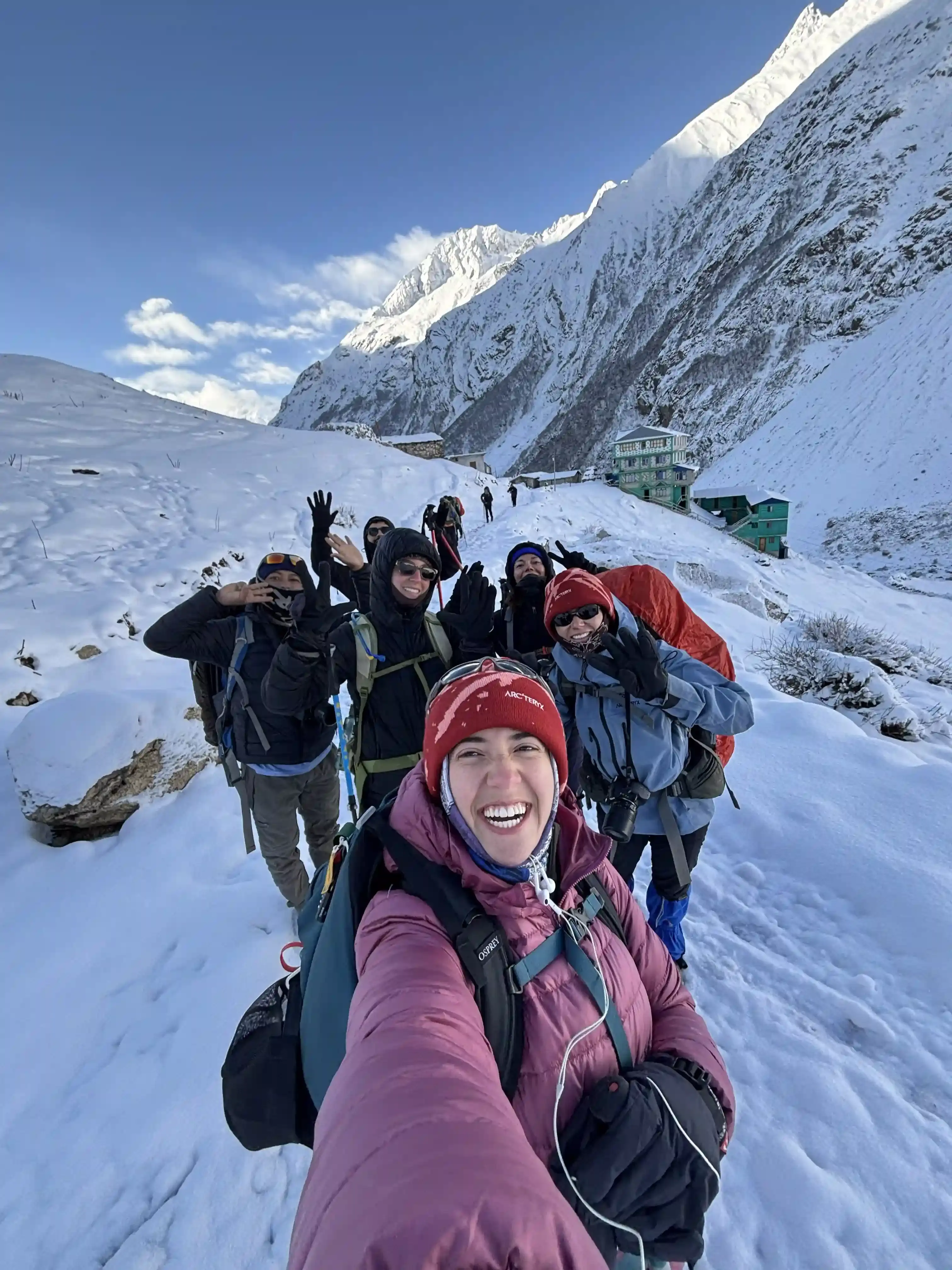
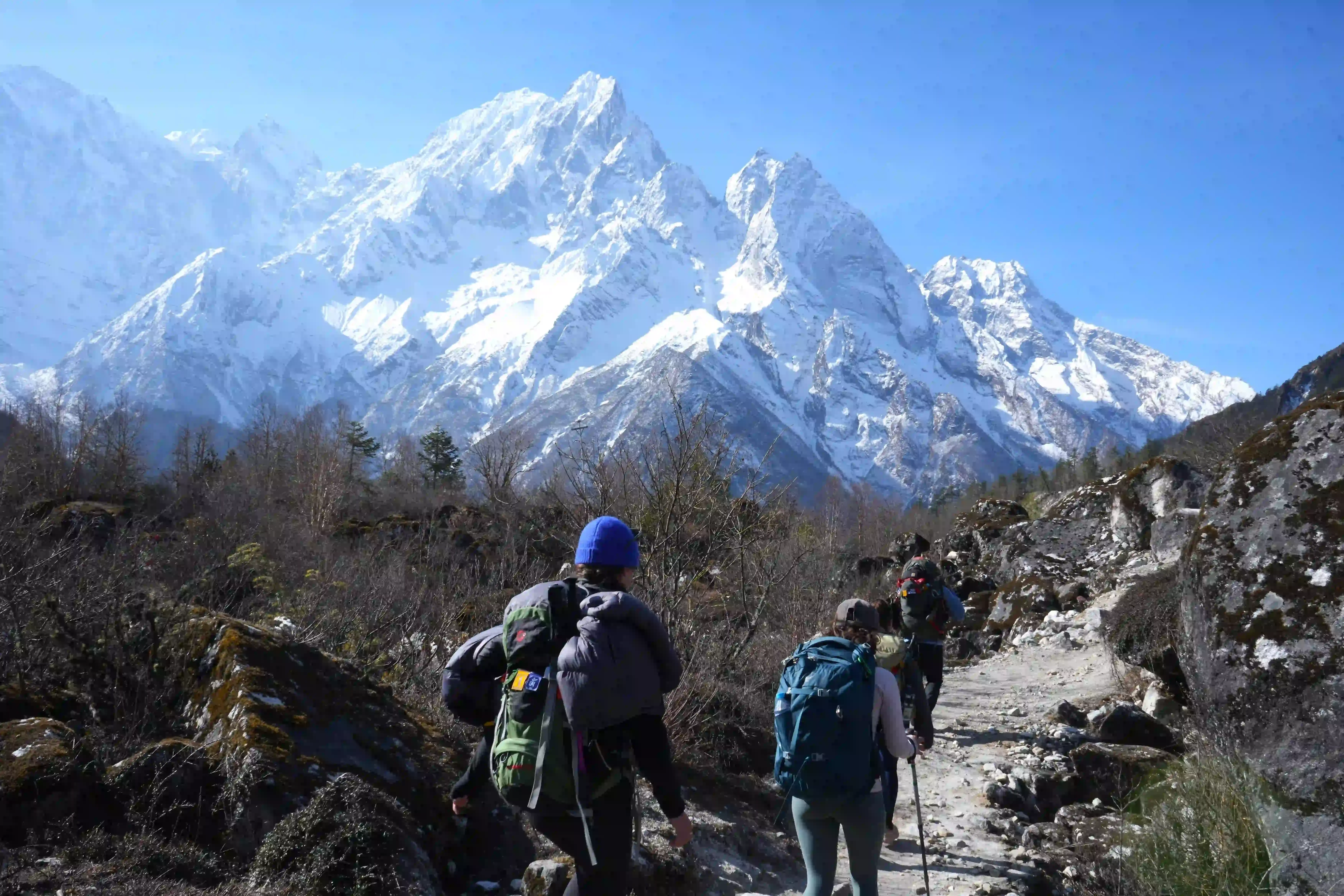
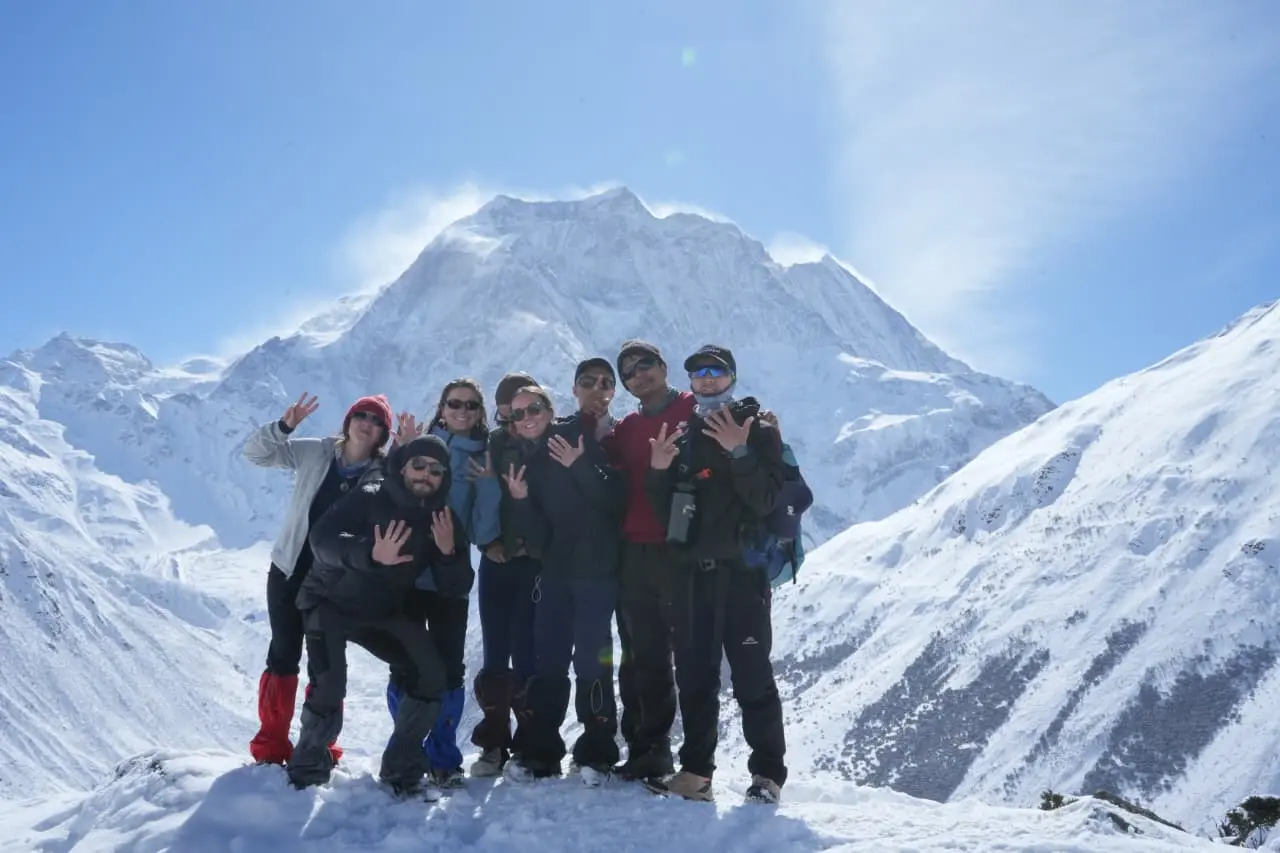
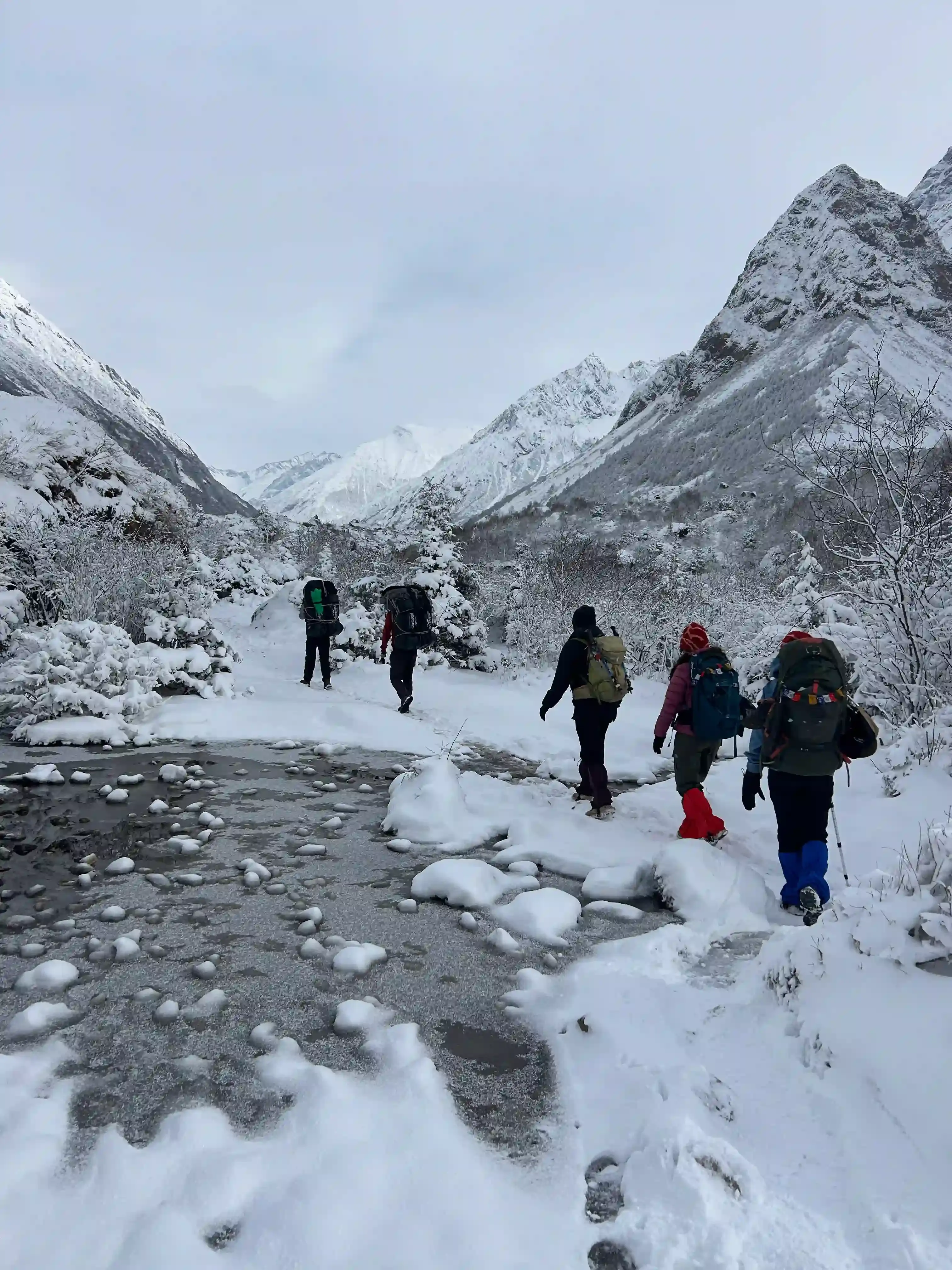
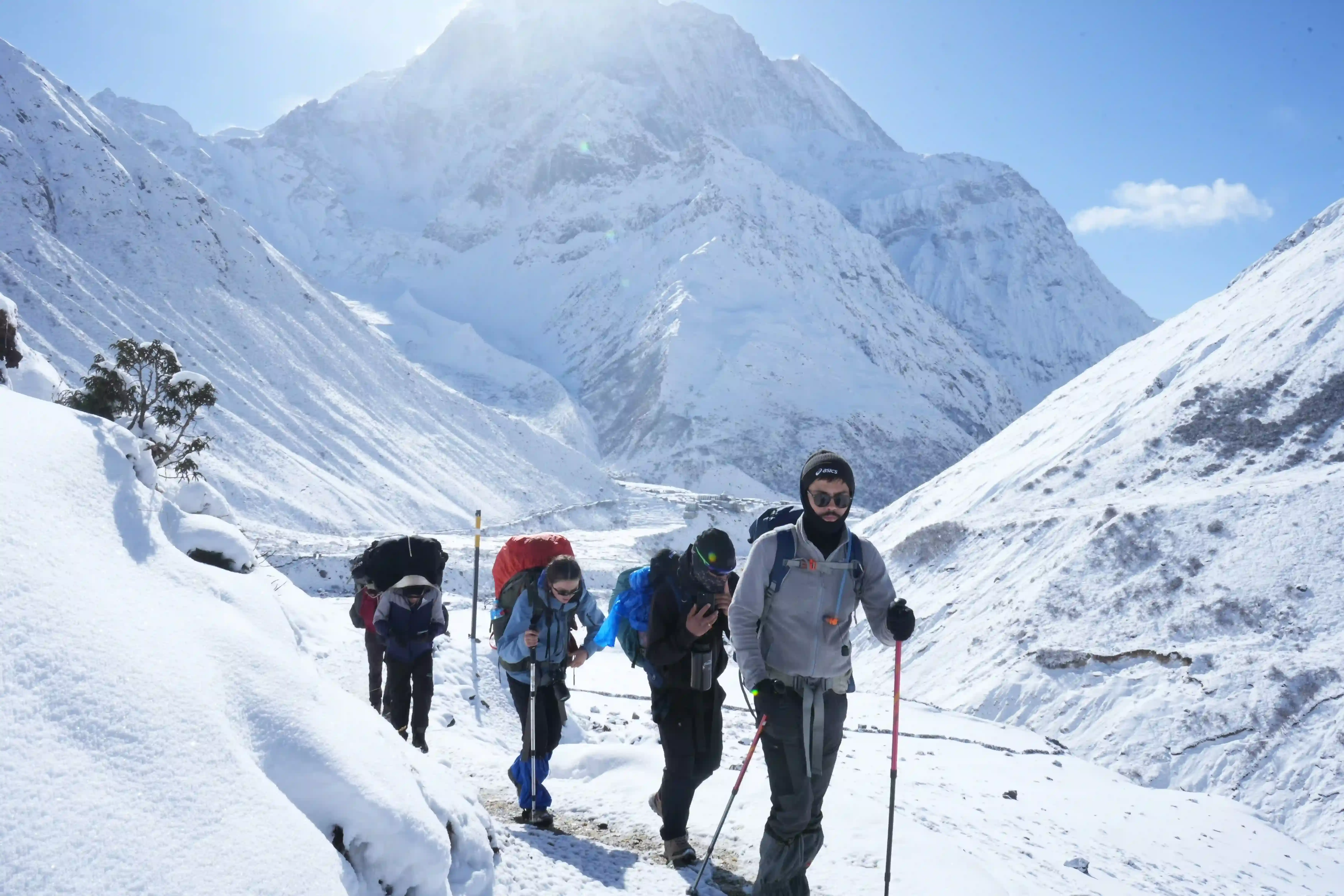
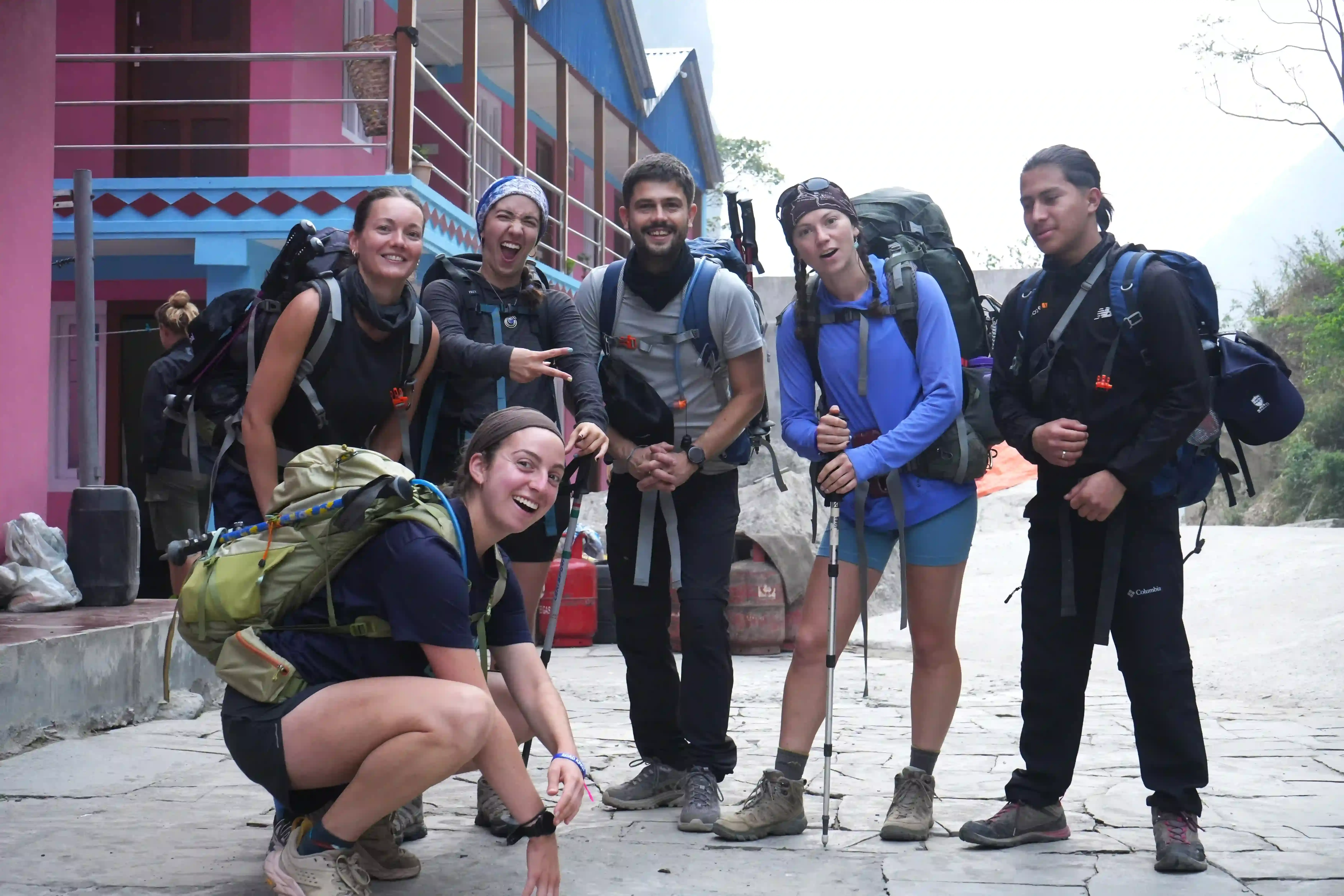
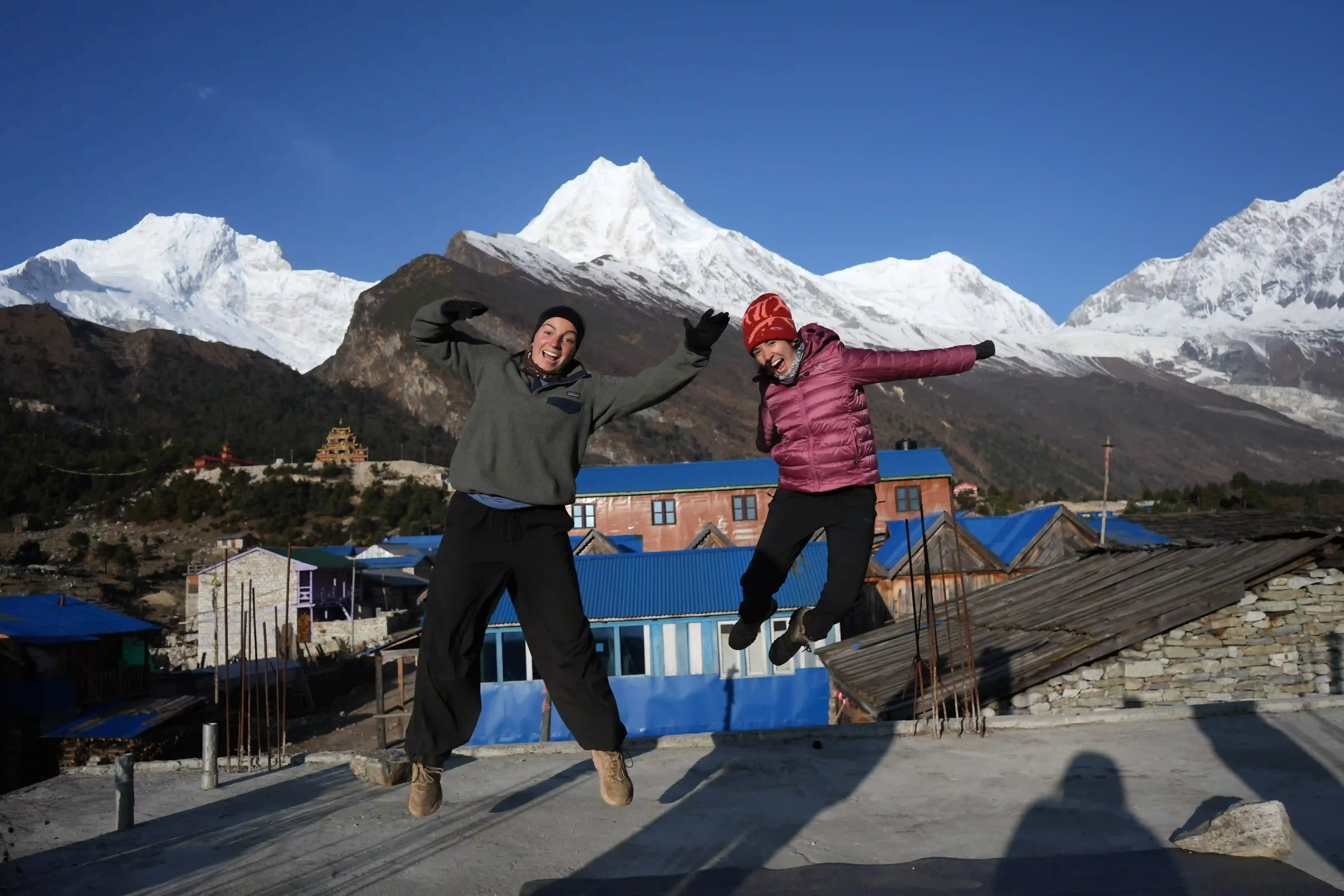
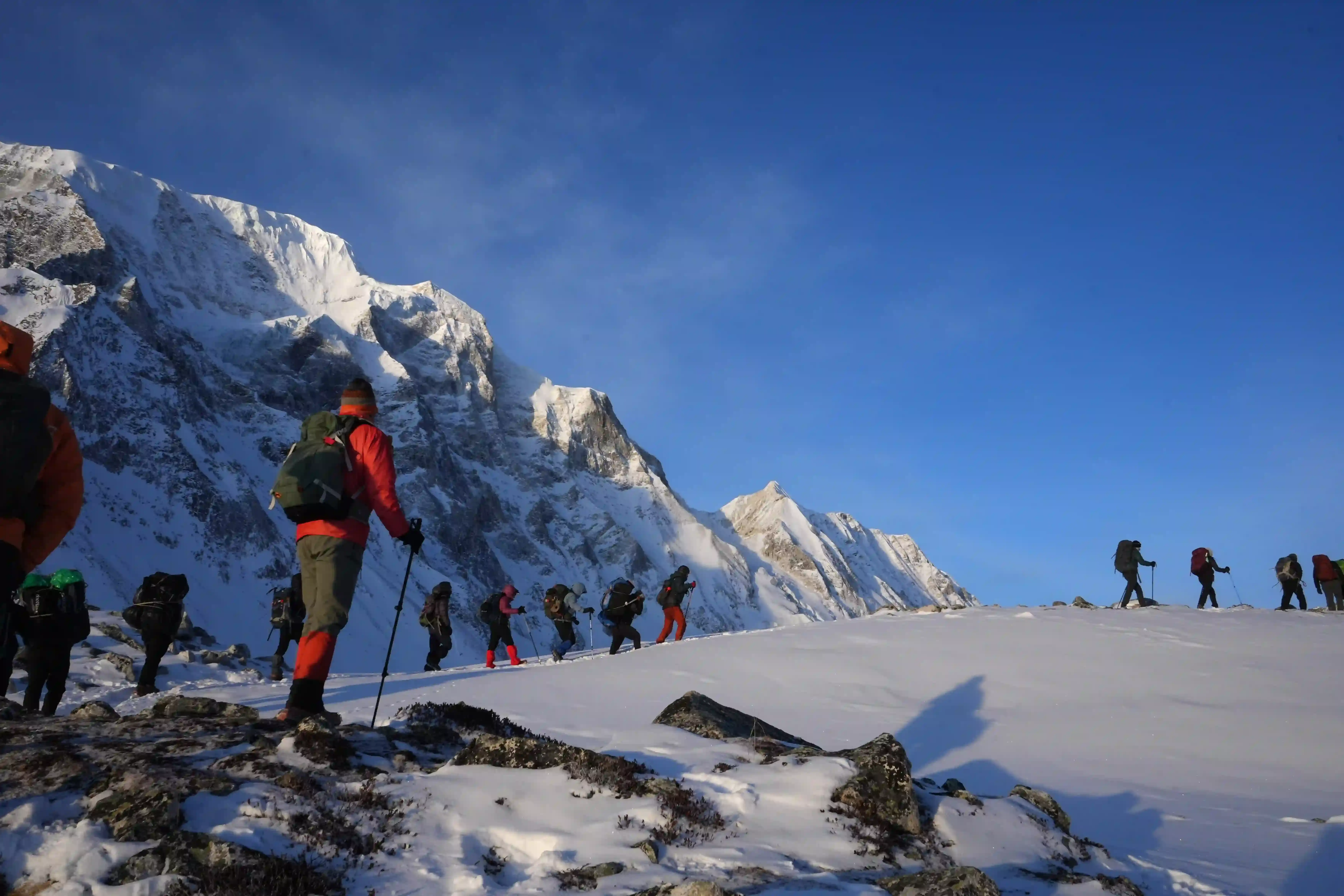
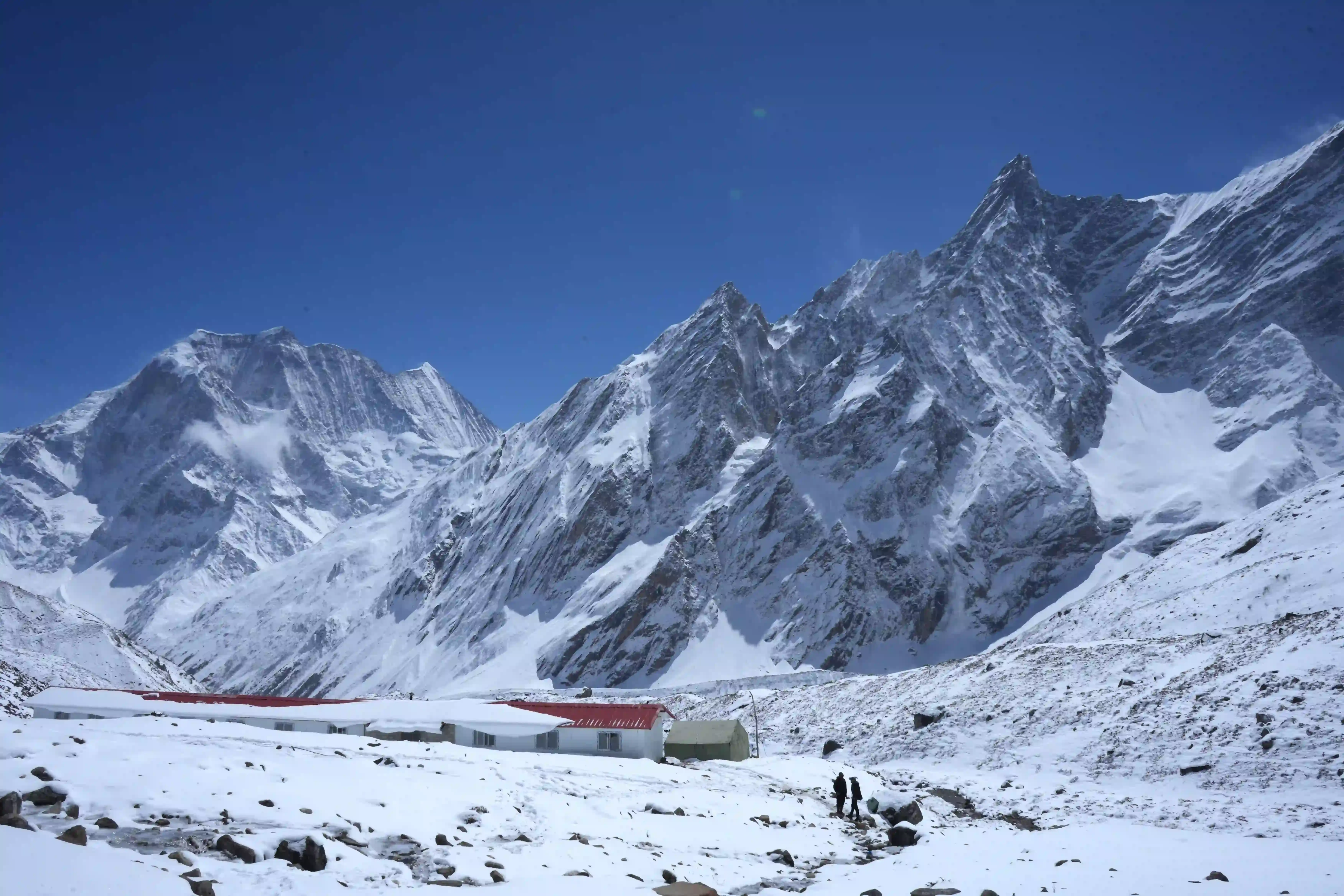
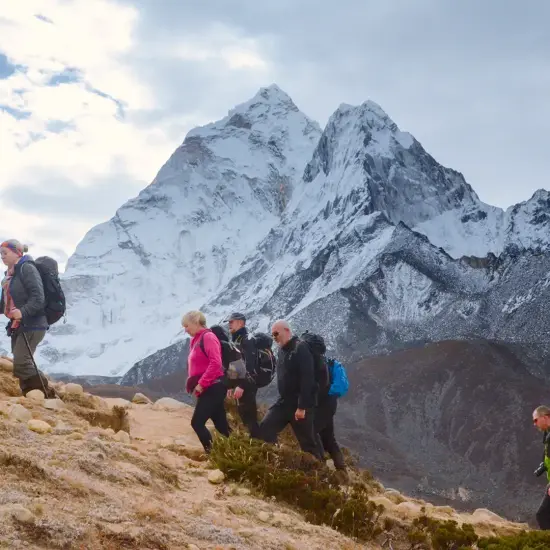
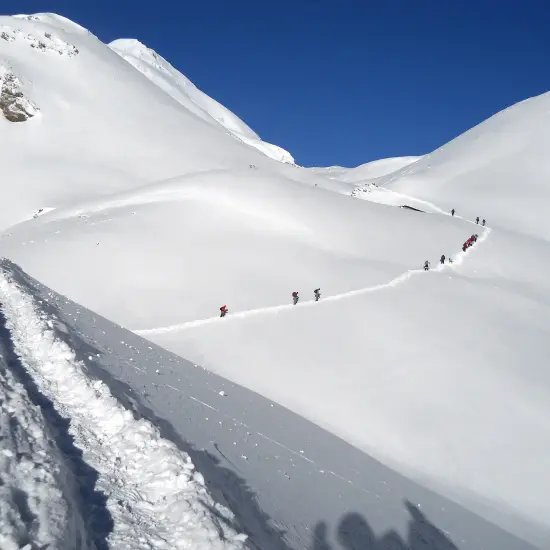
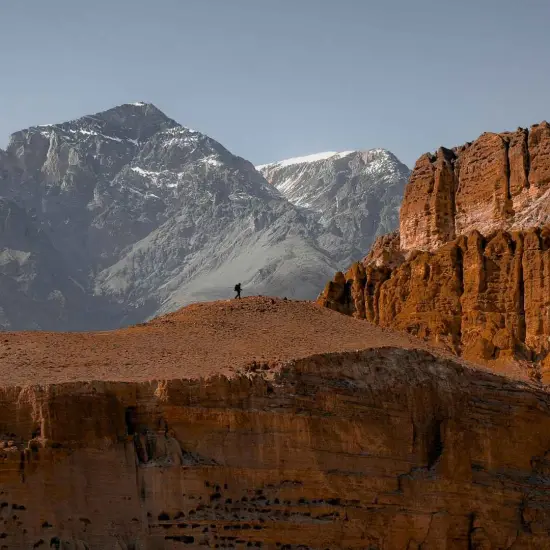
Photos from the Manaslu Circuit Trek
Start the Manaslu trek with a scenic bus ride along the Budhi Gandaki gorge. Towering cliffs and roaring rivers set the stage for pure remoteness.
Trek through rhododendron and bamboo jungles, then ascend through pine and fir as you climb toward high-altitude Manaslu plains.
At Shyala village (3,530 m), catch dawn's light painting Manaslu in pink as you sip butter tea on a hillslope teahouse balcony.
Cross the 5,106 m Larke La—tough but gratifying. From the top, feast your eyes on a sweeping panorama of Manaslu, Cheo Himal, and Ngadi Chuli.
Visit Lho and Sama Gaon's monastery, prayer wheels, and mani walls—living traditions echoing centuries of Tibetan heritage.
5:30 – 6:00 AM
Hotel pickup, taxi to Gongabu Bus Park
Your guide meets you at the hotel lobby and arranges a taxi to Gongabu Bus Park (New Bus Park) in Kathmandu. Have breakfast early or ask your hotel the night before to pack something for the road.
6:00 – 8:00 AM
Bus departs Gongabu Bus Park
Buses to Arughat and Machha Khola depart between 6:00 and 8:00 AM. Your guide handles the boarding — just show up, grab a window seat, and enjoy the view as Kathmandu gives way to open countryside.
Midday
Scheduled lunch stop en route
The bus makes a scheduled lunch stop — usually at a roadside dhaba before reaching Arughat. Use this break to stretch your legs, eat something warm, and refill your water. There are toilet breaks along the way too.
Post-Arughat
Road gets rough — the valley begins
After Arughat the tarmac ends. Expect a bumpy, dusty stretch on unpaved road as the route climbs into the Budhi Gandaki gorge. The scenery more than makes up for the discomfort — terraced hillsides, river crossings, and small farming villages roll past the window.
Late afternoon
Arrive Machha Khola — check in, rest
You pull into Machha Khola after roughly 8–9 hours on the road. Check into your teahouse, clean up, and have dinner. Lights out early — Day 2 starts at the trailhead.
Tourist bus Included
Private jeep / HiAce Optional
Early morning · Machha Khola 890 m
Leaving the trailhead — into the forest
The trail sets off directly from Machha Khola along the eastern bank of the Budhi Gandaki. Within the first hour the forest closes in — dense, subtropical growth with the river thundering alongside. Keep your eyes up in the canopy: langurs and assorted monkeys are a regular morning sighting along this stretch, especially early before the heat builds.
Mid-morning · Lower Khorlabeshi
First Gurung villages — traditional life along the gorge
The path breaks out of the forest into the first of several Gurung villages. Lower Khorlabeshi is a good place to slow down and look around — locals here still wear the traditional Bokkhu, a wraparound cape-style garment that's been part of Gurung dress for generations. It's one of those small, easy-to-miss details that marks the beginning of a genuine cultural shift as you move north.
Late morning · Tatopani
Hot springs — worth a short stop
Tatopani means "hot water" in Nepali, and the name earns its keep. Natural geothermal springs bubble up here at the river's edge — warm, sulphurous, and surprisingly good on legs that are just getting used to trekking again. A 15–20 minute soak is plenty. Most trekkers stop for tea and a snack while they're at it. Don't linger too long though — Jagat is still a few hours ahead.
Midday · Doban to Yaruphant
Suspension bridges and landslide terrain
From Tatopani a suspension bridge carries the trail across to Doban on the far bank. The route then passes through a stretch of landslide-scarred hillside — a reminder that this gorge is geologically active and the trail gets rerouted occasionally after heavy monsoon. Near Yaruphant, a wooden bridge cuts across the river, sparing you a long uphill diversion on the opposite bank. Worth knowing: your guide will navigate this without a second thought.
Early afternoon · Yaru
Cantilever bridge crossing
At Yaru the trail crosses a traditional cantilever bridge — a style of bridge construction common in this part of Nepal, built without modern materials and remarkably sturdy for its age. Cross carefully and pause on the other side to look back up the gorge. The views here are excellent.
Late afternoon · Jagat 1,340 m
Arrive Jagat — permit checkpoint, first teahouse stop
Jagat is the official entry to the Manaslu restricted zone. Government officials at the checkpoint here will inspect your Manaslu Restricted Area Permit, MCAP, and guide credentials. Your guide handles all of this — just have your passport on hand. Once cleared, you're into the conservation area proper. Check in, eat well, and rest. Day 3 pushes deeper into the gorge.
Early morning · Jagat 1,340 m
Leaving Jagat — descending to Sirdibas
The trail drops down from Jagat toward Sirdibas, and the atmosphere changes almost immediately. Prayer flags appear strung between trees and across rocky outcrops, and the first of several gompas comes into view on the hillside above the path. This is the visual language of the upper circuit beginning to assert itself — understated at first, unmistakable by the time you reach Sama Gaon.
Mid-morning · Sirdibas to Philim
Village stops, local raksi, and the trail's social side
The stretch between Sirdibas and Philim passes through small settlements where locals are accustomed to trekkers stopping in. In a few of these villages you may be offered a taste of locally brewed raksi — a mildly potent grain spirit — or tongba, a warm fermented millet drink. Accepting is entirely optional and usually comes with a conversation. It's one of the more unexpectedly enjoyable parts of a long walking day.
Mid-morning · Philim
Second permit checkpoint
Philim is the second checkpoint on the Manaslu Circuit. Officials here verify your permits again — MRAP, MCAP, and guide credentials. Your guide manages the process. From Philim the trail switches to the western bank of the Budhi Gandaki, which it follows for most of the remainder of the day.
Late morning to midday
The gorge narrows — rock sculptures, cliff faces, and forest
This is one of the more visually striking sections of the lower circuit. The river has carved the gorge walls into natural rock formations — smooth, water-sculpted shapes that look almost deliberate. The trail passes beneath overhanging cliffs and through pockets of rhododendron forest and Himalayan pine, with occasional open stretches where Manaslu's ridgeline becomes visible above. Take your time through here. It's the kind of terrain that rewards slowing down.
Early afternoon · Siyar Khola bridge
Tsum Valley junction — the circuit continues left
After crossing the bridge over the Siyar Khola, the trail reaches a marked junction. The right-hand path heads into Tsum Valley — a separate restricted-area trek that branches north into a remote Buddhist valley. The Manaslu Circuit continues straight ahead (left). If you're doing a combined Manaslu-Tsum itinerary, this is where the two routes split. For the standard circuit, stay left and keep moving toward Pewa.
Early afternoon · Pewa
Short rest stop before the final push
Pewa is a small settlement good for a tea stop and a short rest. You're within a couple of hours of Deng at this point — a cup of ginger tea and a snack here makes the final leg considerably more pleasant. Don't sit too long; Deng's teahouses fill up on busy days.
Late afternoon · Deng 1,860 m
Arrive Deng — settle in, fireplace, early night
Deng is a small, tucked-away village in a riverside ravine, and it has real character. The handful of teahouses here are basic but warm, and in the evening most trekkers naturally end up around the same fireplace. It's the kind of unplanned communal moment that makes multi-day trekking what it is. Chat with the locals if you get the chance — Deng is primarily home to people of Tibetan origin and the cultural gap from Kathmandu feels tangible here.
Early morning · Deng 1,860 m
Into the bamboo — the day's first hour
After breakfast the trail heads straight into dense bamboo forest — tall, tight-growing stands that filter the morning light and keep the path cool. It's an unusual environment for a Himalayan trek and one of the more distinctive stretches of the lower circuit. Walk quietly through here and your chances of spotting wildlife are genuinely good.
Mid-morning · Rana and the suspension bridge
River crossing and white-faced monkeys
The bamboo gives way to a suspension bridge crossing into Rana. This area is known for sightings of white-faced langurs — they tend to appear near the village edges, moving between the tree canopy and the ground with little concern for passing trekkers. Keep your camera ready but your distance respectful. From Rana the trail continues upward toward Bihi Phedi.
Mid-morning · Bihi Phedi
Mani walls and the forest transition
Bihi Phedi sits in a forested canyon where the vegetation shifts from bamboo to a mix of fir, oak, and rhododendron. The trail passes several long mani walls — rows of carved prayer stones that you should keep on your left as you pass. The canyon walls here are impressive, and if the morning is clear, the ridge above gives the first real sense of the altitude ahead. Good place to refill water if your guide indicates a clean source.
Midday · Ghap
Landslide zones — stay close to your guide
The section approaching and passing through Ghap includes active landslide terrain — loose rock, eroded trail edges, and slopes that shift after heavy rain or snowmelt. This is the most technically cautious stretch of the day. Walk in single file, follow your guide's line exactly, and don't stop on exposed sections. The risk is manageable with care, but it's not a place to be distracted. Once through, the trail becomes more stable as it turns uphill toward Namrung.
Early afternoon · Above Ghap
Zigzagging climb along the river
After Ghap the trail climbs a series of switchbacks up the river valley — longer than they look on the map, but the reward is the view opening up above the gorge. Manaslu's ridgeline begins to assert itself above the treeline as you gain altitude. Pace yourself here: 770 m of total gain across the day adds up, and this zigzag section comes when your legs are already working.
Late afternoon · Namrung 2,630 m
Arrive Namrung — mountain views, proper facilities, good food
Namrung is a step up in every sense. The village sits on an open plateau with broad views of the surrounding peaks, and the teahouses here are noticeably more comfortable than the last two nights. There's a gompa on the edge of the village worth visiting before dinner, and the mountain panorama from the upper part of the settlement is one of the best viewpoints of the lower circuit. Eat well and rest properly — you're at 2,630 m and the altitude will be felt by morning.
A shorter day with a big payoff — your first full view of Manaslu, a monastery stop at Lho, and arrival in a wide glacial valley ringed by giants
Early morning · Namrung 2,630 m
Gradual ascent through alpine forest
The morning trail out of Namrung climbs gently through alpine forest — rhododendron and fir trees giving way to more open terrain as you gain altitude. The pace is steady rather than steep at first, which is just as well: the air is noticeably thinner now and the body needs time to find its rhythm each morning above 2,500 m. Take it slow, breathe deliberately, and enjoy the quiet forest before the valley opens up.
Mid-morning · Lho village
First full view of Manaslu — and a monastery worth stopping for
Lho is the highlight of the day and arguably one of the most striking stops on the entire lower circuit. The village sits at the edge of the treeline, its traditional stone houses arranged around a large, active Buddhist monastery that dominates the hillside above. But what stops most trekkers in their tracks is the view — Mount Manaslu (8,163 m), the world's eighth highest peak, fills the northern sky in full from here for the first time on the trek. It's worth pausing properly. Have tea, visit the monastery, walk through the village. This is not a pass-through stop.
Late morning to midday
The valley opens — peaks in every direction
Continuing from Lho toward Shyala, the trail leaves the last of the treeline behind and enters a broad glacial valley. The landscape shifts dramatically — no more forested canyon walls, just open sky, rock, and an expanding panorama of high peaks. Himal Chuli, Ngadi Chuli, Baudha Himal, Shiringi Himal, and sections of the Ganesh Himal range appear in sequence as you move north. The scale of the terrain is genuinely hard to process at first.
Early afternoon · Shyala 3,500 m
Arrive Shyala — glacier views, photography, rest
Shyala sits wide open in the glacial valley with snow peaks rising on three sides. It's a peaceful, unhurried village — no permit checkpoints, no junctions, just a handful of teahouses, a monastery, and one of the best mountain panoramas on the circuit. Arriving early afternoon gives you time to walk the village, find a good vantage point before the clouds come in, and acclimatise properly before pushing higher tomorrow. Sunrise and sunset from Shyala are exceptional — set an alarm.
The forest thins, the valley opens fully, and the eighth-highest mountain on earth takes over the sky — with an ancient monastery hidden above the glacier if you want it
Day 6 is a deceptively easy-looking day on paper — just 30 metres of net elevation gain and 10 km of trail. But you're already at 3,500 m when you start, and the optional detour to Pungyen Gompa adds both time and height to your morning. This is also the day the character of the trek shifts decisively: the last real forest disappears, the Budhi Gandaki canyon gives way to a wide glacial basin, and the trail enters the open, high-altitude world of the Nubri Valley. By the time you reach Samagaun — the largest village on the upper circuit — the landscape around you looks nothing like what you walked through on Day 1. You have two nights here. Arrive early, go slowly, and let it settle.
Early morning · Shyala 3,500 m
North through open valley — Manaslu fills the sky ahead
The trail out of Shyala heads north across open glacial terrain, following the Budhi Gandaki as it bends deeper into the Nubri Valley. There's no real treeline to speak of anymore — just alpine scrub, scattered juniper, and widening moraine meadow. Manaslu's north face holds the horizon directly ahead, closer and more imposing than it has appeared at any point on the trek. Walk at the pace your breathing sets, not the pace the gradient allows. The air is thin, the terrain is gentle, and the temptation to move fast is exactly the wrong instinct at this altitude.
Mid-morning · Optional detour
Pungyen Gompa — the monastery above the glacier
Roughly an hour north of Shyala, the trail passes the junction for Pungyen Gompa. The detour climbs an additional 470 metres to reach the monastery at around 4,000 m — steep, slow work at this altitude, but the destination justifies every step. The gompa sits in a quiet alpine meadow above the Manaslu Glacier with an unobstructed view of the mountain's north face and a sense of stillness that feels genuinely removed from the trekking world below. Pungyen Gompa is one of the oldest active monasteries in the Manaslu region. Its name derives from the Tibetan word for happiness, and for the local Nubri community it has served for generations as a spiritual anchor — a place of blessing, protection, and continuity. Monks still live and practise here. Walk quietly, sit with the view, and ask before photographing anything inside the buildings.
Late morning to midday
Back on the main trail, the route threads through the last of the pine and rhododendron forest — a final green corridor before the valley opens entirely into high alpine pasture. A clear glacial stream runs alongside the path for much of this section, crossed on a wooden bridge before the trail bends west through open meadow. Yaks graze freely across the plateau, their bells carrying in the thin air. Mani walls appear with increasing frequency. You're in the cultural heartland of the upper Nubri Valley now, and everything around you — the architecture of the landscape, the carvings underfoot, the quality of the silence — reflects it.
Early afternoon · Samagaun 3,530 m
Arrive Samagaun — the circuit's cultural and acclimatisation hub
The trail descends gently into a broad glacial basin and Samagaun takes shape gradually — first a line of mani walls, then stone houses with carved wooden balconies, then the wide yak pastures that ring the village on three sides. This is the largest settlement in the upper Manaslu valley, and by the standards of the last six days it feels almost like arriving somewhere. There are proper teahouses, a health post, a helipad for emergencies, shops stocking basic supplies, a village gompa, and Wi-Fi at most lodges. Settle in carefully — you're here for two nights, and the way you spend today and tomorrow will directly affect how you cross Larkya La Pass in a few days' time.
Samagaun sits in a wide glacial basin at the foot of Mt. Manaslu — the world's eighth-highest peak at 8,163 m. The village is primarily inhabited by people of Tibetan origin whose daily life is woven through with Buddhist practice: prayer flags on every rooftop, mani walls lining the paths, chortens at the village edge, and the Ribung Gompa at the centre. It is the largest and most well-supplied stop on the upper circuit, and for most trekkers it becomes an unexpected highlight — the kind of place you planned to rest through and ended up genuinely not wanting to leave.
The gompa detour adds 470 m of climbing and 1.5 to 2 hours of walking. Make the call based on how you slept and how your head feels at breakfast — not mid-trail when turning back feels like giving up. Symptoms that arrive at elevation tend to get worse going up, not better.
The gentle gradient gives trekkers a false sense of ease at altitude. Your cardiovascular system is working significantly harder than the terrain suggests — walk at the pace your breathing sets, stop freely on inclines, and resist the urge to push the pace just because the trail is flat.
A 5-hour walking day means an early afternoon arrival. Use it — walk the upper edge of the village, find the mani wall above the houses, visit Ribung Gompa before it closes. The north face of Manaslu from the top of the village catches light in the late afternoon that most trekkers miss by staying indoors.
Samagaun sits in an open glacial basin with nothing between it and the Manaslu massif to the north. Wind picks up sharply in the afternoon and the temperature drops the moment you stop moving. A down jacket and wind layer should be at the top of your daypack — not at the bottom.
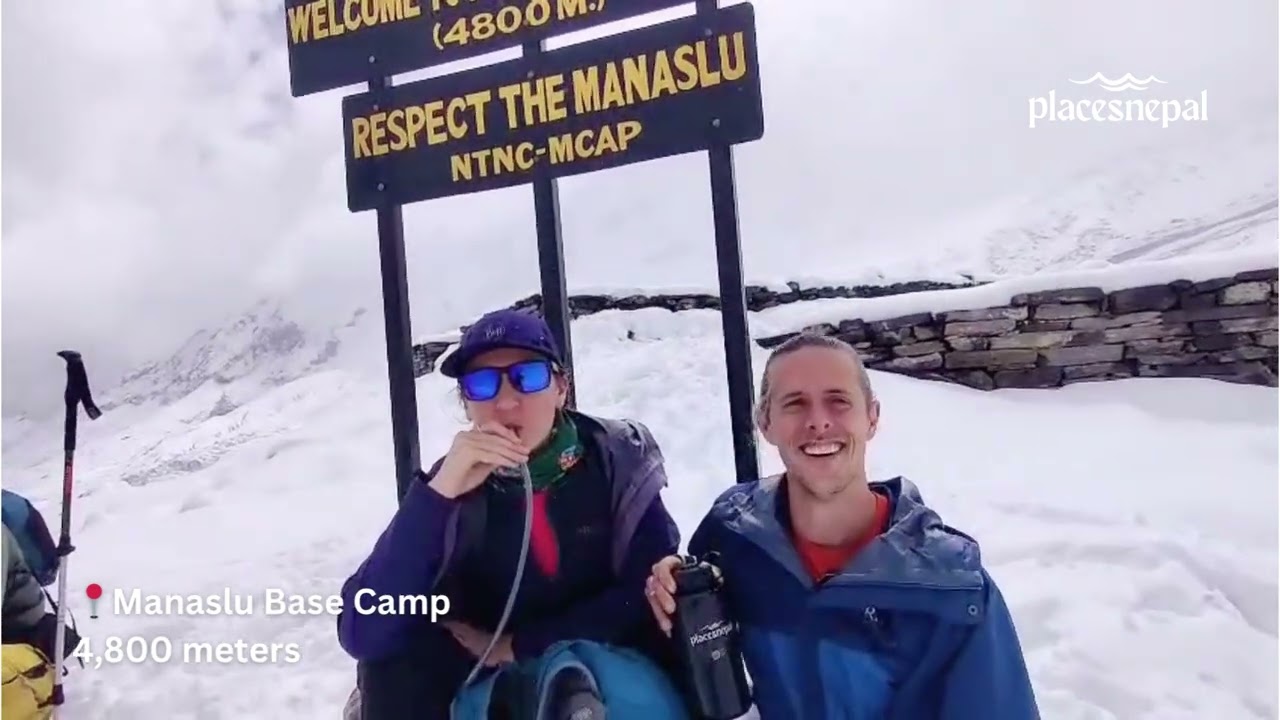
Birendra Lake (3,450 m) is a comfortable two-hour return walk — good if you're acclimatising steadily but want to stay moderate. Manaslu Base Camp (4,800 m) is a full, demanding 6 to 8-hour round trip — worthwhile if you're feeling strong, but physically significant at altitude. Choose based on how you feel, not ambition alone. Talk to your guide over dinner.
Spring trekkers (March to May) catch the forest section in full bloom — bursts of red and pink against the grey moraine. Autumn trekkers (September to November) get sharper mountain definition and more stable afternoon weather. Both seasons are exceptional on this stretch of the circuit.
A non-negotiable rest day at 3,530 m — with two very different ways to spend it depending on how your body is doing
Today is not optional. The acclimatisation day in Samagaun is one of the most important days on the entire Manaslu Circuit — not because of what you do, but because of what your body does while you do it. At 3,530 m, your red blood cell count is climbing, your cardiovascular system is adjusting, and the physiological groundwork is being laid for crossing Larkya La Pass at 5,106 m in a few days' time. Skip this day and you risk turning a difficult pass into a dangerous one. The question isn't whether to rest — it's how active your rest should be. Two options below. Choose honestly, not ambitiously.
4,800 m / 15,748 ft
The most rewarding day hike from Samagaun and one of the most dramatic on the entire circuit. The trail climbs steeply alongside the Manaslu Glacier — past Birendra Tal and up through a wild, rocky landscape of glacial moraine and high alpine wilderness — to the base of the world's eighth-highest mountain. Views of Manaslu's north face at this proximity are unlike anything accessible from the main trail. Himalayan tahr, yaks, and occasionally snow leopard tracks mark the upper sections. This is a strenuous day. Gain 1,270 m from Samagaun, cover 14–15 km round-trip, and return by early afternoon.
Pack for the day
Packed lunch · 2–3 litres water · trekking poles · warm gloves · sunglasses · sun protection · wind layer · camera
3,450 m / 11,319 ft
A short, pleasant walk to a glacial lake sitting just below Samagaun in the valley. Birendra Tal is fed by Manaslu Glacier meltwater and surrounded by open alpine terrain — calm, scenic, and unhurried. The walk takes 30 to 45 minutes each way and involves minimal elevation change, making it genuinely appropriate for active rest. Best for trekkers who slept poorly, are still managing a mild headache, or simply want to move gently without adding stress to a body mid-adaptation. After the lake, return to the village and spend the afternoon in Samagaun — visit the gompa, walk the mani walls, eat well.
Early morning · Samagaun 3,530 m
Depart early — the glacier demands a morning start
Leave Samagaun by 7:00 AM at the latest. The trail to Manaslu Base Camp is long, the altitude is real, and afternoon cloud typically closes in over the upper glacier by early afternoon — well before you want to be descending on loose moraine. Eat a full breakfast, fill all water bottles, and confirm the route with your guide the night before. Your guide leads — do not attempt this hike independently.
Morning · Birendra Tal 3,450 m
First stop — the glacial lake below the moraine
The trail passes Birendra Tal roughly 30 to 45 minutes north of the village. The lake sits in a shallow glacial basin, its milky turquoise water fed by Manaslu Glacier above. It's a natural rest stop — pause here, take in the mountain directly ahead, and let your body register where it is before the real climbing begins. The Base Camp trail continues north from the lake's edge.
Late morning · Manaslu Glacier
Steep moraine — the hardest section of the day
Above Birendra Tal the trail steepens sharply and the terrain shifts to glacial moraine — loose rock, uneven footing, and a relentless climb that gains most of the day's 1,270 m in a concentrated stretch. This is where the altitude makes itself felt. Breathe deliberately, step carefully, and match your guide's pace. The views across the glacier to Manaslu's north face grow more extraordinary with every metre gained. Himalayan tahr are commonly seen on the upper slopes. Snow leopard territory — you won't see one, but you're in it.
Midday · Manaslu Base Camp 4,800 m
Arrive base camp — Manaslu at close range
The base camp sits at roughly 4,800 m on a high glacial shelf with the Manaslu massif filling the sky directly above. No summit teams, no infrastructure — just rock, ice, and one of the most powerful mountain views on earth. Eat your packed lunch here, rest for 20 to 30 minutes, photograph carefully in the thin air, and begin the descent before 1:00 PM. The mountain has the afternoon to itself.
Afternoon · Return to Samagaun
Descend carefully — loose terrain demands attention coming down
The descent reverses the morning's route, passing back through the moraine and past Birendra Tal. Descending on loose rock after a long high-altitude day is when most falls happen — slow down, watch your footing, and use trekking poles actively on the steeper sections. Aim to be back in Samagaun by 3:00 to 4:00 PM. Eat a proper meal, drink 2 to 3 litres of water through the evening, and sleep as early as you can manage.
Samagaun is the largest and most culturally significant village on the upper Manaslu Circuit — a wide-valleyed settlement of ethnic Tibetans who have preserved Buddhist traditions across generations. Stone houses, mani walls, chortens, and prayer flags define the village architecture. The Ribung Gompa sits at the centre of daily religious life. Pungyen Gompa — the monastery visible above the valley on Day 6 — is a short hike from the village edge and worth a quiet afternoon visit if you didn't make it yesterday. Samagaun also functions as a local market hub: the last real resupply point before the route ascends to Samdo and the pass.
The acclimatisation stop in Samagaun is not a comfort buffer built into the itinerary — it is physiologically necessary. Trekkers who skip it or treat it as optional face a significantly higher risk of altitude sickness on and above Larkya La. Your body needs this 24 hours.
Appetite suppression at altitude is normal and misleading — your body is burning more calories than at sea level and needs the fuel. Dal bhat is the best choice: high-carb, warm, filling, and always available. Eat twice if you can. Avoid alcohol completely.
Hydration is the single most effective thing you can do for acclimatisation beyond physical rest. Carry water on both hike options. Monitor your urine colour — pale yellow is the target. Dark yellow means drink more immediately.
Ribung Gompa in the village centre is worth a quiet visit — early morning before the day hike, or late afternoon on return. Remove shoes at the entrance, walk clockwise around any structures, and ask before photographing the interior. Prayer sessions, when they happen, are open to respectful observers.
If doing Base Camp, the morning start is not negotiable. Cloud and wind close in over the upper glacier by early afternoon on most days, and descending wet moraine in low visibility is genuinely hazardous. If you wake to heavy snowfall or strong winds, do Birendra Tal instead — no heroics.
Day 8 moves to Samdo (3,875 m) — a shorter day but another altitude gain. Confirm your departure time, discuss how your body felt today, and flag anything that felt unusual. Your guide has walked this route dozens of times and will calibrate Day 8's pace to how Day 7 went.
A short, high-altitude walk north to the last permanent village before Larkya La Pass — yak pastures, mani walls, and an optional hike to Samdo Peak for Himalayan panoramas
5.7 km / 3.6 miles
Trek distance
2–3 hrs
Walking time
Day 8 is short by design — and at this altitude, that's exactly right. The trail heads north from Samagaun through open yak pastures and past ancient mani walls, gaining height steadily but gently. It's quiet, wide-open trekking with the Manaslu massif dominating the skyline. A wooden bridge carries you over the Budi Gandaki River before the final climb into Samdo, the last permanent settlement on the circuit before Larkya La Pass.
You'll arrive with most of the day still ahead. Use the afternoon to explore the village, visit the monastery, or tackle the optional acclimatization hike to Samdo Peak for some of the best views on the entire circuit. Either way, today is about arriving well-rested and ready for tomorrow.
Morning · Samagaun 3,500 m
The trail leaves Samagaun and enters open high-altitude country almost immediately. Yak grazing grounds spread out on either side as you gain height. There's no forest cover up here — just wide skies, dry scrub, and the full weight of the Himalayan landscape. Walk slowly and breathe deliberately. Your body is working harder than it feels.
Mid-morning · Mani walls
The route passes several mani walls — long rows of hand-carved prayer stones — before reaching the White Kani, a whitewashed stone archway etched with Tibetan mantras and fitted with prayer wheels. Pass these on the left, keeping them to your right, as local Buddhist custom asks. It takes about three seconds and matters genuinely to the communities along this route.
Late morning · Budi Gandaki bridge
A wooden bridge crosses the Budi Gandaki River. Cross one person at a time as standard practice. From the far bank, a short final climb brings you into Samdo — you'll see the prayer flags and stone rooftops of the village well before you reach the first teahouse.
Late morning · Samdo 3,875 m
Check in, eat a proper lunch, then decide how to spend the afternoon. The village monastery is worth 20–30 minutes — small, atmospheric, and usually open after midday. For the more energetic, the optional hike toward Samdo Peak takes 1–2 hours round trip and delivers unobstructed views of Manaslu, Larkya Peak, and the Tibetan plateau. Go if you're feeling well; rest without guilt if you're not.
Samdo sits at 3,875 m (12,713 ft) in a wide valley close to the China border — the last permanent settlement on the Manaslu Circuit before the high pass. The village is home to 30–40 households of Tibetan Buddhist origin, whose livelihoods have long revolved around agriculture, yak herding, and cross-border trade with Tibet. Tourism plays a growing role today, but the pace and character of village life remain distinctly traditional.
Traditional stone houses, stupas, and chortens define the village, with the Manaslu range and Samdo Peak visible straight from teahouse windows. The isolated setting and deeply rooted Tibetan culture make this one of the most memorable overnight stops on the circuit.
Acclimatization tip: Trekkers with time to spare often add an extra rest day in Samdo before the Larkya La crossing. Side hikes to Tibetan viewpoints or nearby ridges help the body adjust to altitude while keeping legs active. Ask your guide if this makes sense for your group.
A short but altitude-critical trek to Dharamsala — base camp for the Larkya La Pass crossing — through barren alpine terrain with sweeping Himalayan panoramas
3 km / 1.8 miles
Trek distance
3 hrs
Walking time
Day 9 is the shortest trek on the entire Manaslu Circuit — just 3 km — but it's arguably the most consequential. You're climbing nearly 600 vertical metres to Larkya Phedi (also called Dharamsala), the high camp that sits at the base of the Larkya La Pass. Distance means nothing at this altitude; what matters is how carefully you manage the ascent and how well you rest once you arrive.
The landscape up here is unlike anything earlier on the circuit — stark, stripped back, and completely exposed. Snow-capped peaks fill every angle of view. Arrive early, eat well, take the short acclimatization hike if your body is up to it, and be in bed before dark. Tomorrow starts at 3:00 AM.
Morning · Samdo 3,875 m
The trail heads north out of Samdo and the landscape changes fast. Within the first 30 minutes you're above any vegetation — bare rock, scree, and glacial debris replace the scrub of the lower valley. The air is noticeably thinner. Walk at a pace where you can hold a conversation without effort. If you can't, slow down.
Mid-morning · Icy stream crossing
The trail crosses a meltwater stream fed by glaciers above — cold, fast-moving, and icy underfoot at the crossing point. Trekking poles are useful here. Cross carefully and don't rush. Your guide will pick the safest line; follow it closely. Wet boots at 4,000 m+ are a problem you don't want heading into the pass.
Late morning · Barren valley
Above the stream the trail moves through a completely barren, open valley. There's no shelter from wind, no trail markers beyond cairns, and the altitude gain is relentless. The panoramas of snow-capped Himalayan peaks are genuinely breathtaking — but keep your attention on your footing and your breathing. Stop and take in the views from a stable standing position, not mid-step on loose ground.
Late morning · Larkya Phedi 4,460 m
Check in, change into dry layers immediately, and eat a proper lunch. Once settled, the recommended acclimatization hike — roughly 200 m of ascent toward Khaki Danda — helps your body adapt to the altitude without exhausting it. One to two hours, slow pace, back in time for dinner. If you're not feeling well enough to hike, lying down at altitude still provides some adaptation benefit. Tell your guide honestly how you're feeling.
Altitude warning — 4,460 m base camp
At nearly 4,500 m you are well into serious altitude territory. Symptoms of Acute Mountain Sickness (AMS) — persistent headache, nausea, dizziness, loss of coordination, or difficulty breathing at rest — must be reported to your guide immediately. Do not attempt to push through AMS at this elevation. If symptoms are severe, descent is the only reliable treatment. Your guide is trained for this situation.
Dharamsala sits at 4,460 m (14,630 ft) and is the highest overnight stop on the entire Manaslu Circuit — a remote, exposed staging post with nothing around it but rock, ice, and altitude. There is no village here, no shops, and no infrastructure beyond three basic lodges that exist solely to shelter trekkers the night before the pass. Conditions are deliberately spartan.
Rooms are simple, and during busy season trekkers may sleep on mats in shared common areas rather than private rooms. This is normal and expected — pack accordingly with a warm sleeping bag liner and ear plugs. The lodge dining rooms double as communal spaces where most trekkers spend the evening eating, hydrating, and trying to sleep early.
Facilities are the most basic on the circuit. There are no attached bathrooms, no in-room charging, and no nearby alternatives if the lodges are full. This is not the place to arrive late. An early start from Samdo is strongly advised.
The biggest day on the circuit — a pre-dawn summit of the Larkya La Pass at 5,106 m, 360-degree Himalayan panoramas, and a long descent into the green valley of Bhimthang
17 km / 10.6 miles
Trek distance
~8-10 hrs
Walking time
Day 10 is the day the entire circuit has been building toward. You leave Dharamsala in darkness at around 3:00 AM, headlamp on, crampons ready, and spend the next four to five hours climbing steadily toward the Larkya La Pass at 5,106 m — the highest point of the Manaslu Circuit and one of the most spectacular high mountain crossings in Nepal.
The summit rewards every hard step: a sweeping 360-degree panorama of Manaslu, Larkya Peak, Himalchuli, Himlung Himal, Kang Guru, and the Annapurna range, all draped in prayer flags that have been marking this pass for generations. Then comes the long descent — three hours of rugged, knee-testing terrain past glaciers and Ponkar Lake before the valley opens up into the green meadows of Bhimthang. It's a full, demanding, unforgettable day.
3:00 AM · Larkya Phedi
Wake-up is typically 1:30–2:00 AM for a hot breakfast and final gear check. Your guide sets the exact time based on conditions. Crampons and trekking poles should be fitted before you leave the lodge. The trail begins in complete darkness — stay tight behind your guide and keep your headlamp beam on the ground directly ahead of you.
Pre-dawn · Steep ascent
The ascent to Larkya La is steep and sustained. Snow and ice are common, particularly in the upper section, which is why crampons are essential rather than optional. The cold at this elevation before sunrise is sharp — all your warm layers are needed. Walk in single file behind your guide, breathe through your nose where possible, and set a pace you can hold for hours without stopping. Rushing gains nothing at 5,000 m.
Early morning · Larkya La 5,106 m
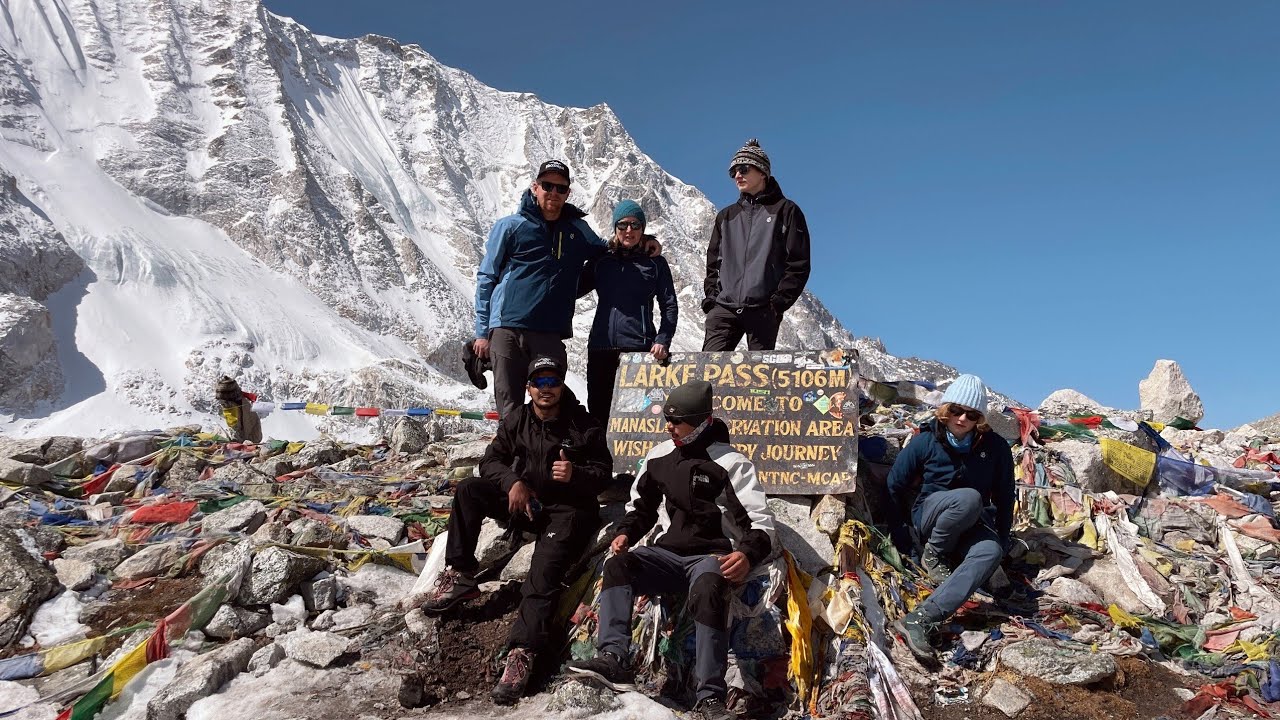
The pass is marked by dense clusters of Buddhist prayer flags strung across the ridgeline — vivid against the snow and sky. Take time here. The views of Manaslu, Larkya Peak, Himalchuli, Peak 29, Himlung Himal, Kang Guru, and the Annapurna II range are extraordinary. Photograph, breathe it in, and congratulate your group. Then move — the descent still lies ahead and lingering too long in cold and wind at 5,000 m is its own risk.
Morning · Glacier descent
The descent from Larkya La is roughly three hours of demanding, technical terrain — loose rock, packed snow, and steep switchbacks. Crampons stay on until the gradient eases. Trekking poles are critical for knee protection on the steeper sections. En route, the frozen expanse of Ponkar Lake appears below — trapped between the Pongkar and Salpu Danda glaciers — one of the more striking sights on the entire circuit.
Midday · Valley approach
As altitude drops the terrain transforms. Rock and ice give way to grass, then scrub, then the wide open meadows of the Bhimthang valley. It's a remarkable change — within a few hours you've gone from a glaciated 5,000 m pass to a lush green valley at 3,700 m, with Manaslu and Ganesh Himal framing the skyline above. The contrast is one of the great rewards of the Manaslu Circuit.
Afternoon · Bhimthang 3,728 m
Check in, remove your boots, and eat a proper meal. You've crossed the Larkya La. The rest of the afternoon is yours — Bhimthang's meadows, glacial streams, and peak views make it a genuinely beautiful place to decompress. Most trekkers are asleep early tonight, and that's entirely appropriate.
Mountain safety — Larkya La Pass crossing
The Larkya La crossing involves sustained exertion above 5,000 m in cold, often icy conditions. Crampons are required — not optional — when snow or ice is present. Do not attempt the crossing if you are showing AMS symptoms from the previous night. Tell your guide honestly how you feel before departing Dharamsala. Turning back from a high pass is not failure; it is the correct decision. Your guide has the authority and experience to make that call with you.
Larkya La is one of the great high mountain passes of Nepal — a long, exposed ridgeline crossing that marks the shift from the remote Tibetan highlands of the Nubri valley to the lush lower valleys of the western circuit. Buddhist prayer flags have adorned the summit for generations, placed by trekkers and local communities alike as offerings and markers of safe passage.
Peaks visible from the summit:
Bhimthang sits at 3,728 m (12,231 ft) in a wide, open valley that feels like a different world from the glaciated terrain of the pass above. Vibrant meadows, clear glacial streams, and unobstructed views of Manaslu and Ganesh Himal define the setting. After days of high-altitude exposure, the relative richness of the landscape here is immediately noticeable.
The village economy runs on agriculture and trekking tourism, with several teahouses and lodges offering comfortable beds and warm meals. Tonight is a genuine recovery stop — most trekkers eat well, sleep long, and wake up feeling the full weight of what they've accomplished.
You've crossed the Larkya La. The hardest day on the Manaslu Circuit is behind you. Bhimthang is where the circuit begins its final descent — enjoy the valley, the lower altitude, and a well-earned long sleep.
Your final day on the trail — a long descent through rhododendron forest, river valley, and terraced farmland to the circuit's last overnight stop at Dharapani
21 km / 13 miles
Trek distance
7 hrs
Walking time
Day 11 is the last full day on the Manaslu Circuit trail, and it's a fittingly varied send-off. You descend nearly 1,800 vertical metres over 21 km — from Bhimthang's alpine meadows down through dense rhododendron and oak forest, along the rugged banks of the Dudh Khola river, past Gurung villages and terraced fields, and finally into Dharapani, the circuit's last overnight stop before the journey back to Kathmandu.
It's a long day with real cumulative descent on already-worked legs, but the scenery shifts dramatically with every few kilometres. After days of snow, rock, and high-altitude exposure, the return of rich green forest and agricultural lowlands feels like a different Nepal entirely. Take your time, enjoy the transition, and arrive in Dharapani knowing you've completed one of the finest trekking circuits in the Himalayas.
Early morning · Bhimthang 3,728 m
After breakfast the trail drops away from Bhimthang's open meadows into the valley below. The descent is steep in the upper section and the path can be loose underfoot — poles are worth having out from the start. Within the first hour the landscape begins to soften as you drop below the alpine zone and the first trees reappear.
Morning · Rhododendron forest
The trail descends through some of the most striking forest on the circuit — dense mixed woodland of rhododendron, pine, and oak that in spring turns vivid red and pink along the slopes. Wildlife reappears here too: birds, langurs, and with luck, the glimpse of a larger animal moving through the undergrowth. Walk quietly and take it in. After the bare high-altitude terrain of the last several days, the density and colour of the forest is genuinely striking.
Midday · Karche
Karche is the natural lunch stop for the day — a good point to sit down, eat a proper meal, and give your legs a break before the afternoon section along the river. Refill water here if your guide confirms a clean source, and take the opportunity to adjust layers. The valley gets warmer as you descend and the afternoon trail along the Dudh Khola can feel significantly hotter than the morning forest section.
Early afternoon · Dudh Khola
After Karche the trail follows the Dudh Khola river — the "Milk River," named for the glacial silt that gives it a pale, opaque colour. The path runs along the river's rugged north bank, with the water rushing noisily alongside. It's good walking — flat enough to move well on tired legs, with the river views keeping things interesting. Keep your footing careful on the rockier bank sections.
Mid-afternoon · Gurung Goa
Gurung Goa is the first proper agricultural village you'll encounter since crossing to the western side of the circuit. Terraced fields of millet, corn, and barley step down the valley slopes — a vivid reminder that this landscape is lived in and worked, not just trekked through. The cultural character shifts noticeably here from the Tibetan-influenced north to the Gurung communities of the lower valley.
Late afternoon · Tilije to Dharapani
From Tilije the trail follows the true right (north) bank of the valley on the final approach into Dharapani. The path is well-worn and straightforward after the more rugged terrain earlier in the day. Dharapani comes into view as the valley widens — a larger, busier settlement than anything you've stayed in since leaving the lower circuit. Check in, eat well, and mark the occasion properly.
Dharapani sits at approximately 1,860–1,910 m (6,102–6,266 ft) in the Lamjung District and marks the official end of the Manaslu restricted zone — the checkpoint here is the last permit inspection point of the trek. It's a noticeably busier, more connected settlement than the remote villages of the upper circuit, with a functioning local market, teahouses, lodges, and road access back toward Besisahar and Kathmandu.
The village is home to a mix of Gurung and Tibetan communities with a strong agricultural and trading economy. Ancient stone houses sit alongside modern facilities, and the presence of jeep tracks and vehicles after days of trail-only travel feels like a genuine gear change back toward the everyday world.
This is the last night on the Manaslu Circuit. Tomorrow the road takes over from the trail. Tonight is the right moment to reflect on the full circuit — from the Budi Gandaki gorge to the Larkya La and back down through the valley. It's been a remarkable route.
After breakfast, take a local jeep from Dharapani to Besisahar, a 3-hour drive through scenic landscapes. From Besisahar, enjoy a 6 to 7-hour drive back to Kathmandu. We recommend opting for a private vehicle for a more comfortable and flexible journey.
Upon arrival in Kathmandu (1,400m), you can relax at a your hotel and celebrate the successful completion of your Manaslu Circuit trek with a farewell dinner in the evening.
Optional: Instead of returning directly to Kathmandu, you may choose to drive to Pokhara to explore its stunning lakes, Annapurna Himalayas, and mountain terrains if your schedule allows.
The Manaslu Circuit Trek begins and ends in Kathmandu. Here's everything — from your flight landing to your first step on the trail.
Local tourist bus Included
Private jeep or HiAce Optional upgrade
| Duration | Entry type | Fee (USD) |
|---|---|---|
| 15 days | Multiple entry | $30 |
| 30 days | Multiple entry | $50 |
| 90 days | Multiple entry | $125 |
Trek start — Machha Khola
Trek end — Dharapani → Kathmandu
Dal Bhat
Staple at all altitudes
Momos
Lower elevations
Noodle soup
Widely available
Tsampa porridge
High altitude staple
Tibetan bread
Common breakfast
Butter tea
Warming at altitude
Boiled potatoes
Energy on the climb
Eggs
Most teahouses
Water safety
Tap water is untreated at every elevation. Carry a filter or purification tablets — don't rely on bottled water alone.
Calorie needs
Long trekking days burn 3,000–4,500 kcal. Dal Bhat refills are usually free — always ask for seconds.
Dietary needs
Vegetarian options are plentiful throughout the route. Vegan and gluten-free trekkers should carry supplemental snacks from Kathmandu.
Snacks to pack
Energy bars, nuts, dried fruit, and electrolyte sachets cover the gap between meals and fuel pre-dawn summit starts.
Teahouse etiquette
Eating where you sleep is expected — it's how host families earn their living. Ordering meals at your lodge keeps trust and pricing fair.
Cash only
No ATMs exist beyond Arughat. Withdraw enough Nepali rupees in Kathmandu — cards are not accepted anywhere on this route.
Route stats
Physical demands
Key altitude checkpoints on the standard 14-day route
880m
Machha Khola
Start point
1,410m
Jagat
Day 3
2,630m
Deng
Day 5
3,530m
Samagaun
Rest day here
4,460m
Dharamsala
Pre-pass camp
5,160m
Larkya La
Summit pass
Not without preparation. Trekkers with little hiking background can complete the route, but only after a structured training program of at least 4 weeks covering cardio, leg strength, and loaded hiking. Mental resilience matters as much as physical fitness here.
Certain sections carry genuine risk. The approach to Larkya La and trails near Dobhan are exposed and prone to rockfall or ice during poor weather. The circuit is significantly more remote than the Everest Base Camp route — helicopter evacuation can take longer and cost more.
Manaslu is longer, higher at its pass, and notably more remote. EBC has better lodge infrastructure, more rescue access, and a more established trekking corridor. Manaslu rewards those seeking a quieter, wilder experience but demands more self-sufficiency.
AMS occurs when the body struggles to adjust to reduced oxygen at altitude — symptoms include headache, nausea, and fatigue. The standard protocol is to ascend slowly, hydrate well, and descend immediately if symptoms worsen. A rest day at Samagaun (3,530m) is built into most itineraries specifically to reduce AMS risk.
March – May
September – November
June – August
December – February
Your 12-day Manaslu Trek itinerary package includes:
Cardio endurance
Running, brisk walking, cycling, or swimming. Builds the aerobic engine you'll need for long days and thinner air above 3,500m.
Leg & hip strength
Squats, lunges, step-ups, and stair climbing. Powers you uphill and protects your knees on the long descents.
Core stability
Planks and balance work keep you steady on uneven terrain and reduce lower-back strain under a loaded pack.
Trail hiking
Nothing replaces the real thing. Start with short, flat routes and gradually add elevation, distance, and pack weight. Break in your boots early.
Flexibility & mobility
Regular stretching or yoga keeps joints supple and prevents the stiffness that builds up over consecutive trekking days.
Altitude exposure
If possible, spend time above 2,500m before your trek. Even a weekend in the hills helps your body begin adapting to thinner air.
Whether you're trekking in spring, autumn, or even during winter, this well-organized checklist ensures you're fully prepared for Manaslu's high altitudes, remote villages, and rapidly changing mountain weather.
Basic first-aid kit (band-aids, gauze, antiseptic wipes)
Absolutely loved the Manaslu trek with PlacesNepal ! The guides (Gokul and Mangal) and porters (Ganesh, Temke, Sujan) were amazing—super helpful, kind, funny and professional. The group chemistry was great, which made the trek even more enjoyable. The views were stunning, but what made the experience truly unforgettable was the time shared with such a great team. I had an incredible time with PlacesNepal and would definitely recommend them for anyone considering going to Nepal. Already looking forward to planning my next trip, jam jam !
Just got back from the Manaslu Circuit with Places Nepal, and I genuinely couldn’t have asked for a better experience. From the very beginning, everything was smooth and well taken care of. Nam helped us organize and communicate all the pre-trek logistics—super responsive, clear, and patient with all our questions. He made sure we felt prepared and confident before we even landed in Nepal. Once on the trail, the team was incredible. Gokul, our main guide, was calm, responsible, and always ensured things ran smoothly. His steady, reliable presence made a huge difference—especially on the more challenging days. Mangal, our second guide (and also a great videographer), was super knowledgeable—not just about the route, but also about the culture, history, and environment. He brought so much insight and energy to the trek, and somehow still managed to capture amazing footage throughout the journey. Our porters—Sujan, Ram, and Ganesh—were absolute legends. Always smiling, always helpful, and they carried the weight (literally and figuratively) that allowed us to enjoy the trail stress-free. Their positivity and work ethic were honestly inspiring. The scenery was breathtaking, but it was this team that made the trek truly special. It never felt like a tour—it felt like an adventure shared with friends. I felt safe, supported, and looked after every step of the way. If you’re planning a trek in Nepal, go with Places Nepal. This trip was an experience I’ll remember for life.
The view we see day by day is really beautiful. Places Nepal team really helpful and caring and supportive. Thank you for Gokul, Mangal, Sujan, Ganesh, and TempK, besides from gaining experience, we also made new family and friends. Such a wonderful experience. These 12 days Manaslu Trek was really pleasant because of guys. Thank you so much. Looking forward to come and trek again!!!
The Manaslu Trek is an unforgettable experience on so many levels, and I had the privilege of planning it with the newly established trekking agency, Places Nepal, founded by two passionate young guides. They went above and beyond to create a personalized trek just for me, ensuring every detail was perfect. They also paired me with an exceptional guide, Manoj, whose expertise, kindness, and adaptability made all the difference in overcoming the trek’s challenges and tailoring the experience to my needs. The landscapes along the trek are absolutely breathtaking, ranging from lush jungles and rainforests to stark, mineral-dominated high-altitude terrain. Crossing the Larke Pass at 5,100 meters was a true highlight, though it’s not to be underestimated. While the trek isn’t overly strenuous in terms of steep climbs, the high altitude and reduced oxygen turn it into a significant challenge. It’s an adventure that pushes you but rewards you with stunning views and a deep sense of accomplishment. The day after the Pass is magical. As you go down, the landscape changes completely every 30 to 60 minutes, from rocky mountains to green meadows, forests, rivers, rock piles… The mix of stunning views makes the descent unforgettable and a perfect way to end the trek. I highly recommend Places Nepal and the extreme professionalism of Manoj for an experience that’s as smooth and well-supported as it is awe-inspiring.
Couldn’t recommend places nepal enough! Nam is incredibly friendly and helpful and helped to put together an unreal trip! Went on the Manaslu circuit with Kapil as our guide who was also perfect. Felt incredibly safe and lucky to have a local guide! The trek itself is unbelievable and was able to be enjoyed fully due to the guide and company!
The Manaslu Circuit was the adventure of a lifetime, and much of that credit goes to our incredible guide and now dear friend, Nam! From the moment we met him, Nam's warmth, professionalism, and deep knowledge of the region stood out. We were a group of 4 and I was especially concerned if my mom would be able to make the entire trail. Nam always stayed in the back helping us pushing forward with in the trail, always making sure my mom was comfortable and taking the necessary rest breaks. With his enthusiasm and gift for jokes (but always super professional) Nam actually made it feel much easier than what it actually was. The trail itself is breathtaking—a journey through lush forests, charming villages, and eventually into the high-altitude, snow-capped landscapes that make the Himalayas so legendary. Nam ensured we didn’t miss a single highlight, from cultural insights about the Tibetan-influenced villages to the hidden spots with the best panoramic views of the mountains. Crossing the Larkya La Pass was challenging, but Nam’s encouragement made it feel like we could conquer anything. The moment we reached the top, with the stunning peaks surrounding us, was nothing short of magical. If you’re considering the Manaslu Circuit, having Nam as your guide is a must. His expertise, kindness, and passion for the region transformed a stunning trek into a deeply personal and enriching journey. We couldn’t have asked for a better guide—or a better friend. Thank you, Nam, for memories we’ll cherish forever! Don't forget: "put your feet okay" and "it is just 5 minutes" :)
I did the Manaslu 12 days trekking in a group of 4 and with Nam as our guide, and we could not be luckier! I loved everything about the experience. Everything was clear, and the team was professional, funny, and knowledgeable. From day first until the end of our trip, I felt safe and comfortable, knowing that I could trust Nam and the rest of the wonderful team. If you are planning to hike in Nepal, choose this agency with your eyes closed because they are truly the best! Grazie di tutto Places Nepal, spero di tornare presto per un'altra avventura insieme ☺️
I have just returned from Nepal, where with PlacesNepal I toured the circuit around Mount Manaslu, up to the Larke Pass (5106 m). Unforgettable experience, either for the places of extraordinary beauty - so distant geographically and so intact in their naturalness - or for the excellent guide who accompanied me. I wanted to do this experience alone, and I had some doubts about being accompanied by a guide: I was pleasantly surprised by the fact that he was very discreet and respectful of my space from the first to the last moment, but always ready to help me if I needed, anticipating my every request. I highly recommend PlacesNepal for the simplicity of interaction, the professionalism and economic honesty of the administrators.
I chose the Manaslu Circuit because I wanted something a bit less crowded than Everest or Annapurna and what I got was so much more. Untouched landscapes, warm locals, a deep sense of peace, and most of all, an amazing team from Places Nepal who truly made me feel like family. From the moment I reached Kathmandu, Nam was in touch making sure everything was on track. He met me personally the day before the trek, explained the route, safety protocols, altitude considerations, everything. It was my first time trekking solo with a guide, so I was nervous but all of that faded within the first hour of hitting the trail. My guide, Gokul, was truly exceptional. He had this perfect mix of calm confidence and humor that made me feel safe and relaxed at all times. When I struggled with altitude on day 8, he slowed the pace, checked my oxygen regularly, and even rearranged our lodge stay without making me feel like a burden. That kind of awareness and care is rare. The scenery was beyond words rushing rivers, suspension bridges, ancient monasteries tucked into cliffside villages, yaks roaming freely and then of course the unforgettable Larke La Pass. It was brutally cold and windy up there, but with Gokul and our porter Sujan encouraging me every step, I made it to the top. I cried when I saw the view. Not from exhaustion, but because I was so overwhelmed by what we’d accomplished together. Every lodge we stayed in felt cozy and clean, with the best food I’ve ever eaten at 3,000+ meters. Dal bhat never gets old, especially when shared with new friends and warm tea by a fire. To anyone considering a trek in Nepal: go with Places Nepal. They’re not just an agency they are people who truly care about you, about the mountains, and about Nepal. 10/10 I’ll be back.
The Manaslu Circuit was raw, wild, and exactly what we wanted. Fewer tourists, more nature. The crew at Places Nepal were absolute legends always smiling and willing to help. Our porters danced at dinner and shared stories by the fire. We learned Nepali phrases and card games. The trek was tough at times, but we never felt unsafe. Shoutout to our guide Gokul for always staying cool under pressure. Already planning Mustang next year with the same team!
Doing the Manaslu Circuit with Places Nepal was one of the best decisions I’ve made. As a solo female traveler, I was a bit nervous at first, but my guide Kapil immediately made me feel comfortable and safe. The trek itself is otherworldly dramatic mountain views, quiet villages, and genuine cultural encounters. The team handled everything smoothly, and I always felt supported but never rushed. I especially appreciated the flexibility when I had a tough altitude day. They adjusted our pace with patience and professionalism. 10/10 recommend.
My best friend and I had been dreaming about a Himalayan trek for years. After a lot of research, we landed on the Manaslu Circuit and booked with Places Nepal. What we didn’t expect was just how personal and meaningful this experience would become. Nam and his team were incredible from day one. He helped us customize the trek to our pace and even arranged a few cultural add-ons in Kathmandu before we started hiking. When we met our guide, Kapil, and porter Ganesh, we instantly felt like we were in great hands. These guys are so much more than service providers, they're mountain people with huge hearts and deep local knowledge. Manaslu itself is pure magic. Each day the terrain changes, from steamy forest to alpine desert to glaciers. And unlike more popular routes, we barely saw any other groups, which made it feel like our own private adventure. Kapil was a walking encyclopedia, pointing out everything from plants to prayer wheels, and sharing local stories at night over tea. He also taught us a few Nepali words and songs, which we proudly tried to use with locals (and were met with plenty of laughs). The altitude did hit us a bit around Sama Gaon, but the acclimatization day helped immensely. We hiked up to Pungyen Gompa, which was one of the most spiritual moments of the trek. Absolute silence, snowy peaks all around, and prayer flags fluttering—it felt like time stood still. Crossing the Larke La Pass was tough, no sugar coating that. But thanks to the careful pacing, support, and even jokes from Kapil and Ganesh, we both made it safely and proudly. The views from the top were jaw-dropping. No photo could ever do it justice. To sum it up: this trip was everything we hoped for and more. We laughed, struggled, learned, and left with full hearts. Merci beaucoup, Places Nepal. We will never forget this journey.
We wanted something off the beaten path, and Manaslu was exactly that. It’s quieter than Everest or Annapurna, but just as stunning. What made the experience unforgettable was the Places Nepal team. Gokul was a walking encyclopedia and also hilarious. He made even rainy days fun. Our porter Sujan was a ray of sunshine—always smiling, always helping. I’ve never felt so cared for on a trip. Highly recommend this trek and this team!
What I liked most was how well the whole trip was managed. Nothing felt rushed or chaotic. The altitude is no joke, but we felt prepared every step. The Places Nepal team briefed us well and checked on us constantly. Our guide Kapil knew the terrain like the back of his hand. And the little things like thermos tea breaks or checking our boots at night made a big difference. This is how trekking should be done.
As two nature lovers and occasional trekkers, my partner and I were looking for a challenge that would also immerse us in local culture. The Manaslu Circuit with Places Nepal exceeded every expectation. First of all, the route is absolutely stunning. Every day the scenery changes dramatically from rice fields to waterfalls to high altitude moonscapes. But what made it truly special was our guide, Manoj, and porter, Ram. They weren’t just guiding us they were sharing their country with us. We learned so much about Buddhism, village life, and the delicate balance of humans and nature in the Himalayas. Manoj managed the perfect balance of professionalism and friendliness. He made sure we always felt safe, especially during acclimatization and the high pass. He checked our heart rates every night, asked about our appetite (a key altitude indicator), and adjusted our pace depending on how we felt. That attention to detail made the trek far more enjoyable and helped us avoid any serious symptoms. I especially appreciated how Places Nepal respects local communities. We visited a school that they support and had tea with the headmaster, who told us about the positive impact tourism has when it’s done responsibly. It gave the trek a deeper meaning than just hiking. Crossing Larke La was one of the hardest physical things we’ve done, but standing at 5,106 meters with the wind howling and the mountains rising on all sides it was pure euphoria. If you want a trek that’s not just beautiful but authentic, filled with connection and soul, go with Places Nepal. It’s not just about reaching a summit it’s about the people you meet along the way. We left Nepal with full hearts and lifelong memories.
I’ve done several treks before, but this was by far the most enriching. Our guide, Nam, was not just experienced, he was deeply connected to the land and its people. He taught us about the Buddhist customs, pointed out rare birds, and introduced us to his friends in local villages. The trail was challenging, yes, but the Places Nepal team made sure we acclimatized properly and never pushed beyond our limits. I felt so cared for.
This trek was not just a hike—it was a personal journey. I went in seeking solitude and came out with lifelong memories and new friends. The views are jaw dropping, yes, but it’s the quiet moments sharing tea in a mountain village or watching yaks at sunrise that stick with you. My guide Kapil had a calming presence and deep respect for the environment. Places Nepal truly supports ethical, eco friendly trekking. I can’t wait to come back.
My wife and I were blown away by the scenery and the smooth organization. Places Nepal made every step stress free. From picking us up at the airport to arranging all permits and gear, everything was on point. Our guide, Mangal, was very professional and had a great sense of humor we laughed our way through some long hiking days. He always knew the best teahouses with warm food and good vibes. A truly authentic Himalayan experience. Thank you guys!
I work in a high-stress job, and I needed a serious reset mentally, physically, emotionally. The Manaslu Circuit was exactly that, and Places Nepal was the perfect team to guide me through it. I did a private trek with a guide and porter, and both were incredible humans. My guide, Kapil, was incredibly intuitive. He never overexplained or pushed too hard he just read the moment. Some days I was quiet and just needed to walk in silence. Other times we had long chats about life, culture, and his childhood in the mountains. He always respected the space while making me feel safe and cared for. This trek strips everything down. You carry only what you need. You wake with the sun. You eat simple meals by a warm fire. And every day you earn each step. There were moments of exhaustion, yes, but also deep peace. The kind of peace that only comes from being surrounded by 7,000 meter peaks and hearing nothing but the wind. The highlight? Without a doubt, the day we crossed the Larke Pass. We left at 4 am with headlamps and silence. Reaching the top was not just a physical achievement it was emotional. I felt like I left something behind on that pass stress, fear, ego—and returned lighter. I’ve done a few treks before, but none like this. If you want something real something quiet, vast, and life-affirming—this is it. And if you want a team who really gets it, go with Places Nepal. These guys walk the talk.
Una experiencia inolvidable. El paisaje es salvaje y puro, y el equipo de Places Nepal fue de diez. Nuestro guía, Krishna, fue amable, profesional y siempre atento. La travesía por el Larke Pass fue dura pero hermosa. Gracias por cuidarnos tan bien. ¡Repetiría sin dudarlo!
From the first contact with Nam, I felt cared for. The team at Places Nepal is beyond professional but also incredibly warm and human. My guide, Ram, treated me like family. The trek was challenging, but every moment from tea house chats to the Larke Pass views was worth it. I left part of my heart in those mountains.
I’ve done Kilimanjaro and Patagonia, but Manaslu was on another level. Less touristy, more raw. Places Nepal kept everything smooth. My guide, Ramesh, was a legend. Helpful, respectful, and full of knowledge. The Larke Pass day was tough snow, wind, early wake up, but the view made me tear up. Book with this agency, no question.
We didn’t want something overly commercial. Manaslu was perfect! quiet trails, rich culture, and unreal scenery. Our guide Sujan was kind, hilarious, and knew every local tea shop owner. Places Nepal made us feel like friends, not clients. Couldn’t have asked for a better anniversary trip.
I don't usually write long reviews, but this trek meant so much to me that I have to share it. I've traveled solo before, but never anything like this high altitude, remote, way out of my comfort zone. I was honestly nervous when I booked it, but Places Nepal made everything easy from day one. My guide Laxman was amazing kind, funny, knowledgeable, and genuinely caring. He always made sure I felt safe and comfortable. When I got a little emotional at the Larke Pass (because it’s that breathtaking), he just smiled and said, “That’s why we walk.” That moment stayed with me. The scenery was beyond anything I expected. Every day brought something new jungle trails, Tibetan villages, glaciers, yaks, monasteries. It wasn’t just a trek, it was a personal journey. I came back feeling stronger, calmer, and somehow more grounded. Thank you Nam and the team. I’ll never forget this.
I came for the mountains, but left changed as a person. There’s something humbling about walking day after day through these ancient landscapes. Places Nepal understands that. They don’t just take you from A to B they guide you with heart. Will never forget it.
We were a group of four women, all mid-30s, and honestly a bit nervous. But Places Nepal made it seamless. Nam answered every single question (we had a lot). Our guide, Dipak, was the perfect balance of safety, fun, and flexibility. The tea houses were cleaner than expected. And the scenery? Mind blowing.
Be ready for long days and basic lodges, but if you’re looking for a true off-the-beaten-path trek, this is it. No crowds. Just mountains, monasteries, and silence. I loved every second. Hats off to Places Nepal for making it so smooth.
Yes, we did a trek for our honeymoon and it turned out to be the most romantic thing we’ve ever done. The peacefulness of the trail, the tea houses, the shared challenge… it brought us closer than ever. Our guide Krishna even surprised us with a cake at 3,500m. Still can’t believe it. ❤️
I’ve done EBC. I’ll take Manaslu any day. Fewer people, more cultural depth, and way more peaceful. Places Nepal kept it real. No pressure, no sales vibe, just honest service and really good guiding. Will book Kanchenjunga with them next.
I just got back from the 10-day Manaslu Circuit with Places Nepal, and I’m still buzzing! I only had a short time for this trip, so the 10-day plan was perfect. Nam was super helpful from the start, answering all my emails and making sure I knew what to pack and expect. Our guide, Anil, was awesome so friendly and knew the trail like his backyard. The porters, Tsering and Mingma, were always smiling, even carrying heavy bags up crazy steep hills. The trek was tough but amazing. You start in jungles with monkeys, then hit these cool villages with stone houses, and finally climb to Larke La Pass, which was freezing but had the best views ever snowy mountains everywhere! Anil made sure we didn’t rush too much and checked if we felt okay with the altitude. I loved the tea houses; they were simple but cozy, and the dal bhat was so good after a long day. One night, we played cards with the porters, and it felt like hanging out with friends. Places Nepal also took us to a small monastery, which was so peaceful. This trip was hard but so worth it. I felt like a champ at the top of the pass. Big thanks to Places Nepal for making it so great. I’m already planning to come back!
I recently completed the 14 days Manaslu Circuit Trek with Places Nepal Treks, and I couldn’t be happier with the whole experience. From the very beginning, the team was professional, organized, and supportive. The booking process was smooth, and they were very clear about the permits and requirements. Our guide, Namaraj, was knowledgeable, friendly, and always attentive to our group’s needs. He helped us acclimatize properly and kept an eye on everyone’s health, which made me feel safe throughout the trek. The porters were hardworking and respectful, carrying loads efficiently while maintaining a great attitude. The itinerary was well-paced, giving us enough time to enjoy stunning views, interact with locals, and explore villages without rushing. The teahouse accommodations were clean and comfortable, and I appreciated that Places Nepal recommended bringing a refillable water bottle and provided purification tablets, which helped reduce plastic waste. One thing to note is that some parts of the trail are still affected by road construction, but this didn’t take away from the beauty or the authenticity of the route. Our team handled logistics flawlessly, including transportation from Kathmandu to the trailhead and back. Overall, I highly recommend trekking Manaslu with Places Nepal Treks and guide Namaraj if you want a genuine Nepal adventure with experienced guides who prioritize safety, culture, and environmental responsibility.
This was my fourth trek in Nepal, but the first with Places Nepal Treks—and certainly the best. Traveling with my teenage son, I was anxious about altitude, food safety, and group dynamics. From the first email, Places Nepal Treks reassured me with prompt replies and clear advice. Our guide, Mingma, met us in Kathmandu and helped us sort last-minute gear. He explained our route, the villages we’d visit, and even local etiquette—crucial for helping my son feel informed and empowered. Our porters, Pasang and Dawa, were equally gentle, always helpful and curious about our lives back in Poland. The Manaslu Circuit is unique. Each day we passed ancient gompas, spinning prayer wheels, then entered forests alive with monkeys and colorful birds. Mingma narrated the legends behind hilltop chortens and shared how remote communities survive with so little. My son, usually attached to his phone, spent evenings learning Nepali card games from Pasang, laughing until curfew. Food was surprisingly delicious: steaming momos, spicy soups, lentils, and freshly baked mountain bread. Mingma always checked the kitchen's hygiene and even arranged for mild options when the spice level knocked my son’s socks off. The altitude is no joke. When headaches appeared, Mingma ensured we drank plenty and rested. His calm, watchful presence was more reassuring than any medicine. After acclimatizing in Samagaon (where we visited a centuries-old monastery), we headed for the high pass. The morning of Larkya La was minus ten degrees and windy. We moved slowly. Dawa sang local folk songs, keeping spirits high. The moment we crossed 5106m, the sheer scale of mountains hit me. I hugged my son with a strange sense we’d travelled not just distance, but back in time. The last days wound through pine forests, small waterfalls, and quiet villages. By now, we knew the whole team’s stories and shared ours too. When the trek ended, saying goodbye felt like leaving old friends. Places Nepal Treks is what every agency should be: personal, skilled, honest, with a heart for people. Manaslu with them was a journey less about conquering peaks and more about discovering enduring friendships and Himalayan spirit.
Solo trekking as a woman in Nepal is both thrilling and daunting. After researching options, I chose Places Nepal Treks because of their reputation for safety, female-friendly guides, and a transparent approach. From the first contact, I felt heard and supported. My guide, Sunita, met me in Kathmandu, her huge smile and confident air put me at ease instantly. The porters assigned to our group doubled as protectors and comedians, cheering us on during the hardest stretches. Sunita briefed me every evening, setting expectations and even teaching me a few phrases to help me connect with local women along the route. The lower Manaslu path bustled with life, schools, farmers, and cheese-makers. Sunita introduced me to a remarkable woman who ran a homestay in Namrung; we shared tea and stories about family, resilience and dreams. These connections were my favorite part of the trek. Accommodation was simple but always clean, the food nourishing and prepared with care. Sunita made it her priority to check the kitchens and speak with lodge owners directly. I never worried about my belongings or safety; she always made sure I had the best room available and privacy when possible. The high altitude days were tough, but Sunita’s encouragement never wavered. We faced snow flurries and cold mornings, she brought me extra blankets and hot ginger tea to help me sleep. Crossing the Larkya Pass, I felt like I conquered not just the mountain, but my own anxieties. Sunita held my hand over icy patches, told stories to distract me, and reminded me of how far I’d come. At the finish, I felt accomplished and joyful. Places Nepal Treks didn’t just get me around Manaslu; they gave me the courage and backing to discover my own strengths. I recommend them to any solo woman wanting a genuine Himalayan adventure with total peace of mind.
If you’re looking for a trek that will blow your mind and your expectations, forget the crowds and head for Manaslu with Places Nepal Treks. As a retired teacher, I’ve read endless travel guides, but nothing prepared me for this. I was drawn by stories of remote valleys and ancient customs, and my experience exceeded every hope. Our group was small: four guests, two porters, and Padam, our endlessly knowledgeable guide. From day one, he treated us like equals; any question about geology, Buddhism, or politics was answered in detail. He pointed out the effects of the 2015 earthquake and discussed how villages have rebuilt with both tradition and innovation. The variety on Manaslu astounded me dense forests alive with orchids, massive river gorges, and alpine tundra creased with yak tracks. We met mule trains, monks, and shy children. Each stop revealed unique dialects and customs. Padam always facilitated authentic interaction, never the staged “tourist show” sometimes found elsewhere. Perhaps most memorable was our night in Samdo, just below the pass. The villagers invited us to a local festival. We danced around the fire, shared chang (fermented millet drink), and witnessed chanting monks in vibrant robes. The sense of community, despite hardship, deeply moved me. Crossing Larkya La was grueling biting cold, biting wind. Padam’s leadership kept us on pace, safe, and positive, checking for signs of altitude sickness at every break. He’d trained at a mountain rescue course and it showed. Coming down past wild rhododendrons and waterfalls, I realized what mattered most wasn’t the stunning photos but the new perspective: true resilience, harmony with nature, and kindness. Places Nepal Treks made it all possible, blending logistical smoothness with deep local knowledge. I came for an adventure; I left with wisdom, new friends, and a heart forever marked by Manaslu.
Visited monasteries, trekked under snowy mountains. The Places Nepal Treks team’s local insight made the journey meaningful and spiritual.
Everyone treated me like family. Our Places Nepal Treks team explained customs and made sure I was comfortable every day.
The trek was an eye-opener, the natural beauty of our neighbouring country, local festivals, and the guide’s deep knowledge. Felt safe, supported, and welcomed.
My journey on the Manaslu Circuit with Places Nepal Treks was about much more than hiking trails. From the first handshake at Kathmandu airport, my guide Tsering and I hit it off. He didn’t just know the way but shared stories about his village and family and taught me about the subtle etiquette at every tea stop. The porters in our group were full of life and laughter in the mornings and somehow always patient, never rushed even on steep climbs. There were days when the sheer elevation took my breath away. On one occasion while trekking near Samdo, I struggled and Tsering noticed quickly. He offered ginger tea from his pack and we took it slow. This patient care made all the difference. In the evenings, we sat around smoky kitchens or played cards inside simple lodges. Locals sometimes joined and soon it felt like we were no longer just visitors but part of something bigger. Crossing Larkya La Pass was unlike anything else. Freezing wind made my cheeks burn but the sunrise and mountains all around silenced every complaint I had about the climb. When we descended, the landscape changed all over again. Waterfalls crashed and forests grew thick and green. I left Manaslu not just filled with awe at nature but grateful for every human moment. With Places Nepal Treks, I discovered that the best journeys are shared from the heart.
I joined the Manaslu Circuit with Places Nepal Treks specifically because I wanted to capture untouched Himalayan beauty. What I got was so much more. Our guide Nima understood my obsession with early light and always woke me up in time for the pinkest sunrises. He even pointed out hidden viewpoints off the main trail, some known only to locals, which made every photo unique. The porters surprised me with their enthusiasm for photography. They took turns showing me the best spots along crystal-clear streams or beneath old wooden bridges. I learned as much about mountain life as I did about the craft of getting a perfect shot. In the evenings, we reviewed photos in candlelit dining rooms while eating hot soup and momos. Villagers invited us into their homes for tea and laughter, letting me photograph their daily routines. Nothing felt staged or awkward which is rare in travel. By the time we reached Larkya La, I realized my camera couldn’t do justice to the friendship and hospitality I had felt. I returned home with memory cards full of landscapes but the true keepsake is my respect and affection for everyone at Places Nepal Treks.
I took on the Manaslu Circuit with my two teenagers and honestly worried it might be too intense for them. Places Nepal Treks proved me wrong at every step. Our guide Nawang had that special knack with kids, teaching them Nepali words and keeping them entertained during tough climbs. The porters never minded the constant questions or our slow pace. Each village visit was a lesson for my children. They played with local kids and shared snacks and laughs despite language differences. Tea house evenings became bonding time as Nawang told stories about mountain yaks and river spirits. Even when one of my kids fell ill for a day, the team took gentle charge and assured us it was just part of the acclimatization process. Crossing Larkya La as a family was one of the happiest moments of my life. We hugged, took photos, and shared a sense of accomplishment I didn’t expect. The Manaslu trek with Places Nepal Treks gave us not only Himalayan views but a deeper family connection built on teamwork and new perspectives.
The landscape on the Manaslu Circuit is mind-blowing but what truly made my trek unforgettable was the warmth and openness of those I met. From day one, our Places Nepal Treks guide Mingma was focused on making every guest comfortable. He remembered tiny preferences, from coffee types to how we liked our walking pace. Porters were always one step ahead, whether it was keeping our path clear or turning a meal stop into laughter hour. Local villagers handed us apples on the trail or invited us to festivals and dinners. I felt far from being just a tourist. The trek itself was challenging but always richly rewarding. Glacial rivers, pine forests, rocky passes—each turn brought something new. What remained constant was the care and connection between everyone sharing the journey. I left Manaslu with muscles sore but my outlook refreshed. Places Nepal Treks made every day not just about reaching the next village but about enjoying the stories and smiles along the way.
Trekking with Places Nepal was more than physical exploration, it was a true cultural exchange. I spoke some English but very little Nepali, yet our guide Prakash encouraged conversation everywhere. He’d translate jokes from porters or villagers so I felt included even in silly banter inside tea houses. Children were curious about phrases in my own language; we taught each other simple greetings and laughed at pronunciation mishaps. This exchange broke the ice at every stop. I realized that understanding and laughter travel further than words on a map. By the end of the trek, I had shared stories, songs, and lessons with locals who felt like old friends.
My goal wasn’t just mountains but spiritual growth and Places Nepal Treks understood that. Our guide Lhakpa shared insights not only about nature but also Buddhist ways that have shaped the region. Meditation sessions at dawn in monasteries, prayer flag rituals, and joining in chants with monks provided moments of deep calm and self-reflection. Each stone stupa, every spinning prayer wheel, felt part of something far older and grander than myself. The physical challenges of the route became part of a spiritual awakening I didn’t expect. Manaslu’s magic, with Lhakpa’s gentle wisdom, gifted me peace I still carry home.
At 62, I was unsure if I was ready for a Himalayan trek. Places Nepal Treks erased my doubts from day one. Guide Sunil adapted the pace, always checking on my comfort and explaining every step the team took to make the climb safe for someone my age. Our porter, only a teenager, treated me like a grandmother—with respect and helpfulness that touched me deeply. Not once did I feel hurried or left behind; instead, I was encouraged to stop for photos or just to catch my breath. The experience proved you are never too old for adventure if your guide understands your needs. The support from Places Nepal Treks ensured that my trek was not just possible but thoroughly joyful.
The Manaslu trek with Places Nepal team became a reunion for my university friends and me. We hadn't seen each other in years and wanted a meaningful way to reconnect. Our guide Dipak immediately caught on to our group’s camaraderie, joining in on stories and ensuring everyone was included. Even our porters would joke with us during rest breaks, adding their own tales. The mountains gave us quiet stretches to reminisce and evenings were alive with laughter, music, and games. Each day we grew closer, not just through the shared challenge but the sense of belonging Dipak and his crew fostered. At the end, it wasn't simply about reaching the pass—it was about rediscovering friendship in a place as grand as Manaslu. I can’t thank Places Nepal Treks enough for making this trip about people, not just peaks.
As someone always in charge at work, giving up control for once was both scary and liberating. Places Nepal Treks handled every detail from permits to porters, so all I had to do was follow. Guide Raj was attentive but never intrusive. Whenever I tried planning ahead with questions, he’d smile and say, “We focus on today, not tomorrow.” Each twist in the weather or trail was met with calm adaptability from the whole team. I learned to trust them and discovered the beauty in being present, letting the landscape unfold hour by hour. This trek helped me begin to slow down and allow life to just happen.
I brought my two children on the Manaslu Circuit hoping to spark a love for the outdoors in them. Our guide, Namaraj, was a natural teacher. He explained how glaciers formed valleys, pointed out wildlife, and organized simple lessons at scenic stops. My kids drew in travel journals as we trekked, inspired by the mountains and the kindness of our porters. Tea houses turned into mini geography discussions and evenings into storytelling sessions. The journey made my children curious and brave, and gave us as a family a shared bank of incredible outdoor memories. Places Nepal Treks made this wild classroom safe and welcoming for all ages.
I happened to join the Manaslu trek during a village festival and it turned my trip into something unexpected. Our guide Suman knew everyone, so he brought us to a celebration that night. We joined locals in dancing, sampling traditional foods, and watching rituals under moonlight. The warmth of villagers and inclusion in their festivities made the trek far more than just scenic. Porters partook in the celebrations too, making us feel fully integrated with the community. It was these spontaneous moments, facilitated by Places Nepal Treks’ close ties with locals, that made my journey unforgettable and proved how travel is always richer with real cultural immersion.
After a long period of personal loss and stress, I decided I needed to get away and reconnect with myself. The Manaslu Circuit trek with Places Nepal Treks was recommended by a friend who called it transformative. From the moment we left Kathmandu, I felt the healing power of nature starting to seep in. Our guide Gokul, a local with pure Nepali heart, paid attention to every detail. He adjusted our pace so I could pause when I wanted to take in the mossy forests and glacial rivers, a blessing for someone craving quiet moments. The porters seemed to understand that sometimes solitude is as important as conversation. Along the trail, Gokul shared folk tales about the spirits guarding the mountains and the festivals that brought joy to these remote villages. Sharing meals with local families, I found warmth in their generosity and stories. Crossing high passes and navigating tricky descents made me realize how much strength I still carried inside. Each day ended with green valleys, prayer flags fluttering, and a feeling of gratitude. This trek did more than show me beautiful scenery; it helped me gather the missing pieces of my resilience.
As a geologist and nature enthusiast, I chose the Manaslu Circuit with Places Nepal Treks specifically to observe the region’s geology and ecology. Our guide Shishir was not only an experienced local trek leader but had a surprising understanding of mountain science. He delighted in explaining how tectonic activity shaped these ranges and often pointed out visible strata and ancient glacier paths. We stopped frequently to collect rock samples and photograph rare alpine plants. Porters shared their observations about changes in the seasons and the effects of climate fluctuations. In Sama Gaon, I met a local teacher who described the area's unique biodiversity and ongoing conservation work. These discussions made every day an intellectual adventure. Standing atop Larkya La and seeing the interplay between snow, wind, and rock, I felt like a child in nature’s greatest museum. This was the best classroom I have ever visited, and Places Nepal Treks’ expertise made it possible.
For my holiday, I wanted purpose beyond simply traveling. I reached out to Places Nepal team about ways to give back on the Manaslu Circuit. They organized visits to two village schools where I taught basic English classes and shared educational materials I’d brought from home. Our guide Anil was the perfect facilitator, translating where needed, encouraging the children, and working with local teachers to blend my lessons into their routines. Trekking each day, I realized how much effort goes into everyday education and how communities pool resources to foster learning. The porters joined in on games with the students and one even volunteered to teach music one afternoon. The gratitude shown to me was humbling—it made the mountains feel even grander. This journey was about exchange, not charity, and I left with a renewed faith in what connection and small acts of kindness can achieve. Places Nepal Treks showed me that travel can enrich not just the traveler but the world they visit.
Traveling with my mother, I worried about the demands of the trek, but Shishir made everything easy and enjoyable for both of us. He adapted the route so my mother had plenty of time to rest and helped us connect with locals along the way. Shishir’s warm humor and strong leadership made our group feel like a family. Our porters treated us with respect and care, making even challenging days a joy. Thanks to Places Nepal Treks and Shishir, our journey was safe, inclusive, and absolutely unforgettable.
I joined Places Nepal team with my teenage daughter, hoping for quality time together. Ramhari, our guide, was a master at relating to all ages. He shared Nepali riddles with the younger trekkers and discussed mountain ecology with me. Ramhari kept spirits high on long climbs with jokes and personal stories, and made sure everyone felt safe on tough trails. Our porters treated my daughter like a little sister, and by the end, our group felt like a lively extended family. The trek was about more than scenery—thanks to Ramhari, it was about laughter and connection above the clouds.
Bringing my two children, ages nine and twelve, on the Manaslu trek was daunting, but Sujan made learning an adventure. He turned every day into an outdoor classroom, letting the kids help spot wildlife, teaching them about the geology of the stunning cliffs, and even organizing an impromptu soccer match with village children. Sujan’s patience and creativity engaged both my kids and the porters, creating a friendly, supportive environment. Instead of just a trek, it became a family journey of discovery. Every evening, we reviewed the day’s “lessons,” and my kids still talk about Sujan months later.
Recovering from illness, I feared signing up for such a demanding trek. Gokul, my guide, checked my oxygen and hydration at every break and always adapted the speed to my needs. On tough days he reassured me and never made me feel like a burden. Gokul’s deep local knowledge made stopping in each village an educational treat. The porters rallied around, bringing herbal tea on cold evenings and encouraging me on steep climbs. Making it over Larkya La was an emotional high, a reminder of how much strength I still have—brought out by the unwavering support of Gokul and Places Nepal Treks.
I love learning about new cultures, so traveling with Shishir as my guide felt like a grand celebration. Shishir shared not only stories about Himalayan life but was keen to learn about European customs too, sparking curious conversations over meals. He organized a joint cooking night where we made both dal bhat and Hungarian goulash, much to everyone’s joy. Our porters taught us traditional dance moves and joined in laughter when we tried and failed. These exchanges made the trek rich and unique—a true blending of Himalayan and European spirits. With Shishir and Places Nepal Treks, I found a place where cultures met as equals, bringing out the best in everyone along the way.
I hiked the Manaslu Circuit as a charity trek, raising awareness for climate change affecting Himalayan communities. My guide, Shishir, not only helped with logistics but shared how changing weather had changed the lives and crops along the trail. He introduced me to farmers struggling with unpredictable monsoons and explained local adaptation efforts. Porters volunteered for litter collection, and together we left trails cleaner. Every step felt purposeful, and the encouragement from the guides and villagers made fundraising more meaningful. Trekking Manaslu with a cause gave my journey heart and hope for local resilience.
I am a journalist, and my aim with Manaslu was to gather authentic local stories for a documentary. Places Nepal Treks matched me with Sujan, whose community links and sensitivity opened doors everywhere. He arranged interviews with elders, facilitated school visits, and explained the importance of respectful curiosity. Porters acted as translators, sometimes stepping in as storytellers themselves. Instead of just scenery, my trek was filled with diary pages of voices and perspectives from those who call Manaslu home. This was a journey of listening and learning, and none of it would have been possible without Sujan’s trust and support.
As a product designer for outdoor equipment, I took to the Manaslu Circuit to stress-test new prototype gear in real Himalayan conditions. Ramhari, our guide, was endlessly patient with my pace and experiments—sometimes doubling back while I tested waterproof layers or backpack ergonomics. The porters gave practical feedback, using the items during long climbs, and shared opinions over each tea break. Weather threw every challenge at us, from torrential rain to biting frost, giving me priceless insight. The trek was an unpredictable lab, and Ramhari’s resourcefulness reminded me that real-world feedback always trumps lab reports. My products improved, but more importantly, so did my respect for those who tackle these wild paths every day.
Joining a group trek on the Manaslu Circuit with Places Nepal was one of the best decisions I made. Traveling with strangers at first felt intimidating but quickly turned into a wonderful social experience. Our guide Manoj encouraged group bonding through shared meals and fun icebreakers on the first day. Hiking alongside people from different countries created a diverse but friendly atmosphere. When the altitude made the trek tough, the group supported each other, sharing energy bars and words of encouragement. The porters also joined in the camaraderie, making everyone feel part of one team. By the time we crossed Larkya La pass, we weren’t just fellow trekkers but friends who had shared an incredible journey.
I usually prefer solo travels but decided to try a group trek for the Manaslu Circuit to break out of my comfort zone. I was pleasantly surprised by how the group dynamic added a new layer to the adventure. Led by our guide Kapil, whose warm personality kept spirits high, the group paced itself well, balancing the physical demands with lots of laughter and curiosity. We exchanged tips, stunning photos, and local legends shared by Kapil. Having porters who were also cheerful and caring strengthened the group bond. The teamwork on the steep climbs and the shared joy on the summit made this trek more memorable than I expected.
Traveling in a group on the Manaslu Circuit created endless opportunities to swap stories from different cultures and lives. Our guide Sujan was an excellent storyteller who added depth to the experience by sharing local folklore and his own mountain tales. Group dinners in cozy guesthouses often turned into informal cultural nights where everyone shared music or traditions from home. The group helped me keep pace on harder days and celebrated small achievements with hugs and high-fives. The porters joined our conversations, revealing the multi-generational life of the Himalayas. Sharing this trek knit us all together and gave me a sense of community in the wild.
The Manaslu Circuit with a group brought unexpected depths to what I anticipated as a solely physical challenge. Our guide Gokul was exceptional in blending the logistics of the trek with personal attention for each trekkers’ needs. The group shared everything from water and snacks to fears and hope on the steep ascent. Each morning brought communal jokes and songs, turning difficult terrain into joyful moments. The shared experience of acclimatization meant that by the time we reached high passes, our group felt like a small family. The porters added humor and warmth, making the journey a beautiful mix of nature, challenge, and human connection.
Joining a group trek of twelve strangers on the Manaslu Circuit turned into a delightful journey of discovery — not just of stunning Himalayan landscapes but of people and cultures. Guided by Shishir, we learned to appreciate the local customs and traditions, which he explained in vivid detail at each stop. The group taught me patience and generosity. On long walking days, casual conversations and shared snacks made time fly. At tea houses, impromptu singalongs and card games created bonds beyond language barriers. Our porters were not just helpers but part of our traveling family, adding humor and resilience to every step. This trek proved to me that the best memories come from shared experiences.
I signed up for the Manaslu Circuit with some hesitation about group dynamics but was blown away by how tight-knit the group became. Our guide Tashi was the cornerstone—organizing us efficiently yet making space for everyone to contribute and share. We juggled language differences and individual fitness levels with patience and humor, much thanks to the cohesive spirit fostered by Tashi and the porters. Celebrating sunrise at Larkya La together was emotional, a shared triumph after days of cooperation. The group trek was not just about the physical journey but the emotional journey of building friendships that will last a lifetime.
Participating in a group trek on the Manaslu Circuit was eye-opening in many ways. Our guide Ramhari created a supportive environment where everyone’s pace and needs were respected. The group included trekkers from many walks of life: a retired teacher, a young couple, and fellow solo hikers. Sharing meals with them broadened my cultural horizons and taught me new ways to see the world. Group discussions around the fire about Nepalese history and mountain ecology added a thoughtful dimension to the trek. Porters often joined in on these conversations, adding their important perspectives. The social learning combined with the physical challenge made the trek deeply fulfilling.
I arrived at the Manaslu Circuit feeling nervous about joining a pre-arranged group. That worry disappeared on day one, thanks to the welcoming atmosphere created by our guide Manoj. He introduced us to each other with genuine warmth, and soon our shared challenges on the trail created camaraderie. Each trekker brought different skills—one was excellent at photography, another great at reading maps—so we helped each other. When the altitude got tough, no one was left behind; the entire group supported one another emotionally and physically. I finished the trek feeling empowered by friendships forged on high mountain paths.
There’s something special about hiking the Manaslu Circuit in a group that a solo trek cannot replicate. Our guide Kapil brought out the best in everyone, encouraging collaboration and fun even in difficult weather. The group shared gear, stories, and motivation. The local porters became part of the team, their upbeat attitude contagious. We faced rain, cold, and altitude sickness as a united front. Group dinners became celebrations of survival and friendship. Kapil balanced professionalism with warmth, making the difficult trek enjoyable and safe for all ages and experience levels.
What surprised me most about joining a group trek on the Manaslu Circuit was how quickly bonds formed and how much stronger we felt facing challenges together. Guide Sujan’s calm command helped us negotiate trail blocks and adjust plans flexibly when needed. The porters carried not just our bags but also spirits, telling jokes and sharing local songs. We celebrated every milestone—each village, every stream crossing, and especially the high pass—cheering loudly. This collective energy turned the trek into a joyous and deeply rewarding experience. It proved to me that the greatest adventures are shared.
Joining the Manaslu Circuit group trek awakened my Swiss mountaineer heart. The crisp morning starts, reminiscent of the Alps, were enriched with Himalayan grandeur and the cheerful, methodical guidance of Kapil. Our group moved in quiet discipline, and yet, evenings turned lively—much yodeling from my tent-mates. The porters’ ingenuity navigating mountain paths reminded me of home but in a wilder setting. Hiking as a group brought out the best in us: safety in numbers and the warmth of shared chocolate under the stars.
A proper group expedition, that’s what it was. Gokul, our guide, was as punctual as any London train, even when the trail wasn't. Our mixed bag of Brits spent a good portion ribbing each other, swapping tea for local brews at every rest. The porters got in on the jokes and soon enough even the quietest group members were tossing puns. By the time we’d reached the pass, we were all in it together, proud as punch and eager for another round of beans on toast—though, here, dal bhat sufficed splendidly.
Ah, the art of trekking together! In France we believe in savoring every moment, and Shishir, our guide, allowed us to do just that—long conversations by rivers, unhurried lunches with cheese I swore resembled home. The group became my mobile salon, debating philosophy and sharing poetry by firelight. The porters admired our attempts at local language, while we admired the mastery of their craft. The mountains, like a fine Bordeaux, only improved the longer we lingered.
I’ve hiked the Tatras, but Manaslu was something new. Our group moved as one—resilient, resourceful, led by Gokul who joked the cold was "almost Polish." The porters, just as strong as any from Zakopane, delighted our team with mountain remedies like garlic soup. At dusk, we traded stories of old Krakow with those of ancient monasteries. There’s pride in the Polish way—toughness, fellowship—and Manaslu delivered challenges we met together.
What a trip! Our group, mostly Americans, kept up the energy with game nights and high-fives. Kapil, our guide, loved our enthusiasm—and our never-ending questions. The porters picked up our slang quickly, and soon we were all hollering encouragement on tough climbs. Celebrating Thanksgiving here with instant mash and canned turkey was unforgettable, and the pride crossing Larkya La as a unified team rivaled any summit back home.
Every day of the trek was a new fiesta. Sujan, our leader, got our group up dancing—even the porters tried the flamenco. We shared tapas from our rucksacks, traded recipes with tea house cooks, and added Spanish songs to the nightly guitar tunes. No siesta up here, but so many memories—laughter echoing off the rocks, shared stories that blurred the line between friends and family.
Joining this trek was like being with an oversized family. Ramhari made sure everyone felt seen, matching our Hungarian love for storytelling and paprika. The group discovered we could spice up any meal—literally—and the porters loved our goulash-inspired trail snacks. We survived tough paths with humor and heart, reaching the pass waving both the Nepali and Hungarian flags.
I appreciated the space to observe and the respect for silence from our group, led thoughtfully by Tashi. Evenings were for slow conversation, sharing coffee, and appreciating the calm—much like a Finnish sauna gathering. The porters moved with quiet strength and included us in simple rituals, making me feel at home despite the alien landscape. Group trekking here was less about words and more about the slow, shared journey—very Finnish, very profound.
I joined the Manaslu Circuit with Places Nepal Treks last fall, and wow, what an unforgettable experience! Our guide Kapil was not only super knowledgeable but also made the trek fun with his jokes and stories about local culture. Sujan, our porter, was incredible, carrying all our gear with a smile and always ready to help. Being in a small group made the whole trek feel like a shared adventure. Hiking through lush valleys and snowy passes, I felt connected to nature like never before. Whether you're solo or with friends, this trek is a must!
I solo-trekked Manaslu Circuit and booked with Places Nepal Treks. Meeting Kapil and Sujan really made the trip special; they were patient and professional, answering all my newbie questions and keeping the pace comfortable. I ended up joining a group from our agency mid-trek, which was awesome for the social vibes and shared meals. The trail was breathtaking, and the cultural spots off the beaten path felt authentic. For a quieter Nepali trek, this is where you want to be.
This trek pushed me physically more than I expected, but with Kapil’s expert guidance and Sujan’s endless support, I made it across the Larke La Pass feeling proud and alive. Places Nepal Treks nailed the itinerary, balancing tough days with acclimatization perfectly. I teamed up with a group of fellow travelers halfway, and those evenings of stories and card games with the crew were highlights. The Manaslu Circuit is challenging but delivers stunning views and unforgettable cultural moments
Joining a group trek to Manaslu with Places Nepal Treks was the best decision I made. Our guide Namaraj was more like a friend who knew every secret spot on the route. Kishor, the porter, was cheerful and kept the gear organized without us even realizing the heavy load he carried. The group vibe was awesome, we shared meals, laughter, and those quiet moments watching the sunrise over the Himalayas. It felt like a magical, once-in-a-lifetime bonding experience.
Places Nepal Treks organized a seamless Manaslu trek for our group of five. Kapil’s guidance felt like having a local guru who was always looking out for us, while Sujan made sure everything ran smoothly behind the scenes. The trek took us through wild forests, high passes, and serene villages that felt untouched. The blend of stunning landscapes and warm Nepali hospitality was everything I hoped for. A solid trekking company that truly cares about your experience.
I loved how local company Places Nepal Treks arranged the Manaslu trip with Kapil and Sujan. Their knowledge of the region really made the journey beyond just the breathtaking scenery. The days were well-paced, leaving room for exploration without feeling rushed. I also met some cool folks on the trek and enjoyed group dinners filled with stories and laughter. For anyone wanting to explore Nepal’s quieter trails with trusted guides, this is a great choice.
Doing the Manaslu Circuit with Places Nepal was honestly life-changing. Our guide Shisir was calm and knowledgeable, guiding us safely through tricky sections. Tenjing, our amazing porter, was cheerful and steady, always making sure we were comfortable. Joining the group helped me meet some great travel buddies. From dense jungles to snowcapped mountains, the vistas were incredible. Plus, the local tea houses served amazing momos! Highly recommend this team for an authentic Himalayan adventure.
Places Nepal put together a fantastic Manaslu itinerary that combined jaw-dropping scenery with deep cultural insights. Kapil’s warmth and experience as a guide made every day smooth and enjoyable. Sujan, the porter (soon to become a great guide), was the unsung hero, always upbeat and helpful. I joined this trek as part of a group and loved the shared experiences from trekking to dinners to playing cards by candlelight. If you want a balanced, culturally rich trek with excellent support, these guys deliver.
I started the Manaslu trek solo with Places Nepal Treks but quickly joined a small group mid-way, and it was the best call! Kapil, our guide, was approachable and super organized, making acclimatizing feel natural. Tsering, carrying all the heavy packs tirelessly, was a rockstar. We shared laughs, stories, and sunsets that I’ll never forget. The less crowded trails gave a peaceful, authentic feel compared to Everest Base Camp
My Manaslu trek with Places Nepal exceeded all expectations. Kapil offered insightful historical and cultural tidbits along the way, making each village stop meaningful. Tenzing worked tirelessly to ensure our comfort, lugging gear uphill without complaint. The group dynamic was friendly and fun, we bonded over fireplace, games and local dishes. The remote and less-trodden path meant the stunning landscapes and Buddhist monasteries felt like a rare discovery. For a genuine cultural trek with expert support, this local company is gold.
The Manaslu Circuit trek with Places Nepal Treks was fantastic! Ramesh, our guide, was patient and knowledgeable, guiding us safely over Larkya La Pass. Porter Suman was a rock, always cheerful and caring for our gear. The views and villages were breathtaking. Highly recommended this local company in Nepal for an authentic Himalayan trekking tour.
I joined a group of 8 strangers for this once-in-a-lifetime trek organized by Places Nepal Treks. Our guide, Prakash, brought so much local knowledge and warmth, sharing stories about the Manaslu Conservation Area that deepened my appreciation of the culture. Our porter, Deepak, Suman and Sujan carried heavy loads with endless energy and a smile that lifted us all. The physical challenge of crossing the rugged Larkya La Pass was immense, but the support from the team made it manageable. The small mountain villages were so welcoming, aampling local momos and chatting with locals created memories beyond the mountains. What stood out was the blend of adventure and culture, this isn’t just a trek, it’s a pilgrimage to a less-travelled Himalayan corner. The varied Manaslu trail from lush forests to icy mountain passes kept every day exciting. If you’re searching for a trek rich in scenery, cultural authenticity, and expert guidance, Places Nepal delivers beyond expectations. Prakash and Deepak, Suman and Sujan are wonderful ambassadors of Nepal’s mountain spirit.
Did a short 10 day Manaslu trek with a small group of five. Guide Nirmal was super attentive, always making sure our pace matched the altitude needs. Porter Rajesh and Suman were dependable and friendly, helping with bags and keeping spirits high. The remote Himalayan villages and stunning mountain views were highlights. Great option if you want an off the beaten path trek but don’t have much time.
The Manaslu trek was a dream. Binod expertly led a group of 6 of us, balancing challenge and enjoyment perfectly. Our porter, Ganesh, Tsering and tenzing was essential, they ook on all loads silently and efficiently. Crossing Larkya La Pass was tough but rewarding. The trail passed through beautiful rhododendron forests and Tibetan Buddhist villages rarely visited by tourists. Group dinners in traditional tea houses created a lovely communal atmosphere.
Just wrapped up a 12-day Manaslu Circuit trek with a small group of 4. Our guide, Santosh, was amazing, so patient on the steep parts. Porter Bikash and Samten always had our backs. The wild nature, quiet trails, and warm locals made it unforgettable. Highly recommended the companh for nature lovers.
Guided by Santosh and carried by Deepak, Suman and Tenjing our small group of six enjoyed every step of the Manaslu trek. The Himalayan scenery was spectacular, the kind you only see in travel magazines. The porters dedication to carrying bags let us focus on the amazing landscape and local customs. Truly a highlight on my travel in Nepal
The Manaslu Circuit Trek with Places Nepal Team was spectacular. Guide Rajesh was knowledgeable and always attentive to the group. Porter Birsing made carrying our gear effortless. Highly recommend for anyone seeking an authentic Nepal trek experience.
Our group trek with Places Nepal was well organized. Rajesh, our guide, expertly managed the tough sections and made sure everyone stayed motivated. Special thanks to porter Prabin for his cheerfulness. Perfect choice for those wanting a safe and scenic Manaslu trek.
The Manaslu Circuit with Places Nepal Team exceeded my expectations. Rajesh’s guidance kept us safe and informed. Our porter Birsing was a silent hero, always ready to assist. The Himalayan views and local culture made this trek unforgettable.
I loved trekking Manaslu with Places Nepal Treks and our guide Rajesh. The camaraderie in the group was fantastic, and the porters Prabin and Birsing were incredibly supportive. A flawless trek combining culture, nature, and challenge.
Places Nepal’s Manaslu trek was expertly led by Rajesh. Porters Birsing and Prabin took great care of our gear. Every day brought new majestic views and a sense of achievement. Recommended for adventure seekers.
Trekking Manaslu with Places Nepal Team was a dream come true. Our guide Rajesh was incredibly professional and knowledgeable about both the terrain and local culture. The trek was demanding but the stunning mountain vistas and peaceful villages made it worthwhile. Our porters, Birsing and Prabin, were always ready with a smile and helped keep our spirits high. The group atmosphere was friendly and supportive, creating memories to last a lifetime. I highly recommend this trek for those wanting a less crowded but authentic Himalayan adventure.
The Manaslu Circuit Trek with Places Nepal exceeded all my expectations. Rajesh, our Nepali guide, showed tremendous expertise in pacing and safety, which helped our group conquer some tough sections including the Larkya La Pass. Our porters Prabin and Birsing worked tirelessly, always ensuring our packs were handled with care. The combination of breathtaking landscapes, local culture, and the camaraderie among the group made this trek unforgettable. For anyone seeking an off-the-beaten-path Nepal trekking experience with reliable support, this is it.
Places Nepal Team made our 16-day Manaslu Circuit Trek seamless and enjoyable. Guide Rajesh expertly navigated the trails, balancing trekking pace and acclimatization perfectly. Porters Birsing and Prabin were invaluable, managing our gear with great care. Beyond the stunning mountain views, I deeply appreciated the cultural immersion into the local villages, which our guide helped facilitate. Trekking with a group fostered great friendship and support. I highly recommend this trek for anyone serious about exploring Nepal’s hidden gems.
The Manaslu Circuit Trek with Places Nepal Team was one of the most rewarding and well-organized trekking experiences I have had. Rajesh, our Nepali guide, brought exceptional knowledge and enthusiasm throughout the journey. His care for group safety, weather updates, and local insights enriched every day. The porters, especially Birsing and Prabin, went beyond their duties—helping with logistics, encouraging group members, and preparing our gear with precise care. The route offered pristine Himalayan mountain views, remote villages, and spiritual sites that remain etched in my memory. Trekking as a group created a supportive atmosphere, where friendships quickly formed. This trek is perfect for those seeking a challenging but deeply cultural and authentic Nepal trek. I would gladly recommend Places Nepal Team for anyone wanting more than just a physical trek—a transformative journey.
My Manaslu Circuit Trek with Places Nepal was life changing. Rajesh, our guide, was patient, professional, and deeply knowledgeable about the Himalayan region and its diverse cultures. His leadership ensured our group stayed motivated and safe, especially when tackling the challenging Larkya La Pass. Porters Prabin and Birsing were indispensable, managing heavy loads and always with a positive attitude, boosting group morale. The trek’s solitude compared to other crowded Nepal routes amplified the beauty and authenticity of the experience, remote high mountain passes, untouched villages, and breathtaking panoramic views of Manaslu and surrounding peaks. Trekking in a group brought new friendships and shared joy in such a magnificent setting. I recommend this trek for anyone yearning to challenge themselves physically while immersing in Nepal’s rich heritage with expert support. Places Nepal Team made this extraordinary experience smooth, safe, and unforgettable.
The Manaslu Circuit was insane! Rajesh, our guide, was super chill and knew all the coolest spots. Porter Birsing was like a trekking legend, carrying stuff like a boss. 10/10 would trek again with Places Nepal Team.
Hiking Manaslu with Places Nepal was a total blast. Rajesh kept things fun and safe, and Prabin the porter was always smiling and helpful. Amazing views and great vibes. Highly recommend for young adventurers!
Places Nepal Team made Manaslu unforgettable. Rajesh is the best guide ever, and porter Birsing helped loads. The mountains were breathtaking. Perfect trek for anyone wanting a real adventure with friends.
Manaslu was tough but so worth it. Rajesh’s tips helped us push through, and porter Prabin was always there with a hand. The group made it a fun experience. Nepal trekking rocks!
Walking Manaslu with Places Nepal was amazing. Rajesh showed us real Nepali culture, and Birsing and Prabin treated us like family. This trek is perfect if you want nature and new friends.
Trekking the Manaslu Circuit with Places Nepal was an incredible experience. Rajesh, our guide, was super knowledgeable and made sure the whole group stayed safe and motivated. The porters, Birsing and Prabin, worked so hard and were always friendly, making everything easier for us. The views of the Himalayas and meeting locals in remote villages made this trek unforgettable. If you’re looking for an epic adventure with a cool crew, this trek is it!
Places Nepal Team’s Manaslu trek was honestly amazing. Rajesh was an awesome guide who knew every detail of the trail and helped us enjoy every step. Prabin and Birsing, our porters, were always there to help and kept the energy high. The trek was hard but the amazing mountain views and group vibes made it one of the best trips ever. Perfect for anyone wanting a real Himalayan adventure with friends.
Manaslu was next-level! Rajesh’s knowledge and jokes kept the group going, and porter Birsing was a legend handling all our stuff. We saw crazy good mountains and met amazing locals. Group trekking with Places Nepal Team was the best decision I made this year. Highly recommend!
My 16-day trek on the Manaslu Circuit with Places Nepal Team felt like the adventure of a lifetime. Our guide Rajesh was incredible—he knew the trail, culture, and how to keep us motivated when things got tough. The porters, Birsing and Prabin, were so kind and worked tirelessly behind the scenes making sure our gear was safe and helping in every way possible. Trekking in a group made it so much more fun—laughs around the campfire, sharing stories, and supporting each other. The Himalayan views? Absolutely breathtaking. This trek gave me so much—new friends, epic memories, and a real connection to Nepal’s wild beauty and culture. If you're a young adventurer craving an authentic Himalayan trek, do the Manaslu Circuit with Places Nepal.
If you want an amazing trek that’s both challenging and super fun, the Manaslu Circuit with Places Nepal Team is your answer. Rajesh, our guide, was so easy to talk to and made a tough trek feel like a really cool journey. Our porters Prabin and Birsing were unreal, always ready to help, friendly, and made everything smoother. The trek took us through insane mountain landscapes and quiet villages where we could really feel Nepal’s culture. Trekking in a group with other young people made it even better—lots of laughs, motivation, and support. This isn’t just a trek, it’s a vibe. I’m already planning my next trip with Places Nepal Team.
I loved my trek of the Manaslu Circuit with Places Nepal. My guide, Kapil, and my porter, Ganesh, were very professional and competent. They were able to adapted to all situations and I trusted their judgement. The scenery was phenomenal and exceeded my expectations.
This was the most enchanting trek I have ever been on and I have hiked all over the world. I would like to thank our guide, Kapil, our porter, Ganesh, and the entire team at Places Nepal for making it possible.
I loved my trek of the Manaslu Circuit with Places Nepal. My guide, Kapil, and my porter, Ganesh, were very professional and competent. They were able to adapted to all situations and I trusted their judgement. The scenery was phenomenal and exceeded my expectations.
The Manaslu Circuit Trek with Places Nepal Treks was an extraordinary adventure through one of Nepal's most remote and beautiful mountain regions. Our guide, Dawa Sherpa, was phenomenal—his knowledge of the Manaslu region's geography, flora, and local Gurung communities was exceptional. The porters worked diligently throughout the challenging terrain, always maintaining cheerful spirits. The trekking route offered breathtaking views and authentic cultural immersion. Places Nepal Treks organised everything flawlessly. This remote mountain circuit is a true gem for serious trekkers.
Mon expérience with the Manaslu Circuit Trek organised by Places Nepal Treks was merveilleuse. Our guide Karma Sherpa demonstrated remarkable expertise in high-altitude trekking and shared profound knowledge about Sherpa traditions. The porters were incredibly dedicated, navigating steep passes with ease. The remoteness of this Himalayan circuit made it feel like a genuine wilderness adventure. The company's planning was meticulous. The trek to Punggen La Pass and around Mount Manaslu was unforgettable and less crowded than other major treks in Nepal.
The Manaslu Circuit Trek through Places Nepal Treks was one of the finest mountain trekking experiences I have encountered. Our guide Tenzin was exceptionally knowledgeable about the challenging Larkya La Pass and the entire circuit. His German language skills were also helpful. The Nepali porters demonstrated outstanding strength and professionalism throughout the trek. The company provided excellent acclimatisation schedules for this high-altitude adventure. The pristine mountain landscapes and authentic cultural encounters made this remote trek incredibly rewarding.
The Manaslu Circuit Trek with Places Nepal Treks was a challenging but deeply satisfying experience. Our guide Pasang was very patient and attentive to our wellbeing throughout the high-altitude sections. The porters carried our equipment with great dedication through difficult mountain passes. The trek around Mount Manaslu offered spectacular views and very few other trekkers, which added to the sense of adventure. Places Nepal Treks' organisation was excellent, and the teahouse accommodations were comfortable. This is a trek for experienced adventurers seeking authentic Nepal.
El Manaslu Circuit Trek con Places Nepal Treks fue una aventura increíble en la región más remota del Himalaya de Nepal. Nuestro guía Ang Dorje tenía un conocimiento profundo de la montaña y era apasionado al compartir la cultura local. Los porteadores trabajaban con una dedicación admirable, especialmente en los pasos de alta altitud. La empresa proporcionó un servicio impecable desde el principio hasta el final. Este circuito ofrece verdadera soledad en las montañas y vistas espectaculares del Manaslu. Altamente recomendado para trekkers experimentados.
The Manaslu Circuit Trek with Places Nepal Treks was absolutely superb. Our guide Pemba Sherpa was a fountain of knowledge about the region's history, geology, and Sherpa culture. He was attentive, professional, and genuinely passionate about the mountains. The porters were exceptional, maintaining excellent spirits even during the most demanding sections of the trek. The remote nature of this Himalayan circuit made it feel like a genuine expedition. Places Nepal Treks managed all logistics brilliantly. This trek offers considerably fewer crowds than Everest Base Camp and is utterly rewarding.
My Manaslu Circuit Trek experience with Places Nepal Treks, guided by Norbu Sherpa, was fantastic. The remote mountain circuit around Mount Manaslu offered stunning panoramic views and cultural authenticity rarely found on more popular trekking routes in Nepal. Norbu's expertise in high-altitude mountaineering and knowledge of local communities was invaluable. The porters were hardworking and professional throughout. The company's acclimatisation protocols ensured our safety during this challenging adventure. The Larkya La Pass crossing was particularly memorable and exhilarating.
The Manaslu Circuit Trek with Places Nepal Treks was absolutely incredible. Our guide Mingma was fantastic—knowledgeable, friendly, and deeply passionate about sharing the mountains and local Gurung culture with us. The porters worked tirelessly through challenging mountain terrain, always with positive attitudes. This remote Himalayan circuit offered authentic experiences far from tourist crowds. Places Nepal Treks managed the entire trekking experience professionally. Reaching Srinagar, crossing Larkya La, and completing the circuit around Mount Manaslu was truly life-changing. Highly recommended.
The Manaslu Circuit Trek organised by Places Nepal Treks with our guide Gyalzen Sherpa was an amazing adventure through pristine mountain wilderness. The remote nature of this trekking circuit in Nepal made it feel like a genuine expedition far from civilisation. Gyalzen's knowledge about the region's Sherpa and Gurung communities was profound and respectful. The porters worked with incredible dedication across high passes and steep terrain. The company provided excellent logistical support throughout. This trek combines natural beauty, cultural richness, and physical challenge perfectly.
My Manaslu Circuit Trek with Places Nepal Treks, guided by Khadak Sherpa, was a remarkable mountain adventure. The remote Himalayan circuit offered spectacular landscapes and genuine cultural immersion in local villages. Khadak demonstrated extensive knowledge of the mountain region and was consistently attentive to our group's needs. The porters were exceptionally strong and dedicated, navigating challenging terrain with expertise. Places Nepal Treks organised all aspects of the trek professionally. The Manaslu region is less crowded than other major treks, offering a more authentic Nepal experience.
The Manaslu Circuit Trek with Places Nepal Treks and our guide Phurba was an unforgettable adventure through remote mountain landscapes. The trekking route offered stunning views of Mount Manaslu and diverse local cultures. Phurba was knowledgeable, patient, and genuinely interested in our experience. The porters worked hard every day through difficult mountain passes. The company provided good accommodation and organised everything carefully. This remote Himalayan circuit is perfect for trekkers seeking authentic mountain experiences away from main tourist trails in Nepal.
The Manaslu Circuit Trek with Places Nepal Treks, guided by Tshering Sherpa, was absolutely fantastic. The remote mountain circuit around Mount Manaslu offered pristine wilderness and cultural authenticity. Tshering was incredibly knowledgeable about Sherpa traditions and the mountain environment. His passion for the mountains was truly inspiring. The porters were dedicated and professional throughout this challenging trek. Places Nepal Treks managed all logistics expertly. The isolation and natural beauty of this Himalayan region made it feel like a genuine expedition far from typical trekking crowds.
As an experienced mountaineer, I found the Manaslu Circuit Trek with Places Nepal Treks exceptional. Our guide Lhakpa Sherpa possessed remarkable mountaineering expertise and genuine passion for the region. His knowledge of high-altitude challenges and local cultures was outstanding. The porters worked with incredible dedication through the demanding passes. The remote Himalayan circuit offered authentic experiences and spectacular mountain views. Places Nepal Treks' safety protocols and acclimatisation planning were excellent. This trek is significantly more rewarding than crowded mainstream trekking routes in Nepal.
Brilliant! The Manaslu Circuit Trek with Places Nepal Treks, guided by Sonam Sherpa, was absolutely cracking. The remote mountain circuit around Mount Manaslu felt like a genuine expedition. Sonam was a top lad—knowledgeable, funny, and genuinely interested in our wellbeing. The porters were fierce workers, carrying our gear through challenging terrain without complaint. The company got everything spot on. This remote Himalayan trek offers fewer tourists and more authentic Nepal experiences. The views from high passes were absolutely stunning.
The Manaslu Circuit Trek with Places Nepal Treks, guided by Tsering, was a wonderful mountain experience. The remote circuit around Mount Manaslu offered spectacular views and genuine cultural encounters. Tsering was very knowledgeable and patient with our group throughout the trek. The porters demonstrated great dedication despite the challenging mountain terrain. The company organised everything carefully and safely. The high-altitude sections required careful acclimatisation, which was well managed. This remote Himalayan trek is perfect for adventurers seeking authentic Nepal mountains.
The Manaslu Circuit Trek with Places Nepal Treks, guided by Pemba, was truly exceptional. Our guide Pemba was incredibly knowledgeable about the remote mountain region and passionate about sharing Nepali culture. The porters worked tirelessly through challenging high-altitude terrain. This remote Himalayan circuit offered spectacular views and authentic village experiences. Places Nepal Treks managed all logistics professionally. The trek around Mount Manaslu is significantly less crowded than mainstream trekking routes in Nepal. The entire experience was transformative and deeply rewarding.
The Manaslu Circuit Trek with Places Nepal Treks was absolutely incredible. Our guide Rinchen Sherpa was exceptional—knowledgeable, enthusiastic, and genuinely dedicated to our safety and experience. The porters were remarkable, carrying equipment through demanding mountain passes with unwavering determination. This remote Himalayan circuit offered authentic wilderness and cultural immersion far from tourist crowds. The company's organisation was impeccable. Crossing Larkya La Pass and completing the circuit around Mount Manaslu was genuinely life-changing. Highly recommended for serious mountain adventurers.
The Manaslu Circuit Trek with Places Nepal Treks, guided by Chimi Sherpa, was a wonderful mountain adventure. Our guide Chimi was professional, knowledgeable, and genuinely interested in sharing the remote region's beauty and culture. The porters worked with impressive dedication through the challenging alpine terrain. This remote Himalayan circuit offered stunning landscapes and authentic local experiences. Places Nepal Treks' logistical support was excellent throughout. The trek around Mount Manaslu provides genuine wilderness experiences and cultural authenticity rarely found on more popular trekking routes in Nepal.
Le Manaslu Circuit Trek avec Places Nepal Treks, guidé par Denjin Sherpa, était absolument remarquable. Notre guide Denjin possédait une connaissance profonde de la région montagneuse isolée et une passion authentique pour partager la culture locale. Les porteurs ont travaillé avec dévouement exceptionnels à travers les passes de haute altitude. Cette région du Himalaya lointaine offrait une véritable solitude en montagne et des rencontres culturelles authentiques. Places Nepal Treks a organisé l'ensemble du trek avec professionnalisme. Ce circuit autour du Manaslu est un véritable joyau pour les trekkers expérimentés cherchant l'authenticité.
The manaslu circuit trek 12 days exceeded every expectation I had. Our guide (Kapil) from Places Nepal Team was incredibly knowledgeable about the region's culture and geography. The trek to Larke Pass Manaslu at 5,106 meters was challenging but absolutely breathtaking. What impressed me most was how well-organized everything was from permits to accommodation. The team handled all logistics seamlessly, allowing me to focus entirely on the experience. The views of Mount Manaslu and the surrounding peaks were spectacular. I felt safe throughout the entire journey, and the porter assigned to our group was friendly and helpful. This trek changed my perspective on mountain adventures.
Choosing Places Nepal Team for my manaslu trail adventure was the best decision. The pre-trek briefing in Kathmandu was thorough and informative. Our guide's expertise in high-altitude trekking made the ascent to manaslu larke pass manageable despite the thin air. The teahouse accommodations were better than anticipated, and the meals provided enough energy for long trekking days. The agency's attention to acclimatization schedules prevented any altitude sickness in our group. I appreciated their transparent pricing structure, no hidden costs emerged during the trek. The manaslu base camp trek portion offered stunning close-up views of the mountain. I've recommended this agency to several friends planning Himalayan treks.
As a solo female traveler, I had concerns about safety and logistics. Places Nepal Team addressed every worry with their professional approach. The manaslu circuit trek 12 days itinerary was perfectly paced for acclimatization. My guide was respectful, communicative, and ensured I felt comfortable throughout. The cultural immersion in Buddhist villages along the route added depth to the physical challenge. Crossing larke pass manaslu was the highlight—standing at that altitude with prayer flags fluttering around me felt surreal. The agency's emergency protocols and communication systems provided peace of mind. The value for money was exceptional compared to other agencies I researched.
Having completed several Himalayan treks, I can confidently say Places Nepal Team operates at a superior level. The manaslu trail presents unique challenges that require experienced guides, and ours demonstrated exceptional mountain knowledge. The route planning avoided overcrowded areas, giving us an authentic wilderness experience. The equipment recommendations provided before departure were spot-on. During the manaslu base camp trek section, our guide shared fascinating stories about mountaineering history in the region. The team's environmental consciousness was evident—they practiced leave-no-trace principles strictly. The support staff worked tirelessly to ensure our comfort in basic mountain conditions
The manaslu circuit trek 12 days with Places Nepal Team offered more than physical adventure. Our guide facilitated meaningful interactions with local communities, translating conversations and explaining cultural practices. Visiting ancient monasteries along the route provided spiritual enrichment.
The entire trek was flawlessly organized by Places Nepal Team. From the airport pickup to the final drop-off, every detail was handled professionally. Our guides were knowledgeable and attentive, making sure we were comfortable throughout the journey.
I appreciated how the team balanced adventure with comfort. Accommodations were cozy, meals nutritious, and the pace was suitable for our group. The cultural insights provided by our guide enriched the experience beyond just trekking.
The Manaslu Circuit is demanding but incredibly rewarding. Thanks to Places Nepal's expert planning and experienced guides, I felt safe tackling tough sections like Larke Pass. Their local knowledge made a huge difference in understanding the region’s history.
What stood out most was the hospitality we received in villages along the route. Our guides facilitated meaningful interactions with locals, helping us appreciate their traditions and lifestyle while ensuring respectful tourism practices.
They designed an itinerary that allowed adequate rest days and acclimatization stops, which is crucial at high altitudes. This thoughtful approach helped me enjoy every moment without feeling rushed or overwhelmed.
The personalized care from the team made a big difference, especially when I faced minor altitude sickness symptoms. Their prompt response and support reassured me throughout the trek.
Every day brought breathtaking landscapes, from lush forests to snow-capped peaks. Our guides’ storytelling about local legends and natural features made each viewpoint even more memorable.
I found their pricing structure very transparent with no hidden costs, which built trust from the start. The value for money was outstanding considering the quality of service and unique experiences offered.
The guides did a fantastic job managing group dynamics, keeping everyone motivated and engaged regardless of differing fitness levels or trekking backgrounds.
It was inspiring to see Places Nepal Team's commitment to responsible tourism—supporting local businesses, employing local staff, and promoting sustainable practices that protect this beautiful region for future generations.
I'd heard that the Manaslu Circuit trek is often called the "new Annapurna Circuit" - offering similar mountain scenery without the crowds - and after completing it, I can confirm this reputation is well-deserved. This 14-day trek around the eighth highest mountain in the world (8,163m) delivered everything I wanted: dramatic Himalayan landscapes, authentic village culture, challenging mountain passes, and the sense of being in a genuinely remote region. Our guide Dawa Sherpa was outstanding from start to finish. His knowledge of the Manaslu region's history, Buddhist culture, and the nuances of high-altitude trekking made all the difference. The Manaslu Circuit follows an ancient salt-trading route between Nepal and Tibet, and Dawa brought this history alive with stories at each village. He explained how the 2015 earthquake affected the region and the resilience of the local communities in rebuilding. The trek begins with a long drive from Kathmandu to Soti Khola, passing through terraced farmland and eventually entering the Budhi Gandaki River valley. The early days (Days 2-4) trek through subtropical forests with waterfalls, suspension bridges, and glimpses of Manaslu's snow-capped peak. The Manaslu trekking difficulty increases gradually - these lower elevation days are moderate, allowing you to build fitness before the serious altitude challenges begin. What struck me most was the cultural diversity. The lower valleys are inhabited by Hindu Nepali communities, but as you ascend past Namrung (around 2,600m), you enter Buddhist territories with Tibetan influence. The villages of Lho, Samagaon, and Samdo are distinctly Tibetan in architecture, language, and religious practice. Prayer flags flutter everywhere, mani walls line the trails, and monasteries anchor each settlement. Our porter team - Mingma, Pasang, and Lakpa - were incredible. Carrying 25-30kg each through steep terrain, river crossings, and high passes, they maintained cheerful attitudes and always arrived at teahouses ahead of us with rooms prepared and tea ready. The camaraderie among the trek team was beautiful - they sang traditional songs during rest breaks and taught us Nepali card games in the evenings. The acclimatization day in Samagaon (Day 8) was crucial. We hiked to Manaslu Base Camp and Birendra Lake - both offering spectacular close-up views of Manaslu's massive ice-covered flanks. The glacier views are stunning, and this rest day helped our bodies adjust before the big challenge: Larkya La Pass. Larkya La Pass (5,160m) on Day 10 is the trek's climax and most challenging day. We started at 3am under headlamps, trekking through darkness to reach the pass by late morning before afternoon winds pick up. The final approach involves walking across a glacier and steep switchbacks. At 5,160m, the altitude is brutal - every step requires effort. But cresting the pass and seeing the panorama of Himlung Himal, Cheo Himal, Annapurna II, and countless other peaks was transcendent. Our guide Dawa monitored everyone for altitude sickness symptoms and his experience ensured our safety. The descent from Larkya La is long and knee-punishing - about 7-8 hours down to Bimthang. Our porters somehow moved faster than us despite their loads and had the teahouse ready when we arrived, exhausted but exhilarated. Their support through that grueling day was invaluable. The latter days descend through rhododendron forests (spectacular if trekking in spring when they bloom), past waterfalls, and through Gurung villages. The landscape changes dramatically from high-altitude barren terrain back to lush green valleys. This variety keeps the trek visually interesting throughout. The Manaslu region requires a restricted area permit (like Upper Mustang) which means fewer trekkers and better preservation of local culture. We encountered other groups but nothing like the crowds on popular routes. Villages felt authentic, and locals were genuinely welcoming rather than jaded by tourism. In Samdo, near the Tibet border, we were invited into a home for butter tea and learned about the family's yak herding traditions. Buddhist monasteries and religious sites are everywhere. Pungyen Gompa near Lho sits on a dramatic hillside and houses ancient murals and statues. The monks welcomed us, offered blessings, and our guide translated their explanations of Tibetan Buddhist practices. These spiritual encounters added profound depth to the physical challenge of trekking. Wildlife spotting opportunities exist - we saw blue sheep near Samdo and numerous Himalayan birds. The conservation area protects red pandas and snow leopards, though seeing them requires serious luck. Practical notes: Teahouse accommodations are basic but adequate. Rooms have twin beds and shared bathrooms. Expect cold nights above 3,000m - a good sleeping bag is essential. Food is mainly dal bhat, momos, noodles, and soups. The Tibetan bread in upper villages is delicious. Electricity is limited (solar power mostly), so bring battery banks for devices. The Manaslu Circuit trekking difficulty is moderate to challenging. Physical fitness is important - several days involve 7-8 hours of walking with significant elevation gain. Altitude is the main challenge, with multiple nights above 3,500m and the pass at 5,160m. Proper acclimatization and listening to your guide's advice about pace is crucial. Our team's support made everything achievable. Guide Dawa's expertise in altitude management, cultural interpretation, and route navigation was invaluable. The porters' tireless work carrying our gear allowed us to focus on enjoying the trek. This level of professional support transforms a challenging trek into an accessible adventure. The Manaslu Circuit offers what serious trekkers seek - remote mountain beauty, authentic cultural immersion, physical challenge, and the satisfaction of completing a less-traveled Himalayan route. It's more demanding than Annapurna Base Camp but less crowded and more culturally intact. For anyone wanting to experience the Himalayas beyond the tourist trail, with excellent guide and porter support, the Manaslu Circuit is an exceptional choice. Highly recommended!
The Manaslu Circuit trek was absolutely incredible! Guide Tsering and porters Nima and Karma provided fantastic support. Larkya La Pass was challenging but the views made every step worthwhile. Loved the Buddhist villages!
I chose Manaslu Circuit specifically because it's less crowded than Annapurna, and it didn't disappoint. The trek from Soti Khola through the Budhi Gandaki valley offers incredible diversity - from humid subtropical forests to high-altitude desert landscapes near the Tibetan border. Our guide Pemba Lama was exceptional, explaining the Buddhist culture in villages like Lho and Samagaon. The locals were so welcoming, inviting us for tea and sharing stories. The Manaslu trekking trails are well-maintained but definitely challenging, especially crossing Larkya La Pass at 5,160m. Our porters Dawa and Tenzing were absolute heroes, carrying heavy loads and always staying positive. The acclimatization strategy our guide used was perfect - we had rest days in Samagaon and Samdo which helped immensely. The hike to Manaslu Base Camp was a highlight, with stunning glacier views. The monastery visits in Tibetan Buddhist villages added spiritual depth to the physical journey. Crossing Larkya La Pass was tough - thin air, steep terrain, and we started at 3am - but reaching the top and seeing the Himalayan panorama was life-changing. Guide Pemba monitored us carefully for altitude sickness and his experience kept us safe. The Manaslu region's restricted area permit keeps crowds minimal, which preserves the authentic culture. This trek offers genuine adventure, incredible mountain scenery, rich Buddhist heritage, and excellent team support. If you want a challenging Himalayan trek with cultural immersion and fewer tourists, Manaslu Circuit is perfect. Our trek team made it unforgettable!
Manaslu Circuit trek was exactly what I needed - remote, beautiful, and physically demanding. Guide Sonam was knowledgeable and porters Lakpa and Mingma worked incredibly hard. Larkya La Pass day was brutal but amazing!
After completing Everest Base Camp two years ago, I wanted a Himalayan trek that offered similar spectacular mountain scenery but with fewer crowds and more authentic cultural experiences. The Manaslu Circuit delivered exactly that and more. Circling Manaslu, the world's eighth highest peak, through remote valleys and over a challenging high pass, this trek combines everything great about Himalayan trekking - dramatic landscapes, Buddhist culture, physical challenge, and genuine adventure. The journey begins with an 8-hour drive from Kathmandu to Soti Khola, winding through Nepali countryside and along rushing rivers. Our guide Ang Dorje used the drive to explain Manaslu region history, the impact of the 2015 earthquake (which destroyed many villages we'd visit, now rebuilt), and what to expect on the trek ahead. His passion for his home region was infectious. The first few days trek through the lower Budhi Gandaki valley - humid, lush, and green. The trail crosses dramatic suspension bridges, passes waterfalls, and winds through terraced farmland. The Manaslu trekking difficulty these early days is moderate - good for building fitness and adjusting to long days of walking with a pack. We stayed in teahouses run by local families who served delicious dal bhat and shared stories about life in these remote valleys. Around Namrung (Day 5), the cultural landscape shifts noticeably. The Hindu Nepali villages give way to Tibetan Buddhist communities. Suddenly you see prayer wheels, chortens, mani walls with carved mantras, and fluttering prayer flags. The architecture changes too - stone houses with flat roofs and intricate woodwork reflecting Tibetan style. Our guide Ang Dorje, who speaks Tibetan, acted as interpreter and cultural bridge, facilitating wonderful interactions with locals. Lho village (around 3,180m) was a highlight. We visited Pungyen Gompa, a monastery perched dramatically on a hillside with jaw-dropping views of Manaslu's north face. The head monk invited us for butter tea and blessed us with white khatas (ceremonial scarves). Through our guide's translation, he explained Tibetan Buddhist philosophy and showed us ancient thangkas and statues. These genuine spiritual encounters, made possible by having a knowledgeable local guide, added immense depth to the trek. Samagaon (3,530m) served as our acclimatization base for two nights. Day 8's acclimatization hike to Manaslu Base Camp and Birendra Lake was spectacular. The trail climbs through alpine meadows with yaks grazing, offering increasingly close views of Manaslu's massive ice-covered flanks. At the lake, surrounded by peaks and glaciers, the mountain scenery is overwhelming. This rest day was crucial - our guide monitored us for altitude symptoms and the extra day at 3,530m helped our bodies produce more red blood cells before going higher. Samdo village (3,860m) near the Tibet border has a distinct frontier feel. The landscape is increasingly barren and windswept. Some villagers still practice traditional trade with Tibet (though much reduced). Our porter team - Phurba, Nuru, and Rajesh - were amazing throughout but especially impressive at this altitude. Carrying 25-30kg loads while we struggled with just daypacks, they'd arrive at teahouses well before us, rooms prepared, hot tea ready, and somehow still smiling. Their work ethic and positive spirits were inspiring. Larkya La Pass (5,160m) crossing on Day 10 was the trek's ultimate challenge and greatest reward. We started at 3am from Dharamsala (4,460m), climbing by headlamp through darkness. The altitude makes every step laborious - breathe, step, breathe, step, repeat. The final approach crosses a glacier and involves steep switchbacks. At this altitude, mental toughness matters as much as physical fitness. Reaching the pass as dawn broke was transcendent. The panorama of Himalayan giants - Himlung Himal, Cheo Himal, Kang Guru, Annapurna II - glowing pink in sunrise light left me speechless. Our guide Ang Dorje had monitored everyone carefully for altitude sickness symptoms throughout the ascent. His experience and vigilance ensured our safety. We spent 30 minutes at the top, taking photos and absorbing the achievement, before beginning the long descent. The descent from Larkya La to Bimthang is brutal on the knees - about 1,600m elevation loss over 7-8 hours. By the time we reached the teahouse, we were utterly exhausted. Our porters, who'd somehow descended faster despite their loads, had rooms ready and hot soup waiting. Their support throughout that grueling 14-hour day was invaluable - carrying our heavy gear allowed us to manage the challenge successfully. The final days descend through rhododendron and pine forests (spectacular blooms if trekking in March-April), past thundering waterfalls, and through Gurung villages. The landscape transitions back to lush greenery - a stark contrast to the barren high-altitude terrain. This variety keeps the trek visually engaging throughout. The Manaslu Circuit trekking difficulty is definitely challenging. You need good fitness - multiple days involve 7-8 hours of walking with significant elevation gain/loss. Altitude is the main challenge, with the pass at 5,160m requiring proper acclimatization. The itinerary's pacing and rest days are well-designed, but you must listen to your guide's advice about pace and hydration. The restricted area permit requirement (similar to Upper Mustang) limits trekker numbers. We encountered other groups but nothing overwhelming. This regulation protects the local culture and environment - villages feel authentic rather than overwhelmed by tourism. The Manaslu Conservation Area project ensures permit fees support local communities and environmental protection. Wildlife exists though sightings require luck. We saw blue sheep, various Himalayan birds, and yak herds. The region is home to snow leopards and red pandas, though these elusive animals rarely appear. The biodiversity adds another dimension to the trek. Buddhist religious sites punctuate the entire route. Beyond major monasteries, we saw countless mani walls, prayer wheels, and chortens. Our guide explained the religious significance and proper etiquette (always pass mani walls clockwise, for example). These cultural insights enriched our understanding and respect for the local way of life. Teahouse accommodations are basic but functional. Rooms have twin beds with thin mattresses. Shared bathrooms (squat toilets mostly) are standard. Above 3,000m, expect cold nights - a good sleeping bag rated to -10°C minimum is essential. Some teahouses have solar showers but don't count on hot water daily. Electricity is limited, so bring battery banks for devices. Food is hearty if not varied - dal bhat (rice and lentils) is the staple and provides good energy. Tibetan bread, momos (dumplings), noodle soups, and occasionally yak cheese are available. The portions are generous and fuel you for long trekking days. Bottled water is expensive and environmentally problematic - bring purification tablets or a filter. The trek team's support cannot be overstated. Guide Ang Dorje's expertise in altitude management, cultural interpretation, navigation, and mountain safety was invaluable. His genuine care for our wellbeing and his pride in sharing his region created a wonderful experience. The porters' tireless work, carrying our heavy duffels through challenging terrain, made the trek achievable. Their friendship and cultural exchange enriched the journey beyond the physical trek. The Manaslu Circuit offers serious trekkers an outstanding Himalayan adventure. It's more remote and challenging than Annapurna Base Camp, less crowded than Everest Base Camp, and offers better cultural preservation than either. The combination of spectacular mountain scenery (circling an 8,000m peak), authentic Buddhist Tibetan culture, physical challenge, diverse landscapes, and professional guide and porter support creates a world-class trekking experience. For anyone seeking the "real" Himalayan trek - remote, culturally rich, physically demanding, and rewarding - the Manaslu Circuit is exceptional. With proper preparation, the right mindset, and excellent team support, this trek will be one of your life's great adventures. Absolutely recommended!
Most treks take you through Nepal. The Manaslu Circuit takes you into it — past permit checkpoints, past phone signal, past the version of the Himalayas that's been photographed ten thousand times.
A restricted zone that stays wild
Mandatory permits cap the number of trekkers. Villages like Sama Gaon and Samdo see only a handful of visitors each season — the landscape and culture remain intact because access is controlled.
Living Tibetan culture, in Nepal
The upper Nubri valley is home to communities whose language, faith, and architecture have more in common with Lhasa than Kathmandu. Ancient gompas, mani walls, and butter-lamp ceremonies are daily life here, not tourist displays.
Altitude gain that keeps rewarding
The route climbs from 890 m to over 5,100 m across 12 days — but the gradient is designed for acclimatisation, not attrition. Each altitude band reveals a completely different world of terrain, vegetation, and sky.
One pass — and it's a proper one
Larkya La (5,106 m) is the circuit's centrepiece. A predawn start, a steep icy ascent, and then — suddenly — a full Himalayan panorama. It's the kind of moment that justifies the whole journey.
Good fit if you —
Worth knowing if you —
Here are essential things every trekker should know before joining the Manaslu Circuit trek:
Teahouses along the Manaslu Circuit are locally run lodges that offer trekkers essential shelter, simple yet satisfying home-cooked meals, and a place to rest and recharge. Expect twin-share rooms, basic bedding, and a communal dining area that serves as the heart of each lodge.
Facilities are modest, and while you’ll be sharing bathrooms and toilets, the atmosphere is welcoming and warm. Teahouses provide more than just lodging—they offer a genuine glimpse into rural Himalayan life, making them an integral part of the Manaslu trekking experience.
This comprehensive guide lets you learn more about Teahouses on the Manaslu Trek.
The food on the Manaslu Circuit Trek mainly consists of traditional Nepali dishes like dal bhat, noodles, momos, and vegetable curries, served in teahouses along the route. Availability decreases at higher altitudes, so trekkers should expect simpler meals and higher prices near Larkya La Pass.
To minimize the risk of stomach issues and altitude complications:
On the Manaslu Circuit Trek, daily hiking distances range from 6 km to 24 km (4–15 miles), averaging 13–19 km (8–12 miles) per day. Trekkers typically walk 6–8 hours daily, depending on altitude, terrain, and acclimatization needs.
During the early and mid stages, you’ll cover 15–22 km on moderate terrain. As you approach Larke La Pass—the trek’s highest and most challenging point—daily distances shorten to 5–8 km to help with acclimatization. The longest day is the Larke Pass crossing, around 24 km (15 miles), with a slow and steady pace due to high elevation and steep sections after crossing the pass.
| Trekking Route | Distance (km) | Distance (miles) | Trekking Time |
|---|---|---|---|
| Machha Khola → Jagat | 17 km | 10.5 mi | 6–7 hrs |
| Jagat → Deng | 20 km | 12.4 mi | 6–8 hrs |
| Deng → Namrung | 17 km | 10.5 mi | 6–7 hrs |
| Namrung → Shyala | 13 km | 8 mi | 4–5 hrs |
| Shyala → Sama Gaon (via Pung Gyen Gompa) | 13 km | 8 mi | 4–5 hrs |
| Sama Gaon → Manaslu Base Camp (side trip) | 13 km | 8 mi | 7–8 hrs |
| Sama Gaon → Samdo | 8.2 km | 5.1 mi | 4–5 hrs |
| Samdo → Dharmasala (Larke Phedi) | 6.1 km | 3.7 mi | 4–5 hrs |
| Dharmasala → Bhimthang (via Larke Pass) | 17 km | 10.5 mi | 7–9 hrs |
| Bhimthang → Dharapani | 21 km | 13 mi | 6–7 hrs |
Note: Times and distances may vary due to route changes, weather, or acclimatization needs.
Tip: The side trip to Manaslu Base Camp is optional but highly recommended for altitude adjustment and panoramic views of Mount Manaslu.
Carrying approximately USD 200 to 300 (or equivalent in NPR) in cash is a reasonable estimate to cover all your daily out-of-pocket expenses for the typical 12-14-day Manaslu Circuit Trek. This assumes your main trekking costs, food, accommodation, guide's salary, and permits are prepaid with your package.
After leaving Kathmandu, there are no ATMs, and digital payments like cards or QR apps do not work along the trekking route.
All personal expenses must be paid in Nepali rupees. The best and only reliable place to exchange foreign currency or withdraw cash (using ATMs) is in Kathmandu, before you depart for the trek
Your Manaslu trek already covers most essentials, including three daily meals, teahouse accommodation, transportation, guide services, and all necessary permits. However, there are still some personal costs you’ll need to cover during the trek.
Most trekkers spend between $10 - $20 per day on personal items. This varies depending on how many luxuries (like hot showers or Wi-Fi) you use and whether you like to snack or drink often.
The best time to trek the Manaslu Circuit is during autumn (September–November) and spring (March–May). These seasons offer the clearest views, stable weather, and ideal trekking conditions for crossing high passes like Larke La (5,106m).
🍁 Autumn (September–November)
Autumn is the most popular time for the Manaslu trek. The post-monsoon skies are clear, revealing stunning views of Mt. Manaslu, Himalchuli, and the surrounding peaks. Daytime temperatures are mild; nights get colder above 3,500m. The trails are lively, and villages come alive with festivals and harvest celebrations.
🌸 Spring (March–May)
Spring is excellent for those who enjoy colorful landscapes. The weather is dry and warm, with rhododendrons and wildflowers blooming along the lower trails. Mountain visibility remains high, and Larke Pass is typically safe to cross. Trails are less crowded than in autumn.
❄️ Winter (December–February)
Trekking in winter is possible but demanding. Snowfall often blocks Larke Pass, and many teahouses close. Only experienced trekkers with proper gear and local support should attempt the route during this season.
🌧️ Monsoon (June–August)
The monsoon season brings heavy rain, muddy trails, and landslide risks. Mountain views are limited due to cloud cover. However, the lush green landscapes and quiet trails may appeal to adventure seekers willing to face the challenges.
Staying connected on the Manaslu Circuit Trek is possible, but coverage becomes limited as you gain altitude. In the lower sections of the trail, mobile reception is relatively stable, especially with Nepal Telecom (NTC), which offers the best network in the region. However, as you ascend toward remote villages like Samdo or Dharamsala, the signal often disappears entirely.
Most teahouses offer Wi-Fi, typically for a small fee (around $2–$5). While convenient for sending messages or checking in, internet speed and reliability vary greatly and shouldn't be relied on for regular communication.
Some teahouses and lodges also provide landline services, useful in emergencies or for quick contact with family, again, for an extra charge.
To stay as connected as possible, it’s best to buy a Nepali SIM card ( preferably NTC) in Kathmandu before the trek. You'll need two passport-sized photos and a copy of your passport for registration.
In terms of handling emergencies, Places Nepal has established robust protocols:
The Manaslu trek reaches a high point of 5,106 meters at Larkya La Pass, making altitude sickness (AMS) a serious concern. AMS usually begins above 2,500–3,000 meters, with symptoms like headache, nausea, dizziness, fatigue, and shortness of breath commonly starting from Namrung (2,630m) onward.
To prevent AMS, trek slowly and allow time to acclimatize, especially by resting at Samagaun (3,530m). Stay well hydrated by drinking 3–4 liters of water daily and avoid alcohol and caffeine. Eating energy-rich foods and drinking ginger tea or garlic soup can help ease symptoms.
If AMS symptoms appear, stop ascending and rest. Medication like Diamox can relieve symptoms but must be used carefully with plenty of fluids. Severe cases require immediate descent and possibly emergency evacuation.
Basic health posts in villages such as Samagaun and Samdo, along with guides carrying pulse oximeters and first aid kits, help monitor trekkers' health. Comprehensive travel insurance with high-altitude evacuation coverage is mandatory.
Booking your Manaslu Circuit Trek with Places Nepal is an easy, secure, and flexible experience designed to fit every adventurer's needs, from solo travelers to groups of friends or families. Our transparent, user-friendly booking system allows you to jumpstart your trekking adventure with just a few simple steps.
You can pay your deposit or the full trek amount via credit card or bank transfer, making the process smooth and accessible wherever you are in the world.
For a detailed breakdown of the latest Manaslu Circuit Trek cost, simply refer to our "What's Included" section above or contact our dedicated support team. You'll find a clear summary that lists what's included—such as permits, guides, meals, and accommodation—so there are no hidden surprises.
The Government of Nepal classifies the Manaslu region—stretching between Jagat and Dharapani—as a restricted area, meaning trekkers cannot enter independently. To hike here, travelers must be in a group of at least two and be accompanied by a licensed guide. All entry permits are issued only through authorized trekking agencies like Places Nepal Treks.
👉 A TIMS card is not necessary unless you continue past Dharapani into the Annapurna Circuit. While a licensed guide is compulsory in the Manaslu region, hiring one in Annapurna is optional—though many trekkers still choose to travel with a porter or guide for safety and convenience.
Along the Manaslu Circuit trail, trekkers pass through traditional villages where centuries-old customs thrive, largely untouched by modern tourism.
Villages such as Lho, Sama Gaon, and Shyala showcase Tibetan-influenced architecture, with stone houses, prayer flags, and mani walls marking the landscape. Residents engage in daily activities like farming, herding yaks, and weaving, offering trekkers a glimpse into a self-sufficient lifestyle shaped by altitude and terrain.
Visitors interact with local families in teahouses or community spaces. Sharing meals of dal bhat or butter tea allows insight into culinary traditions, while casual conversations reveal stories of festivals, religious practices, and seasonal labor. Monasteries along the circuit provide opportunities to observe rituals, spinning prayer wheels, and chanting ceremonies, deepening understanding of Buddhist cultural heritage.
Trekkers also encounter local artisans producing handicrafts and traditional garments. Purchasing these items directly supports communities and fosters respectful engagement. Seasonal festivals, though rare for outsiders, offer vivid encounters with dances, music, and prayer ceremonies, making the trek a cultural as well as a physical adventure.
Tourist visas are available at Tribhuvan International Airport. Fees are USD 30 for 15 days, USD 50 for 30 days, and USD 125 for 90 days, all with multiple entries. Payment must be in cash (USD preferred). Filling out the online visa form up to 15 days before arrival can speed up the process. Immigration and baggage claim usually take 1–1.5 hours.
Local SIM cards from Ncell and Nepal Telecom (NTC) are available 24/7 at the airport. Bring a passport copy and passport photo to register.
24-hour money exchange counters are located in the arrivals hall. Authorized exchanges are also available in the city near your hotel.
Our staff will meet you outside the terminal with your name on a signboard and transfer you to your hotel in a private vehicle.
Yes, trekking in Nepal is currently safe, even after the recent Gen Z protests. Political changes have not affected the country’s popular trekking regions, including Everest Base Camp, Annapurna Circuit, and Langtang , all of which remain fully accessible
The government has restored order, lifted curfews, and is actively prioritizing the safety of both locals and visitors. Trekkers are advised to stay informed about local conditions, follow official travel advisories, and rely on certified guides to ensure a secure and enjoyable trekking experience. With organized tours and well-maintained trails, Nepal remains one of the safest destinations for adventure travel.
The Manaslu Circuit Trek sits at a moderate to high difficulty level. It's not an easy walk, but it's doable for people who prepare well. The trek takes 12 days to complete and covers 177 kilometers through remote Himalayan terrain.
On a difficulty scale of 1-10, this trek rates 7-8. It's harder than the Annapurna Circuit but easier than Everest Base Camp. Many experienced trekkers find it more rewarding because fewer people trek here and the trails stay quieter and less crowded.
The biggest challenge is height. The trek starts at 700 meters and climbs to Larkya La Pass at 5,160 meters. This rapid gain of over 4,400 meters can make you sick. Altitude sickness symptoms include headaches, nausea, trouble sleeping, and dizziness. These can happen to anyone above 3,000 meters, regardless of fitness level. Your body needs time to adjust to lower oxygen levels. The trek includes two rest days for acclimatization, which helps prevent serious problems.
You'll walk 6-9 hours each day on steep, rocky paths. Daily distances range from 8-12 kilometers depending on the trail section. Your legs and knees take constant strain from climbing up and down. The hardest day is when you cross Larkya La Pass, which requires 5-8 hours of steep climbing at high altitude. This section tests both your body and mind.
The paths are rough and uneven. You'll cross suspension bridges, navigate loose rocks, and trek through muddy sections. Some areas have steep gorges and river crossings. The famous Budi Gandaki Gorge in the first days is particularly challenging for beginners. Loose rocks and slippery surfaces are common, especially during rainy seasons. This isn't a smooth, well-maintained trail like popular trekking routes.
Himalayan weather changes fast. Sunny mornings can turn into snowstorms by afternoon. Cold temperatures at higher elevations make sleeping difficult. Wind becomes strong at the pass, which is why climbers cross early in the morning. Rain turns trails to mud and increases landslide risk. The best seasons are spring (March-May) and autumn (September-November). Avoid monsoon months because heavy rain makes the trek dangerous.
The trek passes through a restricted area of Nepal. Villages have basic facilities with simple teahouses. You won't find hot showers or heating at higher elevations. Accommodation is basic with shared bathrooms. During peak season, teahouses fill quickly, so booking in advance is necessary. There's limited electricity, Wi-Fi, and mobile signal. If you get hurt or seriously sick, medical help is far away. Emergency helicopter rescue costs a lot and isn't always available quickly.
You need to be fit before starting. Three months of training beforehand helps greatly. Walking uphill on rough ground is different from gym work. Your legs, knees, and heart need to be ready. Many people complete this trek in their 50s, 60s, and 70s, but they trained well first. Mental toughness matters as much as physical strength. Some days are just hard work with no breaks.
Yes, first-time trekkers can finish the Manaslu Circuit. However, they need to be fit already or willing to train hard. Beginners should prepare for at least three months with regular hiking and fitness work. Starting with easier treks first is a smart idea. Getting an experienced guide makes the journey safer and easier. Taking extra rest days helps your body adapt better.
Hire porters to carry your backpack. This reduces physical strain and lets you focus on walking. Use an authorized guide who knows the trails well. Build your fitness gradually with hill training. Stay hydrated and eat enough food each day. Move slowly at higher altitudes. Don't skip acclimatization days. Listen to your body and stop if you feel very unwell. Choose spring or autumn for better weather conditions. Get all required permits in advance.
The Manaslu Circuit Group Join Trek by Places Nepal Treks is an ideal option for trekkers who want to explore this restricted and remote region without organizing a private trek. Most of our trekkers join solo, and group joining allows you to trek with like-minded adventurers while meeting the minimum requirement for the Manaslu Restricted Area.
Fixed Group Departures Every Season
Places Nepal Treks operates fixed group trek departures in every trekking season (spring and autumn). These scheduled departures make planning easy and reliable. Trekkers can simply check the available dates on our website or click the “Join a Group” button on the Manaslu Circuit Trek package page to secure their spot.
Perfect for Solo Trekkers
Since solo trekking is not permitted in the Manaslu region, group joining is the best solution for independent travelers. You don’t need to find trekking partners yourself—we match you with other trekkers, ensuring permit eligibility and a smooth trekking experience.
Cost-Effective and Well-Organized
Joining a group helps reduce costs, as expenses such as guide services, permits, and logistics are shared. Despite being a group trek, Places Nepal Treks keeps group sizes manageable to maintain comfort, flexibility, and personalized support throughout the journey.
Experienced Guide and Full Support
Every group join trek is led by a licensed, experienced trekking guide, supported by porters when required. Our team handles all permits, transportation, accommodation, and daily logistics, allowing you to focus fully on enjoying the trek.
Social Experience Without Compromising Safety
A group join trek offers companionship, shared motivation on challenging days, and enhanced safety—especially when crossing high passes like Larkya La (5,106 m). Trekkers often form lasting friendships while experiencing the cultural richness of the Manaslu region together.
The Manaslu Circuit Group Join Trek with Places Nepal Treks is a practical, affordable, and rewarding way to experience one of Nepal’s most untouched trekking routes. Whether you are traveling alone or simply prefer the energy of a group, joining one of our fixed departures ensures a hassle-free and memorable Himalayan adventure.
Clothing Essentials:
Footwear:
Trekking Gear:
Personal Items:
Documents & Money:
Optional but Recommended:
Packing Tips:
Travel insurance with comprehensive coverage is mandatory for the Manaslu Circuit Trek and will be verified before confirming your trip. Standard travel insurance is insufficient—you need specialized high-altitude trekking coverage.
Without insurance, you'll pay all evacuation costs upfront—potentially $10,000-$15,000 or more.
Mandatory Coverage Requirements:
1. Altitude Coverage:
2. Emergency Helicopter Evacuation:
3. Medical Coverage:
4. Additional Coverage:
ASC360 (Nepal-based - Highly Recommended):
International Providers:
The Manaslu Circuit Trek requires good physical fitness and proper training. You'll trek 6-8 hours daily over 170 kilometers, reaching 5,106 meters at Larkya La Pass, where oxygen is 50% less than at sea level.
Fitness Level Required:
Training Timeline: Start training at least 8-12 weeks before your trek (ideally 3-4 months for beginners)
Training Program:
Cardiovascular Training (4-5 days/week):
Strength Training (2-3 days/week): Essential for steep climbs and descents:
Specific Trekking Practice:
Altitude Preparation (Optional but Helpful):
Mental Preparation:
Flexibility and Balance:
Nutrition During Training:
Final Preparation (1 week before):
Red Flags You're Not Ready:
Age Considerations: No age limit exists, but older trekkers (50+) should:
Remember: "Bistari bistari" (slowly, slowly) is the mantra in Nepal. The goal isn't speed—it's consistent movement and completion.
The regulations for trekking in the Manaslu region were significantly updated in March 2026. If you’ve come across older information online, be aware that some of it is now outdated. Below is the current and accurate set of rules.
Nepal’s Department of Immigration, in coordination with the Trekking Agencies' Association of Nepal (TAAN), has removed the previous requirement of a minimum of two trekkers for restricted area permits.
This means:
Important details:
Even though solo permits are now allowed, independent trekking is still not permitted.
Trekking with only a porter, regardless of experience, is not allowed under current regulations.
Permits are checked at multiple points along the trail. Your guide will carry and present them on your behalf.
Price: $980 per person
Join a small group of 2–7 trekkers with fixed departure dates each season. This option combines affordability with convenience.
What to expect:
Advantages:
Things to consider:
Price: $1,200 – $1,800+ (depending on services)
With the updated rules, solo trekkers can now book a fully private trek with their own guide.
What to expect:
Advantages:
Things to consider:
Places Nepal Treks is a TAAN-registered agency. We handle all required permits — MRAP, MCAP, and ACAP — as part of your trekking package.
You won’t need to visit any offices or manage paperwork yourself. Simply provide your passport, insurance details, and travel dates, and everything will be arranged before your arrival in Kathmandu.
Tipping your guide and porter is an important cultural practice in Nepal and a meaningful way to show appreciation for their hard work. While not legally mandatory, it's customary and expected in the trekking industry.
Standard Tipping Guidelines:
General Rule: Tip 15-20% of your total trek cost
Group Trekking: When trekking in a group, tips are typically pooled together by all group members and distributed among staff. For example:
When to Tip:
How to Present Tips (Cultural Etiquette):
General FAQs
Best Time to Trek Manaslu
Manaslu Trek Difficulty
Packing and Prep
Accommodation on Manaslu Trek
Foods on Manaslu Trail
Manaslu Trek Permit
Travel Insurance
Health and Safety
Manaslu Trek Guide
Communications on the Trek
Arrival and Visas in Nepal
Booking and Cancellation
Transportation
Manaslu Circuit Trek Cost
Manaslu Circuit Trek Map The Manaslu Circuit Trek is a 12-14 day mountain expedition in Nepal that circles Mount Manaslu, the world's eighth highest peak. This adventure takes trekkers through the Manaslu Conservation Area, a pristine region in northwestern Nepal that remains relatively undiscovered compared to other major trekking routes.
The Manaslu trek covers approximately 170-180 kilometers, starting at lower elevations around 900 meters and ascending to Larkey La Pass at over 5,106 meters.
Along the way, you'll pass through dramatically varied landscapes—from subtropical valleys with cascading waterfalls and terraced farmland to high-altitude alpine terrain with stunning mountain vistas.
What makes the Manaslu Circuit distinctive is its isolation and cultural authenticity. The region requires special permits to enter, which naturally limits trekker numbers and preserves the traditional way of life in remote Tibetan-influenced villages.
You'll encounter local communities living much as they have for centuries, with minimal tourist infrastructure affecting their daily routines.
The route follows ancient pathways that historically served as trade corridors between Nepal and Tibet. Teahouse lodges dot the trail, allowing you to experience local hospitality and cuisine throughout the journey rather than relying on camping.
The trek presents genuine mountain wilderness combined with cultural immersion. Snow-capped peaks surround the circuit, deep gorges carved by rivers create dramatic scenery, and the isolation means fewer crowds and a more personal connection with the Himalayas. This makes the Manaslu Circuit ideal for trekkers seeking an off-the-beaten-path alpine experience with authentic local interaction in Nepal.
The Manaslu Circuit Trek takes 12 days total, with 10 days dedicated to trekking and 2 days for road travel to and from Kathmandu.
The actual trekking distance covers approximately 170-180 kilometers with cumulative elevation gain exceeding 5,000 meters across progressively higher terrain.
Your journey begins with a drive from Kathmandu to Machha Khola (890m), establishing your baseline altitude. Days 2-5 involve gradual ascent through the Budi Gandaki gorge, trekking from Machha Khola to Jagat, then progressing through Deng and Namrung to Shyala (3,500m).
This gradual elevation gain over four trekking days allows physiological acclimatization before reaching higher altitudes.
Day 6 continues to Sama Gaon (3,530m) via Pung Gyen Gompa, while Day 7 serves as a dedicated acclimatization day.
During this rest day, you undertake a supplementary excursion to Manaslu Base Camp (4,800m)—a non-acclimatizing climb that helps your body adapt to altitude stress without advancing further up the circuit.
Days 8-10 constitute the technical section. You trek from Sama Gaon to Samdo (3,875m), then ascend to Dharmasala/Larkya Phedi (4,480m).
Day 10 involves the most demanding segment—crossing Larkya La Pass (5,106m) and descending to Bhimthang (3,728m). This significant elevation change (1,778m descent) places considerable strain on knees and joints.
Day 11 completes the circuit with a steep trek to Dharapani (1,910m), followed by the drive back to Kathmandu on Day 12.
The 12-day Manaslu Circuit Trek duration balances adequate acclimatization with efficient route progression.
Shorter versions of the Manaslu trek can be completed in about 10 days but are more intense due to the condensed schedule.
Joining a group trek with Places Nepal saves you money with shared costs and offers personalized support in a small group. It's also a great way to meet fellow trekkers from around the world, making the journey more social and enjoyable. Plus, you get expert guidance for a safer, more fun Manaslu Circuit experience.
No, you cannot trek solo on the Manaslu Circuit. The Nepalese government has designated the Manaslu region as a restricted area for trekking, which means solo trekking is not allowed.
To get the necessary permits, you must join at least one other trekker and hire a licensed guide through a registered local trekking company like Places Nepal Treks.
This rule is in place for your safety, due to the area's challenging terrain and remote location, and to help support local communities. Even if you’re an experienced trekker, going with a guide and a group is required by law for this trek
The Manaslu Circuit Trek's daily hikes range from 10km to 22km (6–14 miles). You’ll usually hike 6–8 hours per day, adjusting for altitude and changing terrain.
Early and middle days often cover 15km to 22km (9–14 miles) at a steady pace. As you get closer to Larke Pass, distances shorten to 5–8km for better acclimatization.
The longest day comes when crossing Larke La Pass—about 24km (15 miles)—but you’ll take it slower because of the altitude and steepness.
Most days average between 13km and 19km, but rugged paths and high elevation can make distances feel tougher than they appear. This rhythm helps you acclimatize and enjoy the amazing Himalayan scenery.
Here’s a daily walking distance for each stage of your Manaslu Circuit Trek itinerary:
Notes:
Times and distances are approximate and can vary depending on the route, acclimatization, and weather.
The side trip to Manaslu Base Camp from Sama Gaon is optional but highly recommended for acclimatization and incredible views.
The highest point reached on the Manaslu trek is Larkya La Pass at 5,106 meters (16,752 feet)
The Manaslu Circuit is home to diverse wildlife, including Himalayan Tahr, Blue Sheep, and Himalayan Marmots. You might also spot rare animals like Snow Leopards and Red Pandas, though they are elusive. The area is rich in birdlife, featuring species such as the Himalayan Monal, Golden Eagle, and Blood Pheasant.
Yes, you can extend the Manaslu Circuit Trek. Popular options include side trips to Manaslu Base Camp, Tibetan border, or Pungen Gompa, adding the Tsum Valley Trek, Sherang Gompa, or connecting to the Annapurna Circuit for a longer adventure. Contact us to customize your route based on your time and interests.
The Manaslu Circuit offers incredible viewpoints to enjoy the Himalayan beauty:
Larkya La Pass (5,160m): The highest point of the trek with sweeping views of Manaslu, nearby peaks, and on clear days, Annapurna II. Sunrise here is stunning.
Pungyen Gompa: A quiet, ancient monastery near Sama Gaon, offering close-up views of Manaslu and its glaciers.
Birendra Lake: A striking turquoise lake reflecting the southern face of Manaslu, perfect for a short hike and photos.
Sama Gaon & Samdo: High mountain villages set in open meadows with spectacular views, great for rest and acclimatization.
Manaslu Base Camp (side trip): A challenging hike rewarding you with wide glacier and peak panoramas.
Bimthang Valley: A peaceful alpine meadow beyond Larkya La Pass, surrounded by towering peaks—ideal for relaxing after the crossing.
Samdo Ridge: Optional hike with expansive views into Tibet and close encounters with Himalayan giants.
Our Classic 14-day itinerary, which includes all these key spots, will enrich your trek with epic landscapes and cultural highlights.
The best seasons to trek the Manaslu Circuit are spring (March to May) and autumn (September to November). These months offer clear skies, stable temperatures, and excellent mountain views.
Trails are generally dry and safe, with blooming rhododendrons in spring and crisp air with clear panoramas in autumn. Both seasons allow for a comfortable trek and vibrant scenery, making them the most popular and best times for this trek.
| Season | Months | Highlights |
| Spring | March, April, May | Blooming rhododendrons, pleasant weather, clear mountain views |
| Autumn | September, October, November | Best visibility, stable weather, ideal trekking conditions |
| Monsoon/Winter | June, July, August / December, January, February | Challenging weather, slippery or snowy trails, fewer trekkers |
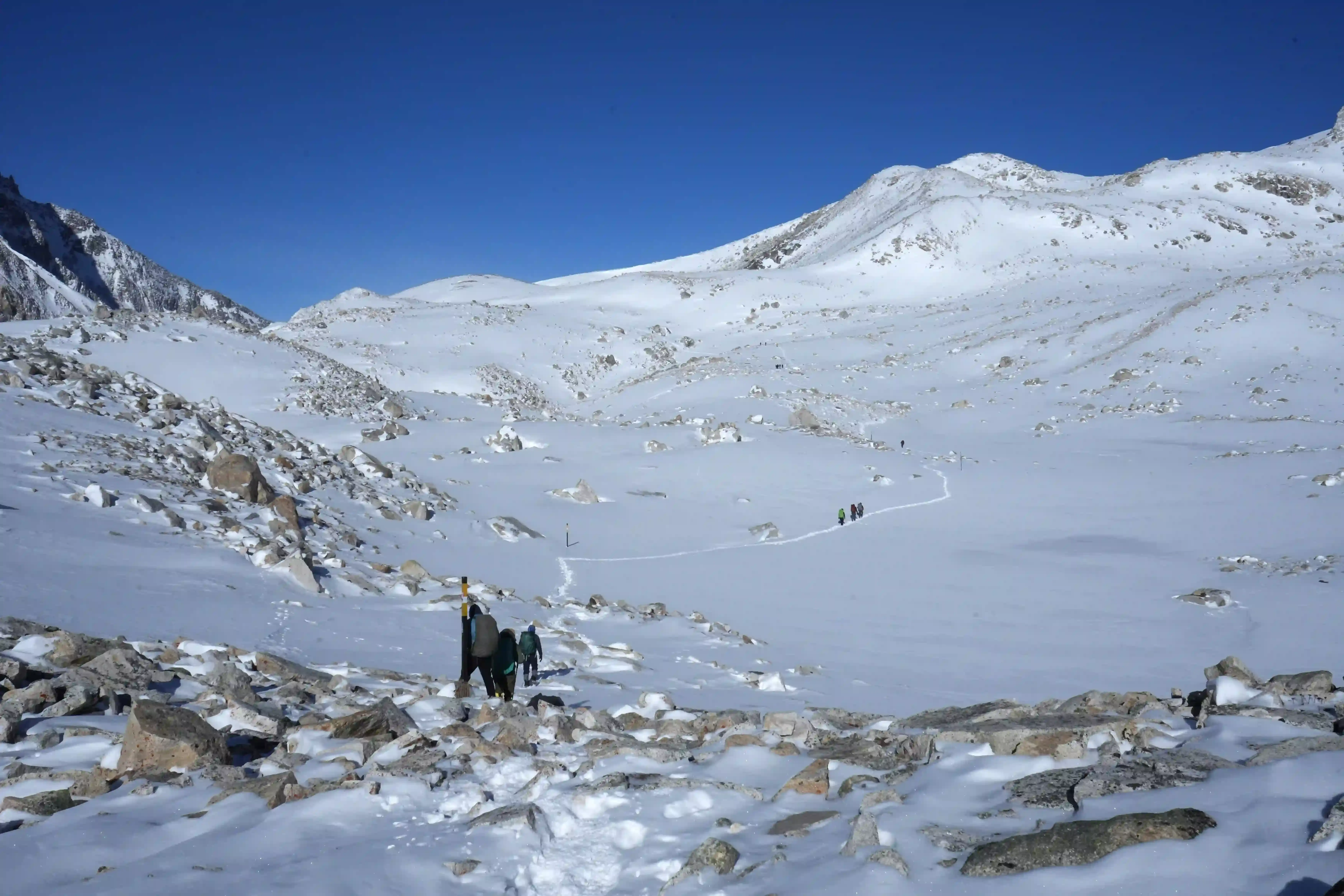
Autumn is peak trekking season for Manaslu Circuit.
The months of September through November bring dry, stable air masses and brilliant insolation.
Daytime temperatures at mid-altitudes (2,500-3,500m) hover between 15-20°C, with nocturnal temperatures dropping to 0-5°C at higher elevations—ideal for sustained trekking without altitude stress.
The reduced moisture content in the atmosphere during autumn delivers panoramic visibility of snow-capped peaks along the circuit.
High-pressure systems dominate the region, keeping precipitation near zero. This is when most trekkers choose to trek Manaslu, so popular teahouses at Samagaon and Samdo fill quickly, but the meteorological stability makes every step worthwhile.
Spring trekking on Manaslu Circuit (March to May) rivals autumn in reliability.
The region experiences post-winter warming with reduced snow cover at high passes. Rhododendron blooms (2,500-3,500m elevation zones) paint hillsides in crimson and pink.
Weather patterns remain stable with low precipitation and excellent optical clarity. Daytime temperatures range from 18-23°C—warmer than autumn, benefiting trekkers with lower cold tolerance.
Avoid monsoon and winter months. June to August brings orographic precipitation from southwesterly winds, reducing visibility to 50-100m and creating unstable trail conditions.
December to February brings heavy snowfall above 4,000m, with Larkey La Pass accumulating 1-2 meters of snow, making the route technically demanding.
The best time to book your Manaslu Circuit Trek is during Autumn (September to November) and Spring (March to May). These seasons offer clear skies, pleasant temperatures, and stunning mountain views, making trekking safe and enjoyable.
Avoid the monsoon (June to August) due to heavy rain and winter (December to February) due to snow and cold. Book early, especially for September, October, and November, to secure permits and accommodations.
March: Expect cool mornings and nights, with daytime temps around 8–10°C (46–50°F). Nights can dip below freezing. Early spring sees blossoming rhododendrons and increasing warmth as the month progresses.
April: Popular for trekking, this month brings mild, pleasant weather—daytimes 10–15°C (50–59°F), and chillier nights. Skies are generally clear, offering excellent mountain views.
May: Warmest of the spring months, with lower elevations reaching 20–31°C (68–88°F). Trails are dry, flowers in full bloom, and panoramic visibility is typically outstanding.
June–August: The Manaslu Circuit experiences its rainy season. Expect warm, humid days (15–30°C/59–86°F at lower levels), frequent heavy rainfall, and muddy trails with increased risk of landslides and leeches. Persistent cloud cover can obscure mountain views, making this the least recommended season for trekking.
September: Early in the month, lingering monsoon showers are possible, but weather improves rapidly. Daytime highs reach 15–21°C (59–70°F). Conditions become dryer and views clearer as the month goes on.
October: Peak trekking season. Ideal, stable temperatures (10–15°C/50–59°F during the day; -2°C/28°F at night higher up) combine with blue skies, crisp air, and dazzling Himalayan scenery.
November: Colder days and frigid nights (down to -6°C/21°F at higher altitudes), but trails stay dry and clear, with excellent mountain vistas.
December: Day temperature averages 8–12°C (46–54°F), but prepare for cold nights as low as -8°C (17°F). Snowfall becomes more common at higher elevations.
January: Coldest month on the Manaslu Circuit. Subzero temperatures prevail above 3,000m (--5 to 0°C / 23–32°F during the day; nighttime lows can reach -15°C/5°F). Snow and ice on the Larkya La Pass may make it impassable.
February: Slowly warming, though higher sections still see deep snow and icy paths. Nights remain cold.
The Manaslu Circuit Trek is moderately challenging to strenuous, requiring good physical fitness, prior trekking experience, and mental resilience for high-altitude terrain.
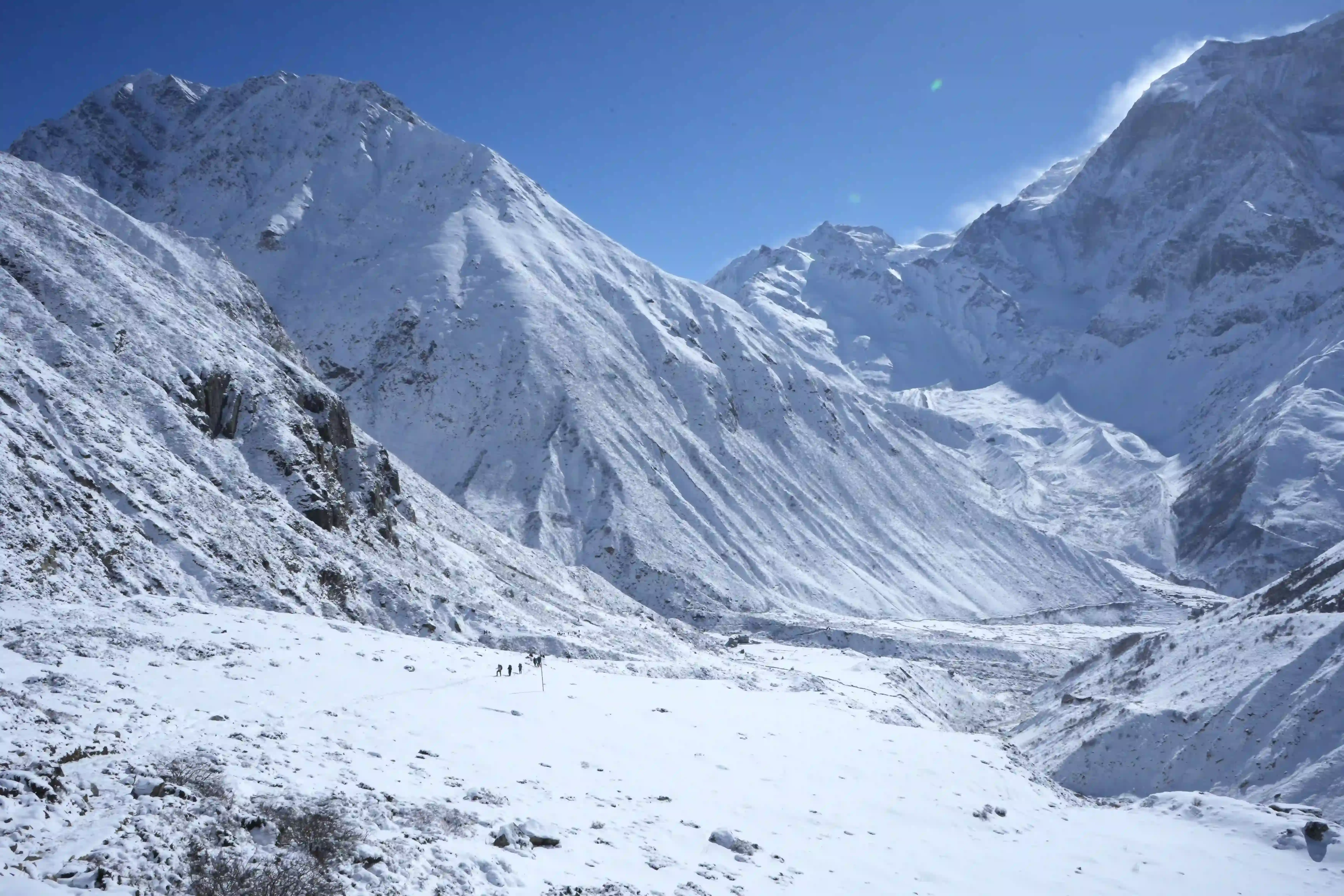
The trek demands 5-8 hours of daily trekking across steep gradients, with the Larkya La Pass crossing (5,106m) presenting the most technical and physically demanding section.
Learn more about how to prepare physically for the Manaslu Circuit Trek in our comprehensive guide
The Manaslu Trek requires good fitness since you’ll hike 6–8 hours daily on steep, uneven terrain and high altitude. Focus on building stamina with cardio exercises like running or cycling, strengthen your legs with squats and lunges, and improve core stability for balance.
You don’t need to be an elite athlete—many trekkers in their 50s, 60s, and even 70s have completed the circuit—but you should be healthy, active, and ready to commit to a regular fitness routine leading up to the trek
The Manaslu Circuit Trek is suitable for both experienced trekkers and well-prepared beginners. While the trek is challenging due to its high altitude, remote and rugged terrain, and long walking days, many beginners have successfully completed it with the right mindset, physical preparation, and support from our guides and porters.

While no technical climbing skills are needed and the trail is well-marked with regular tea houses for meals and rest, the trek is still physically demanding and not a casual walk. Beginners who plan ahead, train well, and trek with support can thoroughly enjoy the adventure and complete the Manaslu Circuit Trek
Pack merino wool or synthetic base layers (avoid cotton, which retains moisture and reduces insulation efficiency). Mid-layer fleece or down jackets provide thermal regulation as temperatures drop with elevation gain.
A waterproof outer shell jacket and trekking pants protect against unpredictable mountain precipitation. Bring 2-3 pairs of moisture-wicking trekking socks—wet feet at high altitude accelerate heat loss and blister formation.
A warm beanie and sun hat protect extremities from both cold and UV radiation intensity at 5,000m+ elevations. Thermal gloves become essential for Larkya La Pass crossing where nighttime temperatures plummet.
Broken-in trekking boots with ankle support prevent ankle sprains on steep descents like Day 10's 1,778m drop to Bhimthang. Ensure boots have insulated linings for high-altitude sections. Pack gaiters to prevent scree and snow ingress during exposed terrain crossings.
Sunscreen (SPF 50+) combats intense UV exposure at altitude—reflection from snow increases burn risk by 80%. Altitude medication (Diamox) prescribed by your physician aids acclimatization above 3,500m.
Thermal water bottles maintain hydration; dehydration accelerates altitude sickness symptoms. A headlamp with extra batteries proves essential for teahouses lacking consistent electricity.
Carry a lightweight sleeping bag rated for -5°C for Dharmasala and high-altitude nights. Compression sacks optimize pack organization.
Include trekking poles to reduce joint stress on steep descents and improve balance on rocky terrain. Toiletries, medications, and a lightweight towel round out essentials.
Pack strategically to balance comfort, safety, and mobility across the 12-day circuit.
Please refer to our comprehensive Manaslu Circuit Trek Packing List or download the Packing checklist from the "Equipment" section above.
Yes, you can rent nearly all the essential trekking gear for your Manaslu trek in Kathmandu, especially in the Thamel area, which is full of gear shops and rental outlets.
Common trekking gear available for rent includes sleeping bags (rated for cold Himalayan nights), down jackets, trekking poles, backpacks, waterproof jackets and pants, gloves, hats, and even some accessories like gaiters and crampons.
While trekking boots are also available for rent, it's generally recommended to bring your own for hygiene and comfort, as finding the right fit can be difficult.
Your Manaslu trek guide will help you find reputable shops. Renting is a popular, budget-friendly option that allows you to travel light and still be well-prepared for the trek.
Yes, a sleeping bag rated for -10°C to -20°C is essential for the Manaslu Circuit Trek to ensure adequate insulation at high altitudes. Use a silk or microfiber sleeping bag liner for added thermal efficiency and hygiene.
Tea houses provide basic bedding, so a separate bed sheet is unnecessary. Bringing a compact, inflatable travel pillow with memory foam or similar ergonomic support is recommended for optimal rest and neck alignment.
Accommodation on the Manaslu trek mainly consists of simple, local, family-run teahouses offering basic, clean rooms with twin beds, pillows, and blankets.
Rooms are shared with two trekkers of the same gender and become more basic at higher altitudes, with limited hot water and electricity.
The teahouse atmosphere is friendly and social. Overall, expect modest but comfortable lodging with genuine local Nepali hospitality.
Yes, you can charge your devices in teahouses on the Manaslu Circuit Trek. Many teahouses offer charging facilities, either in guest rooms or in common areas. However, access to electricity can be limited, especially at higher elevations, and charging usually incurs a small extra fee (typically $1–2 per device). Power outages are not uncommon, so bringing a power bank is recommended as a backup.
Private rooms and attached bathrooms are sometimes available at lower altitudes on the Manaslu Circuit Trek—especially in larger villages where teahouses have more space and better facilities. However, as you ascend to higher elevations, accommodation becomes simpler, and most teahouses offer only shared rooms and communal bathrooms (usually squat toilets and shared washing areas). Private rooms and attached bathrooms become rare the higher you go, so be prepared for shared facilities for much of the trek.
This Manaslu trip includes shared twin-bed rooms by default. If you prefer a private room, you can request one in advance, and our team will do their best to arrange it. However, private rooms are not guaranteed at every stop along the Manaslu Circuit.
Trekkers on the Manaslu Circuit typically eat simple, nourishing meals served in teahouses. Breakfast often includes eggs, pancakes, Tibetan bread, porridge, and tea or coffee.
Lunch and dinner usually feature staple dishes like Dal Bhat (rice with lentils and vegetables), noodles, momos (dumplings), and vegetable or meat curries. Vegetarian options are common, especially at higher altitudes where fresh meat and vegetables are limited.
In a few villages, snacks like chocolate, chips, and desserts are also available. When booking Places Nepal Treks, all meals (breakfast, lunch, and dinner) are included.
Teahouses on the Manaslu route offer basic Western dishes, including:
Pasta with tomato or cheese sauce
Pancakes (plain, banana, or chocolate)
Fried potatoes or French fries
Toast, eggs, or sandwiches
Simple pizza (on Tibetan bread)
Muesli with hot milk
Availability decreases with altitude. Most meals are adapted to local ingredients and may differ in taste. Dal Bhat remains the most reliable and nutritious option throughout the trek.
Yes, both vegetarian and non-vegetarian food are available on the Manaslu trek. However, vegetarian meals are more common and recommended, especially at higher elevations.
Meat is often transported without refrigeration, which increases the risk of contamination. At higher altitudes, it’s safer to avoid meat due to limited storage and hygiene conditions.
Sticking to vegetarian options like Dal Bhat, noodles, or vegetable soups is a safer and healthier choice during the trek.
The Manaslu Circuit Trek requires special permits due to its restricted status, and trekking solo is not allowed. You need:
Nepalese Rupee (NPR)
The Manaslu Circuit Trek falls under a government-designated Restricted Area to protect its fragile environment and cultural heritage. The region lies within the Manaslu Conservation Area, known for its biodiversity, ancient settlements, and sacred monasteries. A Restricted Area Permit (RAP) is mandatory to manage tourism, prevent overuse of the trails, and minimize ecological and cultural disruption.
The permit system controls foot traffic, helping preserve local agriculture, wildlife, and traditional ways of life. The government issues a limited number of permits each season, ensuring sustainable tourism and environmental protection.
To complete the Manaslu trek, you need the following permits:
All fees collected go toward conservation efforts, trail improvement, and community-based tourism development in the Manaslu region. When you book with Places Nepal Treks, the package includes these permits.
Please note that the Manaslu Circuit trek permit can only be obtained through a licensed trekking company like Places Nepal Trek
Here’s an overview of the procedure for obtaining the necessary Manaslu trekking permits for Manaslu:
Fill out the online application form for the trekking permit.
Submit separate online applications for ACAP and MCAP permits.
Forward the application to the Director General of the Department of Immigration.
Include a printed itinerary with your trekking dates.
Provide photocopies of your passport’s main page and visa page.
Prepare US dollars for the fee and note down the serial numbers and denominations of each note on the agent’s letterhead.
Go to the Department of Immigration in Anamnagar with all the required documents.
Pay the permit fee in US dollars at Global IME Bank inside the Immigration Department and obtain the deposit slip.
Submit official documents verifying the trekking agency, including current guide insurance, tax clearance, and valid certification from the central bank.
The first officer will check the online details of all trekkers against the passports and print a preliminary slip.
A second officer verifies the information again and forwards the file to the Head of Immigration (Director General) for final approval and signature.
The first officer prints the individual permits, fills in the details on the stickers, and the second officer signs them.
After the first officer applies the final stamp, your Manaslu Restricted Area Permit (RAP) is ready.
Note: The ACAP and MCAP permits are still pending.
Travel to the Nepal Tourism Board.
Pay the permit fees in local currency and submit the printed online application.
The board will print the permit, attach your photograph, and provide a signed copy—completing the process.
If you have any questions about obtaining permits for the Manaslu trek, feel free to reach out. We also offer affordable Manaslu Circuit trek packages and can provide detailed information and quotes.
Yes, Travel insurance is mandatory for the Manaslu Circuit Trek due to its remote location, high altitude, and challenging terrain.
Your insurance must cover high-altitude trekking up to at least 5,500 meters, emergency helicopter evacuation, medical expenses including altitude sickness treatment, and trip interruption or cancellation.
Standard travel insurance often excludes these, making specialized trekking insurance necessary. Proper coverage ensures safety, access to emergency rescue, and financial protection against unexpected events during the trek.
Proof of insurance is required for obtaining the Manaslu Restricted Area Permit
Common health concerns on the Manaslu Circuit Trek are altitude sickness, dehydration, gastrointestinal issues, cold-related conditions, respiratory problems, and physical injuries. Proper acclimatization, hydration, and prompt response to symptoms are crucial for safety.
To prevent altitude sickness on the Manaslu Circuit Trek, ascend gradually and include acclimatization days to allow your body to adjust. Stay well-hydrated, maintain a balanced diet rich in carbohydrates, avoid alcohol and smoking, and listen to your body’s signals.
Medications like Acetazolamide (Diamox) may help but consult a doctor before use. Following the “climb high, sleep low” principle is effective for proper acclimatization.
The Manaslu Circuit Trek presents challenges such as high altitude, with a risk of altitude sickness at Larkya La Pass, steep and rugged terrain demanding strong fitness, remote locations with limited medical access, unpredictable weather, including cold and landslides, long trekking days, complex permit requirements, and difficult small river crossings, all of which require careful preparation and acclimatization.
To ensure safety on the Manaslu Circuit Trek, ascend gradually with proper acclimatization, stay hydrated, maintain a balanced diet, and avoid alcohol and smoking.
Follow your guide's advice closely, carry necessary medications like Acetazolamide (Diamox), and be prepared for sudden weather changes.
Have travel insurance that covers high altitude helicopter evacuation and descend immediately if severe altitude sickness symptoms occur.
Yes, hiring a licensed guide is mandatory for the Manaslu Circuit Trek due to its designation as a restricted trekking zone. Independent trekking is not allowed in this region—you must be accompanied by a government-registered Nepali guide. Attempting the route without proper guidance can lead to fines or denial of entry at permit checkpoints. This rule is strictly enforced to ensure both safety and compliance with local regulations.
When choosing a trekking guide, look for someone who is government-licensed, experienced in high-altitude trekking, knowledgeable about the Manaslu region’s culture and terrain, and trained in first aid and emergency protocols. Communication skills and positive reviews from past trekkers are essential.
Places Nepal's guides meet all these criteria, ensuring expert navigation, permit handling, acclimatization support, and overall safety. Note that solo trekking is prohibited on the Manaslu Circuit; trekkers must join groups with licensed guides like those from Places Nepal.
To stay warm during the Manaslu Circuit Trek, layer your clothing with moisture-wicking base layers(e.g., merino wool or synthetic fibers), insulated mid-layers(such as down or fleece), and a windproof, waterproof outer shell.
To prevent heat loss, wear thermal socks, gloves, and a warm hat. Remove damp clothes immediately, keep sleeping gear dry, and use a sleeping bag rated -10°C to -20°C.
Stay active, eat high-calorie meals, and avoid alcohol, which lowers body temperature.
No, you cannot trek the Manaslu Circuit without a licensed guide.
The Manaslu region is a restricted area regulated by the Government of Nepal. To enter, you must obtain a Restricted Area Permit (RAP), which is only issued through a registered trekking agency and requires that you trek with a licensed Nepali guide.
Additionally, the rules mandate a minimum of two trekkers (excluding the guide) to be eligible for the permit. Solo trekking is not allowed, and checkpoints along the route will turn away anyone attempting to proceed without proper documentation and an authorized guide.
This regulation is in place for safety, conservation, and cultural protection, especially in remote areas near the Tibetan border.
The Manaslu Circuit Trek, now commonly begins at Machha Khola in the Gorkha District of Nepal. This village sits at an elevation of around 930 meters and marks the start of the Budhi Gandaki River trail toward the high Himalayas.
Previously, the trek started in Soti Khola. However, road access has extended further up the valley, allowing vehicles to reach Machha Khola directly. This shift saves a day of walking and places trekkers closer to the more remote sections of the route.
From Machha Khola, the trail follows the Budhi Gandaki through narrow gorges and terraced hillsides toward Jagat, Deng, and Namrung. Higher up, the path leads to Samagaon and Samdo before crossing the Larke La Pass at 5,106 meters, then descending into the Annapurna region.
By Local Bus: Buses from Gongabu Bus Park take about 9–10 hours, depending on road conditions.
By Jeep: A private jeep is faster and more reliable, especially during the monsoon season when landslides can block the route.
Shorter itinerary compared to starting from Soti Khola
Immediate immersion in riverside landscapes
Avoids some of the busiest lower sections of the trail
Mobile phone networks are available in most areas, but coverage may be limited in remote locations.
We provide airport transfer from Tribhuvan International Airport to your hotel. Our representative will be there to pick you up upon your arrival. Please share your flight details with us in advance so we can arrange your pickup smoothly.
Yes, most travelers can get a tourist visa on arrival at Kathmandu airport or land borders. You need a valid passport, filled application forms, and cash to pay the fee ($30 for 15 days, $50 for 30 days, $125 for 90 days). Indian citizens don’t need a visa. Some nationalities must get a visa beforehand. The process is straightforward but may involve queues.
You can choose your preferred date from our fixed departure schedule and simply click on "Book Now." Our online system will then guide you step-by-step through the booking process. If you prefer a private Manaslu trek, you can select the private trip option to customize your experience.
If your preferred travel dates are not shown in our fixed departure calendar, please click the Private Trip section. We offer flexible or private departures outside of regular itinerary, subject to availability. Our team will work with you to accommodate your desired dates or suggest alternative options.
Yes, a 10% deposit is required to secure your Manaslu Circuit Trek booking. The deposit confirms your spot and initiates the permit and logistics arrangements. The remaining balance can be paid upon arrival via cash or a major credit/debit card.
Once your booking and deposit are confirmed, Places Nepal will send you an email with your booking confirmation, itinerary, packing list, and we request your passport, travel insurance and flight details.
The Manaslu Circuit Trek officially begins at Machha Khola, about 160 km from Kathmandu. You can reach it by:
Daily buses leave at 7 AM from Kathmandu's Gongabu Bus Park. The ride takes 8–10 hours, with smooth roads until Arughat, after which the road becomes rough and bumpy. Buses are budget-friendly but slow due to frequent stops and road conditions. A short lunch break will be taken during the journey.
A faster and more comfortable option is a private 4WD jeep, ideal for groups or those wanting flexibility. The ride takes 5–7 hours, and jeeps handle the rough road beyond Arughat better.
Cost: Around USD 250 per jeep (one-way)
Capacity: Fits five passengers + guide + driver
Benefits: Flexible stops, faster travel, better suited for poor road conditions
As of 2023, shared jeeps are available from Machha Khola or Soti Khola to Jagat, allowing trekkers to start higher up the trail if preferred.
The road to the Manaslu Circuit Trek trailhead (Machha Khola) starts with a paved section from Kathmandu to Arughat, which is generally smooth and takes about 5–6 hours.
From Arughat to Machha Khola, the road turns rough, narrow, and unpaved, with steep sections and sharp turns. This final stretch can take 2–4 hours, especially in poor weather.
During the dry season (Oct–May), the route is dusty but passable by 4WD jeeps or local buses. In the monsoon (June–Sept), landslides and flooding often make the road muddy and risky, causing delays or blockages. A 4WD jeep is strongly recommended year-round for comfort and safety.
Permits for the restricted Manaslu region are mandatory and must be arranged through a registered agency like Places Nepal Treks.
Guides are required—solo trekking is not allowed.
Places Nepal Treks includes transport and permit processing in the trekking package.
The cost of the Manaslu Circuit Trek includes permits, mandatory guide fees, optional porter costs, accommodation, food, transportation, and extra expenses like charging, shower and tips, typically totaling between $1,200 and $1,600 for a standard 12-14 day trek.
Prices vary based on group size, season, and service level, with private or luxury options costing more.
The cost of the Manaslu Circuit Trek includes:
Permits
Manaslu Restricted Area Permit, Annapurna Conservation Area Permit, and TIMS card, costing around $70 to $100 or more depending on trek length and nationality.
Guide and Porter Fees
A licensed guide is mandatory, costing $30–$40 per day.
Porters are optional, about $20–$25 per day.
Accommodation and Food
Basic tea houses charge $25 to $40 per day for room and meals.
Transportation
Travel to/from trek start points (like Kathmandu to Soti Khola) adds extra cost. (600$ two way for private trip)
Extra Expenses
Costs for charging devices, hot showers, Wi-Fi, tips, and souvenirs.
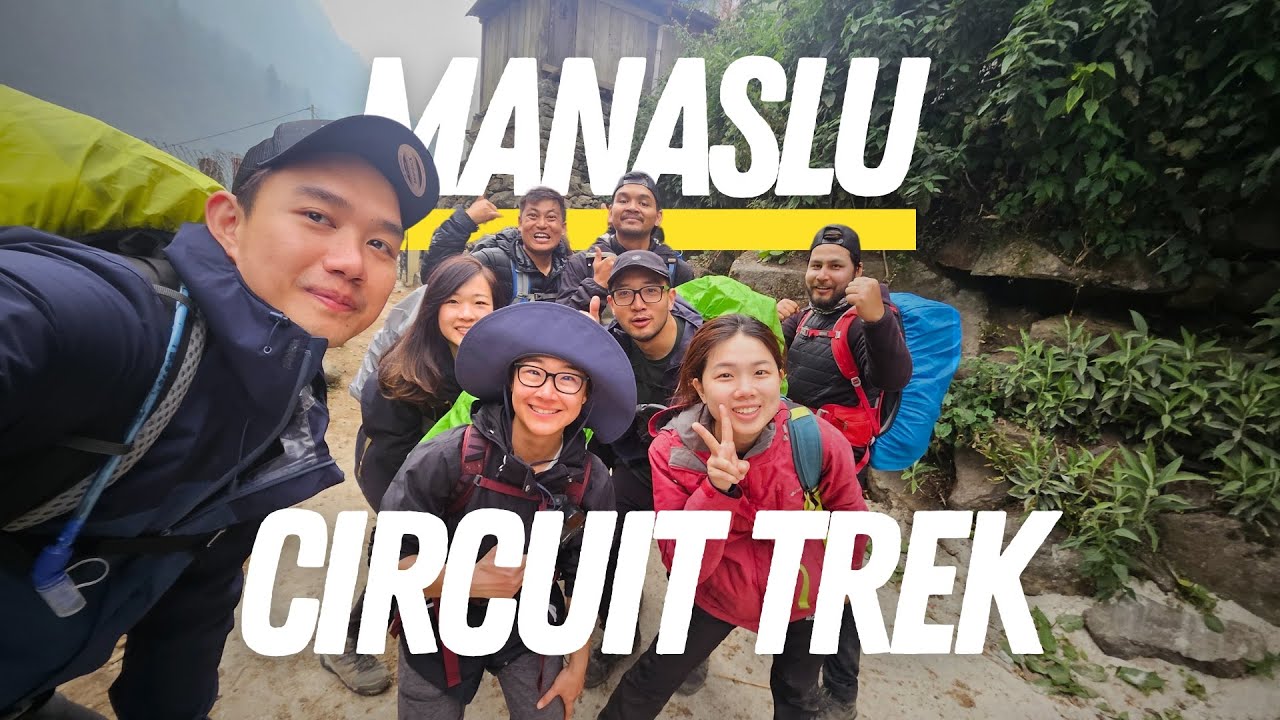
Estimated Total Cost
Group treks range from $950 to $1,500 per person.
Private or luxury options can cost $1,500 to $2,500+.
Average 12-14 day Manaslu trek with guide, porter, permits, accommodation, local bus transfer and food usually costs $1,200 to $1,600 per person.
The cost of the Manaslu Circuit Trek varies depending on several factors, such as the duration of the trek, the time of year, whether you hire a private car transfer, and your chosen level of comfort. Typically, prices range from $1,000 to $2,500.
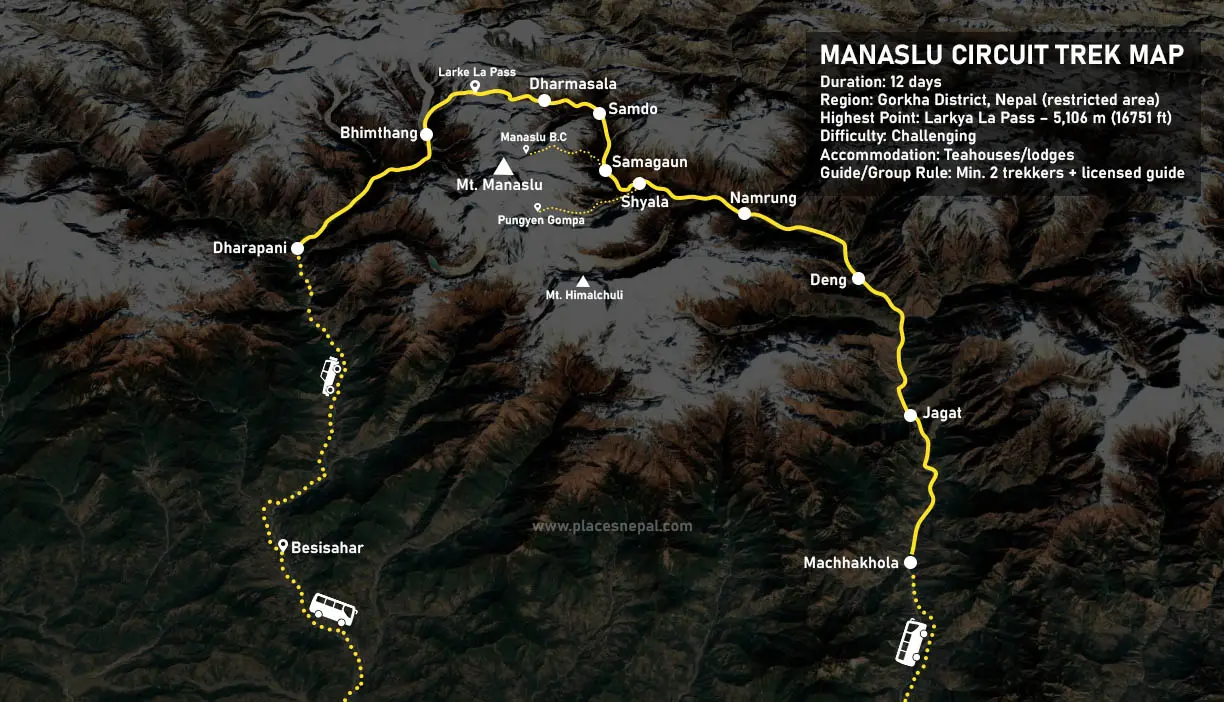
At Places Nepal Treks, the Manaslu Circuit Trek package is priced at $1,150 per person for a private trip, and if you join a group departure, the price is $980 per person for a 12-day itinerary. This cost covers all transportation, accommodations, meals, required permits (including MRAP, ACAP, TIMS, and MCAP), licensed guide fees, and an airport pickup and drop-off.
For complete information on what’s included in the Manaslu package, please refer to the price inclusion section provided by Places Nepal Treks.
The Manaslu Circuit Trek traces approximately 177 km of trail encircling Mount Manaslu (8,163 m). Starting at Machha Khola (810 m), the route follows the Budhi Gandaki Gorge, ascending steadily through Jagat (1,340 m), Deng (1,860 m), Namrung (2,630 m), and Samagaon (3,530 m). It then continues toward Samdo (3,875 m) before crossing the trek’s highest point, the Larkya La Pass (5,160 m). The descent transitions into the Annapurna region, passing Bimthang (3,720 m) and ending at Dharapani (1,860 m).
Check out these other trips in Nepal.
Our trips are led by certified expert guides, granting you access to Nepal’s hidden gems that most travelers miss.
At Places Nepal, trekking is a celebration of nature, a journey that nourishes the body, mind, and soul. Most of our travelers join solo.
All Logistics taken care of. Just show up and have a blast. We handle the details, you enjoy the adventure.
Life happens. If you can't finish your trek, or if you simply love it and want to do it again, you're welcome to repeat it with us, free of charge.
Hear what our travelers had to say about us.